Results by title

6 books match the query 'State governments'
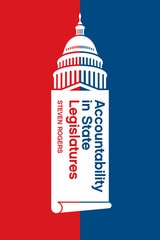
cover of Accountability in State Legislatures

Accountability in State Legislatures

Steven Rogers

University of Chicago Press, 2023

A troubling portrait of democracy in US state legislatures.

State legislatures hold tremendous authority over key facets of our lives, ranging from healthcare to marriage to immigration policy. In theory, elections create incentives for state legislators to produce good policies. But do they?

Drawing on wide-ranging quantitative and qualitative evidence, Steven Rogers offers the most comprehensive assessment of this question to date, testing different potential mechanisms of accountability. His findings are sobering: almost ninety percent of American voters do not know who their state legislator is; over one-third of incumbent legislators run unchallenged in both primary and general elections; and election outcomes have little relationship with legislators’ own behavior.

Rogers’s analysis of state legislatures highlights the costs of our highly nationalized politics, challenging theories of democratic accountability and providing a troubling picture of democracy in the states.

[more]
cover of Gangsters to Governors: The New Bosses of Gambling in America

Gangsters to Governors

The New Bosses of Gambling in America

Clary, David

Rutgers University Press, 2017

Winner of the 2018 Current Events/Social Change Book Award from the Next Generation Indie Book Awards
Winner of the 2018 Bronze Current Events Book Award from the Independent Publisher Book Awards


Generations ago, gambling in America was an illicit activity, dominated by gangsters like Benny Binion and Bugsy Siegel. Today, forty-eight out of fifty states permit some form of legal gambling, and America’s governors sit at the head of the gaming table. But have states become addicted to the revenue gambling can bring? And does the potential of increased revenue lead them to place risky bets on new casinos, lotteries, and online games?

In Gangsters to Governors, journalist David Clary investigates the pros and cons of the shift toward state-run gambling. Unearthing the sordid history of America’s gaming underground, he demonstrates the problems with prohibiting gambling while revealing how today’s governors, all competing for a piece of the action, promise their citizens payouts that are rarely delivered. 

Clary introduces us to a rogue’s gallery of colorful characters, from John “Old Smoke” Morrissey, the Irish-born gangster who built Saratoga into a gambling haven in the nineteenth century, to Sheldon Adelson, the billionaire casino magnate who has furiously lobbied against online betting. By exploring the controversial histories of legal and illegal gambling in America, he offers a fresh perspective on current controversies, including bans on sports and online betting. Entertaining and thought-provoking, Gangsters to Governors considers the past, present, and future of our gambling nation.  

Author's website (http://www.davidclaryauthor.com)
[more]
cover of Patchwork Nation: Sectionalism and Political Change in American Politics

Patchwork Nation

Sectionalism and Political Change in American Politics

James G. Gimpel and Jason E. Schuknecht

University of Michigan Press, 2004
Though local and regional politics are often ignored in political-behavior literature, analyses of these areas are fundamental to understanding the scope of political change in the regimes experiencing realignment and for which there are no survey data. With the unprecedented population movement and socioeconomic mobility of the twentieth century, political support has been reshuffled in many parts of the country. Yet at the dawn of the new century, these local and regional movements are rather poorly understood. Patchwork Nation examines the forces that account for pervasive political regionalism and the geographic shifts that continue to alter the nation's political landscape.
The authors focus on twelve states in particular, identifying regional differences in support for candidates or political parties and find that the electoral foundations for political regionalism differ from state to state. Thus, regionalism within states is not easily reducible to one or two population characteristics that are common to all states. The authors demonstrate the importance of a political geographic approach to American political behavior and challenge the tendency in the scholarly literature to ignore the impact and significance of local contexts.
James G. Gimpel is Professor of Government and Politics, University of Maryland, College Park.
Jason E. Schuknecht is a Research Analyst at Westat, Inc. in Rockville, Maryland.
[more]
cover of State Constitutional Politics: Governing by Amendment in the American States

State Constitutional Politics

Governing by Amendment in the American States

John Dinan

University of Chicago Press, 2018

Since the US Constitution came into force in 1789, it has been amended just twenty-seven times, with ten of those amendments coming in the first two years following ratification. By contrast, state constitutions have been completely rewritten on a regular basis, and the current documents have been amended on average 150 times. This is because federal amendments are difficult, so politicians rarely focus on enacting them. Rather, they work to secure favorable congressional statutes or Supreme Court decisions. By contrast, the relative ease of state amendment processes makes them a realistic and regular vehicle for seeking change.

With State Constitutional Politics, John Dinan looks at the various occasions in American history when state constitutional amendments have served as instruments of governance. Among other things, amendments have constrained state officials in the way they levy taxes and spend money; enacted policies unattainable through legislation on issues ranging from minimum wage to the regulation of marijuana; and updated understandings of rights, including religious liberty, equal protection, and the right to bear arms. In addition to comprehensively chronicling the ways amendments shape politics in the states, Dinan also assesses the consequences of undertaking changes in governance through amendments rather than legislation or litigation. For various reasons, including the greater stability and legitimacy of changes achieved through the amendment process, he argues that it might be a more desirable way of achieving change.

 
[more]
cover of The Dimensions of Federalism: State Governments and Pollution Control Policies

The Dimensions of Federalism

State Governments and Pollution Control Policies

William R. Lowry

Duke University Press, 1991
The resurgence of state involvement in policymaking in recent years has renewed a long-standing debate about the most effective role for states within a federal system of government. In The Dimensions of Federalism, William R. Lowry assesses and examines the responsiveness and innovation of state governments in the area of air and water pollution control policies. Building a theoretical model that demonstrates the relationship between state and federal governments, Lowry combines econometric analysis of data on all fifty states with an in-depth study of a leading state in each of four major areas of pollution policy to conclude that state policymakers will often experiment and willingly improve upon federal pollution control standards. But this willingness is tempered, he maintains, both by a fear of losing important constituents to interstate competition and by the difficulty of coordinating efforts and disseminating information without the active involvement of the federal government. Originally published in 1992, this book continues to be pertinent in a political climate that will inevitably see an increased role for states in domestic policymaking. It will be of great interest to students and scholars of American public policy, federalism, and environmental politics and policy.
[more]
cover of Working, Shirking, and Sabotage: Bureaucratic Response to a Democratic Public

Working, Shirking, and Sabotage

Bureaucratic Response to a Democratic Public

John Brehm and Scott Gates

University of Michigan Press, 1999

Bureaucrats perform most of the tasks of government, profoundly influencing the daily lives of Americans. But who, or what, controls what bureaucrats do?
John Brehm and Scott Gates examine who influences whether federal, state, and local bureaucrats work, shirk, or sabotage policy. The authors combine deductive models and computer simulations of bureaucratic behavior with statistical analysis in order to assess the competing influences over how bureaucrats expend their efforts. Drawing upon surveys, observational studies, and administrative records of the performance of public employees in a variety of settings, Brehm and Gates demonstrate that the reasons bureaucrats work as hard as they do include the nature of the jobs they are recruited to perform and the influence of both their fellow employees and their clients in the public. In contrast to the conclusions of principal-agency models, the authors show that the reasons bureaucrats work so hard have little to do with the coercive capacities of supervisors.
This book is aimed at students of bureaucracy and organizations and will be of interest to researchers in political science, economics, public policy, and sociology.
"This book is breathtaking in its use of models and techniques. . . . The approach developed by Brehm and Gates allows us to re-open empirical questions that have lain dormant for years." --Bryan D. Jones, University of Washington
John Brehm is Associate Professor of Political Science, Duke University. Scott Gates is Associate Professor of Political Science, Michigan State University.
[more]