Results by title
36 books match the query 'Stavans, Ilan'
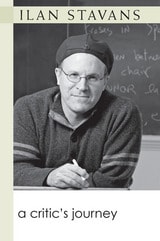
A Critic's Journey
Ilan Stavans
University of Michigan Press, 2009
Ilan Stavans has been a lightning rod for cultural discussion and criticism his entire career. In A Critic's Journey, he takes on his own Jewish and Hispanic upbringing with an autobiographical focus and his typical flair with words, exploring the relationship between the two cultures from his own and also from others' experiences.
Stavans has been hailed as a voice for Latino culture thanks to his Hispanic upbringing, but as a Jew and a Caucasian, he's also an outsider to that culture---something that's sharpened his perspective (and some of his critics' swords). In this book of essays, he looks at the creative process from that point of view, exploring everything from the translation of Don Quixote to the Hispanic anti-Semitism and the Holocaust in Latin America.
Ilan Stavans is Lewis-Sebring Professor in Latin American and Latino Culture and Five College Fortieth Anniversary Professor at Amherst College. A native of Mexico, he received his doctorate in Latin American Literature from Columbia University. Stavans's books include The Hispanic Condition, On Borrowed Words, Spanglish, Dictionary Days, The Disappearance, Love & Language (with Verónica Albin), Resurrecting Hebrew, and Mr. Spic Goes to Washington, and he has edited books including The Oxford Book of Jewish Stories and the upcoming Norton Anthology of Latino Literature. His story "Morirse está en Hebreo" was made into the award-winning movie My Mexican Shivah.
Stavans has received numerous awards, among them a Guggenheim Fellowship, the National Jewish Book Award, an Emmy nomination, the Latino Book Award, Chile's Presidential Medal, the Rubén Darío Distinction, and the Cátedra Roberto Bolaño. His work has been translated into a dozen languages.
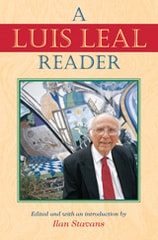
A Luis Leal Reader
Luis Leal
Northwestern University Press, 2007
Instrumental in establishing Mexican literary studies in the United States, Leal’s writings on the topic are especially instructive, ranging from essays on the significance of symbolism, culture, and history in early Chicano literature to studies of the more recent use of magical realism and of individual New Mexican, Tejano, and Mexican authors such as Juan Rulfo, Carlos Fuentes, José Montoya, and Mariano Azuela. Clearly and cogently written, these writings bring to bear an encyclopedic knowledge, a deep understanding of history and politics, and an unparalleled command of the aesthetics of storytelling, from folklore to theory. This collection affords readers the opportunity to consider—or reconsider—Latino literature under the deft guidance of its greatest reader.
Amherst Suite
Emily Dickinson, Spanish Translation & Poetic TranscreationBy Alberto Blanco, Translated and Edited by Jennifer Rathbun, with an Introduction by Ilan Stavans
Amherst College Press, 2026
Opening with a creative essay by renowned author Ilan Stavans, the volume also includes a conversation between Blanco and scholar Ronald J. Friis; Blanco’s own essay on Dickinson, translated into English by Jennifer Rathbun; as well as an introduction by Rathbun that helpfully situates this interlinguistic, intercultural, and inter-generational network. Amherst Suite is a fascinating and unique look into the work and worlds of poets and their translators and will be an invaluable text for students, scholars, and all readers of Emily Dickinson.
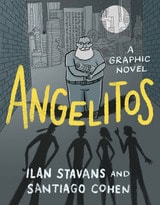
Angelitos
A Graphic NovelIlan Stavans and Santiago Cohen
The Ohio State University Press, 2018
Though Angelitos: A Graphic Novel is a fictional retelling of a desperate time, it draws on autobiographical elements to tell the real-life story of Alejandro García Durán de Lara, popularly known as Padre Chinchachoma, a complicated figure revered by some and reviled by others.
Avenues of Translation
The City in Iberian and Latin American WritingGalasso, Regina
Bucknell University Press, 2019
Cities both near and far communicate in a variety of ways. Travel between, through, and among urban centers initiates contact, and cities themselves are sites of ever-changing cultural and historical encounters. Predictable and surprising challenges and opportunities arise when city borders are crossed, voices meet, and artistic traditions find their counterparts. Using the Latin word for “translation,” translatio, or “to carry across,” as a point of departure, Avenues of Translation explores how translation perpetuates, diversifies, deepens, and expands the literary production of cities in their greater cultural context, and how translation shapes an understanding of and access to a city's past and present literary and cultural practices. Thinking about translation and the city is a way to tell the backstories of the cities, texts, and authors that are united by acts of translation.
Published by Bucknell University Press. Distributed worldwide by Rutgers University Press.
Bandido
The Death and Resurrection of Oscar "Zeta" AcostaIlan Stavans
Northwestern University Press, 2003
Hailed as "a fine, learned homage" (Kirkus), "a kaleidoscopic portrait" (Booklist), and "a game of mirrors" (The Washington Post), Bandido is a veritable tour de force. Through interviews and Acosta's writings (published and unpublished), Ilan Stavans reconstructs—even reinvents—the man behind the myth. Part biographical appraisal, part reflection on the legacy of the Civil Rights era, Bandido is an opportunity to understand the challenges and pitfalls Latinos face in finding a place of their own in America.
Blues for the Buffalo
Manuel Ramos
Northwestern University Press, 2004
The sun, the sand, a young beauty named Rachel in a white bikini—there's no better way to recover from the aches and pains of your latest case. At least that's what attorney and part-time detective Luis Montez thinks until the woman gives him the manuscript of her novel and vanishes.
Montez just wants to rebuild his Denåver practice, but an aggressive young P.I. with an emotional attachment to Rachel draws him in. With the woman's powerful adopted family on one side and unexplained death of a writer friend on the other, Montez digs up a series of long-told lies and long-hidden ugly truths. He also finds himself confronting one of the great unsolved mysteries of recent Chicano history. What happened to Oscar "Zeta" Acosta, the iconic activist-writer presumed dead since 1974? More to the point, what made Rachel insist the legendary Brown Buffalo was alive-and that he was her real father?

Calvert Casey
The Collected StoriesCalvert Casey
Duke University Press, 1998
Born in the United States, Casey was raised in Cuba and spent most of his life there and in Europe. He chose Spanish as his primary artistic tongue. A member of the intelligentsia surrounding Castro in the early years of the revolution, he was eventually exiled—and in 1969 committed suicide in Rome at the age of forty-five. Although most of his luminous stories are set in Havana, his is not a touristy, picturesque landscape but an often strange and nightmarish theater of human passions, inhabited by figures—silhouettes, really—that live on the edge of normality. This volume, which showcases Casey’s mastery of the skill of indirect and gradual revelation, is the most complete to appear in any language and includes a biographical and critical introduction written by Ilan Stavans, the noted novelist and scholar of Hispanic culture.
Readers interested in the art of fiction and in the complexities of the human psyche will find Casey’s work irresistible.
Conversations with Ilan Stavans
Ilan Stavans
University of Arizona Press, 2005
Spontaneous and surprising, these conversations reflect Latino life in the United States in all its facets. Among the more than two dozen selections, Edward James Olmos talks about Hispanics in Hollywood; John Leguizamo describes how he shapes a stage show; author Richard Rodriguez reflects on his gang background; Esmeralda Santiago takes on the Puerto Rican stereotype; and Piri Thomas shares thoughts on the writing of Down These Mean Streets. "A conversation is a tango," writes Stavans, "for it takes two to dance it." Conversations with Ilan Stavans invites readers to catch the rhythm and enjoy these unique meetings of minds.
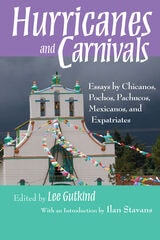
Hurricanes and Carnivals
Essays by Chicanos, Pochos, Pachucos, Mexicanos, and ExpatriatesEdited by Lee Gutkind, with an Introduction by Ilan Stavans
University of Arizona Press, 2007

I Love My Selfie
Essay by Ilan Stavans / Auto-Portraits by ADÁL
Duke University Press, 2017
José Vasconcelos
The Prophet of RaceStavans, Ilan
Rutgers University Press, 2011
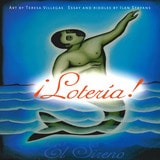
Lotería
Art by Theresa Villegas, Essay and Riddles by Ilan Stavans
University of Arizona Press, 2004
Chips, cards, and a table.
The riddles insightful,
the future, unstable! What is it?
It's Lotería, the Mexican game of chance! For the uninitiated, it might seem like bingo played with a riddling tarot deck. But this enthralling board game is more than entertainment. The images found on its cards—La Virgen, El Pan Dulce, La Telenovela—are miniature reflections of an entire culture, capturing the joys and sorrows of the Mexican people.
Wildly popular on both sides of the border, Lotería cards originated in the Iberian peninsula in the eighteenth century but have been redesigned so many times as to defy expectation, with boards devoted to ecclesiastical figures, soccer idols, and even vaudeville starlets. With the dawn of a new millennium, American artist Teresa Villegas created a new Lotería set that is already gaining popularity in Mexico, and her striking images are also widely exhibited in galleries across the United States.
This gift book, which will bring pleasure and bewilderment to children and adults alike, reproduces more than two dozen of Villegas's 54 colorful cards, pairing them with insightful, humorous riddles written by award-winning author Ilan Stavans. Stavans also revisits his childhood in an essay that examines the role of luck in Mexican life and recreates the sort of poetry jam that often accompanies Lotería contests wherever they might take place. Delve into the emblematic pages of this marvelous volume to find your own Calavera. Let yourself unravel the paths of El Deseo and the mysteries of El Corazón. Before too long, you'll realize that luck is never truly accidental—for a turn at ¡Lotería! is always an opportunity to come face to face with El Destino.
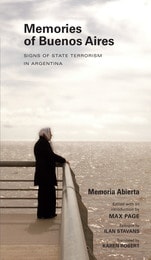
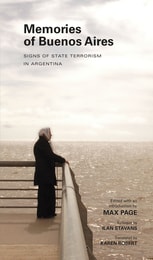
Memories of Buenos Aires
Signs of State Terrorism in ArgentinaMax Page
University of Massachusetts Press, 2013
In the 1970s, Argentina was the leader in the “Dirty War,” a violent campaign by authoritarian South American regimes to repress left-wing groups and any others who were deemed subversive. Over the course of a decade, Argentina's military rulers tortured and murdered upwards of 30,000 citizens. Even today, after thirty years of democratic rule, the horror of that time continues to roil Argentine society.
Argentina has also been in the vanguard in determining how to preserve sites of torture, how to remember the “disappeared,” and how to reflect on the causes of the Dirty War. Across the capital city of Buenos Aires are hundreds of grassroots memorials to the victims, documenting the scope of the state's reign of terror. Although many books have been written about this era in Argentina's history, the original Spanish-language edition of Memories of Buenos Aires was the first to identify and interpret all of these sites. It was published by the human rights organization Memoria Abierta, which used interviews with survivors to help unearth that painful history.
This translation brings this important work to an English-speaking audience, offering a comprehensive guidebook to clandestine sites of horror as well as innovative sites of memory. The book divides the 48 districts of the city into 9 sectors, and then proceeds neighborhood-by-neighborhood to offer descriptions of 202 known “sites of state terrorism” and 38 additional places where people were illegally detained, tortured, and killed by the government.
Memories of Buenos Aires
Signs of State Terrorism in ArgentinaMax Page
University of Massachusetts Press, 2013
In the 1970s, Argentina was the leader in the “Dirty War,” a violent campaign by authoritarian South American regimes to repress left-wing groups and any others who were deemed subversive. Over the course of a decade, Argentina's military rulers tortured and murdered upwards of 30,000 citizens. Even today, after thirty years of democratic rule, the horror of that time continues to roil Argentine society.
Argentina has also been in the vanguard in determining how to preserve sites of torture, how to remember the “disappeared,” and how to reflect on the causes of the Dirty War. Across the capital city of Buenos Aires are hundreds of grassroots memorials to the victims, documenting the scope of the state's reign of terror. Although many books have been written about this era in Argentina's history, the original Spanish-language edition of Memories of Buenos Aires was the first to identify and interpret all of these sites. It was published by the human rights organization Memoria Abierta, which used interviews with survivors to help unearth that painful history.
This translation brings this important work to an English-speaking audience, offering a comprehensive guidebook to clandestine sites of horror as well as innovative sites of memory. The book divides the 48 districts of the city into 9 sectors, and then proceeds neighborhood-by-neighborhood to offer descriptions of 202 known “sites of state terrorism” and 38 additional places where people were illegally detained, tortured, and killed by the government.
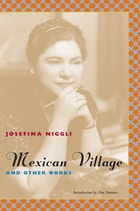
Mexican Village and Other Works
Josefina Niggli
Northwestern University Press, 2007
A long-overdue gathering of Niggli's work, this volume showcases the writer's remarkable literary versatility, as well as the groundbreaking nature of her writing, which in many ways established a blueprint for future generations of writers and readers of Chicano literature. This collection includes Niggli's most famous and influential work, Mexican Village—a literary chronicle of Hidalgo, Mexico, which explores the distinct nature and tensions of Mexican life—along with her novel Step Down, Elder Brother, and five of her most well-known plays.
Mutual Impressions
Writers from the Americas Reading One AnotherIlan Stavans, ed.
Duke University Press, 1999
Divided into symmetrical halves—South reading North and North reading South—the book presents essays by leading novelists, poets, and other writers that focus on the work of another literary figure from across the divide. Borges, for example, finds in Hawthorne the perfect precursor to his own interest in allegories; Katherine Anne Porter examines José Joaquín Fernández de Lizardi as a rascal whose picaresque views of life in The Itching Parrot served to launch the Latin American novel; Cortázar’s study of the plots and style of Poe shows an affinity that left an indelible mark on the Argentine’s short fiction; Susan Sontag views Machado de Assis as the ultimate mirror, a proto–postmodernist.
With other essays by Thomas Pynchon, William H. Gass, John Updike, Gabriel García Márquez, Alejo Carpentier, John Barth, Robert Coover, Pedro Henríquez Ureña, Grace Paley, Juan Carlos Onetti, and Mark Strand, among others, Mutual Impressions offers a remarkable view of the connections that comprise a literary tradition of the Americas. It is a book that will surprise and enliven its readers as it informs and awakens in them a sense of wonder.
Contributors. John Barth, José Bianco, Robert Bly, Jorge Luis Borges, Alejo Carpentier, Hiber Conteris, Robert Coover, Julio Cortázar, Ezequiel Martínez Estrada, Waldo Frank, Carlos Fuentes, William H. Gass, Nicolás Guillén, William Kennedy, Mario Vargas Llosa, Gabriel García Márquez, José Martí, Pablo Neruda, Victoria Ocampo, Juan Carlos Onetti, Grace Paley, Octavio Paz, Katherine Anne Porter, Thomas Pynchon, Kenneth Rexroth, Antonio Benítez Rojo, Barbara Probst Solomon, Susan Sontag, Ilan Stavans, Mark Strand, John Updike, Pedro Henríque Ureña, Derek Walcott, Paul West
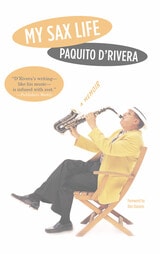
My Sax Life
A MemoirPaquito D'Rivera
Northwestern University Press, 2008
Winner of 2005 Grammy Award for Best Instrumental Composition
Winner of 2005 National Medal of Arts
My Sax Life is the award-winning memoir of famed Cuban musician Paquito D'Rivera. A best-selling artist with more than thirty solo albums to his credit, D'Rivera has performed at the White House and the Blue Note, and with orchestras, jazz ensembles, and chamber groups around the world. Propelled by jazz-fueled high spirits, D'Rivera's story soars and spins from memory to memory in a collage of his remarkable life. D'Rivera recalls his early nightclub appearances as a child, performing with clowns and exotic dancers, as well as his search for artistic freedom in communist Cuba and his hungry explorations of world music after his defection. Opinionated but always good-humored, My Sax Life is a fascinating statement on art and the artist's life.
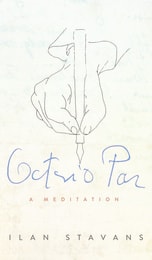
Octavio Paz
A MeditationIlan Stavans
University of Arizona Press, 2001
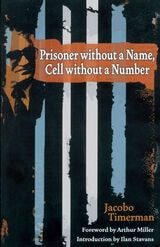
Prisoner Without a Name, Cell Without a Number
Jacobo Timerman
University of Wisconsin Press, 2002
"It ranks with Hannah Arendt's Eichmann in Jerusalem in its examination of the totalitarian mind, the role of anti-Semitism, the silence."—Eliot Fremont-Smith, Village Voice
"It is impossible to read this proud and piercing account of [Timerman's] suffering and his battles without wanting to be counted as one of Timerman's friends."—Michael Walzer, New York Review of Books
"Timerman was a living reminder that real prophets are irritants and not messengers of reassurance. He told it like it is, whether in Argentina, Israel, Europe, or the United States."—Arthur Miller
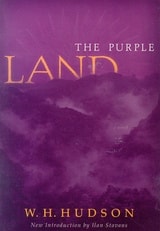
Purple Land
W. H. Hudson; With a new introduction by Ilan Stavans; Illustrated by Keith Henderson
University of Wisconsin Press, 2002
First published in 1885, The Purple Land was the first novel of William Henry Hudson, author of Green Mansions. The Anglo-Argentine naturalist distinguished himself both as one of the finest craftsmen of prose in English literature and as a thinker on ecological matters far ahead of his time.
The Purple Land is the exuberant, often wryly comic, first-person account of a young Englishman’s imprudent adventures, set against a background of political strife in nineteenth-century Uruguay. Eloping with an Argentine girl, young Richard Lamb makes an implacable enemy of his teenage bride’s father. Leaving her behind, he goes ignorantly forth into the interior of the country to seek his fortune and is eventually imprisoned and persecuted by the vengeful father. His narrative closes as he sets off on still another impetuous quest.
This facsimile of the 1904 Three Sirens Press edition includes striking woodcuts by Keith Henderson illustrating the characters in the novel and the fauna of Uruguay. Ilan Stavans’s introduction offers an opportunity to revisit The Purple Land as a "road novel" in which an outsider offers reflections on nationality and diasporic identity.
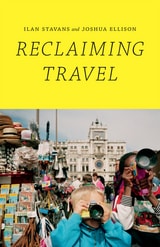
Reclaiming Travel
Ilan Stavans and Joshua Ellison
Duke University Press, 2015
Tourism, Stavans and Ellison argue, is inauthentic, choreographed, sterile, shallow, and rooted in colonialism. They critique theme parks and kitsch tourism, such as the shantytown hotels in South Africa where guests stay in shacks made of corrugated metal and cardboard yet have plenty of food, water and space. Tourists, they assert, are merely content with escapism, thrill seeking, or obsessively snapping photographs. Resisting simple moralizing, the authors also remind us that people don’t divide neatly into crude categories like travelers and tourists. They provoke us to reflect on the opportunities and perils in our own habits.
In this powerful manifesto, Stavans and Ellison argue that travel should be an art through which our restlessness finds expression—a search for meaning not only in our own lives but also in the lives of others. It is not about the destination; rather, travel is about loss, disorientation, and discovering our place in the universe.
Return to Centro Histórico
A Mexican Jew Looks for His RootsStavans, Ilan
Rutgers University Press, 2012
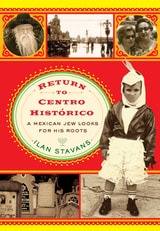
After a stirring e-mail exchange with his father, awardwinning essayist and cultural commentator Ilan Stavans decided to do something bizarre: revisit his hometown, Mexico City, accompanied by a tourist guide. But rather than seeking his roots in the neighborhood where he grew up, he headed to the Centro Histórico, the downtown area at the heart of the world’s largest metropolis. It was there that conversos, the hidden Jews escaping the might of the Holy Office of the Inquisition, were burned at the stake. And, centuries later, it was the same section where Jewish immigrants, both Yiddish-speaking Ashkenazim and Sephardim from the Ottoman Empire, made their homes as peddlers. In a sense, Centro Histórico is to Mexico what the Lower East Side is to the United States: a platform for reinventing one’s self in the New World.
With the same linguistic verve and insight that has made him one of the most distinguished voices in American literature today, Ilan Stavans invites readers along for a personal journey that is not only his own, but that of an entire culture. In Return to Centro Histórico he makes it possible to understand the intimate role that Jews have played in the development of Hispanic civilization.
Sor Juana
Or, the Persistence of PopIlan Stavans
University of Arizona Press, 2018
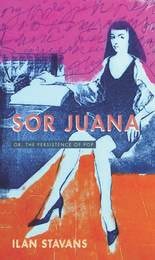
Sor Juana: Or, the Persistence of Pop encapsulates the life, times, and legacy of Sor Juana. In this immersive work, essayist Ilan Stavans provides a biographical and meditative picture of the ways in which popular perceptions of her life and body of work both shape and reflect modern Latinx culture.
The Ballad of Gato Guerrero
Manuel Ramos
Northwestern University Press, 2003
The answer: his friend, Felix "Gato" Guerrero.
Trouble has always followed the larger-than-life Felix the Cat. Now it has jumped all over him. His girlfriend is the wife of a ruthless local crime lord and in spite of bullets and hit men he won't give her up. His former father-in-law blames him for a family tragedy and is bent on revenge. Worst of all, Felix is determined to remain unaware of the dangers. It's up to Montez-and not for the first time-to step in and save him.
As in his Edgar-nominated The Ballad of Rocky Ruiz, Manuel Ramos immerses readers not only in a thrilling mystery but also in the fascinating Chicano culture of the West. Fast-paced and richly textured, The Ballad of Gato Guerrero is an entertaining addition to the acclaimed Luis Montez mystery series.
The Ballad of Rocky Ruiz
Manuel Ramos
Northwestern University Press, 2003
Twenty years ago, a gang attacked four Chicano student activists and shot down their leader, Rocky Ruiz. Now the survivors, Montez's former compatriots in the movement, are in danger. One is killed, another beaten, and a third driven into hiding. Enter Teresa Fuentes, a beautiful young lawyer determined to solve the mystery and just as determined to avoid becoming involved with Montez. To save his friends, Montez must reexamine the central event of their shared past-the murder of Rocky Ruiz. Just as difficult, he finds, may be to untangle his feelings for Teresa Fuentes.
The Disappearance
A Novella and StoriesIlan Stavans
Northwestern University Press, 2008
The Last Client of Luis Montez
Manuel Ramos
Northwestern University Press, 2004
What a difference a day makes. Inside of twenty-four hours, a cop rumored to have received bribes from Montez takes a header off a mountain, Jimmy Esch is found butchered, and the cops consider the attorney their top suspect. Lisa—Montez's alibi—has conveniently disappeared. As if all that wasn't enough, Montez must also cope with the news his father is in the hospital.
Distracted by family strife and a media circus, Montez broods on the latest wrong turns in his life. Then he decides to act. Jumping bail, he heads across the Rockies to the barrios of San Diego. It's not easy to unravel the perfect set-up when you're down to your last cent. But Montez pursues the truths that will clear his name, and ultimately confronts the powerful force that is Family.
The Latin American Ecocultural Reader
Edited by Jennifer French and Gisela Heffes
Northwestern University Press, 2021
The Latin American Ecocultural Reader is a comprehensive anthology of literary and cultural texts about the natural world. The selections, drawn from throughout the Spanish-speaking countries and Brazil, span from the early colonial period to the present. Editors Jennifer French and Gisela Heffes present work by canonical figures, including José Martí, Bartolomé de las Casas, Rubén Darío, and Alfonsina Storni, in the context of our current state of environmental crisis, prompting new interpretations of their celebrated writings. They also present contemporary work that illuminates the marginalized environmental cultures of women, indigenous, and Afro-Latin American populations. Each selection is introduced with a short essay on the author and the salience of their work; the selections are arranged into eight parts, each of which begins with an introductory essay that speaks to the political, economic, and environmental history of the time and provides interpretative cues for the selections that follow.
The editors also include a general introduction with a concise overview of the field of ecocriticism as it has developed since the 1990s. They argue that various strands of environmental thought—recognizable today as extractivism, eco-feminism, Amerindian ontologies, and so forth—can be traced back through the centuries to the earliest colonial period, when Europeans first described the Americas as an edenic “New World” and appropriated the bodies of enslaved Indians and Africans to exploit its natural bounty.
The One-Handed Pianist and Other Stories
Ilan Stavans
Northwestern University Press, 2007
The One-Handed Pianist was published to acclaim in the early 1990’s, with the two-part Spanish edition winning the Latino Literature Prize in 1989 and the Gamma Literature Prize in 1992. Its tales look at what it means to be Jewish in the Hispanic world—a world in which spirituality is often exercised outside the realm of orthodoxy.
Stavans constructs fables that raise questions about ethnicity and community; even Stavans’ person raises questions about ethnicity and community: what does it mean that a Jew of Eastern European lineage can call himself Latino and speak for that group?

The Oven
An Anti-LectureIlan Stavans
University of Massachusetts Press, 2018
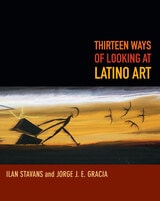
Thirteen Ways of Looking at Latino Art
Ilan Stavans, Jorge J. E. Gracia
Duke University Press, 2014
What is la hispanidad?
A conversationBy Ilan Stavans and Iván Jaksić
University of Texas Press, 2011
Natives of the Iberian Peninsula and the twenty countries of Latin America, as well as their kinsfolk who've immigrated to the United States and around the world, share a common quality or identity characterized as la hispanidad. Or do they?
In this lively, provocative book, two distinguished intellectuals, a cultural critic and a historian, engage in a series of probing conversations in which they try to discern the nature of la hispanidad and debate whether any such shared identity binds the world's nearly half billion people who are "Hispanic." Their conversations range from La Reconquista and Spanish monarchs Ferdinand and Isabella, who united the Spanish nation while expelling its remaining Moors and Jews, to the fervor for el fútbol (soccer) that has swept much of Latin America today. Along the way, they discuss a series of intriguing topics, including the complicated relationship between Latin America and the United States, Spanish language and the uses of Spanglish, complexities of race and ethnicity, nineteenth-century struggles for nationhood and twentieth-century identity politics, and popular culture from literary novels to telenovelas. Woven throughout are the authors' own enlightening experiences of crossing borders and cultures in Mexico and Chile and the United States.
Sure to provoke animated conversations among its readers, What is la hispanidad? makes a convincing case that "our hispanidad is rooted in a changing tradition, flexible enough to persist beyond boundaries and circumstances. Let us not fix it with a definition, but allow it instead to travel, always."
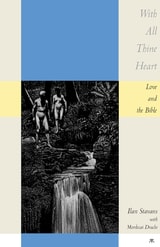
With All Thine Heart
Love and the BibleStavans, Ilan
Rutgers University Press, 2010
Presented in an engaging, conversational format and touched with striking artwork, the textured dialogue between Stavans and Drache is meant to show how the Bible is a multidimensional text and one that, when considered over the course of history, still has the power to shape our world. The theme of love provides the connective tissue that binds this work.
Addressing a wide range of topics, from biblical archaeology and fundamentalism to Hollywood movies, lexicography, and the act of praying, With All Thine Heart suggests that the Hebrew Bible is a novel worth decoding patiently, such as one does with classics like Don Quixote de la Mancha, In Search of Lost Time, and Anna Karenina. Similar to the protagonists in these tales, biblical characters, although not shaped with the artistic nuance of modern literature, allow for astonishing insight. This exploration of love through the pages of the Bible—organized chronologically from Genesis to Exodus and followed by insightful meditations on the Song of Songs and the Book of Job—is a delightful intellectual and spiritual treat . . . Shema Ysrael!

Words in Transit
Stories of ImmigrantsIlan Stavans
University of Massachusetts Press, 2016
Gathered together in a beautifully designed book that showcases Beth Reynolds's photographic portraits of each immigrant, these oral histories illuminate the many paths leading to the Pioneer Valley and demonstrate the shared experience among those seeking a new life in a foreign land. Storytellers include a massage therapist from Ireland, a Fulbright scholar from Palestine, a health educator from Taiwan, a literature professor from Spain, and a yoga teacher from Romania. Other participants hail from far-flung places including Haiti, Jamaica, El Salvador, Côte d'Ivoire, the Dominican Republic, Bhutan, Laos, Syria, Cambodia, Sri Lanka, Nepal, Congo, Slovenia, Iraq, and Ukraine. Introduced by the renowned scholar of translation and global literature Ilan Stavans, these stories testify to the resilience, bravery, and hopefulness of western New England émigrés. Proceeds from this book go to scholarships for immigrants at Holyoke Community College.
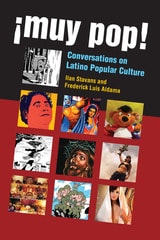
¡Muy Pop!
Conversations on Latino Popular CultureIlan Stavans and Frederick Luis Aldama
University of Michigan Press, 2013
Although investigations of Hispanic popular culture were approached for decades as part of folklore studies, in recent years scholarly explorations—of lucha libre, telenovelas, comic strips, comedy, baseball, the novela rosa and the detective novel, sci-fi, even advertising—have multiplied. What has been lacking is an overarching canvas that offers context for these studies, focusing on the crucial, framing questions: What is Hispanic pop culture? How does it change over time and from region to region? What is the relationship between highbrow and popular culture in the Hispanic world? Does it make sense to approach the whole Hispanic world as homogenized when understanding Hispanic popular culture? What are the differences between nations, classes, ethnic groups, religious communities, and so on? And what distinguishes Hispanic popular culture in the United States?
In ¡Muy Pop!, Ilan Stavans and Frederick Luis Aldama carry on a sustained, free-flowing, book-length conversation about these questions and more, concentrating on a wide range of pop manifestations and analyzing them at length. In addition to making Hispanic popular culture visible to the first-time reader, ¡Muy Pop! sheds new light on the making and consuming of Hispanic pop culture for academics, specialists, and mainstream critics.