Results by title
12 books match the query 'Strategic planning'

Blueprint for Your Library Marketing Plan
A Guide to Help You Survive and ThrivePatricia H. Fisher
American Library Association, 2006
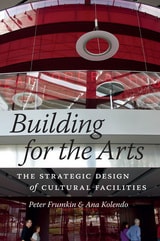
Building for the Arts
The Strategic Design of Cultural FacilitiesPeter Frumkin and Ana Kolendo
University of Chicago Press, 2014
With Building for the Arts, Peter Frumkin and Ana Kolendo explore how artistic vision, funding partnerships, and institutional culture work together—or fail to—throughout the process of major cultural construction projects. Drawing on detailed case studies and in-depth interviews at museums and other cultural institutions varying in size and funding arrangements, including the Art Institute of Chicago, Atlanta Opera, and AT&T Performing Arts Center in Dallas, Frumkin and Kolendo analyze the decision-making considerations and challenges and identify four factors whose alignment characterizes the most successful and sustainable of the projects discussed: institutional requirements, capacity of the institution to manage the project while maintaining ongoing operations, community interest and support, and sufficient sources of funding. How and whether these factors are strategically aligned in the design and execution of a building initiative, the authors argue, can lead an organization to either thrive or fail. The book closes with an analysis of specific tactics that can enhance the chances of a project’s success.
A practical guide grounded in the latest scholarship on nonprofit strategy and governance, Building for the Arts will be an invaluable resource for professional arts staff and management, trustees of arts organizations, development professionals, and donors, as well as those who study and seek to understand them.
Business Confronts Terrorism
Risks and ResponsesDean C. Alexander
University of Wisconsin Press, 2004
These scenarios could be part of a future Hollywood movie. Sadly, they are representative of previous terror attacks against industry and government interests worldwide. Moreover, they are harbingers of global terror threats.
Industry constitutes a prime target of contemporary terrorism. This timely book analyzes the threats companies face due to terrorism, industry responses to these dangers, and terrorism’s effects on conducting business in the post-9/11 environment. Dean C. Alexander details the conventional and unconventional terror capabilities facing industry. He describes the activities of terrorists in the economic system and the ways they finance their operations.
Alexander discusses how companies can reduce terrorist threats and that corporate security can minimize political violence. He outlines the dynamics of the public-private partnership against terrorism: government aiding industry, business supporting government, and tensions between the two. He also delineates terrorism’s effects—financial, physical, and emotional—on workers and employers. He highlights the negative financial and economic consequences of terrorism. He discusses the impact of terrorism on traditional business practices and concludes with an assessment of future trends.
Carbon Strategies
How Leading Companies Are Reducing Their Climate Change FootprintAndrew J. Hoffman
University of Michigan Press, 2007
Collaborative Crisis Management
Prepare, Execute, Recover, RepeatThomas A. Cole and Paul Verbinnen
University of Chicago Press, 2022
All organizations face crises from time to time, and at a time when news, information (or misinformation), and rumors can spread quickly, a timely and thoughtful response to a crisis, is critical. In this book, two industry insiders offer a primer on how organizational leadership should prepare for and handle crises. The steps, plans, and cautions they offer show how organizations can deal openly and honestly with challenges while continuing to survive and prosper.
Thomas A. Cole and Paul Verbinnen show how successful crisis management requires a multi-disciplined approach enacted collaboratively under strong leadership. Drawing on many real-world examples, they speak to not only what to do during a crisis, but also the need for preparedness and post-crisis follow-up. The book is organized around a broad range of discrete issues that need to be addressed in managing any crisis and provides the steps required to successfully address each of those issues. The authors urge crisis managers to focus attention equally on four phases of management: prepare, execute, recover, and then repeat (after reflecting on the results of the last crisis) with the next one. The emphasis is on preparation and planning, setting up the procedures, and organizing the teams that will respond to each crisis.
Unlike other crisis books that focus solely on communication, Collaborative Crisis Management goes further and in addition to communication, it discusses both the legal obligations and organizational challenges that accompany a crisis. The result is an indispensable guide for leaders, board members, and business students.
Collaborative Crisis Management
Prepare, Execute, Recover, RepeatThomas A. Cole and Paul Verbinnen
University of Chicago Press, 2022
Two experienced corporate crisis advisors offer a thorough and approachable guide to successful crisis management from anticipation to resolution.
All organizations face crises from time to time, and at a time when news, information (or misinformation), and rumors can spread quickly, a timely and thoughtful response to a crisis, is critical. In this book, two industry insiders offer a primer on how organizational leadership should prepare for and handle crises. The steps, plans, and cautions they offer show how organizations can deal openly and honestly with challenges while continuing to survive and prosper.
Thomas A. Cole and Paul Verbinnen show how successful crisis management requires a multi-disciplined approach enacted collaboratively under strong leadership. Drawing on many real-world examples, they speak to not only what to do during a crisis, but also the need for preparedness and post-crisis follow-up. The book is organized around a broad range of discrete issues that need to be addressed in managing any crisis and provides the steps required to successfully address each of those issues. The authors urge crisis managers to focus attention equally on four phases of management: prepare, execute, recover, and then repeat (after reflecting on the results of the last crisis) with the next one. The emphasis is on preparation and planning, setting up the procedures, and organizing the teams that will respond to each crisis.
Unlike other crisis books that focus solely on communication, Collaborative Crisis Management goes further and in addition to communication, it discusses both the legal obligations and organizational challenges that accompany a crisis. The result is an indispensable guide for leaders, board members, and business students.
Human Resource for Results
American Library Association, 2007
Implementing for Results
Your Strategic Plan in ActionSandra Nelson
American Library Association, 2009
Investing Wisely
Informed Approaches to Designing and Implementing Allocation Systems for Graduate AssistantshipsRoger B. Sidje, Joan M. Barth, Ellary A. Draper, Matthew J. Jenny, Daniel L. Riches, and Dean M. Townsley
University of Alabama Press, 2026
Investing in Graduate Education Through Data, Equity, and Purpose.
Investing Wisely: Informed Approaches to Designing and Implementing Allocation Systems for Graduate Assistantships tackles one of the most consequential and least understood challenges in higher education: how universities can distribute graduate assistantships fairly, strategically, and transparently. Drawing on a multiyear effort at the University of Alabama, the authors introduce DIASGA™ (Designing and Implementing Allocation Systems for Graduate Assistantships), a practical framework for aligning graduate funding with institutional priorities, departmental needs, and student success. Through real-world experience, the book demonstrates how institutions can move beyond inherited funding patterns and build adaptive systems capable of responding to changing academic realities.
The book proposes a distinctive blend of rigorous analysis and practical guidance. The authors reveal the hidden complexities behind graduate funding decisions, challenging simplistic allocation formulas based on enrollment or credit-hour production. Instead, they advocate a data-informed, collaborative process grounded in departmental expertise, institutional values, and continuous assessment. Featuring case studies, implementation strategies, funding models, committee structures, and lessons learned from both successes and setbacks, Investing Wisely offers an unusually candid account of organizational change and resource allocation in higher education.
This book will be invaluable to provosts, deans, graduate school leaders, department chairs, faculty administrators, and higher education policymakers. It will also appeal to scholars of university governance, institutional effectiveness, and academic planning who seek practical approaches to balancing equity, accountability, and strategic investment. Whether your institution is reconsidering graduate funding practices or simply striving to make better-informed decisions, Investing Wisely provides a thoughtful roadmap for investing in graduate education with clarity, fairness, and purpose.
This book is freely available in open access format thanks to TOME (Toward an Open Monograph Ecosystem) - a collaboration of the Association of American Universities, the Association of University Presses, and the Association of Research Libraries - and the generous support of Virginia Tech. This Open Access publication can be accessed by visiting the University of Alabama Libraries Repository at https://ir.ua.edu/handle/123456789/18409.
Managing the Successful School Library
Strategic Planning and Reflective PracticeLesley S. J. Farmer
American Library Association, 2016
Passing the Torch
Planning for the Next Generation of Leaders in Public ServiceKarl Besel
University of Arkansas Press, 2016
Public-service executives, both elected and appointed within the public and nonprofit sectors, are retiring at record levels, and the number of Americans reaching age sixty-five annually will continue to rise over the next decade and is expected to surpass four million in 2020. Finding qualified, motivated leaders to fill vital public-service positions will challenge the public and nonprofit sectors.
Unfortunately, recent studies show that few proactive steps are being taken by public-service organizations to plan for the next generation. Passing the Torch: Planning for the Next Generation of Public-Service Leaders provides an outline for those who will be facing and managing these looming changes.
In this valuable guide, the factors that influence selection of a career in public service are explored through the authors’ years of experience as leaders in public-service organizations and through interviews with other public-service professionals. Passing the Torch will be essential for leaders of nonprofit organizations, university faculty, researchers in the field of nonprofit management, and students in nonprofit management courses.
Strategic Planning in the Arts
A Practical GuideMichael M. Kaiser
Brandeis University Press, 2018