Results by title
17 books match the query 'Study and teaching (Secondary)'
A Primer for Teaching African History
Ten Design PrinciplesTrevor R. Getz
Duke University Press, 2018
A Primer for Teaching Women, Gender, and Sexuality in World History
Ten Design PrinciplesMerry E. Wiesner-Hanks and Urmi Engineer Willoughby
Duke University Press, 2018
Children of the Stars
Indigenous Science Education in a Reservation ClassroomEd Galindo
Oregon State University Press, 2022
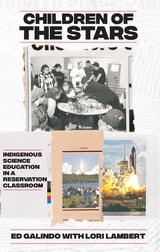
In Children of the Stars, Galindo relates his experience with this first team and with successive student teams, who continued to participate in NASA programs over the course of a decade. He discusses the challenges of teaching American Indian students, from the practical limits of a rural reservation school to the importance of respecting and incorporating Indigenous knowledge systems. In describing how he had to earn the trust of his students to truly be successful as their teacher, Galindo also touches on the complexities of community belonging and understanding; although Indigenous himself, Galindo is not a member of the Shoshone-Bannock tribes and was still an outsider who had as much to learn as the students.
Children of the Stars is the story of students and a teacher, courage and hope. Written in a conversational style, it’s an accessible story about students who were supported and educated in culturally relevant ways and so overcame the limitations of an underfunded reservation school to reach great heights.
Coming To Terms
A Theory of Writing AssessmentPatricia Lynne
Utah State University Press, 2004
In a provocative book-length essay, Patricia Lynne argues that most programmatic assessment of student writing in U.S. public and higher education is conceived in the terms of mid-20th century positivism. Since composition as a field had found its most compatible home in constructivism, she asks, why do compositionists import a conceptual frame for assessment that is incompatible with composition theory?
By casting this as a clash of paradigms, Lynne is able to highlight the ways in which each theory can and cannot influence the shape of assessment within composition. She laments, as do many in composition, that the objectively oriented paradigm of educational assessment theory subjugates and discounts the very social constructionist principles that empower composition pedagogy. Further, Lynne criticizes recent practice for accommodating the big business of educational testing—especially for capitulating to the discourse of positivism embedded in terms like "validity" and "reliability." These terms and concepts, she argues, have little theoretical significance within composition studies, and their technical and philosophical import are downplayed by composition assessment scholars.
There is a need, Lynne says, for terms of assessment that are native to composition. To open this needed discussion within the field, she analyzes cutting-edge assessment efforts, including the work of Broad and Haswell, and she advances a set of alternate terms for evaluating assessment practices, a set of terms grounded in constructivism and composition.
Coming to Terms is ambitious and principled, and it takes a controversial stand on important issues. This strong new volume in assessment theory will be of serious interest to assessment specialists and their students, to composition theorists, and to those now mounting assessments in their own programs.

Coteaching Reading Comprehension Strategies in Secondary School Libraries
Maximizing Your ImpactJudi Moreillon
American Library Association, 2012
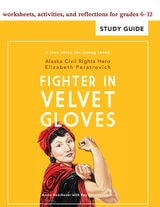
Fighter in Velvet Gloves
Study GuideAnnie Boochever
University of Alaska Press, 2021
Annie Boochever worked with Elizabeth’s eldest son, Roy Peratrovich Jr., to bring Elizabeth’s story to life in the first book written for young teens on this remarkable Alaska Native woman. Written about an Alaska Native civil rights leader, Fighter in Velvet Gloves has been incorporated in school curricula around the country, and won the 2019 Lumen Award for Literary Excellence, in addition to receiving many other national recognitions. This study guide is a custom work designed to help instructors teach the story of Elizabeth Peratrovich to students in grades 6 through 12.
Going Public
What Writing Programs Learn from EngagementShirley Rose
Utah State University Press, 2010
In Going Public, Rose and Weiser locate their discussion in the context of three current conversations in higher education: 1) the engagement movement, particularly as this movement serves to address and respond to calls for greater accountability to broader publics; 2) recent interest in public discourse/civic rhetoric among scholars of rhetorical history and contemporary rhetorical theory; 3) the service learning movement in higher education, especially the ways in which college and university writing programs have contributed to this movement.
While there have been a number of publications describing service-learning and community leadership programs, most of these focus on curricular elements and address administrative issues, if at all, primarily from a curricular perspective. The emphasis of the current book is on the ways that engagement-focused programs change conceptions of WPA identity. Going Public, then, is not only a significant contribution to the scholarly literature, but also supplies an important new resource for WPA preparation courses in rhetoric and composition PhD programs.
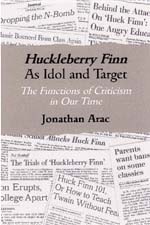
Huckleberry Finn as Idol and Target
The Functions of Criticism in Our TimeJonathan Arac
University of Wisconsin Press, 1997
If racially offensive epithets are banned on CNN air time and in the pages of USA Today, Jonathan Arac asks, shouldn’t a fair hearing be given to those who protest their use in an eighth-grade classroom? Placing Mark Twain’s comic masterpiece, Huckleberry Finn, in the context of long-standing American debates about race and culture, Jonathan Arac has written a work of scholarship in the service of citizenship.
Huckleberry Finn, Arac points out, is America’s most beloved book, assigned in schools more than any other work because it is considered both the “quintessential American novel” and “an important weapon against racism.” But when some parents, students, and teachers have condemned the book’s repeated use of the word “nigger,” their protests have been vehemently and often snidely countered by cultural authorities, whether in the universities or in the New York Times and the Washington Post. The paradoxical result, Arac contends, is to reinforce racist structures in our society and to make a sacred text of an important book that deserves thoughtful reading and criticism. Arac does not want to ban Huckleberry Finn, but to provide a context for fairer, fuller, and better-informed debates.
Arac shows how, as the Cold War began and the Civil Rights movement took hold, the American critics Lionel Trilling, Henry Nash Smith, and Leo Marx transformed the public image of Twain’s novel from a popular “boy’s book” to a central document of American culture. Huck’s feelings of brotherhood with the slave Jim, it was implied, represented all that was right and good in American culture and democracy. Drawing on writings by novelists, literary scholars, journalists, and historians, Arac revisits the era of the novel’s setting in the 1840s, the period in the 1880s when Twain wrote and published the book, and the post–World War II era, to refute many deeply entrenched assumptions about Huckleberry Finn and its place in cultural history, both nationally and globally. Encompassing discussion of Harriet Beecher Stowe, Frederick Douglass, Ralph Ellison, Archie Bunker, James Baldwin, Shelley Fisher Fishkin, and Mark Fuhrman, Arac’s book is trenchant, lucid, and timely.
Learning American Sign Language in High School
Motivation, Strategies, and AchievementRussell S. Rosen
Gallaudet University Press, 2015
Author Russell S. Rosen begins with the history of ASL as a foreign language in high schools, including debates about the foreign language status of ASL, the situation of deaf and hard of hearing students in classes, and governmental recognition of ASL as a language. Based on his study of five high school ASL programs, he defines the factors that motivate students, including community and culture, and analyzes strategies for promoting language processing and learning. Learning American Sign Language in High School provides strategies for teaching ASL as a second language to students with learning disabilities as well. Its thorough approach ensures the best opportunity for high school students to attain high levels of achievement in learning ASL.
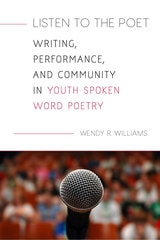
Listen to the Poet
Writing, Performance, and Community in Youth Spoken Word PoetryWendy R. Williams
University of Massachusetts Press, 2019
Listen to the Poet investigates two Arizona spoken word poetry groups—a community group and a high school club—that are both part of the same youth organization. Exploring the writing lives and poetry of several members, Wendy R. Williams takes readers inside a writing workshop and poetry slam and reveals that schools have much to learn about writing, performance, community, and authorship from groups like these and from youth writers themselves.
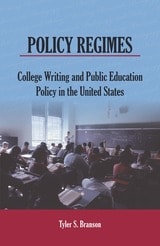
Policy Regimes
College Writing and Public Education Policy in the United StatesTyler S. Branson
Southern Illinois University Press, 2021
Author Tyler S. Branson argues that education reform initiatives in the twentieth century can be understood in terms of historical shifts in the ideas, interests, and governing arrangements that inform the teaching of writing. Today, policy regimes of “accountability” shape education reform programs such as Common Core in K-12 and Dual Enrollment in postsecondary institutions. This book reopens the conversation between policy makers and writing teachers, empirically describing the field’s institutional/historical relationship to policy and the ways teachers work on a daily basis to carry out policy. Federal and state accountability policy significantly shapes classrooms before teachers even enter them, but Branson argues the classroom is where teachers leverage disciplinary knowledge about writing to bridge, partner with, support, and sometimes resist education policies.
Branson deftly blends policy critique, archival analysis, and participant observation to offer the first scholarly treatment of the National Council of Teachers of English (NCTE) Washington Task Force as well as a rare empirical study of a dual enrollment course offered in a high school. This book’s macro-and-micro-level analysis of education policy reveals how writing teachers, researchers, and administrators can strengthen their commitments to successfully teaching their students across all levels of education, while deepening their understanding of the ways education policy helps—and hinders—those commitments.
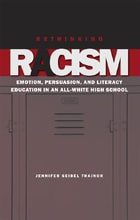
Rethinking Racism
Emotion, Persuasion, and Literacy Education in an All-White High SchoolJennifer Seibel Trainor
Southern Illinois University Press, 2008
In Rethinking Racism: Emotion, Persuasion, and Literacy Education in an All-White High School, Jennifer Seibel Trainor proposes a new understanding of the roots of racism, one that is based on attention to the role of emotion and the dynamics of persuasion. This one-year ethnographic study argues against previous assumptions about racism, demonstrating instead how rhetoric and emotion, as well as the processes and culture of schools, are involved in the formation of racist beliefs.
Telling the story of a year spent in an all-white high school, Trainor suggests that contrary to prevailing opinion, racism often does not stem from ignorance, a lack of exposure to other cultures, or the desire to protect white privilege. Rather, the causes of racism are frequently found in the realms of emotion and language, as opposed to rational calculations of privilege or political ideologies. Trainor maintains that racist assertions often originate not from prejudiced attitudes or beliefs but from metaphorical connections between racist ideas and nonracist values. These values are reinforced, even promoted by schooling via "emotioned rules" in place in classrooms: in tacit, unexamined lessons, rituals, and practices that exert a powerful—though largely unacknowledged—persuasive force on student feelings and beliefs about race.
Through in-depth analysis of established anti-racist pedagogies, student behavior, and racial discourses, Trainor illustrates the manner in which racist ideas are subtly upheld through social and literacy education in the classroom—and are thus embedded in the infrastructures of schools themselves. It is the emotional and rhetorical framework of the classroom that lends racism its compelling power in the minds of students, even as teachers endeavor to address the issue of cultural discrimination. This effort is continually hindered by an incomplete understanding of the function of emotions in relation to antiracist persuasion and cannot be remedied until the root of the problem is addressed.
Rethinking Racism calls for a fresh approach to understanding racism and its causes, offering crucial insight into the formative role of schooling in the perpetuation of discriminatory beliefs. In addition, this highly readable narrative draws from white students' own stories about the meanings of race in their learning and their lives. It thus provides new ways of thinking about how researchers and teachers rep- resent whiteness. Blending narrative with more traditional forms of ethnographic analysis, Rethinking Racism uncovers the ways in which constructions of racism originate in literacy research and in our classrooms—and how these constructions themselves can limit the rhetorical positions students enact.
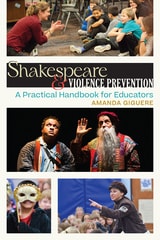
Shakespeare & Violence Prevention
A Practical Handbook for EducatorsAmanda Giguere
University of Wyoming Press, 2025
Framed by examples from Giguere’s work with the Shakespeare & Violence Prevention program, an interdisciplinary outreach project for K–12 schools developed at the University of Colorado Boulder, the text offers helpful entry points, digestible research, and practical exercises to align a violence-prevention curriculum with Shakespeare’s plays. It provides a condensed overview of key findings from violence prevention, clear synopses of the plays, and practicable strategies to implement the program. Guided by firsthand experience with a tried-and-true school program that reaches thousands of K–12 students annually, Giguere shares the Colorado Shakespeare Festival method, which focuses on “upstander” roleplays to practice violence-prevention strategies. Using a clear distillation of Shakespeare studies and violence-prevention research, she shows how the two fields naturally reinforce the concepts of teamwork, empathy, change, and hope.
Shakespeare and Violence Prevention is a new spin on these classic texts that empowers teachers and community leaders to use these tools to create research-guided university engagement programs, theatre company outreach programs, and K–12 student engagement with Shakespeare, even for those without expertise in violence prevention or Shakespeare.
Teaching for Inquiry
Engaging the Learner WithinBarbara K. Stripling
American Library Association, 2012
Teaching through the Archives
Text, Collaboration, and ActivismEdited by Tarez Samra Graban and Wendy Hayden
Southern Illinois University Press, 2022
Disruptive pedagogies for archival research
In a cultural moment when institutional repositories carry valuable secrets to the present and past, this collection argues for the critical, intellectual, and social value of archival instruction. Graban and Hayden and 37 other contributors examine how undergraduate and graduate courses in rhetoric, history, community literacy, and professional writing can successfully engage students in archival research in its many forms, and successfully model mutually beneficial relationships between archivists, instructors, and community organizations.
Combining new and established voices from related fields, each of the book’s three sections includes a range of form-disrupting pedagogies. Section I focuses on how approaching the archive primarily as text fosters habits of mind essential for creating and using archives, for critiquing or inventing knowledge-making practices, and for being good stewards of private and public collections. Section II argues for conducting archival projects as collaboration through experiential learning and for developing a preservationist consciousness through disciplined research. Section III details praxis for revealing, critiquing, and intervening in historic racial omissions and gaps in the archives in which we all work.
Ultimately, contributors explore archives as sites of activism while also raising important questions that persist in rhetoric and composition scholarship, such as how to decolonize research methodologies, how to conduct teaching and research that promote social justice, and how to shift archival consciousness toward more engaged notions of democracy. This collection highlights innovative classroom and curricular course models for teaching with and through the archives in rhetoric and composition and beyond.
Transiciones
Pathways of Latinas and Latinos Writing in High School and CollegeTodd Ruecker
Utah State University Press, 2015
Transiciones is a thorough ethnography of seven Latino students in transition between high school and community college or university. Data gathered over two years of interviews with the students, their high school English teachers, and their writing teachers and administrators at postsecondary institutions reveal a rich picture of the conflicted experience of these students as they attempted to balance the demands of schooling with a variety of personal responsibilities.
Todd Ruecker explores the disconnect between students’ writing experiences in high school and higher education and examines the integral role that writing plays in college. Considering the almost universal requirement that students take a writing class in their critical first year of college, he contends that it is essential for composition researchers and teachers to gain a fuller understanding of the role they play in supporting and hindering Latina and Latino students’ transition to college.
Arguing for situating writing programs in larger discussions of high school/college alignment, student engagement, and retention, Transiciones raises the profile of what writing programs can do while calling composition teachers, administrators, and scholars to engage in more collaboration across the institution, across institutions, and across disciplines to make the transition from high school to college writing more successful for this important group of students.
Writing in the Academic Disciplines, Second Edition
A Curricular HistoryDavid R. Russell. Foreword by Elaine P. Maimon
Southern Illinois University Press, 2002
“To understand the ways students learn to write, we must go beyond the small and all too often marginalized component of the curriculum that treats writing explicitly and look at the broader, though largely tacit traditions students encounter in the whole curriculum,” explains David R. Russell, in the introduction to this singular study. The updated edition provides a comprehensive history of writing instruction outside general composition courses in American secondary and higher education, from the founding public secondary schools and research universities in the 1870s, through the spread of the writing-across-the-curriculum movement in the 1980s, through the WAC efforts in contemporary curriculums.