Results by title
20 books match the query 'Subjectivity in literature'

A Glance Beyond Doubt
Narration, Representation, SubjectivityShlomith Rimmon-Kenan
The Ohio State University Press, 1900

Canonical States, Canonical Stages
Oedipus, Othering, and Seventeenth-Century DramaMitchell Greenberg
University of Minnesota Press, 1994
Canonical States, Canonical Stages was first published in 1994. Minnesota Archive Editions uses digital technology to make long-unavailable books once again accessible, and are published unaltered from the original University of Minnesota Press editions.
In the crucible of seventeenth-century Europe, a new kind of subjectivity formed, private and interior. Perversely, the new private subject made its most spectacular appearance on the public stage-an appearance that, as Mitchell Greenberg amply demonstrates, also marked the emergence of absolutism in Europe. What these two phenomena had to do with one another, and how they were elaborated in the theater of the seventeenth century, is the subject of Greenberg's book, a masterful critical work that relates the dramatic construction of modern subjectivity and absolutist culture to the formation of the Western literary canon.
In particular, Canonical States, Canonical Stages shows how the Oedipus myth, reinterpreted on various stages at the end of the Renaissance, served the purposes of the emerging culture by replaying the founding moment of absolute rule. Working with models of genealogical criticism, psychoanalysis, and a certain Continental feminism, Greenberg reads plays by Shakespeare, Lope de Vega, Calderón, Corneille, and Racine to show how, as symptomatic texts staged within the confines of familial scenarios, they combine a dynamics of politics with a conflicting "private" desire shown to be inimical to the dominant ideology. This analysis reveals how scenarios of sacrifice and transcendence are brought into play to normalize and naturalize inchoate and threatening forces of social change by appealing to preexisting cultural models such as the myth of Oedipus. A fascinating integration of texts from political theory, psychoanalysis, history, and literature, Canonical States, Canonical Stages offers a powerful interpretation of the interrelated representation of subjectivity and absolutism on the seventeenth-century stage.Winner of the 1995 MLA Aldo and Jeanne Scaglione Prize for Comparative Literary Studies
Mitchell Greenberg is chair of the Department of French and Italian at Miami University in Ohio. He is the author of, among other books, Subjectivity and Subjugation in Seventeenth-Century Drama and Prose: The Family Romance of French Classicism (1992).

Echo Chambers
Figuring Voice In NarrativePatrick O'Donnell
University of Iowa Press, 1992
Echo Chambers provides an illuminating discussion of the representation of “voice” in novels by Dickens, Joyce, Faulkner, Lowry, and Gaddis. Focusing on the paradoxes of “voice” as an indication of how different authors understand the contradictions of “identity,” O'Donnell charts the recent history of subjectivity as reflected in the development of modern fiction. With strong theoretical underpinning—O'Donnell skillfully utilizes the theories formulated by Bakhtin, Derrida, Bersani, De Man, Deleuze, and Guattari, among others, and the semiotics of voice put forth by Julia Kristeva—Echo Chambers shows how identity is inherently contradictory, conflicted, and multiple.
This insightful volume compellingly demonstrates that “voice” is a revealing (because contradictory and heterogeneous) site where language, the body, culture, and subjectivity meet. Echo Chambers makes an important contribution to the study of modern literature, the semiotics of identity, and cultural poetics as they are informed by the projections of voice in modern narrativ
Embodied
Victorian Literature and the SensesWilliam A. Cohen
University of Minnesota Press, 2008
Making sense of the body in Victorian literature
What does it mean to be human? British writers in the Victorian period found a surprising answer to this question. What is human, they discovered, is nothing more or less than the human body itself. In literature of the period, as well as in scientific writing and journalism, the notion of an interior human essence came to be identified with the material existence of the body. The organs of sensory perception were understood as crucial routes of exchange between the interior and the external worlds.
Anatomizing Victorian ideas of the human, William A. Cohen considers the meaning of sensory encounters in works by writers including Charles Dickens, Charlotte Brontë, Anthony Trollope, Thomas Hardy, and Gerard Manley Hopkins. Rather than regarding the bodily exterior as the primary location in which identity categories—such as gender, sexuality, race, and disability—are expressed, he focuses on the interior experience of sensation, whereby these politics come to be felt. In these elegant engagements with literary works, cultural history, and critical theory, Cohen advances a phenomenological approach to embodiment, proposing that we encounter the world not through our minds or souls but through our senses.
Impressionist Subjects
Gender, Interiority, and Modernist Fiction in EnglandTamar Katz
University of Illinois Press, 2000
Sophisticated and tightly argued, Impressionist Subjects is a substantial contribution to the reassessment and expansion of the modernist fiction canon.
Intimate Commerce
Exchange, Gender, and Subjectivity in Greek TragedyBy Victoria Wohl
University of Texas Press, 1997
Exchanges of women between men occur regularly in Greek tragedy—and almost always with catastrophic results. Instead of cementing bonds between men, such exchanges rend them. They allow women, who should be silent objects, to become monstrous subjects, while men often end up as lifeless corpses. But why do the tragedies always represent the transferal of women as disastrous?
Victoria Wohl offers an illuminating analysis of the exchange of women in Sophocles' Trachiniae, Aeschylus' Agamemnon, and Euripides' Alcestis. She shows how the attempts of women in these plays to become active subjects rather than passive objects of exchange inevitably fail. While these failures seem to validate male hegemony, the women's actions, however futile, blur the distinction between male subject and female object, calling into question the very nature of the tragic self. What the tragedies thus present, Wohl asserts, is not only an affirmation of Athens' reigning ideologies (including its gender hierarchy) but also the possibility of resistance to them and the imagination of alternatives.
James Baldwin, Toni Morrison, and the Rhetorics of Black Male Subjectivity
Aaron Ngozi Oforlea
The Ohio State University Press, 2017
Oforlea’s book offers new analyses of the character dynamics in Baldwin’s Go Tell It on the Mountain, Tell Me How Long the Train’s Been Gone, and If Beale Street Could Talkand Morrison’s Beloved, Song of Solomon, and Tar Baby. The black male characters in these novels encounter the discursive divide, or a cultural dissonance, when they encounter dominant representations of black male identities. They use these opportunities to construct a counter-discourse about black male subjectivity. Ultimately, Oforlea argues, these characters are strategic about when and how they want to appropriate and subvert dominant ideologies. Their awareness that post-racial discourses perpetuate racial inequality serves as a gateway toward participation in collective struggles for racial justice.
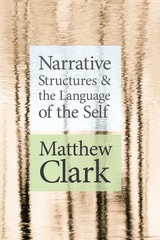
Narrative Structures and the Language of the Self
Matthew Clark
The Ohio State University Press, 2010
Narrative Structures and the Language of the Self by Matthew Clark offers a new way of thinking about the interrelation of character and plot. Clark investigates the characters brought together in a narrative, considering them not as random collections but as structured sets that correspond to various manifestations of the self. The shape and structure of these sets can be thought of as narrative geometry, and various geometries imply various theories of the self. Part One, “Philosophical Fables of the Self,” examines narratives such as The Talented Mr. Ripley,A Farewell to Arms,A Separate Peace, and The Master of Ballantrae in order to show successively more complex versions of the self as modeled by Descartes, Hegel, Freud, and Mead. Part Two, “The Case of the Subject,” uses Case Grammar to extend the discussion to additional roles of the self in narratives such as The Waves,The Great Gatsby,Fifth Business, and Howards End as examples of the self as experiencer, the self as observer, the instrumental self, and the locative self. The book ends with an extended analysis of the subject in Hartley’s The Go-Between. Throughout, the discussion is concerned with practical analysis of specific narratives and with the development of an understanding of the self that moves beyond the simple dichotomy of the self and the other, the subject and the object.

PYNCHON'S POETICS
Interfacing Theory and TextHanjo Berressem
University of Illinois Press, 1993
is a provocative, intelligent analysis of V., The Crying of Lot 49, Gravity's
Rainbow, and Vineland. Hanjo Berrssem examines these works in the
light of post-structuralist thought and literary theory, investigating the notion
of subjectivity and the relations between the subject, culture, and language.
Perspectives
Modes of Viewing and Knowing in Nineteenth-Century EnglandLinda M. Shires
The Ohio State University Press, 2009
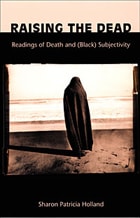
Raising the Dead
Readings of Death and (Black) SubjectivitySharon Patricia Holland
Duke University Press, 2000
Holland argues that the presence of blacks, Native Americans, women, queers, and other “minorities” in society is, like death, “almost unspeakable.” She gives voice to—or raises—the dead through her examination of works such as the movie Menace II Society, Toni Morrison’s novel Beloved, Leslie Marmon Silko’s Almanac of the Dead, Randall Kenan’s A Visitation of Spirits, and the work of the all-white, male, feminist hip-hop band Consolidated. In challenging established methods of literary investigation by putting often-disparate voices in dialogue with each other, Holland forges connections among African-American literature and culture, queer and feminist theory.
Raising the Dead will be of interest to students and scholars of American culture, African-American literature, literary theory, gender studies, queer theory, and cultural studies.
Reflections of Romanity
Discourses of Subjectivity in Imperial RomeRichard Alston
The Ohio State University Press, 2011

Saying I No More
Subjectivity and Consciousness in the Prose of Samuel BeckettDaniel Katz
Northwestern University Press, 1999
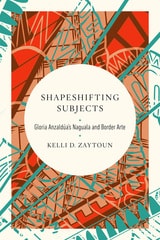
Shapeshifting Subjects
Gloria Anzaldua's Naguala and Border ArteKelli D. Zaytoun
University of Illinois Press, 2022
An original and moving analysis, Shapeshifting Subjects draws on unpublished archival material to apply Anzaldúa's ideas to new areas of thought and action.
Snow on the Cane Fields
Women’s Writing and Creole SubjectivityJudith Raiskin
University of Minnesota Press, 1995
Snow on the Cane Fields was first published in 1995. Minnesota Archive Editions uses digital technology to make long-unavailable books once again accessible, and are published unaltered from the original University of Minnesota Press editions.
In a probing analysis of creole women's writing over the past century, Judith Raiskin explores the workings and influence of cultural and linguistic colonialism. Tracing the transnational and racial meanings of creole identity, Raiskin looks at four English-speaking writers from South Africa and the Caribbean: Olive Schreiner, Jean Rhys, Michelle Cliff, and Zoë Wicomb. She examines their work in light of the discourses of their times: nineteenth-century "race science" and imperialistic rhetoric, turn-of-the-century anti-Semitic sentiment and feminist pacifism, postcolonial theory, and apartheid legislation.
In their writing and in their multiple identities, these women highlight the gendered nature of race, citizenship, culture, and the language of literature. Raiskin shows how each writer expresses her particular ambivalences and divided loyalties, both enforcing and challenging the proprietary British perspective on colonial history, culture, and language. A new perspective on four writers and their uneasy places in colonial culture, Snow on the Cane Fields reveals the value of pursuing a feminist approach to questions of national, political, and racial identity.
Judith Raiskin is assistant professor of women's studies at the University of California, Santa Barbara.
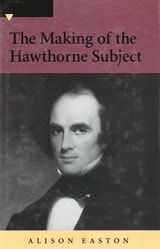
The Making of the Hawthorne Subject
Alison Easton
University of Missouri Press, 1996
This comprehensive study of Nathaniel Hawthorne's early writings analyzes the development of Hawthorne's work over the first twenty-five years of his career. Alison Easton studies that process in relation to current critical debates on subjectivity. By examining Hawthorne's novels, sketches, tales, letters, notebooks, reviews, and children's books up to the publication of The Scarlet Letter, Easton shows how Hawthorne tried to understand the complexities of the clash between desire (that which is unrecognized by the social order) and circumstance (the conditions under which one must live in society). The Hawthorne who emerges from this study proves to be a sophisticated theorist of subjectivity, whose project was central to his times.
The author contends that over the first half of his career Hawthorne explored, experimented, and negotiated his way toward a better model of the human subject than the ones that are usually seen as his cultural inheritance. This approach implies a complex, dialectic development in Hawthorne's work, arising from twenty-five years of accumulated experimentation and ongoing debate. Nearly all critics of Hawthorne have ignored this element of development, thus missing the complex evolution of the subject and the revealing intertextual play of meaning that is evident in everything Hawthorne wrote during this period. Easton's study is the first to supply a full chronology for the works written during these years, and the only one to consider in close detail the full and bewilderingly diverse range of his writing throughout this period and to find an overall pattern in the several stages of his intellectual and artistic enterprise.
Easton brings to scholars and students of nineteenth-century American literature a study of Hawthorne's work that is unique in both scope and perspective. The Making of the Hawthorne Subject offers a substantial and original contribution to the way we think about Hawthorne's work and the relationship of the human subject to the social order of mid-nineteenth-century America.
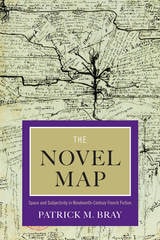
The Novel Map
Space and Subjectivity in Nineteenth-Century French FictionPatrick M. Bray
Northwestern University Press, 2013
Focusing on Stendhal, Gérard de Nerval, George Sand, Émile Zola, and Marcel Proust, The Novel Map: Mapping the Self in Nineteenth-Century French Fiction explores the ways that these writers represent and negotiate the relationship between the self and the world as a function of space in a novel turned map.
With the rise of the novel and of autobiography, the literary and cultural contexts of nineteenth-century France reconfigured both the ways literature could represent subjects and the ways subjects related to space. In the first-person works of these authors, maps situate the narrator within the imaginary space of the novel. Yet the time inherent in the text’s narrative unsettles the spatial self drawn by the maps and so creates a novel self, one which is both new and literary. The novel self transcends the rigid confines of a map. In this significant study, Patrick M. Bray charts a new direction in critical theory.

The Story of All Things
Writing the Self in English Renaissance Narrative PoetryMarshall Grossman
Duke University Press, 1998
Relating subjectivity to the nature of language, Grossman uses the theories of Lacan to analyze the concept of the self as it encounters a transforming environment. He shows how ideological tensions arose from the reorganization and "modernization" of social life in revolutionary England and how the major poets of the time represented the division of the self in writings that are suspended between lyric and narrative genres. Beginning with the portrayals of the self inherited from Augustine, Dante, and Petrarch, he describes the influence of historic developments such as innovations in agricultural technology, civil war and regicide, and the emergence of republican state institutions on the changing representation of characters in the works of Spenser, Donne, Marvell, and Milton. Furthering this psychoanalytic critique of literary history, Grossman probes the linguistic effects of social and personal factors such as Augustine’s strained relationship with his mother and the marital disharmony of Milton and Mary Powell. With its focus on these and other "literary historical events," The Story of All Things not only proposes a new structural theory of narrative but constitutes a significant challenge to New Historicist conceptions of the self.
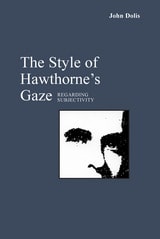
The Style of Hawthorne's Gaze
Regarding SubjectivityJohn Dolis
University of Alabama Press, 1993
Examining subjectivity and narrative perception in Hawthorne’s literary art.
The Style of Hawthorne’s Gaze is an unusual and insightful work that employs a combination of critical strategies drawn from art history, philosophy, psychoanalysis, and contemporary aesthetic and literary theory to explore Nathaniel Hawthorne’s narrative technique and his unique vision of the world. Dolis studies Hawthorne’s anti-technological and essentially Romantic view of the external world and examines the recurring phenomena of lighting, motion, aspectivity, fragmentation, and imagination as they relate to his descriptive techniques.
Dolis sets the world of Hawthorne’s work over and against the aesthetic and philosophical development of the world understood as a “view”, from its inception in the camera obscura and perspective in general, to its 19th-century articulation in photography. In light of this general technology of the image, and drawing upon a wide range of contemporary critical theories, Dolis begins his study of Hawthorne at the level of description, where the world of the work first arises in the reader’s consciousness. Dolis shows how the work of Heidegger, Merleau-Ponty, Freud, Lacan, and Derrida can provide fresh insights into the sophisticated style of Hawthorne’s perception of and system for representing reality.
The Vanishing
Shakespeare, the Subject, and Early Modern CultureChristopher Pye
Duke University Press, 2000
Pye explores the emergence of the early modern subject in terms of a range of subjectivizing mechanisms tied to the birth of a modern conception of history, one that is structured around a spatial and temporal horizon—a vanishing point. He also discusses the distinctly economic character of early modern subjectivity and how this, too, is implicated in our own modern modes of historical understanding. After explaining how the aims of New Historicist and Foucauldian approaches to the Renaissance are inseparably linked to such a historical conception, Pye demonstrates how the early modern subject can be understood in terms of a Lacanian and Zizekian account of the emerging social sphere. By focusing on the Renaissance as a period of remarkable artistic and cultural production, he is able to illustrate his points with discussions of a number of uniquely fascinating topics—for instance, how demonism was intimately related to a significant shift in law and symbolic order and how there existed at the time a “demonic” preoccupation with certain erotic dimensions of the emergent social subject.
Highly sophisticated and elegantly crafted, The Vanishing will be of interest to students of Shakespeare and early modern culture, Renaissance visual art, and cultural and psychoanalytic theory.