Results by title
18 books match the query 'Suburban life'
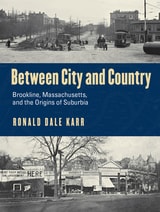
Between City and Country
Brookline, Massachusetts, and the Origins of SuburbiaRonald Dale Karr
University of Massachusetts Press, 2018
Already a fashionable retreat for wealthy Bostonians, Brookline began to suburbanize in the 1840s with the arrival of hundreds of commuter families—and significant numbers of Irish Catholic immigrants drawn by opportunities to work as laborers and servants. In Brookline the poor were segregated but not excluded altogether, as they would be from twentieth-century elite suburbs. A half century later, a distinct suburban way of life developed that combined rural activities with urban pastimes, and a political consensus emerged that sought efficient government and large expenditures on education and public works. Brookline had created the template for the concept of suburbia, not just in wealthy communities but in the less affluent communities of postwar America.
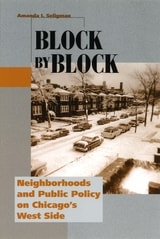
Block by Block
Neighborhoods and Public Policy on Chicago's West SideAmanda I. Seligman
University of Chicago Press, 2005
Seligman's study reveals that the responses of white West Siders to racial changes occurring in their neighborhoods were both multifaceted and extensive. She shows that, despite rehabilitation efforts, deterioration in these areas began long before the color of their inhabitants changed from white to black. And ultimately, the riots that erupted on Chicago's West Side and across the country in the mid-1960s stemmed not only from the tribulations specific to blacks in urban centers but also from the legacy of accumulated neglect after decades of white occupancy. Seligman's careful and evenhanded account will be essential to understanding that the "flight" of whites to the suburbs was the eventual result of a series of responses to transformations in Chicago's physical and social landscape, occurring one block at a time.
California Dreaming
Boosterism, Memory, and Rural Suburbs in the Golden StatePaul J. P. Sandul
West Virginia University Press, 2014
California Dreaming: Boosterism, Memory, and Rural Suburbs in the Golden State analyzes the growth, promotion, and agricultural colonization that fed this dream during the early 1900s. Through this analysis, Paul J. P. Sandul introduces a newly identified rural-suburban type: the agriburb, a rural suburb deliberately planned, developed, and promoted for profit. Sandul reconceptualizes California’s growth during this time period, establishing the agriburb as a suburban phenomenon that occurred long before the booms of the 1920s and 1950s.
Sandul’s analysis contributes to a new suburban history that includes diverse constituencies and geographies and focuses on the production and construction of place and memory. Boosters purposefully “harvested” suburbs with an eye toward direct profit and metropolitan growth. State boosters boasted of unsurpassable idyllic communities while local boosters bragged of communities that represented the best of the best, both using narratives of place, class, race, lifestyle, and profit to avow images of the rural and suburban ideal.
This suburban dream attracted people who desired a family home, nature, health, culture, refinement, and rural virtue. In the agriburb, a family could live on a small home grove while enjoying the perks of a progressive city. A home located within the landscape of natural California with access to urban amenities provided a good place to live and a way to gain revenue through farming.
To uncover and dissect the agriburb, Sandul focuses on local histories from California’s Central Valley and the Inland Empire of Southern California, including Ontario near Los Angeles and Orangevale and Fair Oaks outside Sacramento. His analysis closely operates between the intersections of history, anthropology, geography, sociology, and the rural and urban, while examining a metanarrative that exposes much about the nature and lasting influence of cultural memory and public history upon agriburban communities.
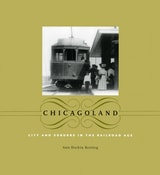
Chicagoland
City and Suburbs in the Railroad AgeAnn Durkin Keating
University of Chicago Press, 2005
Historian and coeditor of the acclaimed Encyclopedia of Chicago, Ann Durkin Keating resurrects for us here the bustling network that defined greater Chicagoland. Taking a new approach to the history of the city, Keating shifts the focus to the landscapes and built environments of the metropolitan region. Organized by four categories of settlements-farm centers, industrial towns, commuter suburbs, and recreational and institutional centers-that framed the city, Chicagoland offers the collective history of 230 neighborhoods and communities, the people who built them, and the structures they left behind that still stand today.
Keating reanimates nineteenth-century Chicagoland with more than a hundred photographs and maps; we find here the taverns, depots, and way stations that were the hubs of the region's vibrant, mobile life. Keating also includes an appendix of driving tours so readers can see this history for themselves. Chicagoland takes us into the buildings and sites that are still part of our landscape and repopulates them with the stories and characters behind their creation. The result is a wide-angle historical view of Chicago, an entirely new way to understand the region.
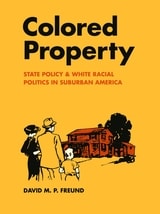
Colored Property
State Policy and White Racial Politics in Suburban AmericaDavid M. P. Freund
University of Chicago Press, 2007

Creating Chicago's North Shore
A Suburban HistoryMichael H. Ebner
University of Chicago Press, 1988

Gravity Hill
A MemoirMaximilian Werner
University of Utah Press, 2013
“The sound of parenthood is the sigh.” So begins Gravity Hill, written from the perspective of a new father seeking hope, beauty, and meaning in an uncertain world. Many memoirs recount the author’s experiences of growing up and struggling with demons; Werner’s shows how old demons sometimes return on the heels of something as beautiful as children. Werner’s memoir is about growing up, getting older, looking back, and wondering what lies ahead—a process that becomes all the more complicated and intense when parenting is involved. Moving backward and forward between past, present, and future, Gravity Hill does not delineate time so much as collapse it.
Werner narrates his struggle growing up in suburban Utah as anon-Mormon and what it took for him, his siblings, and his friends to feel like they belonged. Bonding in separation, they indulged in each other, in natural and urban landscapes, and sometimes in the destructive behaviors that are the native resort of outsidersincluding promiscuous and occasionally violent sexual behavior—and for some, paths to death and suicide. Gravity Hill is the story of the author’s descent into and eventual emergence from his dysfunction and into a newfound life. Infused with humor, honesty, and reflection, this literary memoir will resonate with readers young and old.
Haunted Homes
Dahlia Schweitzer
Rutgers University Press, 2021
Watch a video of the author discussing the topic Haunted Homes (https://youtu.be/_irTEfvtZfQ).
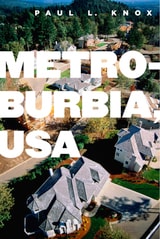
Metroburbia, USA
Knox, Paul L
Rutgers University Press, 2008
Upper-middle-class Americans are moving into larger homes in greater numbers, which leads Knox to explore the relationship between built form and material culture in contemporary society. He covers changes in home design, real estate, the work of developers, and the changing wishes of consumers. Knox shows that contemporary suburban landscapes are a product of consumer demand, combined with the logic of real estate development, mediated by design and policy professionals and institutions of governance. Suburban landscapes not only echo the fortunes of successive generations of inhabitants, Knox argues, they also reflect the country's changing core values.
Knox addresses key areas of concern and importance to today's urban planners and suburban residents including McMansions, traffic disasters, house design, homeowner's associations, exclusionary politics, and big box stores. Through the inclusion of examples and photos, Metroburbia, USA creates an accessible portrait of today's suburbs supported by data, anecdotes, and social theory. It is a broad interpretation of the American metropolitan form that looks carefully at the different influences that contribute to where and how we live today.

Once the American Dream
Inner-Ring Suburbs of the Metropolitan United StatesBernadette Hanlon
Temple University Press, 2012
Once the American Dream analyzes this downward trend, examining 5,000 suburbs across 100 different metropolitan areas and census regions in 1980 and 2000. Hanlon defines the suburbs’ geographic boundaries and provides a ranking system for assessing and acting upon inner-ring suburban decline. She also illuminates her detailed statistical analysis with vivid case studies. She demonstrates how other suburbs, particularly those in the outer reaches of cities, flourished during the 1980s and 1990s. Once the American Dream closes with a discussion of policy implications and recommendations for policymakers and planners who deal with suburbs of various stripes.
Peacocks, Chameleons, Centaurs
Gay Suburbia and the Grammar of Social IdentityWayne Brekhus
University of Chicago Press, 2003
In this first-ever ethnography of American gay suburbanites, Wayne H. Brekhus demonstrates that who one is depends at least in part on where and when one is. For many urban gay men, being homosexual is key to their identity because they live, work, and socialize in almost exclusively gay circles. Brekhus calls such men "lifestylers" or peacocks. Chameleons or "commuters," on the other hand, live and work in conventional suburban settings, but lead intense gay social and sexual lives outside the suburbs. Centaurs, meanwhile, or "integrators," mix typical suburban jobs and homes with low-key gay social and sexual activities. In other words, lifestylers see homosexuality as something you are, commuters as something you do, and integrators as part of yourself.
Ultimately, Brekhus shows that lifestyling, commuting, and integrating embody competing identity strategies that occur not only among gay men but across a broad range of social categories. What results, then, is an innovative work that will interest sociologists, psychologists, anthropologists, and students of gay culture.

SUBURBAN ALCHEMY
1960S NEW TOWNS AND THE TRANSFORMATION ONICHOLAS DAGEN BLOOM
The Ohio State University Press, 2001
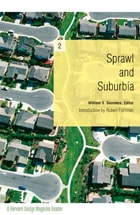
Sprawl and Suburbia
A Harvard Design Magazine ReaderWilliam Saunders
University of Minnesota Press, 2005
Sprawl and Suburbia brings together some of the foremost thinkers in the field to present in-depth diagnosis and critical analysis of the physical and social realities of exurban sprawl. Along with an introduction by Robert Fishman, these essays call for architects, urban planners, and landscape designers to work at mitigating the impact of sprawl on land and resources and improving the residential and commercial built environment as a whole. In place of vast residential exurbs, these writers offer visions of a fresh urbanism—appealing and persuasive models of life at greater density, with greater diversity, and within genuine communities.
With sprawl losing the support of suburban citizens themselves as economic, environmental, and social costs are being paid, Sprawl and Suburbia appears at a moment when design might achieve some critical influence over development—if architects and planners accept the challenge.
Contributors: Mike Davis, Ellen Dunham-Jones, Peter Hall, David Harvey, Jerold S. Kayden, Matthew J. Kiefer, Alex Krieger, Andrew Ross, James S. Russell, Mitchell Schwarzer.
William S. Saunders is editor of Harvard Design Magazine and assistant dean for external relations at the Harvard Design School. He is the author of Modern Architecture: Photographs by Ezra Stoller.
Robert Fishman is professor of architecture and urban planning at the Taubman College of Architecture, University of Michigan. He is author of Bourgeois Utopias: The Rise and Fall of Suburbia and editor of The American Planning Tradition: Culture and Policy.

Suburban Dreams
Imagining and Building the Good LifeGreg Dickinson
University of Alabama Press, 2014
2016 CHOICE OUTSTANDING ACADEMIC TITLE AND JANE JACOBS URBAN COMMUNICATION BOOK AWARD FINALIST
Explores how the suburban imaginary, composed of the built environment and imaginative texts, functions as a resource for living out the “good life”
Starting with the premise that suburban films, residential neighborhoods, chain restaurants, malls, and megachurches are compelling forms (topos) that shape and materialize the everyday lives of residents and visitors, Greg Dickinson’s Suburban Dreams offers a rhetorically attuned critical analysis of contemporary American suburbs and the “good life” their residents pursue.
Dickinson’s analysis suggests that the good life is rooted in memory and locality, both of which are foundations for creating a sense of safety central to the success of suburbs. His argument is situated first in a discussion of the intersections among buildings, cities, and the good life and the challenges to these relationships wrought by the twentieth and twenty-first centuries. The argument then turns to rich, fully-embodied analyses of suburban films and a series of archetypal suburban landscapes to explore how memory, locality, and safety interact in constructing the suburban imaginary. Moving from the pastoralism of residential neighborhoods and chain restaurants like Olive Garden and Macaroni Grill, through the megachurch’s veneration of suburban malls to the mixed-use lifestyle center’s nostalgic invocation of urban downtowns, Dickinson complicates traditional understandings of the ways suburbs situate residents and visitors in time and place.
The analysis suggests that the suburban good life is devoted to family. Framed by the discourses of consumer culture, the suburbs often privilege walls and roots to an expansive vision of worldliness. At the same time, developments such as farmers markets suggest a continued striving by suburbanites to form relationships in a richer, more organic fashion.
Dickinson’s work eschews casually dismissive attitudes toward the suburbs and the pursuit of the good life. Rather, he succeeds in showing how by identifying the positive rhetorical resources the suburbs supply, it is in fact possible to engage with the suburbs intentionally, thoughtfully, and rigorously. Beyond an analysis of the suburban imaginary, Suburban Dreams demonstrates how a critical engagement with everyday places can enrich daily life. The book provides much of interest to students and scholars of rhetoric, communication studies, public memory, American studies, architecture, and urban planning.
Suburban Lives
Marsh, Margaret
Rutgers University Press, 1990

Suburban Plots
Men at Home in Nineteenth-Century American Print CultureMaura D'Amore
University of Massachusetts Press, 2014
In Suburban Plots, Maura D'Amore explores how Henry David Thoreau, Henry Ward Beecher, Donald Grant Mitchell, Nathaniel Hawthorne, Nathaniel Parker Willis, and others utilized the pen to plot opportunities for a new sort of male agency grounded, literarily and spatially, in a suburbanized domestic landscape. D'Amore uncovers surprising narratives that do not fit easily into standard critical accounts of midcentury home life. Taking men out of work spaces and locating them in the domestic sphere, these writers were involved in a complex process of portraying men struggling to fulfill fantasies outside of their professional lives, in newly emerging communities. These representations established the groundwork for popular conceptions of suburban domestic life that remain today.
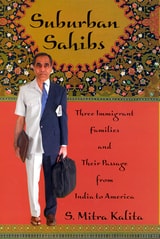
Suburban Sahibs
Kalita, S. Mitra
Rutgers University Press, 2003
In this updated edition, journalist S. Mitra Kalita shows that although the reception from long-time residents has not been entirely welcoming, Indians have come to achieve economic success and their desire for political and social parity continues to grow stronger. She traces the evolution of the suburb from a destination for new arrivals to a launching pad for them.
In the late nineteenth century, tourists descended upon Edison to gawk at its Christmas lights displays. Today, thousands of Indians from all over the United States arrive in the same bedroom community to celebrate their own festivals of lights and colors. Suburban Sahibs attempts to answer the question of how and why they arrived, and offers a window into what America has become: a nation of suburbs as well as a nation of immigrants.

Teenage Wasteland
Suburbia's Dead End KidsDonna Gaines
University of Chicago Press, 1998
"A powerful book."—Samuel G. Freedman, New York Times Book Review
"[Gaines] sheds light on a poorly understood world and raises compelling questions about what society might do to help this alienated group of young people."—Ann Grimes, Washington Post Book World
"There is no comparable study of teenage suburban culture . . . and very few ethnographic inquiries written with anything like Gaines's native gusto or her luminous eye for detail."—Andrew Ross, Transition
"An outstanding case study. . . . Gaines shows how teens engage in cultural production and how such social agency is affected by economic transformations and institutional interventions."—Richard Lachman, Contemporary Sociology
"The best book on contemporary youth culture."—Rolling Stone