Results by title
42 books match the query 'Supreme Court'
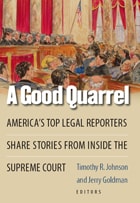
A Good Quarrel
America's Top Legal Reporters Share Stories from Inside the Supreme CourtTimothy R. Johnson and Jerry Goldman, Editors
University of Michigan Press, 2009
While reading what top legal reporters say about some of the most important U.S. Supreme Court oral arguments in recent history, go to www.goodquarrel.com to listen to audio and hear for yourself the very style and delivery of the oral arguments that have shaped the history of our nation's highest law. See Preface for full instructions.
Contributors
- Charles Bierbauer, CNN
- Lyle Denniston, scotusblog.com
- Fred Graham, Court TV
- Brent Kendall, Los Angeles Daily Journal
- Steve Lash, Houston Chronicle
- Dahlia Lithwick, Slate.com
- Tony Mauro, American Lawyer Media
- Tim O'Brien, ABC News
- David Savage, Los Angeles Times
- Greg Stohr, Bloomberg News
- Nina Totenberg, NPR
Timothy R. Johnson teaches in the Department of Political Science and the Law School at the University of Minnesota.
Jerry Goldman teaches political science at Northwestern University and directs the OYEZ Project, a multimedia archive devoted to the Supreme Court, at www.oyez.org.
Cover sketch by Dana Verkouteren
"Supreme Court oral arguments are good government in action. A Good Quarrel brilliantly showcases this important aspect of the Court's work."
---Paul Clement, Partner, King & Spalding, and former United States Solicitor General
"Few legal experiences are as exhilarating as a Supreme Court oral argument---a unique art form that this superb collection brings vividly to life."
---Kathleen Sullivan, Partner, Quinn Emanuel Urquhart Oliver and Hedges, and former Dean, Stanford Law School
"[A Good Quarrel] shines a brilliant spotlight on the pivotal moment of advocacy when the Supreme Court confronts the nation's most profound legal questions."
---Thomas C. Goldstein, Partner, Akin Gump, and Lecturer, Supreme Court Litigation, Harvard Law School and Stanford Law School
"A brilliant way to understand America's most important mysterious institution."
---Lawrence Lessig, Stanford Law School
A Year at the Supreme Court
Neal Devins and Davison M. Douglas, eds.
Duke University Press, 2004
Some essays consider the role of “swing” Justices Sandra Day O’Connor and Anthony Kennedy within a Court that divides 5–4 more than any other group of Justices in the nation’s history. Others examine the political reaction to and legal context of the Court’s Lawrence v. Texas decision declaring a Texas law criminalizing homosexual sodomy unconstitutional. Contributors analyze the Court’s rulings on affirmative action and reassess its commitment to states’ rights. Considering the Court’s practices, one advocate explores the use and utility of amicus curiae, or “friend of the court” briefs, while another reflects on indications of an increased openness by the Court to public scrutiny. Two advocates who argued cases before the Court—one related to hate speech and the other to a “three strikes and you’re out” criminal statute—offer vivid accounts of their experiences. Intended for general readers, A Year at the Supreme Court is for all those who want to understand the Rehnquist Court and its momentous 2002–03 term.
Contributors
Erwin Chemerinsky
Neal Devins
Davison M. Douglas
David J. Garrow
Dahlia Lithwick
Tony Mauro
Carter Phillips
Ramesh Ponnuru
Jeffrey Rosen
David G. Savage
Rodney A. Smolla
Stuart Taylor Jr.
A Year in the Life of the Supreme Court
Rodney A. Smolla, ed.
Duke University Press, 1995
The cases heard by the Supreme Court are, first and foremost, disputes involving real people with actual stories. The accidents and twists of circumstance that have brought these people to the last resort of litigation can make for compelling drama. The contributors to this volume bring these dramatic stories to life, using them as a backdrop for the larger issues of law and social policy that constitute the Court’s business: abortion, separation of church and state, freedom of speech, the right of privacy, crime, violence, discrimination, and the death penalty. In the course of these narratives, the authors describe the personalities and jurisprudential leanings of the various Justices, explaining how the interplay of these characters and theories about the Constitution interact to influence the Court’s decisions.
Highly readable and richly informative, this book offers an unusually clear and comprehensive portrait of one of the most influential institutions in modern American life.

Congress Versus the Supreme Court, 1957-1960
C. Herman Pritchett
University of Minnesota Press, 1961
Congress Versus the Supreme Court, 1957–1960 was first published in 1961. Minnesota Archive Editions uses digital technology to make long-unavailable books once again accessible, and are published unaltered from the original University of Minnesota Press editions.
This is an account of the effort made in the last two sessions of Congress to curb the Supreme Court because of certain liberal decisions of the Court, and an analysis of the reasons for the congressional failure. Many times in history Congress has objected to Court decisions and has tried to retaliate against the Court. The most recent period of difficulty traces back to the Court's school segregation decisions in 1954, but not until the Court took a liberal line in certain national security cases in 1956 and 1957 was an organized effort made in Congress to attack it. Professor Pritchett analyzes the specific decisions which aroused congressional concern and reviews the methods by which their reversal was sought. The failure of this effort to curb the Court is important to an understanding of the role of the Supreme Court in the American governmental system. This book is an expansion of the Guy Stanton Ford lectures given by Mr. Pritchett at the University of Minnesota.
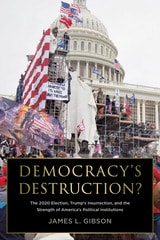
Democracy’s Destruction? Changing Perceptions of the Supreme Court, the Presidency, and the Senate after the 2020 Election
Changing Perceptions of the Supreme Court, the Presidency, and the Senate after the 2020 ElectionJames L. Gibson
Russell Sage Foundation, 2024
Focusing on the U.S. Supreme Court, the presidency, and the U.S. Senate, Gibson reveals that how people assessed the election, the insurrection, and even the second Trump impeachment has little connection to their willingness to view American political institutions as legitimate. Instead, legitimacy is grounded in more general commitments to democratic values and support for the rule of law. On most issues of institutional legitimacy, those who denied the election results and supported the insurrection were not more likely to be alienated from political institutions and to consider them illegitimate.
Gibson also investigates whether Black people might have responded differently to the events of the 2020 election and its aftermath. He finds that in comparison to the White majority, Black Americans were less supportive of America’s democratic institutions and of democratic values, such as reverence for the rule of law, because they often have directly experienced unfair treatment by legal authorities. But he emphasizes that the actions of Trump and his followers are not the cause of those weaker commitments.
Democracy’s Destruction? offers rigorous analysis of the effect of the Trump insurrection on the state of U.S. democracy today. While cautioning that Trump and many Republicans may be devising schemes to subvert the next presidential election more effectively, the book attests to the remarkable endurance of American political institutions.
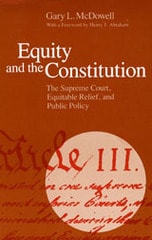
Equity and the Constitution
The Supreme Court, Equitable Relief, and Public PolicyGary L. McDowell
University of Chicago Press, 1982
In this volume, Gary McDowell considers the equity power created by Article III of the Constitution, on which the most controversial decisions of the Supreme Court have rested. He points out the equity was originally understood as an extraordinary means of offering relief to individuals in cases of fraud, accident, mistake, or trust and as a means of "confining the operation of unjust and partial laws." It has now been stretched to offer relief to broadly defined social classes. This "sociological" understanding, in McDowell's view, has undermined equity as a substantive body of law. He urges a return to the former definition as a means of restraining the reach of federal jurisdiction.
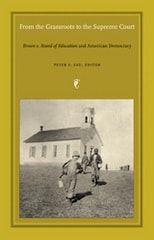
From the Grassroots to the Supreme Court
Brown v. Board of Education and American DemocracyPeter F. Lau, ed.
Duke University Press, 2004
The contributors illuminate the breadth of developments that led to Brown, from the parallel struggles for social justice among African Americans in the South and Mexican, Asian, and Native Americans in the West during the late nineteenth century to the political and legal strategies implemented by the National Association for the Advancement of Colored People (naacp) in the twentieth century. Describing the decision’s impact on local communities, essayists explore the conflict among African Americans over the implementation of Brown in Atlanta’s public schools as well as understandings of the ruling and its relevance among Puerto Rican migrants in New York City. Assessing the legacy of Brown today, contributors analyze its influence on contemporary law, African American thought, and educational opportunities for minority children.
Contributors
Tomiko Brown-Nagin
Davison M. Douglas
Raymond Gavins
Laurie B. Green
Christina Greene
Blair L. M. Kelley
Michael J. Klarman
Peter F. Lau
Madeleine E. Lopez
Waldo E. Martin Jr.
Vicki L. Ruiz
Christopher Schmidt
Larissa M. Smith
Patricia Sullivan
Kara Miles Turner
Mark V. Tushnet
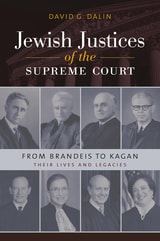
Jewish Justices of the Supreme Court
From Brandeis to KaganDavid G. Dalin
Brandeis University Press, 2017
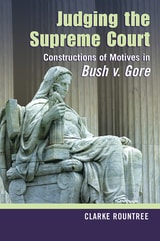
Judging the Supreme Court
Constructions of Motives in Bush v. GoreClarke Rountree
Michigan State University Press, 2007
This volume questions the motives of Supreme Court justices in a landmark case: The Supreme Court's intervention in the presidential election of 2000, and its subsequent decision in favor of George W. Bush, elicited immediate, heated, and widespread debate. Critics argued that the justices used weak legal arguments to overturn the Florida Supreme Court's ruling, ending a ballot recount and awarding the presidency to Bush. More fundamentally, they questioned the motives of conservative judges who arrived at a decision in favor of the candidate who reflected their political leanings.
Judging the Supreme Court examines this controversial case and the extensive attention it has received. To fully understand the case, Clarke Rountree argues, we must understand "judicial motives." These are comprised of more than each judge's personal opinions. Judges' motives, which Rountree calls "rhetorical performances," are as influential and publicly discussed as their decisions themselves. Before they are dissected in the media, judges' motives are carefully crafted by the decision- makers themselves, their critics, and their defenders. Justices consider not only the motives of the government, of military officials, of criminals, of public speakers, and of others, they also consider, construct, construe, spin, and deconstruct the motives of dissenters (whom they want to show are "misguided"), earlier courts, lower courts, and, especially, themselves.
Every judicial opinion is essentially a portrait of motives that says, "Here's what we did and here's why we did it." Well-constructed judicial motives reinforce the idea that we live under "the rule of law," while motives articulated less successfully raise questions about the legitimacy not just of individual judicial decisions but also of our political system and its foundation on an impartial judiciary. In Bush v. Gore, Rountree concludes, the judges of the majority opinion were not motivated by judicial concerns about law and justice, but rather by their own political and personal motives.
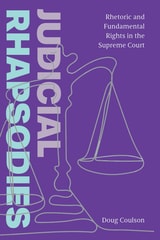
Judicial Rhapsodies
Rhetoric and Fundamental Rights in the Supreme CourtDoug Coulson
Amherst College Press, 2023
First examining the classical origins of divisions between law and rhetoric, Coulson tracks what he calls an epideictic register—highly affective forms of expression that utilize hyperbole, amplification, and vocabularies of praise—through a surprising number of landmark Supreme Court opinions. Judicial Rhapsodies recovers and revalues these instances as significant to establishing and maintaining shared perspectives that form the basis for common experience and cooperation.
“Judicial Rhapsodies is both compelling and important. Coulson brings his well-developed knowledge of rhetoric to bear on one of the most central (and most democratically fraught) means of governance in the United States: the Supreme Court opinion. He demonstrates that the epideictic, far from being a dispensable or detestable element of judicial rhetoric, is an essential feature of how the Court operates and seeks to persuade.” —Keith Bybee, Syracuse University
Law at the End of Life
The Supreme Court and Assisted SuicideCarl E. Schneider, Editor
University of Michigan Press, 2000
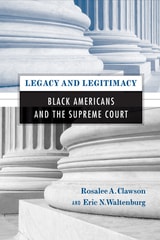
Legacy and Legitimacy
Black Americans and the Supreme CourtRosalee A. Clawson and Eric N. Waltenburg
Temple University Press, 2008
Thoroughly grounded in the latest scholarly literature, theoretical sources, and experimental results, Legacy and Legitimacy substantially advances understanding of Black Americans’ attitudes toward the Supreme Court, the Court’s ability to influence Blacks’ opinions about the legitimacy of public institutions and policies, and the role of media in shaping Blacks’ judgments.
Drawing on legitimacy theory—which explains the acceptance of or tolerance for controversial policies—the authors begin by reexamining the significance of “diffuse support” in establishing legitimacy. They provide a useful overview of the literature on legitimacy and a concise history of the special relationship between Blacks and the Court. They investigate the influences of group attitudes and media “framing.” And they employ data from large-scale surveys to show that Blacks with greater levels of diffuse support for the Court are more likely to adopt positions consistent with Court rulings.
With its broad scope and inclusion of new experimental findings, Legacy and Legitimacy will interest students and scholars of judicial politics, racial politics, media and politics, black studies and public opinion.
Like a Loaded Weapon
The Rehnquist Court, Indian Rights, and the Legal History of Racism in AmericaRobert Williams Jr.
University of Minnesota Press, 2005
Beginning with Chief Justice John Marshall’s foundational opinions in the early nineteenth century and continuing today in the judgments of the Rehnquist Court, Williams shows how undeniably racist language and precedent are still used in Indian law to justify the denial of important rights of property, self-government, and cultural survival to Indians. Building on the insights of Malcolm X, Thurgood Marshall, and Frantz Fanon, Williams argues that racist language has been employed by the courts to legalize a uniquely American form of racial dictatorship over Indian tribes by the U.S. government.
Williams concludes with a revolutionary proposal for reimagining the rights of American Indians in international law, as well as strategies for compelling the current Supreme Court to confront the racist origins of Indian law and for challenging bigoted ways of talking, thinking, and writing about American Indians.
Robert A. Williams Jr. is professor of law and American Indian studies at the James E. Rogers College of Law, University of Arizona. A member of the Lumbee Indian Tribe, he is author of The American Indian in Western Legal Thought: The Discourses of Conquest and coauthor of Federal Indian Law.
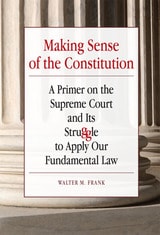
Making Sense of the Constitution
A Primer on the Supreme Court and Its Struggle to Apply Our Fundamental LawWalter M. Frank
Southern Illinois University Press, 2012
In Making Sense of the Constitution: A Primer on the Supreme Court and Its Struggle to Apply Our Fundamental Law, Walter Frank tackles in a comprehensive but lively manner subjects rarely treated in one volume.
Aiming at both the general reader and students of political science, law, or history, Frank begins with a brief discussion of the nature of constitutional law and why the Court divides so closely on many issues. He then proceeds to an analysis of the Constitution and subsequent amendments, placing them in their historical context. Next, Frank shifts to the Supreme Court and its decisions, examining, among other things, doctrinal developments, the Court’s decision making processes, how justices interact with each other, and the debate over how the Constitution should be interpreted.
The work concludes with a close analysis of Court decisions in six major areas of continuing controversy, including abortion, affirmative action, and campaign finance.
Outstanding by the University Press Books for Public and Secondary Schools
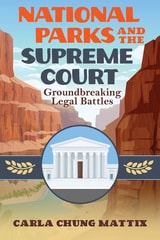
National Parks and the Supreme Court
Groundbreaking Legal BattlesCarla Chung Mattix
University of Nevada Press, 2026
This book examines five landmark Supreme Court cases involving national parks—Gettysburg, Yellowstone, Grand Canyon, Death Valley, and the National Mall. Each chapter blends legal analysis with historical context, tracing the origins of the parks and the disputes that brought them before the nation’s highest court. Spanning nearly a century, these cases reveal how the Court has shaped park policy, land use, Native American rights, water law, and free speech.
Through these pivotal decisions, National Parks and the Supreme Court offers a new lens on the contested terrain of the national parks, where legal, environmental, and cultural values collide. By exploring the courts’ influence on public lands, it deepens our understanding of the complexities of managing America’s most cherished landscapes.
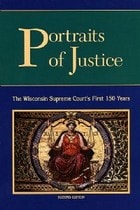
Portraits of Justice
The Wisconsin Supreme Court's First 150 YearsTrina E. Gray
Wisconsin Historical Society Press, 2003
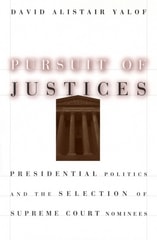
Pursuit of Justices
Presidential Politics and the Selection of Supreme Court NomineesDavid Alistair Yalof
University of Chicago Press, 1999
Yalof draws on the papers of seven modern presidents, from Truman to Reagan, and firsthand interviews with key figures, such as Ramsey Clark, Edwin Meese, and President Gerald Ford. He documents and analyzes the selection criteria these presidents used, the pool of candidates from which they chose, their strategies, and the political pressures affecting their decisions, both successes and failures. Yalof also disputes much conventional wisdom about the selection process, including the widely held view that presidents choose nominees primarily to influence future decisions of the high court. In a substantial epilogue, Yalof offers insightful observations about the selections of Presidents George Bush and Bill Clinton.
By focusing on a neglected area of presidential politics, Yalof offers a fascinating and unprecedented glimpse into the intricate world of executive branch decisionmaking and the Supreme Court appointment process as a whole.
Winner of the 2000 Richard E. Neustadt Award for Best Book on the American Presidency
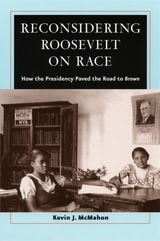
Reconsidering Roosevelt on Race
How the Presidency Paved the Road to BrownKevin J. McMahon
University of Chicago Press, 2003
McMahon shows how FDR's attempt to strengthen the presidency and undermine the power of conservative Southern Democrats dovetailed with his efforts to seek racial equality through the federal courts. By appointing a majority of rights-based liberals deferential to presidential power, Roosevelt ensured that the Supreme Court would be receptive to civil rights claims, especially when those claims had the support of the executive branch.
Reconstructing Reconstruction
The Supreme Court and the Production of Historical TruthPamela Brandwein
Duke University Press, 1999
Delving into the circumstances, assumptions, and rhetoric that shaped the “official” story of Reconstruction, Brandwein describes precisely how a dominant interpretation of events ultimately emerged and what its implications have been for twentieth-century judicial decisions, particularly for Supreme Court rulings on civil rights. While analyzing interpretive disputes about slavery, Brandwein offers a detailed rescoring of post–Civil War legislative and constitutional history, including analysis of the original understanding of the Fourteenth Amendment. She identifies the perspectives on Reconstruction that were endorsed or rejected by the Supreme Court. Explaining what it meant—theoretically and practically—to resolve Reconstruction debates with a particular definition of slavery, Brandwein recounts how the Northern Democratic definition of “ending” slavery was not the only definition, just the one that prevailed. Using a familiar historical moment to do new interpretive work, she outlines a sociology of constitutional law, showing how subjective narrative construction can solidify into opaque institutional memory.
Regulatory Rights
Supreme Court Activism, the Public Interest, and the Making of Constitutional LawLarry Yackle
University of Chicago Press, 2007
Traversing a wide range of Supreme Court decisions that established crucial precedents about racial discrimination, the death penalty, and sexual freedom, Yackle contends that the rights we enjoy are neither more nor less than what the justices choose to make of them. Regulatory Rights is a bracing read that will be heatedly debated by all those interested in constitutional law and the judiciary.
Representation Rights and the Burger Years
Nancy Maveety
University of Michigan Press, 1991
Supreme Court Decision-Making
New Institutionalist ApproachesEdited by Cornell W. Clayton and Howard Gillman
University of Chicago Press, 1998
Drawing on interpretive-historical institutionalism as well as rational choice theory, a group of leading scholars consider such factors as the influence of jurisprudence, the unique characteristics of supreme courts, the dynamics of coalition building, and the effects of social movements. The volume's distinguished contributors and broad range make it essential reading for those interested either in the Supreme Court or the nature of institutional politics.
Original essays contributed by Lawrence Baum, Paul Brace, Elizabeth Bussiere, Cornell Clayton, Sue Davis, Charles Epp, Lee Epstein, Howard Gillman, Melinda Gann Hall, Ronald Kahn, Jack Knight, Forrest Maltzman, David O'Brien, Jeffrey Segal, Charles Sheldon, James Spriggs II, and Paul Wahlbeck.
Supreme Court and Judicial Choice
The Role of Provisional Review in a DemocracyPaul R. Dimond
University of Michigan Press, 1989
Supreme Court and Judicial Choice
The Role of Provisional Review in a DemocracyPaul R. Dimond
University of Michigan Press, 1989
The American Supreme Court
Robert G. McCloskey
University of Chicago Press, 2000
As in the second edition, McCloskey's original text remains unchanged. In his historical interpretation, he argues that the strength of the Court has always been its sensitivity to the changing political scene, as well as its reluctance to stray too far from the main currents of public sentiments. In two new chapters, Levinson discusses the Court's more recent role, especially during the 1960s, as protector of the civil rights and liberties of minorities. He updates as well the Court's continuing role as monitor of the welfare state, looking at the litigation following the 1996 changes in welfare policy by Congress and the President. Also covered in this new edition are the recent Court decisions on federalism, which perhaps portend an enhanced role for the court as the "umpire" of the federal system; the clash between Congress and the Court over the scope of the required accommodation by government of religious conduct; and the Court's role in the impeachment of President Clinton.
Wonderfully readable and concisely written, McCloskey's book is an essential guide to the past, present, and future prospects of America's highest court.
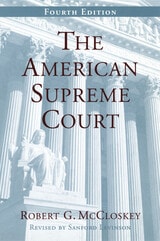
The American Supreme Court
Robert G. McCloskey
University of Chicago Press, 2004
As in previous editions, McCloskey's original text remains unchanged. He argues that the Court's strength has always been its sensitivity to the changing political scene, as well as its reluctance to stray too far from the main currents of public sentiment. Levinson's two new chapters show how McCloskey's approach continues to illuminate recent developments, such as the Court's seeming return to its pre-1937 role as "umpire" of the federal system. It is in Bush v. Gore, however, where the implications of McCloskey's interpretation stand out most clearly.
The best and most concise account of the Supreme Court and its place in American politics, McCloskey's wonderfully readable book is an essential guide to its past, present, and future prospects of this institution.
The Assault on American Labor Law
Unions Before the Supreme Court, 1965–2025Roger C. Hartley
University of Massachusetts Press, 2025
Reviewing the dismantling of American labor law in more than 100 Supreme Court cases
The National Labor Relations Act (NLRA), signed into law by Franklin Delano Roosevelt in 1935, guarantees the right of private sector employees to organize into trade unions, engage in collective bargaining, and take collective action such as strikes. Since its passage, the NLRA has functioned as the foundational statute of United States labor law. Opposed by conservatives and members of the Republican Party from the beginning, its provisions were largely upheld by the Supreme Court until the 1960s. In the latter part of the twentieth century and into the twenty-first, however, the Court began to erode the protections of the NLRA. While some cases have received widespread attention from commentators and scholars, such as Starbucks Corp. v. McKinney (2024), there have been numerous detrimental rulings that are little discussed. Taken as a whole, the Supreme Court’s efforts to undermine the NLRA appear sustained and systematic.
In The Assault on American Labor Law, distinguished labor law professor Roger C. Hartley collects and carefully reviews every Supreme Court decision concerning the NLRA over the past sixty years. By examining approximately 100 cases, Hartley demonstrates that the Court has often operated more like a legislature than a judicial body, effectively amending the NLRA’s collectivist policy underpinnings in favor of the interests of individuals and businesses. These judicial decisions create staggering obstacles for American workers to collectively organize and force them to face globalization, deindustrialization, and technological change individually, without the negotiating leverage provided by union representation. While scholars have suggested individual reforms to re-establish the efficacy of the NLRA, Hartley’s thorough study illuminates how the current crisis in US labor law evolved—a comprehensive view that is necessary to help restore the rights of workers to unionize.

The Collected Works of William Howard Taft, Volume V
Popular Government and The Anti-trust Act and the Supreme CourtDavid H. Burton
Ohio University Press, 2003
The fifth volume of The Complete Works of William Howard Taft presents two publications Taft wrote as Kent Professor of Constitutional Law at Yale University, the position he assumed in 1913 after he was defeated in his bid for re-election as U.S. president. The first, Popular Government, was prepared for a series of lectures, but was motivated by Taft’s passion over the issue of constitutional interpretation, which had been hotly contested during the campaign. Organized around the preamble of the Constitution, the lectures and later the book were opportunities for Taft to restate his opposition to the direct democracy movement and to reveal the workings of a conservative mind.
In the second, The Anti-trust Act and the Supreme Court, Taft articulates his position in the ongoing debate over the conventional nineteenth-century notion of “laissez faire” and the provisions of the Sherman Antitrust Act. Taft had pursued a policy of vigorous antitrust enforcement during his presidency. In this book he intended to demonstrate that restraint of trade was part of the common law, thereby arguing to good effect in favor of reasonable restraint of trade in his own time.
Taft's careful distinction between predatory monopolistic practices and the reasonable business practices of well-behaved corporations continues to inform today's chambers of government.
The Congressional Black Caucus, Minority Voting Rights, and the U.S. Supreme Court
Christina R. Rivers
University of Michigan Press, 2014
Both the U.S. Supreme Court and the Congressional Black Caucus (CBC) claim to advocate minority political interests, yet they disagree over the intent and scope of the Voting Rights Act (VRA), as well as the interpretation of the equal protection clause of the 14th Amendment. Whereas the Court promotes color-blind policies, the CBC advocates race-based remedies. Setting this debate in the context of the history of black political thought, Rivers examines a series of high-profile districting cases, from Rodgers v. Lodge (1982) through NAMUDNO v. Holder (2009). She evaluates the competing approaches to racial equality and concludes, surprisingly, that an originalist, race-conscious interpretation of the 14th Amendment, along with a revised states' rights position regarding electoral districting, may better serve minority political interests.
The Constitution in the Supreme Court
The First Hundred Years, 1789-1888David P. Currie
University of Chicago Press, 1985
"A thorough, systematic, and careful assessment. . . . As a reference work for constitutional teachers, it is a gold mine."—Charles A. Lofgren, Constitutional Commentary
The Constitution in the Supreme Court
The Second Century, 1888-1986David P. Currie
University of Chicago Press, 1990
"Elegant and readable. Whether you are in favor of judicial restraint or judicial activism, whatever your feelings about the Warren Court, or the Renquist Court, this is a book that justifies serious study."—Robert Stevens, New York Times Book Review
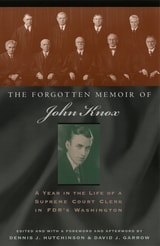
The Forgotten Memoir of John Knox
A Year in the Life of a Supreme Court Clerk in FDR's WashingtonJohn Knox
University of Chicago Press, 2002
When John Frush Knox (1907-1997) wrote these words, he was in the middle of law school, and his attempt at surpassing Pepys—part scrapbook, part social commentary, and part recollection—had already reached 750 pages. His efforts as a chronicler might have landed in a family attic had he not secured an eminent position after graduation as law clerk to Justice James C. McReynolds—arguably one of the most disagreeable justices to sit on the Supreme Court—during the tumultuous year when President Franklin D. Roosevelt tried to "pack" the Court with justices who would approve his New Deal agenda. Knox's memoir instead emerges as a record of one of the most fascinating periods in American history.
The Forgotten Memoir of John Knox—edited by Dennis J. Hutchinson and David J. Garrow—offers a candid, at times naïve, insider's view of the showdown between Roosevelt and the Court that took place in 1937. At the same time, it marvelously portrays a Washington culture now long gone. Although the new Supreme Court building had been open for a year by the time Knox joined McReynolds' staff, most of the justices continued to work from their homes, each supported by a small staff. Knox, the epitome of the overzealous and officious young man, after landing what he believes to be a dream position, continually fears for his job under the notoriously rude (and nakedly racist) justice. But he soon develops close relationships with the justice's two black servants: Harry Parker, the messenger who does "everything but breathe" for the justice, and Mary Diggs, the maid and cook. Together, they plot and sidestep around their employer's idiosyncrasies to keep the household running while history is made in the Court.
A substantial foreword by Dennis Hutchinson and David Garrow sets the stage, and a gallery of period photos of Knox, McReynolds, and other figures of the time gives life to this engaging account, which like no other recaptures life in Washington, D.C., when it was still a genteel southern town.
The Great Justices, 1941-54
Black, Douglas, Frankfurter, and Jackson in ChambersWilliam Domnarski
University of Michigan Press, 2006
This is rare and little-examined territory: in the public consciousness the Supreme Court is usually seen as an establishment whose main actors, the justices, remain above emotion, vitriol, and gossip, the better to interpret our nation of laws. Yet the Court's work is always an interchange of ideas and individuals, and the men and women who make up the Court, despite or because of their best intentions, are as human as the rest of us. Appreciating that human dimension helps us to discover some of the Court's secrets, and a new way to understand the Court and its role.
Comparing four brilliant but very different jurists of the Roosevelt Court-Hugo Black, William O. Douglas, Felix Frankfurter, and Robert Jackson-William Domnarski paints a startling picture of the often deeply ambiguous relationship between ideas and reality, between the law and the justices who interpret and create it. By pulling aside the veil of decorous tradition, Domnarski brings to light the personalities that shaped one of the greatest Courts of our time-one whose decisions continue to affect judicial thinking today.
William Domnarski is the author of In the Opinion of the Court (1996), a study of the history and nature of federal court judicial opinions. He holds a J.D. from the University of Connecticut and a Ph.D. in English from the University of California. Domnarski currently practices law in California, where he is also working on a forthcoming biography of legendary Hollywood lawyer Bert Fields.
The Most Activist Supreme Court in History
The Road to Modern Judicial ConservatismThomas M. Keck
University of Chicago Press, 2004
Ranging from 1937 to the present, The Most Activist Supreme Court in History traces the legal and political forces that have shaped the modern Court. Thomas M. Keck argues that the tensions within modern conservatism have produced a court that exercises its own power quite actively, on behalf of both liberal and conservative ends. Despite the long-standing conservative commitment to restraint, the justices of the Rehnquist Court have stepped in to settle divisive political conflicts over abortion, affirmative action, gay rights, presidential elections, and much more. Keck focuses in particular on the role of Justices O'Connor and Kennedy, whose deciding votes have shaped this uncharacteristically activist Court.
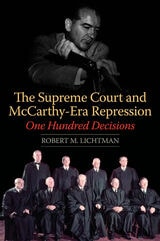
The Supreme Court and McCarthy-Era Repression
One Hundred DecisionsRobert M. Lichtman
University of Illinois Press, 2015

The Supreme Court and Patents and Monopolies
Edited by Philip B. Kurland
University of Chicago Press, 1975
The Supreme Court and the Judicial Function
Edited by Philip B. Kurland
University of Chicago Press, 1976
The Supreme Court and the NCAA
The Case for Less Commercialism and More Due Process in College SportsBrian L. Porto
University of Michigan Press, 2013
Two Supreme Court decisions, NCAA v. Board of Regents (1984) and NCAA v. Tarkanian (1988), have shaped college sports by permitting the emergence of a supercharged commercial enterprise with high financial stakes for institutions and individuals, while failing to guarantee adequate procedural protections for persons charged with wrongdoing within that enterprise. Brian L. Porto examines the conditions that led to the cases, the reasoning behind the justices' rulings, and the consequences of those rulings.
Arguing that commercialized college sports should be compatible with the goals of higher education and fair to all participants, Porto suggests that the remedy is a federal statute. His proposed College Sports Legal Reform Act would grant the NCAA a limited "educational exemption" from the antitrust laws, enabling it to enhance academic opportunities for athletes. The Act would also afford greater procedural protections to accused parties in NCAA disciplinary proceedings. Porto's prescription for reform in college sports makes a significant contribution to the debate about how best to address perennial problems in college sports such as cost containment, access to a meaningful education for athletes, and fairness in rule enforcement.
The Supreme Court and the Press
The Indispensable ConflictJoe Mathewson
Northwestern University Press, 2011
The Supreme Court on Trial
How the American Justice System Sacrifices Innocent DefendantsGeorge C. Thomas III
University of Michigan Press, 2011
The chief mandate of the criminal justice system is not to prosecute the guilty but to safeguard the innocent from wrongful convictions; with this startling assertion, legal scholar George Thomas launches his critique of the U.S. system and its emphasis on procedure at the expense of true justice.
Thomas traces the history of jury trials, an important component of the U.S. justice system, since the American Founding. In the mid-twentieth century, when it became evident that racism and other forms of discrimination were corrupting the system, the Warren Court established procedure as the most important element of criminal justice. As a result, police, prosecutors, and judges have become more concerned about following rules than about ensuring that the defendant is indeed guilty as charged. Recent cases of prisoners convicted of crimes they didn't commit demonstrate that such procedural justice cannot substitute for substantive justice.
American justices, Thomas concludes, should take a lesson from the French, who have instituted, among other measures, the creation of an independent court to review claims of innocence based on new evidence. Similar reforms in the United States would better enable the criminal justice system to fulfill its moral and legal obligation to prevent wrongful convictions.
"Thomas draws on his extensive knowledge of the field to elaborate his elegant and important thesis---that the American system of justice has lost sight of what ought to be its central purpose---protection of the innocent."
—Susan Bandes, Distinguished Research Professor of Law, DePaul University College of Law
"Thomas explores how America's adversary system evolved into one obsessed with procedure for its own sake or in the cause of restraining government power, giving short shrift to getting only the right guy. His stunning, thought-provoking, and unexpected recommendations should be of interest to every citizen who cares about justice."
—Andrew E. Taslitz, Professor of Law, Howard University School of Law
"An unflinching, insightful, and powerful critique of American criminal justice---and its deficiencies. George Thomas demonstrates once again why he is one of the nation's leading criminal procedure scholars. His knowledge of criminal law history and comparative criminal law is most impressive."
—Yale Kamisar, Distinguished Professor of Law, University of San Diego and Clarence Darrow Distinguished University Professor Emeritus of Law, University of Michigan
The Vote
Bush, Gore, and the Supreme CourtEdited by Cass R. Sunstein and Richard A. Epstein
University of Chicago Press, 2001
The contributors to this volume were highly visible in the national media while the controversy raged, and here they present fully fleshed-out arguments for the positions they promoted on the airwaves. Readers will find in The Vote equally impassioned defenses for and indictments of the Court's actions, and they will come to understand the practical and theoretical implications of the Court's ruling in the realms of both law and politics. No doubt a spate of books will appear on the 2000 presidential election, but none will claim as distinguished a roster of contributors better qualified to place these recent events in their appropriate historical, legal, and political contexts.
Leading constitutional scholars render their verdicts on the 2000 presidential election controversy
Contributors:
Richard A. Epstein
Elizabeth Garrett
Samuel Issacharoff
Pamela S. Karlan
Michael W. McConnell
Frank I. Michelman
Richard H. Pildes
Richard A. Posner
David A. Strauss
Cass R. Sunstein
John Yoo
An earlier electronic edition of The Vote was available on the University of Chicago Press Web site.
White But Not Equal
Mexican Americans, Jury Discrimination, and the Supreme CourtIgnacio M. García
University of Arizona Press, 2008
Ignacio García’s White But Not Equal explores this historic but mostly forgotten case, which became the first to recognize discrimination against Mexican Americans. Led by three dedicated Mexican American lawyers, the case argued for recognition of Mexican Americans under the 14th Amendment as a “class apart.” Despite a distinct history and culture, Mexican Americans were considered white by law during this period, yet in reality they were subjected to prejudice and discrimination. This was reflected in Hernández’s trial, in which none of the selected jurors were Mexican American. The concept of Latino identity began to shift as the demand for inclusion in the political and judicial system began.
García places the Hernández v. Texas case within a historical perspective and examines the changing Anglo-Mexican relationship. More than just a legal discussion, this book looks at the whole case from start to finish and examines all the major participants, placing the story within the larger issue of the fight for Mexican American civil rights.