Results by title
12 books match the query 'Teacher-student relationships'
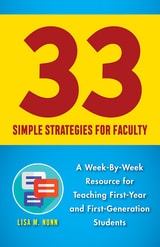
33 Simple Strategies for Faculty
A Week-by-Week Resource for Teaching First-Year and First-Generation StudentsNunn, Lisa M
Rutgers University Press, 2019
Many students struggle with the transition from high school to university life. This is especially true of first-generation college students, who are often unfamiliar with the norms and expectations of academia. College professors usually want to help, but many feel overwhelmed by the prospect of making extra time in their already hectic schedules to meet with these struggling students.
33 Simple Strategies for Faculty is a guidebook filled with practical solutions to this problem. It gives college faculty concrete exercises and tools they can use both inside and outside of the classroom to effectively bolster the academic success and wellbeing of their students. To devise these strategies, educational sociologist Lisa M. Nunn talked with a variety of first-year college students, learning what they find baffling and frustrating about their classes, as well as what they love about their professors’ teaching.
Combining student perspectives with the latest research on bridging the academic achievement gap, she shows how professors can make a difference by spending as little as fifteen minutes a week helping their students acculturate to college life. Whether you are a new faculty member or a tenured professor, you are sure to find 33 Simple Strategies for Faculty to be an invaluable resource.
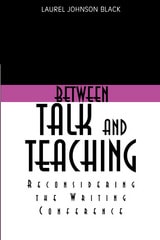
Between Talk And Teaching
Reconsidering the Writing ConferenceLaurel Johnson Black
Utah State University Press, 1998
The teacher-student conference is standard in the repertoire of teachers at all levels. Because it's a one-to-one encounter, teachers work hard to make it comfortable; but because it's a pedagogical moment, they hope that learning occurs in the encounter, too. The literature in this area often suggests that a conference is a conversation, but this doesn't account for a teacher's need to use it pedagogically. Laurel Johnson Black's new book explores the conflicting meanings and relations embedded in conferencing and offers a new theoretical understanding of the conference along with practical approaches to conferencing more effectively with students.
Analyzing taped conferences of several different teachers and students, Black considers the influence that power, gender, and culture can have on a conference. She draws on sociolinguistic theory, as well as critical theory in composition and rhetoric, to build an understanding of the writing conference as an encounter somewhere between conversation and the classroom. She finds neither the conversation model nor versions of the master-apprentice model satisfactory. Her approach is humane, student-centered, and progressive, but it does not ignore the valid pedagogical purposes a teacher might have in conferencing. Between Talk and Teaching will be a valuable addition to the professional library of writing teachers and writing program administrators.

College Belonging
How First-Year and First-Generation Students Navigate Campus LifeLisa M. Nunn
Rutgers University Press, 2021
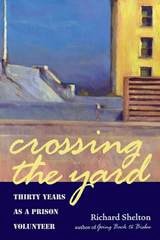
Crossing the Yard
Thirty Years as a Prison VolunteerRichard Shelton
University of Arizona Press, 2007
Richard Shelton was a young English professor in 1970 when a convict named Charles Schmid—a serial killer dubbed the “Pied Piper of Tucson” in national magazines—shared his brooding verse. But for Shelton, the novelty of meeting a death-row monster became a thirty-year commitment to helping prisoners express themselves. Shelton began organizing creative writing workshops behind bars, and in this gritty memoir he offers up a chronicle of reaching out to forgotten men and women—and of creativity blossoming in a repressive environment. He tells of published students such as Paul Ashley, Greg Forker, Ken Lamberton, and Jimmy Santiago Baca who have made names for themselves through their writing instead of their crimes. Shelton also recounts the bittersweet triumph of seeing work published by men who later met with agonizing deaths, and the despair of seeing the creative strides of inmates broken by politically motivated transfers to private prisons. And his memoir bristles with hard-edged experiences, ranging from inside knowledge of prison breaks to a workshop conducted while a riot raged outside a barricaded door. Reflecting on his decision to tutor Schmid, Shelton sees that the choice “has led me through bloody tragedies and terrible disappointments to a better understanding of what it means to be human.”
Crossing the Yard is a rare story of professional fulfillment—and a testament to the transformative power of writing.

Excavation
A MemoirWendy C. Ortiz
Northwestern University Press, 2025
A darkly vibrant and daring memoir, Wendy C. Ortiz’s Excavation challenged the standard telling of abuse narratives when first published in 2014; over a decade later, it remains deeply prescient. Set in Los Angeles’s San Fernando Valley in the late 1980s, the narrative follows the spiraling entanglement between Wendy and her eighth-grade English teacher as she becomes both victim to and participant in a simultaneously predatorial and impassioned relationship. Baited by initial praise and a false sense of control, Wendy tumbles into a dangerous dynamic that spans the duration of her teens. Artfully constructed from her own journals and decades of personal excavation, the story of this secret relationship has imprinted on Wendy and readers alike. A stunningly honest look at memory, agency, and power, Excavation will claim your whole heart.
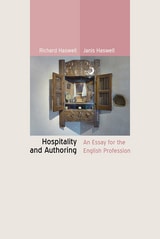
Hospitality and Authoring
An Essay for the English ProfessionRichard Haswell
Utah State University Press, 2015
Hospitality and Authoring, a sequel to the Haswells’ 2010 volume Authoring, attempts to open the path for hospitality practice in the classroom, making a strong argument for educational use and offering an initial map of the territory for teachers and authors.
Hospitality is a social and ethical relationship not only between host and guest but also between writer and reader or teacher and student. Hospitality initiates, maintains, and completes acts of authoring. This extended essay explores the ways that a true hospitable classroom community can be transformed through assigned reading, one-on-one conferencing, interpretation, syllabus, reading journals, topic choice, literacy narrative, writing centers, program administration, teacher training, and many other passing habitations.
Hospitality and Authoring strives to offer a few possibilities of change to help make college an institution where singular students and singular teachers create a room to learn with room to learn.
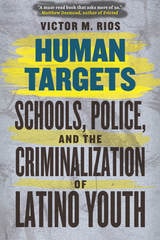
Human Targets
Schools, Police, and the Criminalization of Latino YouthVictor M. Rios
University of Chicago Press, 2017
In Human Targets, Rios takes us to the streets of California, where we encounter young men who find themselves in much the same situation as fifteen-year-old Victor. We follow young gang members into schools, homes, community organizations, and detention facilities, watch them interact with police, grow up to become fathers, get jobs, get rap sheets—and in some cases get killed. What is it that sets apart young people like Rios who succeed and survive from the ones who don’t? Rios makes a powerful case that the traditional good kid/bad kid, street kid/decent kid dichotomy is much too simplistic, arguing instead that authorities and institutions help create these identities—and that they can play an instrumental role in providing young people with the resources for shifting between roles. In Rios’s account, to be a poor Latino youth is to be a human target—victimized and considered an enemy by others, viewed as a threat to law enforcement and schools, and burdened by stigma, disrepute, and punishment. That has to change.
This is not another sensationalistic account of gang bangers. Instead, the book is a powerful look at how authority figures succeed—and fail—at seeing the multi-faceted identities of at-risk youths, youths who succeed—and fail—at demonstrating to the system that they are ready to change their lives. In our post-Ferguson era, Human Targets is essential reading.
Mutuality in the Rhetoric and Composition Classroom
David L. Wallace and Helen Rothschild Ewald
Southern Illinois University Press, 2000
In Mutuality in the Rhetoric and Composition Classroom, David L. Wallace and Helen Rothschild Ewald point out the centrality of rhetoric in the academy, asserting the intimate connection between language and knowledge making. They also stress the need for a change in the roles of teachers and students in today’s classroom. Their goal is mutuality, a sharing of authority among teachers and students in the classroom that would allow everyone an equal voice in the communication of ideas.
Arguing that the impetus to empower students by engaging them in liberatory and emancipatory pedagogies is simply not enough, Wallace and Ewald seek to “help readers identify, theorize, and work through problems faced by teachers who already value alternative approaches but who are struggling to implement them in the classroom." It is not the teacher’s job merely to convey a received body of knowledge, nor is knowledge a prepackaged commodity to be delivered by the teacher. It is “constituted in the classroom through the dialogic interaction between teachers and students alike.”
Wallace and Ewald see mutuality as potentially transformative, but they “do not believe that the nature or that transformation can be designated in advance.” Rather it is located in the interaction between teachers and students. Wallace and Ewald look at how the transformative notion of mutuality can be effected in classrooms in three important ways: reconstituting classroom speech genres, redesigning the architecture of rhetoric and writing courses, and valuing students’ interpretive agency in classroom discourse. Mutuality in alternative pedagogy, they assert, is neither a single approach nor a specific set of valued practices; it is a continuous collaboration between teachers and students.
Notes on the Heart
Affective Issues in the Writing ClassroomSusan H. McLeod
Southern Illinois University Press, 1997
It has long been recognized that affect (that is, the noncognitive aspect of mental activity) plays a large role in writing and in learning to write. According to Susan H. McLeod, however, the model that has been most used for empirical research on the writing process is based on cognitive psychology and does not take into account affective phenomena. Nor does the social constructionist view of the writing process acknowledge the affective realm except in a very general way. To understand the complete picture, McLeod insists, we need to explore how cognitive, affective, and social elements interact as people write.
In this book, McLeod follows a group of students through a semester of writing assignments, tracking the students’ progress and examining the affective elements relevant to their writing. To facilitate future discussion of these phenomena, McLeod also provides suggested definitions for terms in the affective domain.
In a very real sense, this book is the result of a collaboration of three Susans: Susan McLeod, who researched and wrote the book; Sue Hallett, an instructor in Washington State University’s composition program whose classes McLeod observed and who helped provide much of the data; and Susan Parker, a graduate student who observed Hallett’s class and who ran a tutorial connected to that class. To provide a narrative structure, McLeod and her two collaborators have constructed a simulated semester, conflating the year and a half of the study into one semester and creating a class that is a composite drawn from seven classrooms over three semesters.
Although philosophers have had much to say about the affective domain, Notes on the Heart is based for the most part on research from the social sciences. Discussions of pedagogy, while meant to have practical value, are suggestive rather than prescriptive. The goal is to help teachers see their practice in new way.
Teachers will be particularly interested in McLeod’s discussion of teacher affect/effect. This section examines both the issue of the "Pygmalion effect" (students becoming better because the teacher believes they are) and perhaps the more common opposite, the "golem effect" (students becoming less capable because their teachers view them that way).
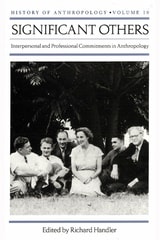
Significant Others
Interpersonal and Professional Commitments in AnthropologyEdited by Richard Handler
University of Wisconsin Press, 2004
The Graduate Advisor Handbook
A Student-Centered ApproachBruce M. Shore
University of Chicago Press, 2014
One of the first books to approach advising from the advisor’s point of view, the handbook highlights the importance of a partnership in which both parties need to be invested. Shore emphasizes the interpersonal relationships at the heart of advising and reveals how advisors can draw on their own strengths to create a rewarding rapport.
The Graduate Advisor Handbook moves chronologically through the advising process, from the first knock on the door to the last reference letter. Along the way it covers transparent communication, effective motivation, and cooperative troubleshooting. Its clear-eyed approach also tackles touchy subjects, including what to do when personal boundaries are crossed and how to deliver difficult news. Sample scripts help advisors find the right words for even the toughest situations.
With resources dwindling and student and advising loads increasing, graduate advisors need all the resources they can find to give their students the help they need. The Graduate Advisor Handbook has the cool-headed advice and comprehensive coverage that advisors need to make the advising relationship not just effective but also enjoyable.
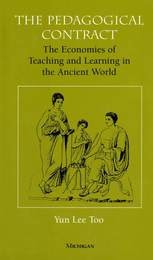
The Pedagogical Contract
The Economies of Teaching and Learning in the Ancient WorldYun Lee Too
University of Michigan Press, 2000