Results by title

6 books match the query 'Teleology'
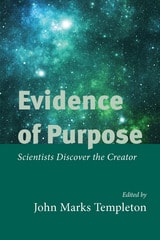
cover of Evidence Of Purpose: Scientists Discover The Creator

Evidence Of Purpose

Scientists Discover The Creator

John Marks Templeton

Templeton Press, 1996
For nearly a century, the central theological message of science seemed to be that there was no need for theology: science could stand alone to explain the universe. But today, that message is changing. In this volume, a gallery of respected scientists describes new developments in their fields and their relationship with theological views of the universe. Contributors include Owen Gingerich, Russell Stannard, Paul Davies, Walter R. Hearn, Robert Russell, Arthur Peacocke, John Polkinghorne, John C. Eccles, Daniel H. Osmond, and David Wilcox.
[more]
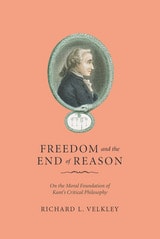
cover of Freedom and the End of Reason: On the Moral Foundation of Kant's Critical Philosophy

Freedom and the End of Reason

On the Moral Foundation of Kant's Critical Philosophy

Richard L. Velkley

University of Chicago Press, 1989
In Freedom and the End of Reason, Richard L. Velkley offers an influential interpretation of the central issue of Kant’s philosophy and an evaluation of its position within modern philosophy’s larger history. He persuasively argues that the whole of Kantianism—not merely the Second Critique—focuses on a “critique of practical reason” and is a response to a problem that Kant saw as intrinsic to reason itself: the teleological problem of its goodness. Reconstructing the influence of Rousseau on Kant’s thought, Velkley demonstrates that the relationship between speculative philosophy and practical philosophy in Kant is far more intimate than generally has been perceived. By stressing a Rousseau-inspired notion of reason as a provider of practical ends, he is able to offer an unusually complete account of Kant’s idea of moral culture.
[more]
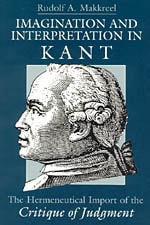
cover of Imagination and Interpretation in Kant: The Hermeneutical Import of the Critique of Judgment

Imagination and Interpretation in Kant

The Hermeneutical Import of the Critique of Judgment

Rudolf A. Makkreel

University of Chicago Press, 1990
In this illuminating study of Kant's theory of imagination and its role in interpretation, Rudolf A. Makkreel argues against the commonly held notion that Kant's transcendental philosophy is incompatible with hermeneutics. The charge that Kant's foundational philosophy is inadequate to the task of interpretation can be rebutted, explains Makkreel, if we fully understand the role of imagination in his work. In identifying this role, Makkreel also reevaluates the relationship among Kant's discussions of the feeling of life, common sense, and the purposiveness of history.
[more]
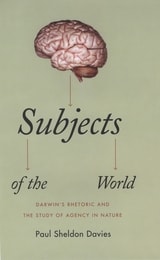
cover of Subjects of the World: Darwin's Rhetoric and the Study of Agency in Nature

Subjects of the World

Darwin's Rhetoric and the Study of Agency in Nature

Paul Sheldon Davies

University of Chicago Press, 2009

Being human while trying to scientifically study human nature confronts us with our most vexing problem. Efforts to explicate the human mind are thwarted by our cultural biases and entrenched infirmities; our first-person experiences as practical agents convince us that we have capacities beyond the reach of scientific explanation. What we need to move forward in our understanding of human agency, Paul Sheldon Davies argues, is a reform in the way we study ourselves and a long overdue break with traditional humanist thinking.

            Davies locates a model for change in the rhetorical strategies employed by Charles Darwin in On the Origin of Species. Darwin worked hard to anticipate and diminish the anxieties and biases that his radically historical view of life was bound to provoke. Likewise, Davies draws from the history of science and contemporary psychology and neuroscience to build a framework for the study of human agency that identifies and diminishes outdated and limiting biases. The result is a heady, philosophically wide-ranging argument in favor of recognizing that humans are, like everything else, subjects of the natural world—an acknowledgement that may free us to see the world the way it actually is.

[more]
cover of Teleology and the Conceptual Genesis of the Modern State: Essays on the Nature of Philosophy

Teleology and the Conceptual Genesis of the Modern State

Essays on the Nature of Philosophy

Francis Slade

Catholic University of America Press, 2027
This volume is a collection of thirteen essays written by the late Francis Slade, a contemporary philosopher who has made an original contribution to political philosophy through the clarity of distinction he achieves between the modern state and the natural city/civitas/polis. Slade’s distinction between these two political forms is made in terms of their differing relation to philosophy. The city, as the political form belonging properly to human nature, exists independently of philosophical thought; the form of the state, on the other hand, with its genesis in the deliberate and creative design of philosophical thought, is dependent on philosophy for its coming to be. Slade’s distinction illuminates the radical transformation in what philosophy understood itself to be that occurs with advent of modernity: the contemplative philosophy of premodernity is displaced in favor of modern philosophy’s active generation of ideal forms, of which the state is an instance. Philosophy is transformed by the erasure of the distinction between theoria and praxis. And it is a differing view of nature that underlies the two versions of philosophy Slade presents in these essays: the givenness of ends as constitutive of natural things is at the heart of the issue. Slade’s work thus has important consequences for the recovery of natural things in their ordinary givenness, a givenness overwhelmed into obscurity by the dominance of the various forms of philosophical idealism and their remarkably successful imposition on nature. Slade’s essays point to the “theological” stance (improperly) adopted by modern idealism, as it constructs a stance from outside nature which confounds the philosophic voice that originally and properly voices what is from within nature. These essays are introduced by the distinguished philosopher, Robert Sokolowski, a long-time friend of Francis Slade, whom Sokolowski gratefully acknowledges as having had a significant influence on his thought.
[more]
cover of The Strategy of Life: Teleology and Mechanics in Nineteenth-Century German Biology

The Strategy of Life

Teleology and Mechanics in Nineteenth-Century German Biology

Timothy Lenoir

University of Chicago Press, 1989

In the early nineteenth century, a group of German biologists led by Johann Friedrich Blumenbach and Karl Friedrich Kielmeyer initiated a search for laws of biological organization that would explain the phenomena of form and function and establish foundations for a unified theory of life. The tradition spawned by these efforts found its most important spokesman in Karl Ernst von Baer. Timothy Lenoir chronicles the hitherto unexplored achievements of the practitioners of this research tradition as they aimed to place functional morphology at the heart of a new science, which they called "biology."

Strongly influenced by Immanuel Kant, the biologists' approach combined a sophisticated teleology with mechanistic theories and sparked bitter controversies with the rival programs, mechanistic reductionism and Darwinism. Although temporarily eclipsed by these two approaches, the morphological tradition, Lenoir argues, was not vanquished in the field of scientific debate. It contributed to pathbreaking research in areas such as comparative anatomy, embryology, paleontology, and biogeography.
[more]