Results by title
8 books match the query 'Television talk shows'
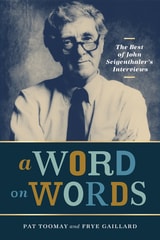
A Word on Words
The Best of John Seigenthaler's InterviewsEdited by Pat Toomay and Frye Gaillard; Epilogue by Andrew Maraniss
Vanderbilt University Press, 2023
Featuring interviews with:
Arna Bontemps • Marshall Chapman • Pat Conroy • Rodney Crowell • John Egerton • Jesse Hill Ford • Charles Fountain • William Price Fox • Kinky Friedman • Frye Gaillard • Nikki Giovanni • Doris Kearns Goodwin • David Halberstam • Waylon Jennings • John Lewis • David Maraniss • William Marshall • Jon Meacham • Ann Patchett • Alice Randall • Dori Sanders • John Seigenthaler Sr. • Marty Stuart • Pat Toomay
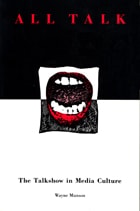
All Talk
The Talkshow in Media CultureWayne Munson
Temple University Press, 1993
Wayne Munson examines the talkshow as a cultural form whose curious productivity has become vital to America's image economy. As the very name suggests, the talkshow is both interpersonal exchange and mediated spectacle. Its range of topics defies classification: from the sensational and bizarre, to the conventional and the advisory, to politics and world affairs. Munson grapples with the sense and nonsense of the talkshow, particularly its audience participation and its construction of knowledge.
This hybrid genre includes the news/talk "magazine," celebrity chat, sports talk, psychotalk, public affairs forum, talk/service program, and call-in interview show. All share characteristics of lucidity and contradiction—the hallmarks of postmodernity—and it is this postmodern identity that Munson examines and links to mass and popular culture, the public sphere, and contemporary political economy.
Munson takes a close look at the talkshow’s history, programs, production methods, and the "talk" about it that pervades media culture—the press, broadcasting, and Hollywood. He analyzes individual shows such as "Geraldo," "The Morton Downey Show," "The McLaughlin Group," and radio call-in "squawk" programs, as well as movies such as Talk Radio and The King of Comedy that investigate the talkshow’s peculiar status. Munson also examines such events as the political organizing of talkhosts and their role in the antitax and anti-incumbency groundswells of the 1990s. In so doing, Munson demonstrates how "infotainment" is rooted in a deliberate uncertainty. The ultimate parasitic media form, the talkshow promiscuously indulges in—and even celebrated—its dependencies and contradictions. It "works" by "playing" with boundaries and identities to personalize the political and politicize the personal. Arguing that the talkshow's form and host are productively ill-defined, Munson asks whether the genre is a degradation of public life or part of a new, revitalized public sphere in which audiences are finally and fully "heard" through interactive.
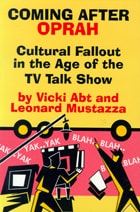
Coming after Oprah
Cultural Fallout in the Age of the TV Talk ShowVicki Abt and Leonard Mustazza
University of Wisconsin Press, 1997
More than just a commentary on the aesthetics of the genre, this book looks at the evolution and cultural significance of these programs, disputing claims that they are nothing more than harmless entertainment. In the work’s revealing first half, Vicki Abt and Leonard Mustazza uncover the mechanics of the talk-show game. The second half examines the behind-the-scenes economic games and their implications, revealing a web of complex commercial and political interests that influence their production. A detailed description of the corporate players and the revenues they are generating is also provided. The study concludes with suggestions for what we as a culture might do to protect ourselves from its inherent deceptions and misinformation.
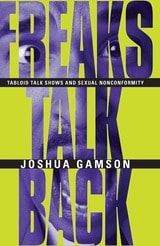
Freaks Talk Back
Tabloid Talk Shows and Sexual NonconformityJoshua Gamson
University of Chicago Press, 1998
"This entertaining, accessible, sobering discussion should make every viewer sit up and ponder the effects and possibilities of America's daily talk-fest with newly sharpened eyes."—Publishers Weekly
"Bold, witty. . . . There's a lot of empirical work behind this deceptively easy read, then, and it allows for the most sophisticated and complex analysis of talk shows yet."—Elayne Rapping, Women's Review of Books
"Funny, well-researched, fully theorized. . . . Engaged and humane scholarship. . . . A pretty inspiring example of what talking back to the mass media can be."—Jesse Berrett, Village Voice
"An extraordinarily well-researched volume, one of the most comprehensive studies of popular media to appear in this decade."—James Ledbetter, Newsday
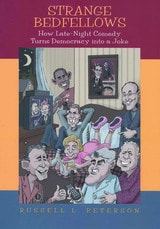
Strange Bedfellows
How Late-Night Comedy Turns Democracy into a JokePeterson, Russell
Rutgers University Press, 2008
It is no coincidence that presidential candidates have been making it a point to add the late-night comedy circuit to the campaign trail in recent years. In 2004, when John Kerry decided it was time to do his first national television interview, he did not choose CBS’s 60 Minutes, ABC’s Nightline, or NBC Nightly News. Kerry picked Comedy Central’s The Daily Show. When George W. Bush was lagging in the polls, his appearance on the David Letterman Show gave him a measurable boost. Candidates for the 2008 presidential election began their late-night bookings almost as soon as they launched their campaigns.
How can this be? The reason is that polls have been consistently finding that a significant number of Americans—and an even larger proportion of those under the age of thirty—get at least some of their “news” about politics and national affairs from comedy shows. While this trend toward what some have called “infotainment” seems to herald the descent of our national discourse—the triumph of entertainment over substance—the reality, according to Russell L. Peterson, is more complex. He explains that this programming is more than a mere replacement for traditional news outlets; it plays its own role in shaping public perception of government and the political process.
From Johnny Carson to Jon Stewart, from Chevy Chase’s spoofing of President Ford on Saturday Night Live to Stephen Colbert’s roasting of President Bush at the White House Correspondents Dinner, Strange Bedfellows explores what Americans have found so funny about our political institutions and the people who inhabit them, and asks what this says about the health of our democracy. Comparing the mainstream network hosts—Jay, Dave, Conan, and Johnny before them—who have always strived to be “equal opportunity offenders” to the newer, edgier crop of comedians on cable networks, Peterson shows how each brand of satire plays off a different level of Americans’ frustrations with politics.
Tabloid Culture
Trash Taste, Popular Power, and the Transformation of American TelevisionKevin Glynn
Duke University Press, 2000
Glynn begins by situating these media shifts within the context of Reaganism, which gave rise to distinctive ideological currents in society and led the socially and economically disenfranchised to access new forms of information via the exploding television industry. He then tackles specific daytime talk shows and tabloid newscasts such as Jerry Springer and A Current Affair, reality-TV programs such as Cops and America’s Most Wanted, and two different supermarket tabloids’ coverage of the O.J. Simpson case. Tabloid Culture is the first book to treat these diverse yet related media forms and events in tandem. Rejecting the elitist dismissal of sensationalist media, Glynn instead traces the cultural currents and countercurrents running through their forms and products. Locating both reactionary and oppositional meanings in these texts, he demonstrates how these particular media genres draw on and contribute to important cultural struggles over the meanings of race, sexuality, gender, class, “normality,” “truth,” and “reality.” The study ends by discussing how the growing use of the Internet provides an entirely new realm in which such material can circulate, distort, inform, and flourish.
This innovative and provocative study of contemporary mainstream media culture in the United States will be valuable to those interested in both print and television media, the cultural-political influence of the Reagan era, and American culture in general.
Television Talk
A History of the TV Talk ShowBy Bernard M. Timberg
University of Texas Press, 2002
A CHOICE Outstanding Academic Book
Flip through the channels at any hour of the day or night, and a television talk show is almost certainly on. Whether it offers late-night entertainment with David Letterman, share-your-pain empathy with Oprah Winfrey, trash talk with Jerry Springer, or intellectual give-and-take with Bill Moyers, the talk show is one of television's most popular and enduring formats, with a history as old as the medium itself.
Bernard Timberg here offers a comprehensive history of the first fifty years of television talk, replete with memorable moments from a wide range of classic talk shows, as well as many of today's most popular programs. Dividing the history into five eras, he shows how the evolution of the television talk show is connected to both broad patterns in American culture and the economic, regulatory, technological, and social history of the broadcasting industry. Robert Erler's "A Guide to Television Talk" complements the text with an extensive "who's who" listing of important people and programs in the history of television talk.
The Money Shot
Trash, Class, and the Making of TV Talk ShowsLaura Grindstaff
University of Chicago Press, 2002
From "classy" shows like Oprah to "trashy" shows like Jerry Springer, the key to a talk show's success is what Laura Grindstaff calls the money shot—moments when guests lose control and express joy, sorrow, rage, or remorse on camera. In this new work, Grindstaff takes us behind the scenes of daytime television talk shows, a genre focused on "real" stories told by "ordinary" people. Drawing on extensive interviews with producers and guests, her own attendance of dozens of live tapings around the country, and more than a year's experience working on two nationally televised shows, Grindstaff shows us how producers elicit dramatic performances from guests, why guests agree to participate, and the supporting roles played by studio audiences and experts.
Grindstaff traces the career of the money shot, examining how producers make stars and experts out of ordinary people, in the process reproducing old forms of cultural hierarchy and class inequality even while seeming to challenge them. She argues that the daytime talk show does give voice to people normally excluded from the media spotlight, but it lets them speak only in certain ways and under certain rules and conditions. Working to understand the genre from the inside rather than pass judgment on it from the outside, Grindstaff asks not just what talk shows can tell us about mass media, but also what they reveal about American culture more generally.