Results by title
8 books match the query 'Terrorists'
A Foreigner Carrying in the Crook of His Arm a Tiny Bomb
Amitava Kumar
Duke University Press, 2010
Cutting the Fuse
The Explosion of Global Suicide Terrorism and How to Stop ItRobert A. Pape and James K. Feldman
University of Chicago Press, 2012
Defending the Homeland
Historical Perspectives on Radicalism, Terrorism, and State ResponsesMELINDA M. HICKS
West Virginia University Press, 2007
Terrorism and national security have been in the foreground of the nation’s political landscape since the uncertain times brought on by the attacks of September 11, 2001. This collection of scholarly essays provides a chance to learn from the past by offering an analytic—and sometimes provocative—look at the inseparability of security and history. This work is divided into separate elements depicting security on the national and international levels. "Part One–The US and National Security," focuses on topics such as “Rank-And-File Rednecks: Radicalism and Union Leadership in the West Virginia Mine Wars,” among others. "Part Two–International Terrorism," looks at violence overseas, such as “Beyond Victims and Perpetrators: Women Terrorists and Their Own Stories.”

Guerrillas and Terrorists
Richard L. Clutterbuck
Ohio University Press, 1980
Terrorism and guerrilla warfare, whether justified as resistance to oppression or condemned as disrupting the rule of law, are as old as civilization itself. The power of the terrorist, however, has been magnified by modern weapons, including television, which he has learned to exploit.
To protect itself, society must understand the terrorist and what he is trying to do; thus Dr. Clutterbuck’s purpose in writing this book: “to contribute to the understanding and cooperation between the police, the public and the media.”
In the Name of Osama Bin Laden
Global Terrorism and the Bin Laden BrotherhoodRoland Jacquard
Duke University Press, 2002
International terrorism expert Roland Jacquard’s In the Name of Osama bin Laden presents a dramatic portrait of the world's most wanted terrorist and his extensive brotherhood--the network of people who operate “in his name.” Published originally in France the very week of September 11, as events in the United States shook the world, the book has become an international bestseller.
Jacquard details how bin Laden became an international emblem of fundamentalist, pan-Islamic, anti-U.S. fervor and the leader of a brotherhood so passionate that devotees who have never met him will act autonomously in his name. The author explains the global character of bin Laden’s organization, elaborating the extent of his sphere of influence in Europe and Asia. Jacquard reveals the construction of bin Laden’s networks—including a profile of his inner circle—and their collaboration with overlapping webs of banking, drug trafficking, religious, and terrorist organizations. He considers the brotherhood’s access to biological, chemical, and nuclear weapons and warns that, with or without bin Laden, this global terrorist force will remain a threat.
Now in English, this edition has been substantially updated in light of recent world events and expanded to include previously unpublished materials, featuring a new introduction and afterword. New documents include an April 2001 interview by the author with bin Laden; a September 24 proclamation by bin Laden to Muslims in Pakistan; and a key page from Dr. Ayman al-Zawahiri’s book justifying eternal jihad, which was smuggled out of Afghanistan in October 2001.
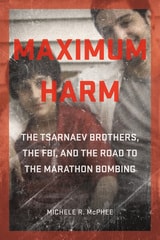
Maximum Harm
The Tsarnaev Brothers, the FBI, and the Road to the Marathon BombingMichele R. McPhee
University Press of New England, 2017

Slave of Allah
Zacarias Moussaoui Vs the USAKatherine C. Donahue
Pluto Press, 2007
The book begins with his arrest and moves to the courtroom, telling the tale of Moussaoui's struggle with his defense lawyers and raising questions about his ability to be "represented" given his national and personal identity. Donahue explores his background in France as the son of Moroccan immigrants and follows him to London, Afghanistan, and Malaysia as he joins the growing fraternity of an Islam without borders. He acquires an extra-national identity in which his loyalty is no longer constituted by his national identity, but by his allegiance to fundamental Islam.
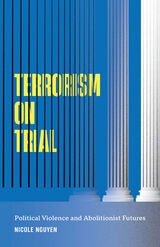
Terrorism on Trial
Political Violence and Abolitionist FuturesNicole Nguyen
University of Minnesota Press, 2023
A landmark sociological examination of terrorism prosecution in United States courts
Rather than functioning as a final arbiter of justice, U.S. domestic courts are increasingly seen as counterterrorism tools that can incapacitate terrorists, maintain national security operations domestically, and produce certain narratives of conflict. Terrorism on Trial examines the contemporary role that these courts play in the global war on terror and their use as a weapon of war: hunting, criminalizing, and punishing entire communities in the name of national security.
Nicole Nguyen advocates for a rethinking of popular understandings of political violence and its root causes, encouraging readers to consider anti-imperial abolitionist alternatives to the criminalization, prosecution, and incarceration of individuals marked as real or perceived terrorists. She exposes how dominant academic discourses, geographical imaginations, and social processes have shaped terrorism prosecutions, as well as how our fundamental misunderstanding of terrorism has led to punitive responses that do little to address the true sources of violence, such as military interventions, colonial occupations, and tyrannical regimes. Nguyen also explores how these criminal proceedings bear on the lives of defendants and families, seeking to understand how legal processes unevenly criminalize and disempower communities of color.
A retheorization of terrorism as political violence, Terrorism on Trial invites readers to carefully consider the role of power and politics in the making of armed resistance, addressing the root causes of political violence, with a goal of building toward a less violent and more liberatory world.