Results by title
16 books match the query 'Theatrical producers and directors'
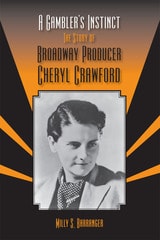
A Gambler’s Instinct
The Story of Broadway Producer Cheryl CrawfordMilly S. Barranger
Southern Illinois University Press, 2010
Broadway producer Cheryl Crawford (1902–1986) declared in her 1977 autobiography, “The theatre has been my life.” Crawford was notoriously circumspect about her private life, and only now, with Milly S. Barranger’s insightful biography, is her full story revealed.
A major Broadway producer in an era when women producers were exceedingly rare, Crawford found unprecedented success with the plays of Tennessee Williams, including The Rose Tattoo and Sweet Bird of Youth, but her enduring legend is as a musical producer, having brought Kurt Weill’s One Touch of Venus, Lerner and Loewe’s Brigadoon and Paint Your Wagon to the stage. Her commercial success, though, was balanced with the founding of studios that would enable actors to explore their art outside the strictures of commercial theater. She cofounded the Group Theatre with Harold Clurman and Lee Strasberg, the American Repertory Theatre with Margaret Webster and Eva Le Gallienne, and the Actors Studio with Elia Kazan and Robert Lewis, but her idealism was constantly frustrated by unfulfilled artistic promises from her male counterparts and by the chronic shortage of funding for the nonprofit enterprises.
As Barranger traces Crawford’s career as an independent producer, she tells the parallel story of American theater in the mid-twentieth century, making A Gambler’s Instinct both an enjoyable and informative biography of a remarkable woman and an important addition to the literature of the modern theater.

A Triptych from the Russian Theatre
An Artistic Biography of the Komissarzhevsky FamilyVictor Borovsky
University of Iowa Press, 2001

Acting Now
Conversations on Craft and CareerVilga, Edward
Rutgers University Press, 1997

Beyond the Mask
Gordon Craig, Movement, and the ActorIrene Eynat-Confino
Southern Illinois University Press, 1987
Eynat-Confino goes beyond the usual consideration of Craig’s purported theories of the actor, scenery, and the scene painter to get at the heart of Craig’s idea of theater.
She draws not only on the research of contemporary Craig scholars but on material hitherto unavailable—his writings and daybooks and the writings of friends. She ties Craig’s encounter with Isadora Duncan to a decisive modification in his notion of movement. To have an instrument more controllable than the actor, he invented the über-marionette, a giant puppet. Craig also invented the “Scene,” a kinetic stage, the “screens” that brought him worldwide fame were simply an adaptation of this concept.
Eynat-Confino argues that a scenario Craig wrote in 1905, here published for the first time, reveals a theosophical system like that of Blake, a system that was the main force motivating Craig’s artistic quest. In her final chapter, she carefully examines the psychological, aesthetic, and circumstantial factors that kept Craig from completing his work to bring “friendliness—humor—love—ease—peace” to the world.

Further on, Nothing
Tadeusz Kantor’s TheatreMichal Kobialka
University of Minnesota Press, 2009
A new encounter with the work of a master of avant-garde theatre
Tadeusz Kantor (1915–1990) was one of the twentieth century’s most innovative visual artists, stage directors, and theoreticians. His theatre productions and manifestos challenged the conventions of creating art in post–World War II culture and expanded the boundaries of Dada, surrealist, Constructivist, and happening theatre forms. Kantor’s most widely known productions—The Dead Class (1975), Wielopole, Wielopole (1980), Let the Artists Die (1985), and Today Is My Birthday (1990)—have had a profound impact on playwrights and artists who continue today to engage with his radical theatre.
In Further on, Nothing, Michal Kobialka explores Kantor’s theatre practice from the critical perspective of current debates about representation, memory, and history. He pursues the intriguing proposition that Kantor gave material form to a theatre practice that defined the very mode of postmodern operation and that many of its theoretical notions are still in circulation. According to Kobialka, Kantor’s theatre still offers an answer to reality rather than a portrayal of a utopian alternative. Further on, Nothing includes new translations of Kantor’s work, presented in conversation with Kobialka’s own theoretical analyses, to show us a Kantor who continues to offer—and deliver on—the promise of the avant-garde.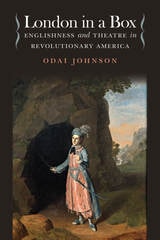
London in a Box
Englishness and Theatre in Revolutionary AmericaOdai Johnson
University of Iowa Press, 2017
If one went looking for the tipping point in the prelude to the American Revolution, it would not be the destruction of the tea in Boston Harbor, or the blockade of Boston by British warships, or even the gathering of the first Continental Congress; rather, it was the Congress’s decision in late October of 1774 to close the theatres. In this remarkable feat of historical research, Odai Johnson pieces together the surviving fragments of the story of the first professional theatre troupe based in the British North American colonies. In doing so, he tells the story of how colonial elites came to decide they would no longer style themselves British gentlemen, but instead American citizens.
London in a Box chronicles the enterprise of David Douglass, founder and manager of the American Theatre, from the 1750s to the climactic 1770s. The ambitious Scotsman’s business was teaching provincial colonials to dress and behave as genteel British subjects. Through the plays he staged, the scenery and costumes, and the bearing of his actors, he displayed London fashion and London manners. He counted among his patrons the most influential men in America, from British generals and governors to local leaders, including the avid theatre-goers George Washington and Thomas Jefferson. By 1774, Douglass operated a monopoly of theatres in six colonies and the Anglophone Caribbean, from Jamaica to Charleston and northward to New York City. (Boston remained an impregnable redoubt against theatre.)
How he built this network of patrons and theatres and how it all went up in flames as the revolution began is the subject of this witty history. A treat for anyone interested in the world of the American Revolution and an important study for historians of the period.
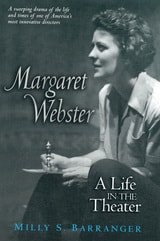
Margaret Webster
A Life in the TheaterMilly S. Barranger
University of Michigan Press, 2004
-Marian Seldes
"Margaret Webster is a highly welcome addition to our knowledge of the first important female director in American theater. Remembered now especially for her staging of Othello with Paul Robeson, Uta Hagen, and Jose Ferrer, Margaret Webster was probably the best-known, in-demand, and admired director of Shakespeare in America in the 1940s and 1950s. Fascinating throughout, the book's discussions of working with Robeson, and of HUAC, which targeted her just as her career was reaching a peak, make for especially engrossing reading."
-Oscar Brockett
Margaret Webster: A Life in the Theater is an engrossing backstage account of the life of pioneering director Margaret Webster (1905-72).
This is the first book-length biography of Webster, a groundbreaking stage and opera director whose career challenged not only stage tradition but also mainstream attitudes toward professional women.
Often credited with first having brought Shakespeare to Broadway, and renowned for her bold casting of an African American (Paul Robeson) in the role of Othello, Webster was a creative force in modern American and British theater.
Her story reveals the independent-minded artist undeterred by stage tradition and unmindful of rules about a woman's place in the professional theater. In addition to providing fascinating glimpses into Webster's personal and family life, Margaret Webster: A Life in the Theater also offers a who's-who list of the biggest names in New York and London theater of the time, as well as Hollywood: John Gielgud, Noël Coward, George Bernard Shaw, Uta Hagen, Sybil Thorndike, Eva LeGallienne, and John Barrymore, among others, all of whom crossed paths with Webster. Capping Webster's amazing story is her investigation by Senator Joseph McCarthy and HUAC, which left her unable to work for a year, and from which she never fully recovered.
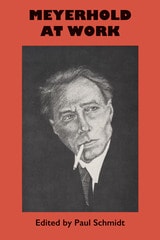
Meyerhold at Work
Edited by Paul Schmidt; translations by Paul Schmidt, Ilya Levin, and Vern McGee
University of Texas Press, 1980
“Not a mirror but a magnifying glass”—such, in the poet Mayakovsky’s words, was the theater of Vsevolod Meyerhold. The first to insist on the primacy of the director’s role, indeed the first to conceive of it as a role, this passionately dedicated Russian director tore down the fourth wall and forced the actors and audience together into one inescapable community of experience.
Yet Meyerhold recorded few of his theories in writing, and the intensity and brilliance of his work must be recaptured through the actors and artists who helped create the performances. Focusing on Meyerhold’s postrevolutionary career, Paul Schmidt has assembled in this book journals, letters, reminiscences, and, of special interest, actual rehearsal notes that build a fascinating, intimate picture of Meyerhold as a theorist and as a man.
Included are Meyerhold’s frantic notes to his teacher, friend, and bête noire Stanislavsky; detailed descriptions of how he trained his actors in “biomechanics”; and memories by such students as Eisenstein and such friends as Pasternak and Ehrenburg. One chapter deals with Meyerhold’s never-realized conception of Boris Godunov, while another describes his direction of Camille, which starred Zinaida Raikh, his wife, and which played its 725th and last performance on the day Stalin’s government liquidated Meyerhold’s theater. Paul Schmidt’s introduction and headnotes enhance our understanding of Meyerhold as a pioneer of modern theater.
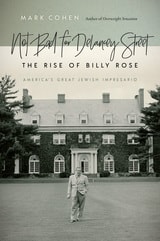
Not Bad for Delancey Street
The Rise of Billy RoseMark Cohen
Brandeis University Press, 2018
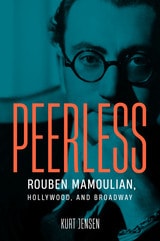
Peerless
Rouben Mamoulian, Hollywood, and BroadwayKurt Jensen
University of Wisconsin Press, 2024
Kurt Jensen’s magisterial volume, extensively researched and filled with trenchant observations, brings to life this charming, flawed, and fascinating man—and demonstrates how the wellspring of his art contained the seeds of his own destruction. Drawing upon Mamoulian’s unfinished memoir and voluminous diaries, as well as interviews with the director’s surviving collaborators, Jensen delivers fresh and informative insider stories from seminal productions. Meanwhile, he explores Mamoulian’s aesthetic principles and strategies as manifested in lighting, choreography, and sound design. A tour de force, Peerless offers readers a multifaceted, in-depth look at an idiosyncratic genius.
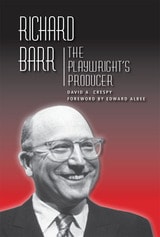
Richard Barr
The Playwright's ProducerDavid A. Crespy
Southern Illinois University Press, 2013
In Richard Barr: The Playwright’s Producer, author David A. Crespy investigates the career of one of the theatre’s most vivid luminaries, from his work on the film and radio productions of Orson Welles to his triumphant—and final—production of Stephen Sondheim’s Sweeney Todd: The Demon Barber of Fleet Street. Explored in detail along the way are the producer’s relationship with playwright Edward Albee, whose major plays such as A Zoo Story and Who’s Afraid of Virginia Woolf Barr was the first to produce, and his innovative productions of controversial works by playwrights like Samuel Beckett, Terrence McNally, and Sam Shepard. Crespy draws on Barr’s own writings on the theatre, his personal papers, and more than sixty interviews with theatre professionals to offer insight into a man whose legacy to producers and playwrights resounds in the theatre world. Also included in the volume are a foreword and an afterword by Edward Albee, a three-time Pulitzer Prize–winning playwright and one of Barr’s closest associates.
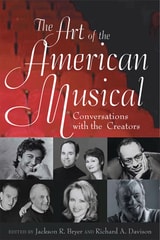
The Art of the American Musical
Conversations With the CreatorsBryer, Jackson R
Rutgers University Press, 2019
Musical theater has captivated American audiences from its early roots in burlesque stage productions and minstrel shows to the million-dollar industry it has become on Broadway today. What is it about this truly indigenous American art form that has made it so enduringly popular? How has it survived, even thrived, alongside the technology of film and the glitz and glamour of Hollywood? Will it continue to evolve and leave its mark on the twenty-first century?
Bringing together exclusive and previously unpublished interviews with nineteen leading composers, lyricists, librettists, directors, choreographers, and producers from the mid-1900s to the present, this book details the careers of the individuals who shaped this popular performance art during its most prolific period. The interviewees discuss their roles in productions ranging from On the Town (1944) and Finian's Rainbow (1947) to The Producers (2001) and Bounce (2003).
Readers are taken onto the stage, into the rehearsals, and behind the scenes. The nuts and bolts, the alchemy, and the occasional agonies of the collaborative process are all explored. In their discussions, the artists detail their engagements with other creative forces, including such major talents as Leonard Bernstein, Jerome Robbins, Bob Fosse, Liza Minnelli, Judy Garland, Barbra Streisand, Jule Styne, Richard Rodgers and Oscar Hammerstein, Alan Jay Lerner, Zero Mostel, and Gwen Verdon. They speak candidly about their own work and that of their peers, their successes and failures, the creative process, and how a show progresses from its conception through rehearsals and tryouts to opening night.
Taken together, these interviews give fresh insight into what Oscar Hammerstein called "a nightly miracle"—the creation of the American musical.
The Diaries of Judith Malina
1947-1957Judith Malina, Kate Bredeson
Northwestern University Press, 2026
Judith Malina’s newly restored diaries from a critical early decade in her personal, artistic, and political development
Judith Malina’s diaries from 1947 to 1957 are brought back into print in this volume, which charts her cofounding of The Living Theatre with husband and lifelong artistic partner Julian Beck. In these diaries, she narrates her developing political commitments and her expansive collaborations and personal relationships, as well as a moving account of her time in prison with activist Dorothy Day. This new edition features Kate Bredeson’s comprehensive introduction, which offers a detailed examination of Malina’s life and work in this period, along with additional historical context of these years and never-before-published photographs from Malina’s personal archives.
The Diaries of Judith Malina is a four-volume set that publishes for the first time together the edited diaries of radical theater director, actor, and activist Judith Malina from 1947 to 1971, the most influential period of her remarkable and storied career. A committed anarchist and pacifist, Malina made theater as a way to stoke revolutionary action. Her diaries showcase her political and social observations, cultural commentary, self-reflection, and wit. This expertly prepared set invites us to recognize Malina for her accomplishments not only as an artist and an activist but as one of the great literary diarists.
The Gay and Lesbian Theatrical Legacy
A Biographical Dictionary of Major Figures in American Stage History in the Pre-Stonewall EraBilly J. Harbin, Kim Marra, and Robert A. Schanke, Editors
University of Michigan Press, 2005
“A superb tribute to theatrical pioneers—The Gay and Lesbian Theatrical Legacy is required reading for both theatre scholars and gay/lesbian/bisexual history aficionados. A fascinating journey awaits them all in this highly recommended volume.”
—Broadside: Newsletter of the Theatre Library Association
The Gay and Lesbian Theatrical Legacy collects in a single volume biographies of more than one hundred notable figures whose careers flourished in the years before the 1969 Stonewall Riots marked the beginning of the gay and lesbian civil rights movement in the United States. The leading lights in American theater have included innumerable individuals whose sexualities have deviated from prevailing norms, but this history has until recently been largely unwritten and unknown. This book contributessignificantly to the recovery of this history, fashioning a much fuller, more nuanced portrait of American theater as it evolved and shedding light on the influence that sexual desire may have had on professional choices, relationships, and artistic achievements.
The Gay and Lesbian Theatrical Legacy collects biographies and portraits of influential actors, playwrights, composers, directors, designers, dancers, producers, managers, critics, choreographers, and technicians who made their mark on the American theater. Its broad coverage provides an extended glimpse into lives and careers that intersected and into networks of affiliation that made theatrical history and, by extension, social and cultural history.
The late Billy J. Harbin was Professor of Theater, Louisiana State University. Kim Marra is Associate Professor of Theater, University of Iowa. Robert A. Schanke is Professor of Theater Emeritus, Central College, Pella, Iowa.

The Very Thought of Herbert Blau
Clark Lunberry and Joseph Roach, Editors
University of Michigan Press, 2018
Herbert Blau (1926–2013) was the most influential theater theorist, practitioner, and educator of his generation. He was the leading American interpreter of the works of Samuel Beckett and as a director was instrumental in introducing works of the European avant-garde to American audiences. He was also one of the most far-reaching and thoughtful American theorists of theater and performance, and author of influential books such as The Dubious Spectacle, The Audience, and Take Up the Bodies: Theater at the Vanishing Point.
In The Very Thought of Herbert Blau, distinguished artists and scholars offer reflections on what made Blau's contributions so visionary, transformative, and unforgettable, and why his ideas endure in both seminar rooms and studios. The contributors, including Lee Breuer, Sue-Ellen Case, Gautam Dasgupta, Elin Diamond, S. E. Gontarski, Linda Gregerson, Martin Harries, Bill Irwin, Julia Jarcho, Anthony Kubiak, Daniel Listoe, Clark Lunberry, Bonnie Marranca, Peggy Phelan, Joseph Roach, Richard Schechner, Morton Subotnick, Julie Taymor, and Gregory Whitehead, respond to Blau's fierce and polymorphous intellect, his relentless drive and determination, and his audacity, his authority, to think, as he frequently insisted, "at the very nerve ends of thought."
Theater Games for Rehearsal
A Director's Handbook, Updated EditionViola Spolin with a foreword by Rob Reiner
Northwestern University Press, 2010
An updated edition of a key reference text by “the high priestess of improvisational theater”
A major force in the development of American theater, Viola Spolin devised pedagogical techniques that have influenced and inspired legions of actors, improvisers, and directors. Theater Games for Rehearsal: A Director's Handbook, first published in 1985, is a practical application of Spolin's famous method that guides directors and their companies step-by-step through all phases of the rehearsal period.
In Theater Games for Rehearsal, Spolin shows in easy-to-follow detail how her techniques can be used for a variety of theater needs, from selecting performance material, casting, and building a harmonious company to warming up actors, creating stage space, and overcoming opening-night jitters. This new edition, edited by Carol Bleackley Sills, incorporates Spolin's wished-for updates: four important exercises have been added, and instructions presenting her improvisational approach have been clarified throughout. Sidecoaching instructions and game evaluations are boxed and highlighted for on-the-spot reading by the director during rehearsal.
With these additions and improvements, Theater Games for Rehearsal: A Director's Handbook brings Spolin's ideas to a new generation with greater accessibility and excitement. Featuring a new foreword by renowned film director Rob Reiner, the updated edition is mandatory for any theater bookshelf.