Results by title
30 books match the query 'To 146 B.C'
A History of Trust in Ancient Greece
Steven Johnstone
University of Chicago Press, 2011
Alexander’s Veterans and the Early Wars of the Successors
By Joseph Roisman
University of Texas Press, 2012
This first focused analysis of veterans’ experiences in ancient Greece offers a fresh, “bottom-up” perspective on important military and political aspects of early Hellenistic history.
Runner-up, PROSE Award, Classics and Ancient History, 2013
From antiquity until now, most writers who have chronicled the events following the death of Alexander the Great have viewed this history through the careers, ambitions, and perspectives of Alexander’s elite successors. Few historians have probed the experiences and attitudes of the ordinary soldiers who followed Alexander on his campaigns and who were divided among his successors as they fought for control of his empire after his death. Yet the veterans played an important role in helping to shape the character and contours of the Hellenistic world.
This pathfinding book offers the first in-depth investigation of the Macedonian veterans’ experience during a crucial turning point in Greek history (323–316 BCE). Joseph Roisman discusses the military, social, and political circumstances that shaped the history of Alexander’s veterans, giving special attention to issues such as the soldiers’ conduct on and off the battlefield, the army assemblies, the volatile relationship between the troops and their generals, and other related themes, all from the perspective of the rank-and-file. Roisman also reexamines the biases of the ancient sources and how they affected ancient and modern depictions of Alexander’s veterans, as well as Alexander’s conflicts with his army, the veterans’ motives and goals, and their political contributions to Hellenistic history. He pays special attention to the Silver Shields, a group of Macedonian veterans famous for their invincibility and martial prowess, and assesses whether or not they deserved their formidable reputation.
An Introduction to Greek Epigraphy of the Hellenistic and Roman Periods from Alexander the Great down to the Reign of Constantine
B. H. McLean
University of Michigan Press, 2011
“In short, this is a reference work of the best kind. For the beginner, it is indispensable. And for those who already know something about its subject matter, the book is in many ways useful, informative, and interesting. We all owe a debt to [the author] for undertaking this significant project, and for completing it so well.”
—Michael Peachin, Classical World
“. . . provides invaluable road maps for non-epigraphers faced with passages of inscribed Greek.”
—Graham Shipley, Bryn Mawr Classical Review
Greek inscriptions form a valuable resource for the study of all aspects of the Greco-Roman world. They are primary witnesses to society's laws and institutions, religious habits, and language. This volume provides students with the tools to take advantage of the historical value of these treasures. It examines letter forms, ancient names, and ancient calendars, knowledge of which is essential in reading inscriptions of all kinds.
B. H. McLean discusses the classification of inscriptions into their various categories and analyzes particular types of inscriptions, including decrees, honorary inscriptions, dedications, funerary inscriptions, and manumissions. Finally, McLean includes special topics that bear upon the interpretation of specific features of inscriptions, such as Greek and Roman administrative titles and functions.
Athens 415
The City in CrisisClara Shaw Hardy, with translations by Robert B. Hardy
University of Michigan Press, 2020
On a summer night in 415 BCE, unknown persons systematically mutilated most of the domestic “herms”—guardian statues of the god Hermes—in Athens. The reaction was immediate and extreme: the Athenians feared a terrifying conspiracy was underway against the city and its large fleet—and possibly against democracy itself. The city established a board of investigators, which led to informants, accusations, and flight by many of the accused. Ultimately, dozens were exiled or executed, their property confiscated.
This dramatic period offers the opportunity to observe the city in crisis. Sequential events allow us to see the workings of the major institutions of the city (assembly, council, law courts, and theater, as well as public and private religion). Remarkably, the primary sources for these tumultuous months name conspirators and informants from a very wide range of status-groups: citizens, women, slaves, and free residents. Thus the incident provides a particularly effective entry-point into a full multifaceted view of the way Athens worked in the late fifth century.
Designed for classroom use, Athens 415 is no potted history, but rather a source-based presentation of ancient urban life ideal for the study of a people and their institutions and beliefs. Original texts—all translated by poet Robert B. Hardy—are presented along with thoughtful discussion and analyses by Clara Shaw Hardy in an engaging narrative that draws students into Athens’ crisis.

Black Athena Writes Back
Martin Bernal Responds to His CriticsMartin Bernal
Duke University Press, 2001
The subsequent rancor among classicists over Bernal’s theory and accusations was picked up in the popular media, and his suggestion that Greek culture had its origin in Africa was widely derided. In a report on 60 Minutes, for example, it was suggested that Bernal’s hypothesis was essentially an attempt to provide blacks with self-esteem so that they would feel included in the march of progress.
In Black Athena Writes Back Bernal provides additional documentation to back up his thesis, as well as offering persuasive explanations of why traditional scholarship on the subject remains inaccurate and why specific arguments lobbed against his theories are themselves faulty.
Black Athena Writes Back requires no prior familiarity with either the Black Athena hypothesis or with the arguments advanced against it. It will be essential reading for those who have been following this long-running debate, as well as for those just discovering this fascinating subject.
Black Athena
Afroasiatic Roots of Classical Civilization, Volume I: The Fabrication of Ancient Greece, 1785-1985Edited by Martin Bernal
Rutgers University Press, 1987
Could Greek philosophy be rooted in Egyptian thought? Is it possible that the Pythagorean theory was conceived on the shores of the Nile and the Euphrates rather than in ancient Greece? Could it be that much of Western civilization was formed on the “Dark Continent”? For almost two centuries, Western scholars have given little credence to the possibility of such scenarios.
In Black Athena, an audacious three-volume series that strikes at the heart of today’s most heated culture wars, Martin Bernal challenges Eurocentric attitudes by calling into question two of the longest-established explanations for the origins of classical civilization. To use his terms, the Aryan Model, which is current today, claims that Greek culture arose as the result of the conquest from the north by Indo-European speakers, or “Aryans,” of the native “pre-Hellenes.” The Ancient Model, which was maintained in Classical Greece, held that the native population of Greece had initially been civilized by Egyptian and Phoenician colonists and that additional Near Eastern culture had been introduced to Greece by Greeks studying in Egypt and Southwest Asia. Moving beyond these prevailing models, Bernal proposes a Revised Ancient Model, which suggests that classical civilization in fact had deep roots in Afroasiatic cultures.
This long-awaited third and final volume of the series is concerned with the linguistic evidence that contradicts the Aryan Model of ancient Greece. Bernal shows how nearly 40 percent of the Greek vocabulary has been plausibly derived from two Afroasiatic languages—Ancient Egyptian and West Semitic. He also reveals how these derivations are not limited to matters of trade, but extended to the sophisticated language of politics, religion, and philosophy. This evidence, according to Bernal, greatly strengthens the hypothesis that in Greece an Indo-European–speaking population was culturally dominated by Ancient Egyptian and West Semitic speakers
Provocative, passionate, and colossal in scope, this volume caps a thoughtful rewriting of history that has been stirring academic and political controversy since the publication of the first volume.
Black Athena
Afroasiatic Roots of Classical Civilization, Volume II: The Archaeological and Documentary EvidenceBernal, Martin
Rutgers University Press, 1991
This volume is the second in a projected four-part series concerned with the competition between two historical models for the origins of Greek civilization. The model current today is the Aryan Model, according to which Greek culture arose as the result of the conquest from the north by Indo-European speakers or "Aryans" of the native "pre-Hellenes." The Ancient Model, which was the model maintained in Classical Greece, held that the native population of Greece had initially been civilized by Egyptian and Phoenician colonists and that more Near Eastern culture had been introduced to Greece by Greeks studying in Egypt and Southwest Asia. In these and later volumes, Martin Bernal proposes a Revised Ancient Model. According to this, the Indo-European aspects of Greek language and culture should be recognized as fundamental and the considerable non-Indo-European elements should be seen largely as Egyptian and Levantine additions to this basis.
Volume II is concerned with the archaeological and documentary evidence for contacts between Egypt and the Levant on the one hand and the Aegean on the other, during the Bronze Age from c. 3400 B.C. to c. 1100 B.C. These approaches are supplemented by information from later Greek myths, legends, religious cults, and language. The author concludes that contact between the two regions was far more extensive and influential than is generally believed. In the introduction to this volume, Bernal also responds to some reviews and criticisms of Volume I of Black Athena.
Martin Bernal is Professor of Government at Cornell University.
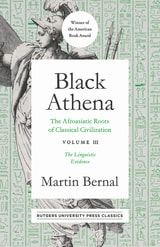
Black Athena
The Afroasiatic Roots of Classical Civilation Volume III: The Linguistic EvidenceMartin Bernal
Rutgers University Press, 2020
What is classical about Classical civilization? In one of the most audacious works of scholarship ever written, Martin Bernal challenges the foundation of our thinking about this question. Classical civilization, he argues, has deep roots in Afroasiatic cultures. But these Afroasiatic influences have been systematically ignored, denied or suppressed since the eighteenth century—chiefly for racist reasons.
The popular view is that Greek civilization was the result of the conquest of a sophisticated but weak native population by vigorous Indo-European speakers—Aryans—from the North. But the Classical Greeks, Bernal argues, knew nothing of this “Aryan model.” They did not see their institutions as original, but as derived from the East and from Egypt in particular.
This long-awaited third and final volume of the series is concerned with the linguistic evidence that contradicts the Aryan Model of ancient Greece. Bernal shows how nearly 40 percent of the Greek vocabulary has been plausibly derived from two Afroasiatic languages – Ancient Egyptian and West Semitic. He also reveals how these derivations are not limited to matters of trade, but extended to the sophisticated language of politics, religion, and philosophy. This evidence, according to Bernal, greatly strengthens the hypothesis that in Greece an Indo-European-speaking population was culturally dominated by Ancient Egyptian and West Semitic speakers.
Provocative, passionate, and colossal in scope, this volume caps a thoughtful rewriting of history that has been stirring academic and political controversy since the publication of the first volume.
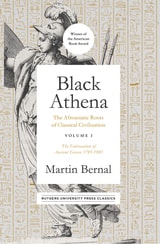
Black Athena
The Afroasiatic Roots of Classical Civilization Volume I: The Fabrication of Ancient Greece 1785-1985Martin Bernal
Rutgers University Press, 2020
What is classical about Classical civilization? In one of the most audacious works of scholarship ever written, Martin Bernal challenges the foundation of our thinking about this question. Classical civilization, he argues, has deep roots in Afroasiatic cultures. But these Afroasiatic influences have been systematically ignored, denied or suppressed since the eighteenth century—chiefly for racist reasons.
The popular view is that Greek civilization was the result of the conquest of a sophisticated but weak native population by vigorous Indo-European speakers—Aryans—from the North. But the Classical Greeks, Bernal argues, knew nothing of this “Aryan model.” They did not see their institutions as original, but as derived from the East and from Egypt in particular.
In an unprecedented tour de force, Bernal links a wide range of areas and disciplines—drama, poetry, myth, theological controversy, esoteric religion, philosophy, biography, language, historical narrative, and the emergence of “modern scholarship.”
Black Athena
The Afroasiatic Roots of Classical Civilization Volume II: The Archaeological and Documentary EvidenceMartin Bernal
Rutgers University Press, 2020
What is classical about Classical civilization? In one of the most audacious works of scholarship ever written, Martin Bernal challenges the foundation of our thinking about this question. Classical civilization, he argues, has deep roots in Afroasiatic cultures. But these Afroasiatic influences have been systematically ignored, denied or suppressed since the eighteenth century—chiefly for racist reasons.
The popular view is that Greek civilization was the result of the conquest of a sophisticated but weak native population by vigorous Indo-European speakers—Aryans—from the North. But the Classical Greeks, Bernal argues, knew nothing of this “Aryan model.” They did not see their institutions as original, but as derived from the East and from Egypt in particular.
In an unprecedented tour de force, Bernal links a wide range of areas and disciplines—drama, poetry, myth, theological controversy, esoteric religion, philosophy, biography, language, historical narrative, and the emergence of “modern scholarship.”
This volume is the second in a three-part series concerned with the competition between two historical models for the origins of Greek civilization. Volume II is concerned with the archaeological and documentary evidence for contacts between Egypt and the Levant on the one hand, and the Aegean on the other, during the Bronze Age from c. 34000 BC to c. 1100 BC. These approaches are supplemented by information from later Greek myths, legends, religious cults, and language. The author concludes that contact between the two regions was far more extensive and influential than is generally believed. In the introduction to this volume, Bernal also responds to some reviews and criticism of Volume I of Black Athena.
Centaurs and Amazons
Women and the Pre-History of the Great Chain of BeingPage duBois
University of Michigan Press, 1991
In Centaurs and Amazons, Page duBois offers a prehistory of hierarchy. Using structural anthropology, symbolic analysis, and recent literary theory, she demonstrates a shift in Greek thought from the fifth to the fourth century B.C. that had a profound influence upon subsequent Western culture and politics.
Through an analysis of mythology, drama, sculpture, architecture, and Greek vase painting, duBois documents the transition from a system of thought that organized the experience of difference in terms of polarity and analogy to one based upon a relatively rigid hierarchical scheme. This was the beginning of "the great chain of being," the philosophical construct that all life was organized in minute gradations of superiority and inferiority. This scheme, in various guises, has continued to influence philosophical and political thought.
The author's intelligent and discriminating use of scholarship from various fields makes Centaurs and Amazons an impressive interdisciplinary study of interest to classicists, feminist scholars, historians, art historians, anthropologists, and political scientists.

Courtesans and Fishcakes
The Consuming Passions of Classical AthensJames N. Davidson
University of Chicago Press, 2011
As any reader of the Symposium knows, the ancient Greek philosopher Socrates conversed over lavish banquets, kept watch on who was eating too much fish, and imbibed liberally without ever getting drunk. In other words, James Davidson writes, he reflected the culture of ancient Greece in which he lived, a culture of passions and pleasures, of food, drink, and sex before—and in concert with—politics and principles. Athenians, the richest and most powerful of the Greeks, were as skilled at consuming as their playwrights were at devising tragedies. Weaving together Greek texts, critical theory, and witty anecdotes, this compelling and accessible study teaches the reader a great deal, not only about the banquets and temptations of ancient Athens, but also about how to read Greek comedy and history.
Dangerous Counsel
Accountability and Advice in Ancient GreeceMatthew Landauer
University of Chicago Press, 2019
With Dangerous Counsel, Matthew Landauer analyzes the sometimes ferocious and unpredictable politics of accountability in ancient Greece and offers novel readings of ancient history, philosophy, rhetoric, and drama. In comparing the demos to a tyrant, thinkers such as Herodotus, Plato, Isocrates, and Aristophanes were attempting to work out a theory of the badness of unaccountable power; to understand the basic logic of accountability and why it is difficult to get right; and to explore the ways in which political discourse is profoundly shaped by institutions and power relationships. In the process they created strikingly portable theories of counsel and accountability that traveled across political regime types and remain relevant to our contemporary political dilemmas.
Fear of Diversity
The Birth of Political Science in Ancient Greek ThoughtArlene W. Saxonhouse
University of Chicago Press, 1992
Saxonhouse opens up fresh understandings of such issues as the Greeks' fear of the feminine and their attempts to ignore the demands that gender, reproduction, and the family inevitably make on the individual.
Hallowed Stewards
Solon and the Sacred Treasurers of Ancient AthensWilliam S. Bubelis
University of Michigan Press, 2016
Hallowed Stewards closely examines those magistracies that were central to Athenian religious efforts, and which are best described as “sacred treasurers.” Given the extensive but fragmentary evidence available to us, which consists mainly of inscriptions but includes such texts as the ps.-Aristotelian Constitution of the Athenians, no catalog-like approach to these offices could properly encompass their details, much less their wider significance. By situating the sacred treasurers within a broader religious and historical framework, Hallowed Stewards not only provides an incisive portrait of the treasurers themselves but also elucidates how sacred property and public finance alike developed in ancient Athens.
Hellenicity
Between Ethnicity and CultureJonathan M. Hall
University of Chicago Press, 2002
With Hellenicity, Jonathan M. Hall explores these questions in the context of ancient Greece, drawing on an exceptionally wide range of evidence to determine when, how, why, and to what extent the Greeks conceived themselves as a single people. Hall argues that a subjective sense of Hellenic identity emerged in Greece much later than is normally assumed. For instance, he shows that the four main ethnic subcategories of the ancient Greeks—Akhaians, Ionians, Aiolians, and Dorians—were not primordial survivals from a premigratory period, but emerged in precise historical circumstances during the eighth and seventh centuries B.C. Furthermore, Hall demonstrates that the terms of defining Hellenic identity shifted from ethnic to broader cultural criteria during the course of the fifth century B.C., chiefly due to the influence of Athens, whose citizens formulated a new Athenoconcentric conception of "Greekness."
Honor and Profit
Athenian Trade Policy and the Economy and Society of Greece, 415-307 B.C.E.Darel Tai Engen
University of Michigan Press, 2010
Honor and Profit offers a welcome corrective to the outmoded Finleyite view of the ancient economy. This important volume collects and analyzes economic evidence including government decrees for all known occasions on which Athens granted honors and privileges for services relating to trade.
The analysis proceeds within the intellectual framework of substantive economic theory, in which formal market behavior and institutions are considered to be but a subset of a larger group of economic behaviors and institutions devoted to the production, distribution, and exchange of goods.
Honor and Profit merges theory with empirical historical evidence to illustrate the complexity and dynamism of the ancient Greek economy. The author's conclusions have broad implications for our understanding not only of Athens and environs but also of the social and political history of Greece and the ancient Mediterranean world.
Darel Tai Engen is Associate Professor of History at California State University, San Marcos.
Also of interest
An Introduction to Greek Epigraphy of the Hellenistic and Roman Periods from Alexander the Great down to the Reign of Constantine (323 B.C.---A.D. 337)
By B. H. McLean
The Athenian Empire Restored: Epigraphic and Historical Studies
By Harold B. Mattingly
The Athenian Experiment: Building an Imagined Political Community in Ancient Attica, 508---490 B.C.
By Greg Anderson
Information Gathering in Classical Greece
Frank S. Russell
University of Michigan Press, 2000
Insults in Classical Athens
Deborah Kamen
University of Wisconsin Press, 2022
While the classical city celebrated the democratic equality of "autochthonous" citizens, it counted a large population of noncitizens as inhabitants, so that ancient Athenians developed a preoccupation with negotiating, affirming, and restricting citizenship. Kamen raises key questions about what it meant to be a citizen in democratic Athens and demonstrates how insults were deployed to police the boundaries of acceptable behavior. In doing so, she illuminates surprising differences between antiquity and today and sheds light on the ways a democratic society valuing "free speech" can nonetheless curb language considered damaging to the community as a whole.

Lessons from the Past
The Moral Use of History in Fourth-Century ProseFrances Pownall
University of Michigan Press, 2003
Memories of Odysseus
Frontier Tales From Ancient GreeceFrançois Hartog
University of Chicago Press, 2001
Popular Tyranny
Sovereignty and Its Discontents in Ancient GreeceEdited by Kathryn A. Morgan
University of Texas Press, 2003
The nature of authority and rulership was a central concern in ancient Greece, where the figure of the king or tyrant and the sovereignty associated with him remained a powerful focus of political and philosophical debate even as Classical Athens developed the world's first democracy. This collection of essays examines the extraordinary role that the concept of tyranny played in the cultural and political imagination of Archaic and Classical Greece through the interdisciplinary perspectives provided by internationally known archaeologists, literary critics, and historians.
The book ranges historically from the Bronze and early Iron Age to the political theorists and commentators of the middle of the fourth century B.C. and generically across tragedy, comedy, historiography, and philosophy. While offering individual and sometimes differing perspectives, the essays tackle several common themes: the construction of authority and of constitutional models, the importance of religion and ritual, the crucial role of wealth, and the autonomy of the individual. Moreover, the essays with an Athenian focus shed new light on the vexed question of whether it was possible for Athenians to think of themselves as tyrannical in any way. As a whole, the collection presents a nuanced survey of how competing ideologies and desires, operating through the complex associations of the image of tyranny, struggled for predominance in ancient cities and their citizens.
Sexual Labor in the Athenian Courts
Allison Glazebrook
University of Texas Press, 2021
Oratory is a valuable source for reconstructing the practices, legalities, and attitudes surrounding sexual labor in classical Athens. It provides evidence of male and female sex laborers, sex slaves, brothels, sex traffickers, the cost of sex, contracts for sexual labor, and manumission practices for sex slaves. Yet the witty, wealthy, and independent hetaira, well-known from other genres, does not feature. Its detailed narratives and character portrayals provide a unique discourse on sexual labor and reveal the complex relationship between such labor and Athenian society.
Through a holistic examination of five key speeches, Sexual Labor in the Athenian Courts considers how portrayals of sex laborers intersected with gender, the body, sexuality, the family, urban spaces, and the polis in the context of the Athenian courts. Drawing on gender theory and exploring questions of space, place, and mobility, Allison Glazebrook shows how sex laborers represented a diverse set of anxieties concerning social legitimacy and how the public discourse about them is in fact a discourse on Athenian society, values, and institutions.
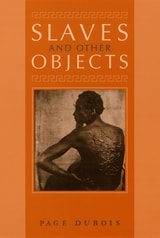
Slaves and Other Objects
Page duBois
University of Chicago Press, 2003
DuBois begins her study by exploring the material culture of slavery, including how most museum exhibits erase the presence of slaves in the classical world. Shifting her focus to literature, she considers the place of slaves in Plato's Meno, Aristotle's Politics, Aesop's Fables, Aristophanes' Wasps, and Euripides' Orestes. She contends throughout that portraying the difference between slave and free as natural was pivotal to Greek concepts of selfhood and political freedom, and that scholars who idealize such concepts too often fail to recognize the role that slavery played in their articulation.
Opening new lines of inquiry into ancient culture, Slaves and Other Objects will enlighten classicists and historians alike.
Social Memory in Athenian Public Discourse
Uses and Meanings of the PastBernd Steinbock
University of Michigan Press, 2013
Integrating literary, epigraphic, and archaeological evidence with recent scholarship on memory, identity, rhetoric, and international relations, Social Memory in Athenian Public Discourse: Uses and Meanings of the Past enhances our understanding of both the function of memory in Athenian public discourse and the history of Athenian-Theban relations. It should be of interest not only to students of Greek history and oratory but to everybody interested in memory studies, Athenian democracy, and political decision making.
The History
Herodotus
University of Chicago Press, 1988
Here is the historian, investigating and judging what he has seen, heard, and read, and seeking out the true causes and consequences of the great deeds of the past. In his History, the war between the Greeks and Persians, the origins of their enmity, and all the more general features of the civilizations of the world of his day are seen as a unity and expressed as the vision of one man who as a child lived through the last of the great acts in this universal drama.
In Grene's remarkable translation and commentary, we see the historian as a storyteller, combining through his own narration the skeletal "historical" facts and the imaginative reality toward which his story reaches. Herodotus emerges in all his charm and complexity as a writer and the first historian in the Western tradition, perhaps unique in the way he has seen the interrelation of fact and fantasy.
The Roots of Cooperation
Constructing Interstate Alliances in Ancient GreeceNicholas D. Cross
University of Michigan Press, 2026
Nicholas D. Cross’s The Roots of Cooperation reinterprets how the Greeks conceived, enacted, and displayed their alliances, offering a socially grounded understanding of interstate relations in antiquity. Following the international relations model of constructivism, Cross emphasizes the social features of Greek alliances including words used to articulate agreements, ceremonial acts they performed during the formation process, and the symbols they employed to illustrate how the alliances contributed to the creation of shared goals, ideas, and identities. The study covers the proposals for alliances, the articulation of alliance treaties, the ratification of alliances by means of religious ceremonies, the public display of the agreements in visual media, and the implications of terminated alliances. While alliances had political and military objectives, the Greeks represented them as collective and consensual achievements. Relying as much on epigraphic and numismatic evidence as on the literary record, this study recontextualizes interstate activity by analyzing how contemporaries imagined and depicted their formal interstate agreements. The Roots of Cooperation offers fresh insights that go beyond just alliances and can deepen our understanding of interstate relations, broadly speaking, in the ancient world.
The Shotgun Method
The Demography of the Ancient Greek City-State CultureMogens Herman Hansen
University of Missouri Press, 2006
Although the polis, or city-state, defined the essence of classical Greek civilization, evidence of its most basic characteristics is woefully inadequate. Now a leading scholar in the evaluation of data from the ancient world sheds new light on how those units were constituted.
The Sleep of Reason
Erotic Experience and Sexual Ethics in Ancient Greece and RomeEdited by Martha C. Nussbaum and Juha Sihvola
University of Chicago Press, 2002
The Sleep of Reason brings together an international group of philosophers, philologists, literary critics, and historians to consider two questions normally kept separate: how is erotic experience understood in classical texts of various kinds, and what ethical judgments and philosophical arguments are made about sex? From same-sex desire to conjugal love, and from Plato and Aristotle to the Roman Stoic Musonius Rufus, the contributors demonstrate the complexity and diversity of classical sexuality. They also show that the ethics of eros, in both Greece and Rome, shared a number of commonalities: a focus not only on self-mastery, but also on reciprocity; a concern among men not just for penetration and display of their power, but also for being gentle and kind, and for being loved for themselves; and that women and even younger men felt not only gratitude and acceptance, but also joy and sexual desire.
Contributors:
* Eva Cantarella
* Kenneth Dover
* Chris Faraone
* Simon Goldhill
* Stephen Halliwell
* David M. Halperin
* J. Samuel Houser
* Maarit Kaimio
* David Konstan
* David Leitao
* Martha C. Nussbaum
* A. W. Price
* Juha Sihvola
Wandering in Ancient Greek Culture
Silvia Montiglio
University of Chicago Press, 2005
Attitudes toward wandering have evolved in accordance with cultural perspectives, causing some characterizations to persist while others have faded. For instance, the status of wanderers in Greek societies varied from outcasts and madmen to sages, who were recognized as mystical, even divine. Examining the act of wandering through many lenses, Wandering in Ancient Greek Culture shows how the transformation of the wanderer coincided with new perceptions of the world and of travel and invites us to consider its definition and import today.