Results by title
265 books match the query 'To 1500' and 27 start with a
A Commentary on Cicero, De Legibus
Andrew R. Dyck
University of Michigan Press, 2004
Surprisingly, de Legibus has been one of Cicero's most neglected works. Andrew R. Dyck's commentary is the first to appear on the complete work in well over one hundred years. Dyck provides a detailed interpretation and sets the essay into the context of the politics and philosophical thought of its time. While previous commentaries focused primarily on grammar and textual criticism, this one also seeks to relate Cicero's text to the political, philosophical, and religious trends of his day. The author identifies the influences on Cicero's thinking and analyzes the relation of this theoretical treatise to his other works. This commentary is based on a new text, worked out in consultations between the author and Jonathan Powell of Royal Holloway, London.
Andrew Dyck is Professor of Classics, University of California at Los Angeles.
A Maya Universe in Stone
Stephen Houston
J. Paul Getty Trust, The, 2021
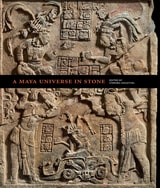
In 1950, Dana Lamb, an explorer of some notoriety, stumbled on a Maya ruin in the tropical forests of northern Guatemala. Lamb failed to record the location of the site he called Laxtunich, turning his find into the mystery at the center of this book. The lintels he discovered there, long since looted, are probably of a set with two others that are among the masterworks of Maya sculpture from the Classic period. Using fieldwork, physical evidence, and Lamb’s expedition notes, the authors identify a small area with archaeological sites where the carvings were likely produced.
Remarkably, the vividly colored lintels, replete with dynastic and cosmic information, can be assigned to a carver, Mayuy, who sculpted his name on two of them. To an extent nearly unique in ancient America, Mayuy can be studied over time as his style developed and his artistic ambition grew. An in-depth analysis of Laxtunich Lintel 1 examines how Mayuy grafted celestial, seasonal, and divine identities onto a local magnate and his overlord from the kingdom of Yaxchilan, Mexico. This volume contextualizes the lintels and points the way to their reprovenancing and, as an ultimate aim, repatriation to Guatemala.
A Pernicious Sort of Woman
Quasi-Religious Women and Canon Lawyers in the Later Middle Ages (Studies in Medieval and Early Modern Canon Law, Volume 6)Elizabeth Makowski
Catholic University of America Press, 2005
A Sacred Kingdom
Bishops and the Rise of Frankish Kingship, 300-850Michael Edward Moore
Catholic University of America Press, 2011
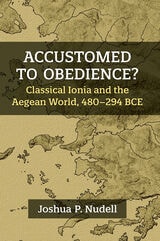
Accustomed to Obedience?
Classical Ionia and the Aegean World, 480–294 BCEJoshua P. Nudell
University of Michigan Press, 2023
This book offers a clear and accessible narrative of the period between the Persian Wars and the wars of the early Hellenistic period, two nominal liberations of the region. The volume complements existing histories of Classical Greece. Close inspection reveals that the Ionians were active partners in the imperial endeavor, even as imperial competition constrained local decision-making and exacerbated local and regional tensions. At the same time, the book offers interventions on critical issues related to Ionia such as the Athenian conquest of Samos, rhetoric about the freedom of the Greeks, the relationship between Ionian temple construction and economic activity, the status of the Panionion, Ionian poleis and their relationship with local communities beyond the circle of the dodecapolis, and the importance of historical memory to our understanding of ancient Greece. The result is a picture of an Aegean world that is more complex and less beholden narratives that give primacy to the imperial actors at the expense of local developments.

Aetna and the Moon
Explaining Nature in Ancient Greece and RomeLiba Taub
Oregon State University Press, 2008
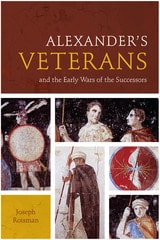
Alexander’s Veterans and the Early Wars of the Successors
By Joseph Roisman
University of Texas Press, 2012
This first focused analysis of veterans’ experiences in ancient Greece offers a fresh, “bottom-up” perspective on important military and political aspects of early Hellenistic history.
Runner-up, PROSE Award, Classics and Ancient History, 2013
From antiquity until now, most writers who have chronicled the events following the death of Alexander the Great have viewed this history through the careers, ambitions, and perspectives of Alexander’s elite successors. Few historians have probed the experiences and attitudes of the ordinary soldiers who followed Alexander on his campaigns and who were divided among his successors as they fought for control of his empire after his death. Yet the veterans played an important role in helping to shape the character and contours of the Hellenistic world.
This pathfinding book offers the first in-depth investigation of the Macedonian veterans’ experience during a crucial turning point in Greek history (323–316 BCE). Joseph Roisman discusses the military, social, and political circumstances that shaped the history of Alexander’s veterans, giving special attention to issues such as the soldiers’ conduct on and off the battlefield, the army assemblies, the volatile relationship between the troops and their generals, and other related themes, all from the perspective of the rank-and-file. Roisman also reexamines the biases of the ancient sources and how they affected ancient and modern depictions of Alexander’s veterans, as well as Alexander’s conflicts with his army, the veterans’ motives and goals, and their political contributions to Hellenistic history. He pays special attention to the Silver Shields, a group of Macedonian veterans famous for their invincibility and martial prowess, and assesses whether or not they deserved their formidable reputation.
Amoral Gower
Language, Sex, and PoliticsDiane Watt
University of Minnesota Press, 2003
An innovative reading of John Gower’s work and an exciting new approach to medieval vernacular texts
“Moral Gower” he was called by friend and sometime rival Geoffrey Chaucer, and his “Confessio Amantis” has been viewed as an uncomplicated analysis of the universe, combining erotic narratives with ethical guidance and political commentary. Diane Watt offers the first sustained reading of John Gower’s “Confessio” to argue that this early vernacular text offers no real solutions to the ethical problems it raises—and in fact actively encourages perverse readings.
Drawing on a combination of queer and feminist theory, ethical criticism, and psychoanalytic, historicist, and textual criticism, Watt focuses on the language, sex, and politics in Gower’s writing. How, she asks, is Gower’s “Confessio” related to contemporary controversies over vernacular translation and debates about language politics? How is Gower’s treatment of rhetoric and language gendered and sexualized, and what bearing does this have on the ethical and political structure of the text? What is the relationship between the erotic, ethical, and political sections of “Confessio Amantis”? Watt demonstrates that Gower engaged in the sort of critical thinking more commonly associated with Chaucer and William Langland at the same time that she contributes to modern debates about the ethics of criticism.
Amorous Games
A Critical Edition of Les adevineaux amoureuxBy James Woodrow Hassell
University of Texas Press, 1974
Among the more interesting incunabula preserved in the Salle de la Réserve of the Bibliothèque National in Paris are the apparently unique copies of two editions, very similar in content, of a work entitled Les Adevineaux amoureux. In much more comprehensive form Les Adevineaux amoureux is preserved in a manuscript belonging to the Musée Conde at Chantilly. All three texts, in medieval French, appear to date from the 1470s. The present work, Amorous Games, is a critical edition of Les Adevineaux amoureux.
Amorous Games is a miscellany whose principal unifying force is the compiler's aim to provide a manual of conversation and entertainment for polite society. Included are series of questions and answers belonging to the well-established medieval tradition of the "Demandes amoureuses"; a very large number of riddles, mainly folk riddles; and "venditions en amours," little poems that apparently came into bing as part of a social game.
Students of medieval French literature, particularly those with a penchant for some of the minor genres, will find new material in the Amorous Games. Folklorists will discover what is probably the largest collection of riddles bequeathed to us by medieval France and also much that is of value to specialists in the proverb and folk tale.
For this critical edition of Les Adevineaux amoureux Professor Hassell has selected the Chantilly manuscript, because it is the most complete and also because it had not yet been published. The Appendix contains the text of the more complete of the two incunabula and the significant variants appearing in the other fifteenth-century printed edition. The manuscript text has been collated with that of the incunabula, and copious notes and an index to the riddles have been supplied. In his introduction Professor Hassell discusses in detail the major classes and subclasses of the riddle, drawing on the work of Petsch, Taylor, Abrahams, and other scholars of the genre.
Anaximander
Carlo Rovelli
Westholme Publishing, 2011
THIS EBOOK IS NO LONGER AVAILABLE.
Anchoress and Abbess in Ninth-Century Saxony
The Lives of Liutbirga of Wendhausen and Hathumoda of GandersheimFrederick S. Paxton
Catholic University of America Press, 2009
Ancient Indigenous Cuisines
Archaeological Explorations of the MidcontinentEdited by Susan M. Kooiman, Jodie A. O'Gorman, and Autumn M. Painter
University of Alabama Press, 2025
New essays from foodways archaeology related to cuisine in social, cultural, and environmental contexts.
This collection of original essays is the first to cover recent trends in foodways archaeology in the Midwest using the concept of cuisine: the selection of food ingredients and methods of food preparation, cooking, and serving/consumption in relation to their social, cultural, and environmental contexts. This work span the Early Archaic (9000 BC) to Late Precontact (up to around AD 1500) in ecological zones of present-day Michigan, Indiana, Illinois, Wisconsin, Minnesota, North Dakota, and Manitoba. Chapters trace development from hunter-gathering to horticultural practices to the more robust farming/fishing/hunting model centered on maize, squash, and other domesticates.
As Susan M. Kooiman, Jodie A. O’Gorman, and Autumn M. Painter note, identification of past cooking habits and evolving methods for foodstuffs identification can help archaeologists to reconstruct foodways and connect food behaviors with identity and associated fundamental societal beliefs. Contributors to this collection use cutting-edge methods and perspectives and consider a range of questions and outcomes that demonstrate the versatility and strength of culinary studies. To move the field forward, contributors also note areas for further analysis and improvement.
This volume targets archaeologists and students, archaeobotanists and zooarchaeologists, and those curious about Indigenous food culture. Engaging content includes chapters on the construction of earth ovens, the use-alteration of pottery and residue, a discussion of cuisine combining plant and animal data with ceramic trends, and the various contexts of plates to understand cooking methods and the social role of cuisine. Others examine faunal remains, the plant remains of feasting, the introduction of maize, the use of limestone nixtamalization, and archaeobotanical assemblages that reveal shifts in cuisine. A conclusion addresses the question, Why cuisine?
CONTRIBUTORS
Rebecca K. Albert / Alleen Betzenhauser / Jennifer R. Haas / Mary M. King / Susan M. Kooiman / Mary E. Malainey / Terrance J. Martin / Fernanda Neubauer / Kelsey Nordine / Jodie A. O’Gorman / Autumn M. Painter / Jeffrey M. Painter / Kimberly Schaefer / Mary Simon
Ancient Plants and People
Contemporary Trends in ArchaeobotanyEdited by Marco Madella, Carla Lancelotti, and Manon Savard
University of Arizona Press, 2014
Food has both a public and a private role, and it permeates the life of all people in a society. Food choice, production, and distribution probably represent the most complex indicators of social life, and thus a study of foods consumed by ancient peoples reveals many clues about their lifestyles. But in addition to yielding information about food production, distribution, preparation, and consumption, plant remains recovered from archaeological sites offer precious insights on past landscapes, human adaptation to climate change, and the relationship between human groups and their environment. Revealing important aspects of past human societies, these plant-driven insights widen the spectrum of information available to archaeologists as we seek to understand our history as a biological and cultural species.
Often answers raise more questions. As a result, archaeobotanists are constantly pushed to reflect on the methodological and theoretical aspects of their discipline. The contributors discuss timely methodological issues and engage in debates on a wide range of topics from plant utilization by hunter-gatherers and agriculturalists, to uses of ancient DNA. Ancient Plants and People provides a global perspective on archaeobotanical research, particularly on the sophisticated interplay between the use of plants and their social or environmental context.
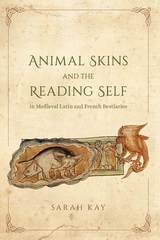
Animal Skins and the Reading Self in Medieval Latin and French Bestiaries
Sarah Kay
University of Chicago Press, 2017
Bestiaries present accounts of animals whose fantastic behaviors should be imitated or avoided, depending on the given trait. In a highly original argument, Kay suggests that the association of beasts with books is here both literal and material, as nearly all surviving bestiaries are copied on parchment made of animal skin, which also resembles human skin. Using a rich array of examples, she shows how the content and materiality of bestiaries are linked due to the continual references in the texts to the skins of other animals, as well as the ways in which the pages themselves repeatedly—and at times, it would seem, deliberately—intervene in the reading process. A vital contribution to animal studies and medieval manuscript studies, this book sheds new light on the European bestiary and its profound power to shape readers’ own identities.
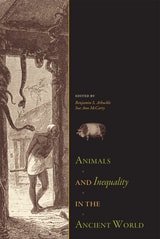
Animals and Inequality in the Ancient World
Benjamin S. Arbuckle
University Press of Colorado, 2014
The authors provide a global range of case studies from both New and Old World archaeology—a royal Aztec dog burial, the monumental horse tombs of Central Asia, and the ceremonial macaw cages of ancient Mexico among them. They explore the complex relationships between people and animals in social, economic, political, and ritual contexts, incorporating animal remains from archaeological sites with artifacts, texts, and iconography to develop their interpretations.
Animals and Inequality in the Ancient World presents new data and interpretations that reveal the role of animals, their products, and their symbolism in structuring social inequalities in the ancient world. The volume will be of interest to archaeologists, especially zooarchaeologists, and classical scholars of pre-modern civilizations and societies.
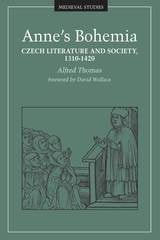
Anne’s Bohemia
Czech Literature And Society, 1310-1420Alfred Thomas
University of Minnesota Press, 1998
The first book in English on medieval Czech literature.
Anne’s Bohemia is the first general book in English to introduce the little-known riches of medieval Bohemian culture. Alfred Thomas considers the development of Czech literature and society from the election of Count John of Luxembourg as king of Bohemia in 1310 to the year 1420, when the papacy declared a Catholic crusade against the Hussite reformers. This period is of particular relevance to the study of medieval England because of the marriage of Richard II to Anne of Bohemia, the figure around whom this book is focused.
Anne’s Bohemia provides a social context for the most important works of literature written in the Czech language, from the earliest spiritual songs and prayers to the principal Hussite and anti-Hussite tracts of the fifteenth century. The picture that emerges from Thomas’s close readings of these texts is one of a society undergoing momentous political and religious upheavals in which kings, queens, clergy, and heretics all played crucial roles. During the reign of Charles IV (1346-78), the Bohemian Lands became the administrative and cultural center of the Holy Roman Empire and Prague its splendid capital. Comparing and contrasting the situation in Bohemia with the England of Richard II, Anne’s Bohemia charts the growth and decline of the international court culture and the gradual ascendancy of the Hussite reformers in the fifteenth century. Expert but accessibly written, the book offers an engaging overview of medieval Bohemian culture for specialist and nonspecialist alike.ISBN 0-8166-3053-4 Cloth $49.95xxISBN 0-8166-3054-2 Paper $19.95x232 pages 6 black-and-white photos 5 7/8 x 9 AprilMedieval Cultures Series, volume 13Translation inquiries: University of Minnesota Press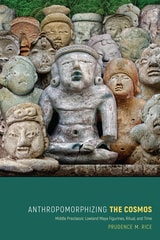
Anthropomorphizing the Cosmos
Middle Preclassic Lowland Maya Figurines, Ritual, and TimePrudence M. Rice
University Press of Colorado, 2019
Presenting original data, Anthropomorphizing the Cosmos offers insight into the synchronous appearance of fired-clay figurines with the emergence of societal complexity in and beyond Mesoamerica. Rice situates these Preclassic Maya figurines in the broader context of Mesoamerican human figural representation, identifies possible connections between anthropomorphic figurine heads and the origins of calendrics and other writing in Mesoamerica, and examines the role of anthropomorphic figurines and zoomorphic musical instruments in Preclassic Maya ritual. The volume shows how community rituals involving the figurines helped to mitigate the uncertainties of societal transitions, including the beginnings of settled agricultural life, the emergence of social differentiation and inequalities, and the centralization of political power and decision-making in the Petén lowlands.
Literature on Maya ritual, cosmology, and specialized artifacts has traditionally focused on the Classic period, with little research centering on the very beginnings of Maya sociopolitical organization and ideological beliefs in the Middle Preclassic. Anthropomorphizing the Cosmos is a welcome contribution to the understanding of the earliest Maya and will be significant to Mayanists and Mesoamericanists as well as nonspecialists with interest in these early figurines
Apples and Oranges
Explorations In, On, and With ComparisonBruce Lincoln
University of Chicago Press, 2018
Lincoln presents critiques of recent attempts at grand comparison, and enlists numerous theoretical examples of how a more modest, cautious, and discriminating form of comparison might work and what it can accomplish. He does this through studies of shamans, werewolves, human sacrifices, apocalyptic prophecies, sacred kings, and surveys of materials as diverse and wide-ranging as Beowulf, Herodotus’s account of the Scythians, the Native American Ghost Dance, and the Spanish Civil War.
Ultimately, Lincoln argues that concentrating one's focus on a relatively small number of items that the researcher can compare closely, offering equal attention to relations of similarity and difference, not only grants dignity to all parties considered, it yields more reliable and more interesting—if less grandiose—results. Giving equal attention to the social, historical, and political contexts and subtexts of religious and literary texts also allows scholars not just to assess their content, but also to understand the forces, problems, and circumstances that motivated and shaped them.
Archaeology and Identity on the Pacific Coast and Southern Highlands of Mesoamerica
Edited by Claudia García-Des Lauriers and Michael W. Love
University of Utah Press, 2016
The Pacific coast and southern highlands of Chiapas and Guatemala is a region significant to debates about the origins of social complexity, interaction, and colonialism. The area, however, has received uneven attention and much of what we know is largely restricted to the Preclassic period. This theoretically eclectic volume presents greater temporal coverage, is geographically unified, and engages some of the most important questions of each period through a discussion of the archaeology of identity.
Chapters range from traditional assessments of identity to discussion of practice and relational personhood; all share a concern for how archaeology and ethnohistory provide opportunities and challenges in the reconstruction of identities. The region is one with a multifaceted history of interactions between local populations and those from other parts of Mesoamerica. Linguistic diversity, landscape, and artistic representations have added to the complexities of understanding identity formation here. Rather than providing a unified voice on the issues, Archaeology and Identity on the Pacific Coast and Southern Highlands of Mesoamerica is a dialogue presented through case studies, one that will hopefully encourage future research in this complex and little understood region of Mesoamerica.
Archaeology at El Perú-Waka'
Ancient Maya Performances of Ritual, Memory, and PowerEdited by Olivia C. Navarro-Farr and Michelle Rich
University of Arizona Press, 2014
El Perú-Waka’ is an ancient Maya city located in present-day northwestern Petén, Guatemala. Rediscovered by petroleum exploration workers in the mid-1960s, it is the largest known archaeological site in the Laguna del Tigre National Park in Guatemala’s Maya Biosphere Reserve. The El Perú-Waka’ Regional Archaeological Project initiated scientific investigations in 2003, and through excavation and survey, researchers established that Waka’ was a key political and economic center well integrated into Classic-period lowland Maya civilization, and reconstructed many aspects of Maya life and ritual activity in this ancient community. The research detailed in this volume provides a wealth of new, substantive, and scientifically excavated data, which contributors approach with fresh theoretical insights. In the process, they lay out sound strategies for understanding the ritual manipulation of monuments, landscapes, buildings, objects, and memories, as well as related topics encompassing the performance and negotiation of power throughout the city’s extensive sociopolitical history.
Archaeometallurgy in Mesoamerica
Current Approaches and New PerspectivesAaron N. Shugar
University Press of Colorado, 2013
The chapters are organized following the cyclical nature of metals--beginning with extracting and mining ore, moving to smelting and casting of finished objects, and ending with recycling and deterioration back to the original state once the object is no longer in use. Data obtained from archaeological investigations, ethnohistoric sources, ethnographic studies, along with materials science analyses, are brought to bear on questions related to the integration of metallurgy into local and regional economies, the sacred connotations of copper objects, metallurgy as specialized crafting, and the nature of mining, alloy technology, and metal fabrication.
Aristotle's Poetics
Stephen Halliwell
University of Chicago Press, 1998
The core of the book is a fresh appraisal of Aristotle's view of tragic drama, in which Halliwell contends that at the heart of the Poetics lies a philosophical urge to instill a secularized understanding of Greek tragedy.
"Essential reading not only for all serious students of the Poetics . . . but also for those—the great majority—who have prudently fought shy of it altogether."—B. R. Rees, Classical Review
"A splendid work of scholarship and analysis . . . a brilliant interpretation."—Alexander Nehamas, Times Literary Supplement
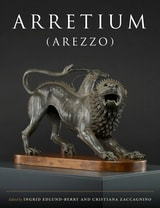
Arretium (Arezzo)
Edited by Ingrid Edlund-Berry and Cristiana Zaccagnino
University of Texas Press, 2024
A comprehensive examination of the history and excavation of the Etruscan city of Arretium.
Beneath the Italian city of Arezzo lie the remains of Etruscan Arretium. This volume, the first comprehensive treatment of excavations at Arretium, gathers the most up-to-date scholarship on the city and delves into key archaeological discoveries and the stories they tell about life in the Etruscan world.
Chapters explore local history—including the city’s complex political exchanges with Rome—Etruscan religion, Arretium’s role as a center of the arts, and the challenges of excavation amid the bustle of European urban modernity. Editors Ingrid Edlund-Berry and Cristiana Zaccagnino have gathered chapters by expert contributors that detail Arretium’s material culture, including the city’s famed pottery, Arretine ware, which was known across the Mediterranean; terracotta pieces depicting gods and other supernatural beings; and exquisite bronze-work, most notably the piece now known as the Chimaera of Arezzo. One of the few Etruscan cities that continued flourishing after the Roman takeover, Arretium proves to be a trove of archaeological riches and of the historical insights they reveal.
Arthurian Intertextualities
Misreading and Rereading Malory's Morte Darthur and the Alliterative and Stanzaic MortesFiona Tolhurst and K. S. Whetter
University of Michigan Press, 2025
Arthurian Intertextualities offers new readings of Malory’s Morte as well as the two English poems that most influenced him. Tolhurst and Whetter situate Malory’s Arthur story in the context of fourteenth- and fifteenth-century England. Combining these contexts with intertextual analysis of scenes and characters from Le Morte Darthur and both sources, the authors illustrate the full extent of Malory’s debt to these two English poems while making a stronger case for Malory’s artistry—and the stanzaic-poet’s artistry—than previous scholarship has acknowledged. These new readings demand a reassessment of Arthurian women, kingship, and warfare and heroism, including reconsidering the alliterative-poet’s attitude to war and to Arthur as conqueror. The authors also offer a spirited defense of Malory’s Guenevere, who remains frequently maligned by scholars, and argue for Palomydes’s acceptance by his Round Table Fellowship. Arthurian Intertextualities will appeal to readers who are interested in the book that serves as the source for most of the Arthuriana (whether novels, plays, works of art, or films) in today’s world: Le Morte Darthur.
At Play in the Tavern
Signs, Coins, and Bodies in the Middle AgesAndrew Cowell
University of Michigan Press, 1999
Drawing on recent work in medieval literature, history, popular culture, gender studies, and sign theory, Andrew Cowell employs a wide range of traditional and, until now, little known sources to show the unity and importance of a countercultural literary mode.
Andrew Cowell is Assistant Professor, Department of French and Italian, University of Colorado at Boulder.
At the Margins
Minority Groups in Premodern ItalyStephen J. Milner
University of Minnesota Press, 2005
Authoring the Past
History, Autobiography, and Politics in Medieval CataloniaJaume Aurell
University of Chicago Press, 2012
Authoring the Past surveys medieval Catalan historiography, shedding light on the emergence and evolution of historical writing and autobiography in the Middle Ages, on questions of authority and authorship, and on the links between history and politics during the period. Jaume Aurell examines texts from the late twelfth to the late fourteenth century—including the Latin Gesta comitum Barcinonensium and four texts in medieval Catalan: James I’s Llibre dels fets, the Crònica of Bernat Desclot, the Crònica of Ramon Muntaner, and the Crònica of Peter the Ceremonious—and outlines the different motivations for the writing of each.
For Aurell, these chronicles are not mere archaeological artifacts but rather documents that speak to their writers’ specific contemporary social and political purposes. He argues that these Catalonian counts and Aragonese kings were attempting to use their role as authors to legitimize their monarchical status, their growing political and economic power, and their aggressive expansionist policies in the Mediterranean. By analyzing these texts alongside one another, Aurell demonstrates the shifting contexts in which chronicles were conceived, written, and read throughout the Middle Ages.
The first study of its kind to make medieval Catalonian writings available to English-speaking audiences, Authoring the Past will be of interest to scholars of history and comparative literature, students of Hispanic and Romance medieval studies, and medievalists who study the chronicle tradition in other languages.