Results by title
13 books match the query 'To 622'
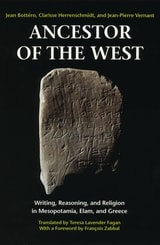
Ancestor of the West
Writing, Reasoning, and Religion in Mesopotamia, Elam, and GreeceJean Bottéro, Clarisse Herrenschmidt, and Jean-Pierre Vernant
University of Chicago Press, 2000
"Full of matter for anyone interested in language, religion, and politics in the ancient world."—R. T. Ridley, Journal of Religious History
"In this accessible introduction to the ancient world, three leading French scholars explore the emergence of rationality and writing in the West, tracing its development and its survival in our own traditions. . . . Jean Bottero focuses on writing and religion in ancient Mesopotamia, Clarisse Herrenschmidt considers a broader history of ancient writing, and Jean-Pierre Vernant examines classical Greek civilization in the context of Near Eastern history."—Translation Review
Empires in Collision in Late Antiquity
G. W. Bowersock
Brandeis University Press, 2012
Judicial Decisions in the Ancient Near East
Sophie Démare-Lafont
SBL Press, 2023
This volume presents the first broadly inclusive collection, with accessible text and English translation, of documents related to judicial decisions in the ancient Near East, the oldest setting for such writing in the world. The texts in this volume belong to various genres, especially legal records and letters, and span almost two thousand years. With such varied material, the work depends on the expertise of specialists in each setting, from the Sumerian of early Ur to the late Akkadian of Babylonia under the Persians. The collection brings together not only 183 transliterated texts and new translations but also introductions and commentary that place these legal documents in their historical and social contexts. A glossary of legal terms, a concordance of texts included, and an index of legal terms makes this an invaluable tool for students and scholars across disciplines. The contributors are Dominique Charpin, Sophie Démare-Lafont, Daniel E. Fleming, Francis Joannès, Bertrand Lafont, Brigitte Lion, Ignacio Márquez Rowe, Cécile Michel, and Pierre Villard.
Life and Thought in the Ancient Near East
Louis L. Orlin
University of Michigan Press, 2010
Intended for readers seeking insight into the day-to-day life of some of the world's most ancient peoples, Life and Thought in the Ancient Near East presents brief, fascinating explorations of key aspects of the civilizations of Egypt, Mesopotamia, Palestine, Asia Minor, and Iran. With vignettes on agriculture, architecture, crafts and industries, literature, religion, topography, and history, Orlin has created something refreshingly unique: a modern guidebook to an ancient world. The book also reaches out to students of the Ancient Near Eastern World with essays on decipherments, comparative cultural developments between Egypt and Mesopotamia, and language and literature.
In addition to general readers, the book will be useful in the classroom as a text supplementing a more conventional introduction to Near Eastern Studies.
"Well-written and accessible, Life and Thought in the Ancient Near East deftly connects the past with present experience by drawing out the differences between, for instance, modern churches and ancient temples, and frequently employing biblical references. This simplicity together with connecting contemporary to ancient experience makes the text ideal for freshmen and general readers."
---Marc Cooper, Professor of History, Missouri State University
Now Professor Emeritus, Louis L. Orlin taught in the department of Ancient Near Eastern History and Literature at the University of Michigan for more than thirty years. He is the author and editor of several books, including Assyrian Colonies in Cappadocia and Ancient Near Eastern Literature: A Bibliography of One Thousand Items on the Cuneiform Literatures of the Ancient World.
Power and Identity at the Margins of the Ancient Near East
Sara Mohr
University Press of Colorado, 2022
The borderlands of hegemonic entities within the Near East and Egypt pressed against each other, creating cities and societies with influence from several competing polities. The peoples, cities, and cultures that resulted present a unique lens by which to examine how states controlled and influenced the lives, political systems, and social hierarchies of these subjects (and vice versa). This volume addresses the distinct traditions and experiences of areas beyond the core; terminology used when discussing empire, core, periphery, borderlands, and frontiers; conceptualization of space; practices and consequences of warfare, captive-taking, and slavery; identity- and secondary state–formation; economy and society; ritual; diplomacy; and the negotiation of claims to power.
It is imperative that historians and social scientists understand the ways in which these cultures developed, spread, and interacted with others along frontier edges. Using an intersectional approach across disciplines, Power and Identity at the Margins of the Ancient Near East brings together professionals from archaeology, religious studies, history, sociology, and anthropology to make new contributions to the study of the frontier.
Contributors: Alexander Ahrens, Peter Dubovský, Avraham Faust, Daniel E. Fleming, Mahri Leonard-Fleckman, Alvise Matessi, Ellen Morris, Valeria Turriziani, Eric M. Trinka
Predicting the Past in the Ancient Near East
Mantic Historiography in Ancient Mesopotamia, Judah, and the Mediterranean WorldMatthew Neujahr
SBL Press, 2012
Royal Apologetic in the Ancient Near East
Andrew Knapp
SBL Press, 2015
A fresh exploration of apologetic material that pushes beyond form criticism
Andrew Knapp applies modern genre theory to seven ancient Near Eastern royal apologies that served to defend the legitimacy of kings who came to power under irregular circumstances. Knapp examines texts and inscriptions related to Telipinu, Hattusili III, David, Solomon, Hazael, Esarhaddon, and Nabonidus to identify transhistorical common issues that unite each discourse.
Features:
- Compares Hittite, Israelite, Aramean, Assyrian, and Babylonian apologies
- Examination of apologetic as a mode instead of a genre
- Charts and illustrations
Soldiers, Cities, and Civilians in Roman Syria
Nigel Pollard
University of Michigan Press, 2000
Nigel Pollard is currently a Research Assistant at the Institute of Archaeology, University of Oxford.
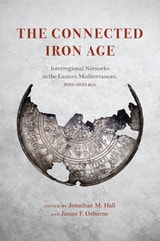
The Connected Iron Age
Interregional Networks in the Eastern Mediterranean, 900-600 BCEEdited by Jonathan M. Hall and James F. Osborne
University of Chicago Press, 2022
The early first millennium BCE marks one of the most culturally diverse periods in the history of the eastern Mediterranean. Surveying the region from Greece to Iraq, one finds a host of cultures and political formations, all distinct, yet all visibly connected in meaningful ways. These include the early polities of Geometric period Greece, the Phrygian kingdom of central Anatolia, the Syro-Anatolian city-states, the seafaring Phoenicians and the biblical Israelites of the southern Levant, Egypt’s Twenty-first through Twenty-fifth Dynasties, the Urartian kingdom of the eastern Anatolian highlands, and the expansionary Neo-Assyrian Empire of northern Mesopotamia. This volume adopts an interdisciplinary approach to understanding the social and political significance of how interregional networks operated within and between Mediterranean cultures during that era.
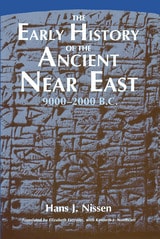
The Early History of the Ancient Near East, 9000-2000 B.C.
Hans J. Nissen
University of Chicago Press, 1988
With a unique combination of material culture analysis written data, Nissan traces the emergence of the earliest isolated settlements, the growth of a network of towns, the emergence of city states, and finally the appearance of territorial states. From his synthesis of the prehistoric and literate periods comes a unified picture of the development of Mesopotamian economy, society, and culture. Lavishly illustrated, The Early History of the Ancient Near East, 9000-2000 B.C. is an authoritative work by one of the most insightful observers of the evolution and character of Mesopotamian civilization.
The SBL Handbook of Style
SBL Press, 2014
The definitive source for how to write and publish in the field of biblical studies
The long-awaited second edition of the essential style manual for writing and publishing in biblical studies and related fields includes key style changes, updated and expanded abbreviation and spelling-sample lists, a list of archaeological site names, material on qur’anic sources, detailed information on citing electronic sources, and expanded guidelines for the transliteration and transcription of seventeen ancient languages.
Features:
- Expanded lists of abbreviations for use in ancient Near Eastern, biblical, and early Christian studies
- Information for transliterating seventeen ancient languages
- Exhaustive examples for citing print and electronic sources
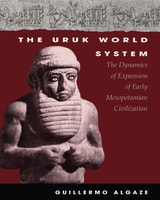
The Uruk World System
The Dynamics of Expansion of Early Mesopotamian CivilizationGuillermo Algaze
University of Chicago Press, 1993
In The Uruk World System, Guillermo Algaze concentrates instead on the unprecedented and wide-ranging process of external expansion that coincided with the rapid initial crystallization of Mesopotamian civilization. He contends that the rise of early Sumerian polities cannot be understood without also taking into account developments in surrounding peripheral areas.
Algaze reviews an extensive body of archaeological evidence for cross-cultural exchange between the nascent city-states in the Mesopotamian lowlands and communities in immediately surrounding areas. He shows that at their very inception the more highly integrated lowland centers succeeded in establishing a variety of isolated, far-flung outposts in areas at the periphery of the Mesopotamian lowlands. Embedded in an alien hinterland characterized by demonstrably less complex societies, the outposts were commonly established at the apex of preexisting regional settlement hierarchies and invariably at focal nodes astride important trade routes. Algaze argues that these early colonial out-posts served as collection points for coveted peripheral resources acquired in exchange for core manufactures and that they reflect an inherently asymmetrical system of economic hegemony that extended far beyond areas under the direct political control of Sumerian polities in southern Mesopotamia. From this he concludes that economic exploitation of less developed peripheral areas was integral to the earliest development of civilization in the ancient Near East.
The Uruk World System
The Dynamics of Expansion of Early Mesopotamian Civilization, Second EditionGuillermo Algaze
University of Chicago Press, 2005