Results by title

8 books match the query 'Trollope, Anthony'

cover of He Knew She Was Right: The Independent Woman in the Novels of Anthony Trollope

He Knew She Was Right

The Independent Woman in the Novels of Anthony Trollope

Jane Nardin

Southern Illinois University Press, 1989

Trollope’s mother, wife, and a friend he loved platonically most of his life provided him three very different views of the Victorian woman. And, according to Jane Nardin, they were responsible for the dramatic shift in his treatment of women in his novels.

This is the first book in Sandra Gilbert’s Ad Feminam series to examine a male author. Nardin initially analyzes the novels Trollope wrote from 1855 to 1861, in which male concerns are central to the plot and women are angelic heroines, submissive and self-sacrificing. Even the titles of his novels written during this period are totally male oriented. The Three Clerks, Doctor Thorne, and The Bertrams all refer to men. Shortly after meeting Kate Field, Trollope wrote Orley Farm, which refers to the estate an angry woman steals from her husband and which marks a change in the attitudes toward women evident in his novels.

His next four books, The Small House at Allington, Rachel Ray, Can You Forgive Her?, and Miss Mackenzie, prove that women’s concerns had become central in his writing. Nardin examines specific novels written from 1861 to 1865 in which Trollope, with increasing vigor, subverts the conventional notions of gender that his earlier novels had endorsed.

Nardin argues that his novels written after 1865 and often recognized as feminist are not really departures but merely refinements of attitudes Trollope exhibited in earlier works.

[more]
cover of NOVEL PROFESSIONS: INTERESTED DISINTEREST AND THE MAKING OF THE VICTORIAN NOVEL

NOVEL PROFESSIONS

INTERESTED DISINTEREST AND THE MAKING OF THE VICTORIAN NOVEL

Jennifer Ruth

The Ohio State University Press, 2006
[more]
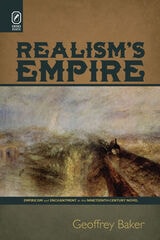
cover of Realism's Empire: Empiricism and Enchantment in the Nineteenth-Century Novel

Realism's Empire

Empiricism and Enchantment in the Nineteenth-Century Novel

Geoffrey Baker

The Ohio State University Press, 2009
If realist novels are the literary avatars of secular science and rational progress, then why are so many canonical realist works organized around a fear of that progress? Realism is openly indebted, at the level of form and content, to imperialist and scientific advances. However, critical emphasis on this has obscured the extent to which major novelists of the period openly worried about the fate of mystery and the dissolution of tradition that accompanied science’s shrinking of the world. Realism’s modernization is inseparable from nostalgia.
 
In Realism’s Empire: Empiricism and Enchantment in the Nineteenth-Century Novel, Geoffrey Baker demonstrates that realist fiction’s stance toward both progress and the foreign or supernatural is much more complex than established scholarship has assumed. The work of Honoré de Balzac, Anthony Trollope, and Theodor Fontane explicitly laments the loss of mystery in the world due to increased knowledge and exploration. To counter this loss and to generate the complications required for narrative, these three authors import peripheral, usually colonial figures into the metropolitan centers they otherwise depict as disenchanted and rationalized: Paris, London, and Berlin. Baker’s book examines the consequences of this duel for realist narrative and readers’ understandings of its historical moment. In so doing, Baker shows Balzac, Trollope, and Fontane grappling with new realities that frustrate their inherited means of representation and oversee a significant shift in the development of the novel.
 
 
[more]
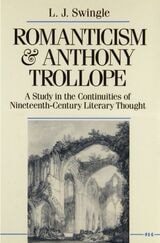
cover of Romanticism and Anthony Trollope: A Study in the Continuities of Nineteenth-Century Literary Thought

Romanticism and Anthony Trollope

A Study in the Continuities of Nineteenth-Century Literary Thought

L. J. Swingle

University of Michigan Press, 1990
Most people who study Romanticism suppose the Victorian novelist Anthony Trollope has little or nothing to do with Romantic literary thought, except perhaps opposition to it. Most people who study Trollope agree. Romanticism and Anthony Trollope argues that these suppositions are mistaken, reflecting erroneous ideas about Romanticism or about Trollope—or perhaps about both.L. J. Swingle invites reexamination of popular assumptions about the nature of nineteenth-century literary art, generally, and, especially, reconsideration of the idea that Romanticism and what is called Victorian Realism are fundamentally antithetical. Romantic writers and Trollope share basic assumptions about how human beings think; and, as a result, they also share uneasy notions about the substantiality of human relationships, particularly marriage. Swingle shows that our understanding of Trollope is clarified and enriched when we think about his work in relation to Romantic literary art; and, as well, it shows that we gain a better understanding of Romanticism by thinking about it in connection withTrollope. At a time when the resurrection of Trollope’s writings is increasingly common and popular enthusiasm for his work is high, this book will be especially welcomed. Romanticists, students of fiction, literary historians, and people working in nineteenth-century cultural studies will find its insights important and provocative, leading not only to a revaluation of Trollope’s work but to a rethinking of our stereotypes of Romanticism.
[more]
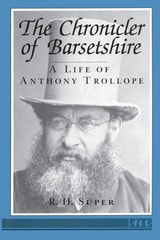
cover of The Chronicler of Barsetshire: A Life of Anthony Trollope

The Chronicler of Barsetshire

A Life of Anthony Trollope

R. H. Super

University of Michigan Press, 1990
The Chronicle of Barsetshire presents the life of Anthony Trollope, who, although perhaps best known for his popular novels of Victorian English life, was also a prolific writer of nonfiction and a distinguished civil servant. R. H. Super, professor emeritus of English at the University of Michigan, has drawn upon a wide range of primary sources, archival as well as published, to give a complete sense of the man, his variety of talents, his place in the intellectual world of nineteenth-century England, and the interplay between his fiction and the events of his life. It is a biography of the highest merit, a work that, unlike the previous studies of Trollope's life, is not overshadowed by Trollope's own colorful (but frequently inaccurate) Autobiography. Exhaustive in its portrayal of Trollope's long, productive life, and impeccable in its scholarship, The Chronicler of Barsetshire sets a new standard of execellence in Trollopian studies.
[more]
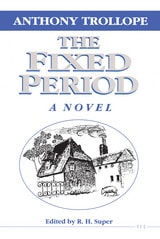
cover of The Fixed Period

The Fixed Period

Anthony Trollope

University of Michigan Press, 1990

At a time when concern over the ethics of euthanasia and the implications of a rapidly aging population are frequent topics of discussion, Trollope’s only science fiction novel strikes a very modern chord. The Fixed Period, begun in 1880 when Trollope was 65, is set in the then far-distant year of 1980. The story is narrated by the president of the fictitious Republic of Britannula, an ex-British colony on an imaginary island near New Zealand. The original young settlers, led by their president, adopt a plan called the Fixed Period. Under this plan, the island would be relieved of the burden of an aging population by calling for compulsory euthanasia for citizens reaching the age of 67. Opposition to the plan grows as the time approaches for “depositing” the first citizen in the euthanasia park, and the elderly citizens successfully persuade the British government to send a gunboat armed with a powerful new weapon to reannex the country.
 
Trollope’s satiric portrayal of the statisticians who calculate the savings to be realized by putting the old people away before they become an expensive catastrophic burden, and the ironic presentation of the narrator’s justification of euthanasia by appeal to Christian practice and doctrine, will delight contemporary readers. Trollope’s strong dislike of government bureaucracy is evident throughout, as is his awareness of the dangers to the world of an imagined weapon of destruction not unlike (in its effect) the atomic bomb.
 
In making accessible the complete text of this work with corrections from the original manuscript, Super has performed an invaluable service for Trollope scholars and enthusiasts.

 
[more]
cover of Trollope and Comic Pleasure

Trollope and Comic Pleasure

Christopher Herbert

University of Chicago Press, 1987

Challenging the sentimentalized and moralized view of comedy that prevails in modern criticism, Christopher Herbert outlines a theory of comedy as a mode whose dominant motive and function is the glorification of pleasure. Using this model, he presents a detailed study of Anthony Trollope that sharply contradicts the persistent image of this novelist as a conventional writer and complacent spokesman for middle-class pieties.

The comic mode as Herbert describes it was antagonistic to the repressive moral ethos widely prevalent in Victorian England. Herbert shows how Trollope, under a mask of self-proclaimed conventionality, employed this mode in a steady, sometimes scandalous critique of the Victorian subversion of pleasure. Drawing on Trollope's unpublished notes on seventeenth-century drama and bringing to light many instances in the novels of direct borrowings from old plays, Herbert demonstrates the inventiveness and subtlety of Trollope's deployment of comic materials. Thematically organized around such subjects as Trollope's investigations of sex, his formal structures, and his principles of "realism," Herbert's study includes detailed readings of two of the nineteenth century's most ambitious exercises in comedy: The Way We Live Now and Trollope's neglected masterpiece, Ayala's Angel.

Of primary importance for readers of Trollope and students of comedy, Herbert's study will also prove valuable to those interested more generally in Victorian and modern fiction and the cultural history of the Victorian age.
[more]
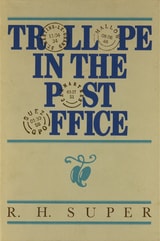
cover of Trollope in the Post Office

Trollope in the Post Office

R. H. Super

University of Michigan Press, 1981

The works of Anthony Trollope are currently enjoying a popularity not seen since the success they met during his lifetime, a success that obscured until long after his death the true nature and extent of his literary merit. With this new found popularity has come a flurry of publishing about Trollope, primarily criticisms of the novels. Professor Super provides for the first time a scholarly examination of Trollope’s life — not his life as a writer who wrote 2,500 words every morning and published about four dozen novels — but his other life, his professional life with the British Post Office. Trollope was a civil servant before he was a novelist. For thirty-four years, from age nineteen to age fifty-two, he served the Post Office in assignments that gave him a detailed famillarity with Ireland, England, and Wales, and a personal acquaintance with the postal patrons. As a roving ambassador for the Post Office, he went to the West Indies, the Near East, and the United States. The book draws for the first time on the extensive records of Trollope’s career preserved in the Post Office archives in London. Interweaving these materials with other sources ofinformation, Professor Super presents, with meticulous scholarship and lucid style, the interrelation between Trollope’s Post Office work and his books.
[more]