Results by title
13 books match the query 'Truthfulness and falsehood'

A Big Enough Lie
A NovelEric Bennett
Northwestern University Press, 2015
Awaiting a TV talk show appearance, John Townley is quaking with dread. He has published a best-selling memoir about the Iraq War, a page-turner climaxing in atrocity. In a green room beyond the soundstage, he braces himself to confront the charismatic soldier at the violent heart of it. But John has never actually seen the man before—nor served in Iraq, nor the military. Even so, and despite the deception, he knows his fabricated memoir contains stunning truths.
By turns comic, suspenseful, bitingly satirical, and emotionally potent, A Big Enough Lie pits personal mistruths against national ones of life-and-death consequence. Tracking a writer from the wilds of Florida to New York cubicles to Midwestern workshops to the mindscapes of Baghdad—and from love to heartbreak to solitary celebrity—Bennett’s novel probes our endlessly frustrated desire to grab hold of something (or somebody) true.
A Democratic Theory of Truth
Linda M. G. Zerilli
University of Chicago Press, 2025
We say that we live in a “post-truth” era because disinformation threatens our confidence in the existence of a shared public world. Affirming objective truth may, therefore, seem necessary to save democracy. According to political theorist Linda M. G. Zerilli, such affirmation can stifle political debate and silence dissent. In fact, Zerilli argues that the unqualified insistence on objective truth is as dangerous for democracy as denying it.
Drawing on Arendt, Foucault, and Wittgenstein, A Democratic Theory of Truth challenges the concept of truth presupposed by the post-truth debate. It argues that we, the people, have an essential role in discovering and evaluating any truth relevant to the political realm. The result is a striking defense of plurality, dissent, and opinion in contemporary democratic societies.

A Matter of Facts
The Value of Evidence in an Information AgeLaura A. Millar
American Library Association, 2019
The safeguarding of authentic facts is essential, especially in this disruptive Orwellian age, where digital technologies have opened the door to a post-truth world in which “alternative facts” can be so easily accepted as valid. And because facts matter, evidence matters. In this urgent manifesto, archives luminary Millar makes the case that authentic and accurate records, archives, data, and other sources of documentary proof are crucial in supporting and fostering a society that is respectful, democratic, and self-aware. An eye-opening treatise for the general public, an invaluable resource for archives students, and a provocative call-to-arms for information and records professionals, Millar’s book
- explains the concept of evidence and discusses the ways in which records, archives, and data are not just useful tools for our daily existence but also essential sources of evidence both today and in the future;
- includes plentiful examples that illustrate the critical role evidence plays in upholding rights, enforcing responsibilities, tracing family or community stories, and capturing and sharing memories; and
- examines the impact of digital technologies on how records and information are created and used.
With documentary examples ranging from Mesopotamian clay tablets to World War II photographs to today’s Twitter messages and Facebook posts, Millar’s stirring book will encourage readers to understand more fully the importance of their own records and archives, for themselves and for future generations.
Conspiracy/Theory
Joseph Masco and Lisa Wedeen, editors
Duke University Press, 2024
Contributors. Nadia Abu El-Haj, Hussein Ali Agrama, Kathleen Belew, Elizabeth Anne Davis, Joseph Dumit, Faith Hillis, Lochlann Jain, Demetra Kasimis, Susan Lepselter, Darryl Li, Louisa Lombard, Joseph Masco, Robert Meister, Timothy Melley, Rosalind C. Morris, George Shulman, Lisa Wedeen
Duped
Truth-Default Theory and the Social Science of Lying and DeceptionTimothy R. Levine
University of Alabama Press, 2020
Unmasking the science of deception—and why truth wins by default.
From the advent of fake news to climate-science denial and Bernie Madoff’s appeal to investors, people can be astonishingly gullible. Some people appear authentic and sincere even when the facts discredit them, and many people fall victim to conspiracy theories and economic scams that should be dismissed as obviously ludicrous. This happens because of a near-universal human tendency to operate within a mindset that can be characterized as a “truth-default.” We uncritically accept most of the messages we receive as “honest.” We all are perceptually blind to deception. We are hardwired to be duped. The question is, can anything be done to militate against our vulnerability to deception without further eroding the trust in people and social institutions that we so desperately need in civil society?
Timothy R. Levine’s Duped: Truth-Default Theory and the Social Science of Lying and Deception recounts a decades-long program of empirical research that culminates in a new theory of deception—truth-default theory. This theory holds that the content of incoming communication is typically and uncritically accepted as true, and most of the time, this is good. Truth-default allows humans to function socially. Further, because most deception is enacted by a few prolific liars, the so called “truth-bias” is not really a bias after all. Passive belief makes us right most of the time, but the catch is that it also makes us vulnerable to occasional deceit.
Levine’s research on lie detection and truth-bias has produced many provocative new findings over the years. He has uncovered what makes some people more believable than others and has discovered several ways to improve lie-detection accuracy. In Duped, Levine details where these ideas came from, how they were tested, and how the findings combine to produce a coherent new understanding of human deception and deception detection.

Gilles Deleuze and the Fabulation of Philosophy
Powers of the False, Volume 1Gregory Flaxman
University of Minnesota Press, 2011
Although much has been written about Deleuze’s engagement with the arts, Gilles Deleuze and the Fabulation of Philosophy concerns the art of his philosophy. Gregory Flaxman suggests that Deleuze’s notorious rejection of representation gives rise to a singular task—to create new concepts and invent new means of philosophical expression. Tracing this task throughout Deleuze’s vast oeuvre, Flaxman argues that Deleuze’s ambition to think and write “otherwise” constitutes the fabulation of philosophy itself.
For Flaxman, Deleuze’s philosophy is organized around the notion of the friend (philos). This book dramatizes the practice of friendship in Deleuze’s intimate affairs with philosophers—including Plato, Aristotle, Spinoza, Kant, and Foucault—and close encounters with a range of writers, including Homer, More, Kafka, Woolf, and Borges. Flaxman traces Deleuze’s relationship with Nietzsche, the friend from whom he learned to write “in his own name,” to explain how apprenticeship becomes the initial condition of Deleuze’s philosophical method. Detailing the transformation of Nietzsche’s genealogy into “geophilosophy,” Flaxman goes on to show how Deleuze’s philosophy of the earth precipitates his return to ancient Greece and induces his resolution to overturn Platonism. In this spirit, the book demonstrates Deleuze’s evocation of the “powers of the false” by examining how, in his battle against representation, he makes fiction the basis for a minor philosophy. This first volume draws to a close with a timely elaboration of Deleuze’s avowed, if enigmatic, “style as politics” in an age when capitalism and communication challenge the claims of philosophy as never before.
A stunning and original contribution, Flaxman’s book restores the question of aesthetics to Deleuze’s thinking and writing. Gilles Deleuze and the Fabulation of Philosophy not only revitalizes our sense of the philosopher but revises the sense of his philosophy, provoking critical problems and novel possibilities with which readers will wrestle for years to come.
Integrity and Agreement
Economics When Principles Also MatterLanse Minkler
University of Michigan Press, 2009
"Two impressive features of this book are its clarity of purpose and the breadth of disciplinary resources to which it appeals."
---Geoffrey Brennan, Professor of Economics, Australian National University
"Facing massive evidence that people do not act generally as self-regarding payoff maximizers, economists have become increasingly interested in issues of cooperation, altruism, identity, and morality. Lanse Minkler's contribution is particularly important because of his powerful argument that the evidence of cooperation cannot be explained adequately by a more complicated preference function. A disposition for honesty is not simply a matter of preference---it is an issue of personal integrity, identity, and commitment. This has major implications. In particular we have to reconstruct the theory of the firm from first principles. No economist committed to the pursuit of truth should ignore this volume."
---Geoffrey Hodgson, Research Professor in Business Studies, University of Hertfordshire, United Kingdom, and Editor in Chief of the Journal of Institutional Economics
"This is an interesting account of the role of integrity---preference-integrity and commitment-integrity---on economic behavior. While drawing knowledge from traditional subfields of economics, it also includes insights gleaned from psychology and philosophy, showing their effects in varied areas such as political behavior, the employment relation, religion, and human rights. In this exciting volume Lanse Minkler does an excellent job of incorporating various newer concepts of fairness and integrity into economic analysis."
---Ernst Fehr, Professor and Head of the Chair of Microeconomics and Experimental Economic Research and Director of the Institute for Empirical Research in Economics, University of Zurich
Social scientists who treat humans as rational beings driven exclusively by self-interest ignore a key factor shaping human behavior: the influence of moral principles. Starting with the elementary principle "lying is wrong," economic theorist Lanse Minkler examines the ways in which a sense of morality guides real-life decision making.
Whether one feels committed to specific or general moral principles, Minkler explains, integrity demands consistently acting on that commitment. Because truthfulness is the most basic moral principle, integrity means honesty. And honesty extends beyond truth-telling. It requires good faith when entering an agreement and then standing by one's word. From this premise, Minkler explores the implications of integrity for contracts between buyers and sellers and understandings between employers and employees. He also finds a role for integrity in an individual's religious vows, an elected official's accountability to constituents, and a community's obligation to human rights.
Integrity and Agreement reintroduces morality as a factor for economists, sociologists, psychologists, and political scientists to consider in their efforts to comprehend human behavior.
Lanse Minkler is Associate Professor of Economics at the University of Connecticut.
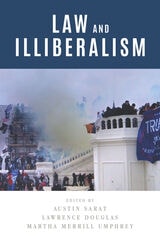
Law and Illiberalism
Edited by Austin Sarat, Lawrence Douglas, and Martha Merrill Umphrey
University of Massachusetts Press, 2022
Does the law shield citizens from authoritarian regimes? Are the core beliefs of classical liberalism—namely the rights of all individuals and constraints on state power—still protected by law? Liberalism and its expansion of rights could not exist without the legal system, and unsurprisingly, many scholars have explored the relationship between law and liberalism. However, the study of law and illiberalism is a relatively recent undertaking, a project that takes on urgency in light of the rise of authoritarian powers, among them Donald Trump’s administration, Viktor Orban’s Hungary, Recep Erdogan’s Turkey, and Jair Bolsanoro’s Brazil.
In this volume, six penetrating essays explore the dynamics of the law and illiberal quests for power, examining the anti-liberalism of neoliberalism; the weaponization of “free speech”; the role of the administrative state in current crises of liberal democracy; the broad and unstoppable assault on facts, truth, and reality; and the rise of conspiracism leading up to the Capitol insurrection. In addition to the editors, contributors include Sharon Krause, Elizabeth Anker, Jeremy Kessler, Lee McIntyre, and Nancy Rosenblum.
Post-Truth Rhetoric and Composition
Bruce Mccomiskey
Utah State University Press, 2017
Post-Truth Rhetoric and Composition is a timely exploration of the increasingly widespread and disturbing effect of “post-truth” on public discourse in the United States. Bruce McComiskey analyzes the instances of bullshit, fake news, feigned ethos, hyperbole, and other forms of post-truth rhetoric employed in recent political discourse.
The book frames “post-truth” within rhetorical theory, referring to the classic triad of logos, ethos, and pathos. McComiskey shows that it is the loss of grounding in logos that exposes us to the dangers of post-truth. As logos is the realm of fact, logic, truth, and valid reasoning, Western society faces increased risks—including violence, unchecked libel, and tainted elections—when the value of reason is diminished and audiences allow themselves to be swayed by pathos and ethos. Evaluations of truth are deferred or avoided, and mendacity convincingly masquerades as a valid form of argument.
In a post-truth world, where neither truth nor falsehood has reliable meaning, language becomes purely strategic, without reference to anything other than itself. This scenario has serious consequences not only for our public discourse but also for the study of composition.
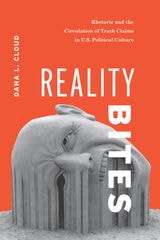
Reality Bites
Rhetoric and the Circulation of Truth Claims in U.S. Political CultureDana L. Cloud
The Ohio State University Press, 2018
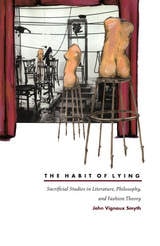
The Habit of Lying
Sacrificial Studies in Literature, Philosophy, and Fashion TheoryJohn Vignaux Smyth
Duke University Press, 2002
With recourse to Rene Girard, Paul de Man, Theodor Adorno, Leo Strauss, and other theoreticians not usually considered together, Smyth arrives at some surprising conclusions about the connections between lying, mimesis, sacrifice, sadomasochism, and the sacred, among other central subjects. Arguing that the relation between lying and truthtelling has been characterized in the West by sharply sacrificial features, he begins with a critique of the philosophies of lying espoused by Kant and Sissela Bok, then concludes that the problem of truth and lies leads to the further problem of the relation between law and arbitrariness as well as to the relation between rationality and unanimity. Constructively criticizing the work of such philosophers as Bertrand Russell, Ludwig Wittgenstein, Richard Rorty, and Nelson Goodman, Smyth shows how these problems occur comparably in fiction theory and how Paul de Man’s definition of fiction as arbitrariness finds confirmation in analytic philosophy. Through the novels of Defoe, Stendhal, and Beckett—with topics ranging from Defoe’s treatment of lies, fiction, and obscenity to Beckett’s treatment of the anus and the sacred—Smyth demonstrates how these texts generalize the issues of mendacity, concealment, and sacrificial arbitrariness in Girard’s sense to almost every aspect of experience, fiction theory, and cultural life. The final section of the book, taking its cue from Shakespeare, elaborates a sacrificial view of the history of fashion and dress concealment.
The Varnished Truth
Truth Telling and Deceiving in Ordinary LifeDavid Nyberg
University of Chicago Press, 1993
The Varnished Truth takes us beyond philosophical speculation and clinical analysis to give us a sense of what it really means to tell the truth. As Nyberg lays out the complexities involved in leading a morally decent life, he compels us to see the spectrum of alternatives to telling the truth and telling a clear-cut lie.
Truth Be Told
White Nostalgia and Antiracist Queer Resistance in “Post-Truth” AmericaLaura Elliot Tetreault
The Ohio State University Press, 2025
Taking a critical disinformation studies approach, Tetreault analyzes post-truth political messaging in the US after 2016. Using racial rhetorical criticism combined with a queer lens, they focus on how contemporary antiracist, queer, and feminist activists used various forms of cultural production to work against disinformation and its circulation, enacting refusal and insisting on the validity of their own knowledges as a form of community care. Tetreault ultimately argues that it’s not just the truth that academics must advocate for; they must question whose truth and how that truth is mediated and circulated.