Results by title
3 books match the query 'Tsunamis'
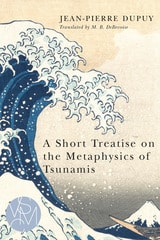
A Short Treatise on the Metaphysics of Tsunamis
Jean-Pierre Dupuy
Michigan State University Press, 2015
In 1755 the city of Lisbon was destroyed by a terrible earthquake. Almost 250 years later, an earthquake beneath the Indian Ocean unleashed a tsunami whose devastating effects were felt over a vast area. In each case, a natural catastrophe came to be interpreted as a consequence of human evil. Between these two events, two indisputably moral catastrophes occurred: Auschwitz and the bombing of Hiroshima and Nagasaki. And yet the nuclear holocaust survivors likened the horror they had suffered to a natural disaster—a tsunami.
Jean-Pierre Dupuy asks whether, from Lisbon to Sumatra, mankind has really learned nothing about evil. When moral crimes are unbearably great, he argues, our ability to judge evil is gravely impaired, and the temptation to regard human atrocity as an attack on the natural order of the world becomes irresistible. This impulse also suggests a kind of metaphysical ruse that makes it possible to convert evil into fate, only a fate that human beings may choose to avoid. Postponing an apocalyptic future will depend on embracing this paradox and regarding the future itself in a radically new way.
The American edition of Dupuy’s classic essay, first published in 2005, also includes a postscript on the 2011 nuclear accident that occurred in Japan, again as the result of a tsunami.
[more]
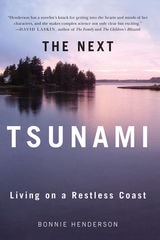
The Next Tsunami
Living on a Restless CoastBonnie Henderson
Oregon State University Press, 2014
On a March evening in 1964, ten-year-old Tom Horning awoke near midnight to find his yard transformed. A tsunami triggered by Alaska’s momentous Good Friday earthquake had wreaked havoc in his Seaside, Oregon, neighborhood. It was, as far as anyone knew, the Pacific Northwest coast’s first-ever tsunami.
More than twenty years passed before geologists discovered that it was neither Seaside’s first nor worst tsunami. In fact, massive tsunamis strike the Pacific coast every few hundred years, triggered not by distant temblors but by huge quakes less than one hundred miles off the Northwest coast. Not until the late 1990s would scientists use evidence like tree rings and centuries-old warehouse records from Japan to fix the date, hour, and magnitude of the Pacific Northwest coast’s last megathrust earthquake: 9 p.m., January 26, 1700, magnitude 9.0—one of the largest quakes the world has known. When the next one strikes—this year or hundreds of years from now—the tsunami it generates is likely to be the most devastating natural disaster in the history of the United States.
In The Next Tsunami, Bonnie Henderson shares the stories of scientists like meteorologist Alfred Wegener, who formulated his theory of continental drift while gazing at ice floes calving from Greenland glaciers, and geologist Brian Atwater, who paddled his dented aluminum canoe up coastal streams looking for layers of peat sandwiched among sand and silt. The story begins and ends with Tom Horning, who grew up to become a geologist and return to his family home at the mouth of the river in Seaside—arguably the Northwest community with the most to lose from what scientist Atwater predicts will be an “apocalyptic” disaster. No one in Seaside understands earthquake science—and the politics and complicated psychology of living in a tsunami zone—better than Horning.
Henderson’s compelling story of how scientists came to understand the Cascadia Subduction Zone—a fault line capable of producing earthquakes even larger than the 2011 Tohoku quake in Japan—and how ordinary people cope with that knowledge is essential reading for anyone interested in the charged intersection of science, human nature, and public policy
[more]
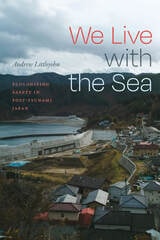
We Live with the Sea
Ecologizing Safety in Post-Tsunami JapanAndrew Littlejohn
Duke University Press, 2026
In We Live with the Sea, Andrew Littlejohn addresses the implementation and controversy surrounding safety infrastructures following the March 2011 tsunami in northeastern Japan. While the Japanese government proposed and enforced infrastructural transformations in the wake of the tsunami, these changes did not consider the impact on residents who built their communities and livelihoods around the coast. Focusing on the tsunami survivors who resisted government plans for increased coastal defenses, Littlejohn highlights alternative proposals offered by the local residents as well as the environmental, ecological, and more-than-human dependencies and imbrications those proposals reveal. In doing so, he argues that imposed modernist safety structures undermine the very things they claim to protect, showing how attempts to “ecologize” safety may offer more sustainable ways of thinking about security, preservation, and infrastructure.
[more]