Results by title
9 books match the query 'Twelfth Century'
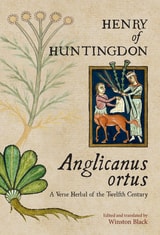
Anglicanus ortus
A Verse Herbal of the Twelfth CenturyHenry of Huntingdon
Bodleian Library Publishing, 2012
[more]
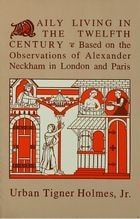
Daily Living in the Twelfth Century
Urban Tigner Holmes, Jr.
University of Wisconsin Press, 1962
“This useful reference work is a model of compact scholarship. Its modest format encloses a wealth of information. . . . Holmes shows an easy familiarity with the vast major and minor source materials centering upon 1150–1200.”—Speculum
[more]
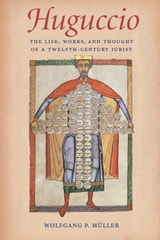
Huguccio
The Life, Works, and Thought of a Twelfth-Century JuristWolfgang Muller
Catholic University of America Press, 1994
Huguccio was an important lawyer of the medieval church, bishop of Ferrara, and one of the greatest representatives of twelfth-century scholasticism. In this book-length study of this influential figure, Wolfgang P. Müller provides a critical account of the biographical information on the man and his writings. He discusses the various aspects of Huguccio's career and thought as well as the manuscript tradition of some of his works. The author's scholarship rests on direct consultation and painstaking analysis of enormous quantities of manuscript material.
This book provides the point of departure for anyone wishing to study Huguccio first-hand. It will be worthy reading for students of medieval canon law and an essential addition to all libraries supporting research in medieval studies.
This book provides the point of departure for anyone wishing to study Huguccio first-hand. It will be worthy reading for students of medieval canon law and an essential addition to all libraries supporting research in medieval studies.
[more]
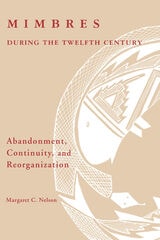
Mimbres during the Twelfth Century
Abandonment, Continuity, and ReorganizationMargaret C. Nelson
University of Arizona Press, 1999
During the mid twelfth century, villages that had been occupied by the Mimbres people in what is now southwestern New Mexico were depopulated and new settlements were formed. While most scholars view abandonment in terms of failed settlements, Margaret Nelson shows that, for the Mimbres, abandonment of individual communities did not necessarily imply abandonment of regions. By examining the economic and social reasons for change among the Mimbres, Nelson reconstructs a process of shifting residence as people spent more time in field camps and gradually transformed them into small hamlets while continuing to farm their old fields. Challenging current interpretations of abandonment of the Mimbres area through archaeological excavation and survey, she suggests that agricultural practices evolved toward the farming of multiple fields among which families moved, with small social groups traveling frequently between small pueblos rather than being aggregated in large villages. Mimbres during the Twelfth Century is the first book-length contribution on this topic for the Classic Mimbres period and also addresses current debates on the role of Casas Grandes in these changes. By rethinking abandonment, Nelson shows how movement by prehistoric cultivators maintained continuity of occupation within a region and invites us to reconsider the dynamic relationship between people and their land.
[more]
The Clerical Dilemma
Peter of Blois and Literate Culture in the Twelfth CenturyJohn D. Cotts
Catholic University of America Press, 2009
The Clerical Dilemma is the first book-length study of Peter of Blois's life, thought, and writings in any language
[more]
The Late Medieval Balkans
A Critical Survey from the Late Twelfth Century to the Ottoman ConquestJohn V. A. Fine
University of Michigan Press, 1994
"Any further advances in scholarship on the late medieval Balkans will have to begin with this book." ---George Majeska, University of Maryland The Late Medieval Balkans is the first comprehensive examination of the events of the late medieval Balkan history---events that were as important as they were fascinating. The period that John Fine examines was an era of significant demographic, political, and religious change in the region. During this time, native populations were supplemented or replaced by the Bulgars and various Slavic tribes, who were to become the Bulgarians, Serbs, and Croats---ethnic identities whose historical conflicts have persisted to this day. The Late Medieval Balkans is an important source for those who wish to expand their knowledge of this turbulent period and who wish to broaden their understanding of the region. John V. A. Fine, Jr., is Professor of History, University of Michigan.
[more]
Women of the Twelfth Century, Volume 1
Eleanor of Aquitaine and Six OthersGeorges Duby
University of Chicago Press, 1997
In this volume, Georges Duby examines the lives of prominent twelfth-century French women as well as popular female literary figures of that time. Focusing on medieval notions of women and love, Duby looks for the ideological motivations for the representation of the female sex. He analyzes the ways in which women's biographies were written and how female characters were treated in fable and legend, pointing to the social and political forces at work in these representations.
The historical personages include Eleanor of Aquitaine whose several marriages brought her wealth and autonomy; the virtuous Héloïse; and the visionary recluse Juette. Duby also studies the literary figures of St. Marie-Madeleine, a composite figure who personified the essential female traits of frailty, ardent love, and evangelicalism; Iseut, literary beloved of Tristan; and two other emblematic figures, Dorée d'Amour and Phénix—women who became ladies through chivalrous love.
Provocative, informative, and entertaining, this book offers new insight on courtly love and the representations of women under medieval patriarchy.
[more]
Women of the Twelfth Century, Volume 2
Remembering the DeadGeorges Duby
University of Chicago Press, 1997
In this volume, one of the greatest medieval historians of our time continues his rich and illuminating inquiry into the lives of twelfth-century women. Georges Duby bases his account on a twelfth-century genre that commemorated the virtues of noblewomen who had died and the roles they came to play in the history of their lineage. From these genealogical works a vivid picture emerges of the lives these women led, the values they held, and the way in which they were viewed by the ecclesiastical and chivalric writers who immortalized them.
The first section outlines the ways in which the dead—in both memory and legend—served to bond noble society in the twelfth century. Drawing on the Gesta by Dudo of Saint Quentin, the second section reflects on the roles that wives, concubines, and other women played during times of war and in the great exchanges of power that established the grand lineages of the Middle Ages. The third section reconstructs women as wives, mothers, and widows through the work of Lambert, Priest of Ardres.
The first section outlines the ways in which the dead—in both memory and legend—served to bond noble society in the twelfth century. Drawing on the Gesta by Dudo of Saint Quentin, the second section reflects on the roles that wives, concubines, and other women played during times of war and in the great exchanges of power that established the grand lineages of the Middle Ages. The third section reconstructs women as wives, mothers, and widows through the work of Lambert, Priest of Ardres.
[more]
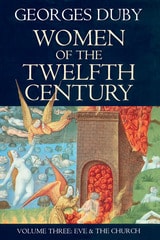
Women of the Twelfth Century, Volume 3
Eve and the ChurchGeorges Duby
University of Chicago Press, 1998
In this volume, Georges Duby studies the relationship between the Church and women in twelfth-century Europe. By that time, the Church had begun to see the evolving roles and expectations of women as serious matters, resulting in a wide range of clerical writings addressing "the woman question."
Drawing on these writings, Duby describes how women were thought to embody particular sins, such as sorcery, disobedience, and licentiousness. He evaluates Eve's role in man's fall from grace in the Garden of Eden and analyzes the reasoning behind the view that women are unstable, curious, frivolous creatures. He also notes that these charges are leveled against women, even as praise is heaped upon them for the conventional virtues they exhibit in their roles as wives and mothers.
As the final installment in Duby's three-volume study of French noblewomen of the twelfth century, Eve and the Church is the last work of this superb historian. It will be of interest to scholars of medieval history and women's history as well as to anyone interested in current debates about women and religion.
Georges Duby (1919-1996) was a member of the Académie française and for many years held the distinguished chair in medieval history at the Collège de France. His books include The Three Orders; The Age of Cathedrals; The Knight, the Lady, and the Priest; Love and Marriage in the Middle Ages; and History Continues, all published by the University of Chicago Press.
[more]