Results by title
20 books match the query 'Untold Story'
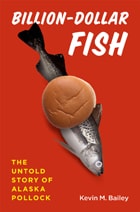
Billion-Dollar Fish
The Untold Story of Alaska PollockKevin M. Bailey
University of Chicago Press, 2013
In Billion-Dollar Fish, Kevin M. Bailey combines his years of firsthand pollock research with a remarkable talent for storytelling to offer the first natural history of Alaska pollock. Crucial to understanding the pollock fishery, he shows, is recognizing what aspects of its natural history make pollock so very desirable to fish, while at the same time making it resilient, yet highly vulnerable to overfishing. Bailey delves into the science, politics, and economics surrounding Alaska pollock in the Bering Sea, detailing the development of the fishery, the various political machinations that have led to its current management, and, perhaps most important, its impending demise. He approaches his subject from multiple angles, bringing in the perspectives of fishermen, politicians, environmentalists, and biologists, and drawing on revealing interviews with players who range from Greenpeace activists to fishing industry lawyers.
Seamlessly weaving the biology and ecology of pollock with the history and politics of the fishery, as well as Bailey’s own often raucous tales about life at sea, Billion-Dollar Fish is a book for every person interested in the troubled relationship between fish and humans, from the depths of the sea to the dinner plate.
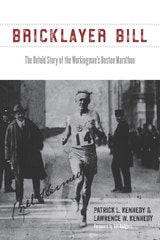
Bricklayer Bill
The Untold Story of the Workingman's Boston MarathonPatrick L. Kennedy and Lawrence W. Kennedy
University of Massachusetts Press, 2017
Two weeks after the United States officially entered World War I, Irish American “Bricklayer Bill” Kennedy won the Boston Marathon wearing his stars-and-stripes bandana, rallying the crowd of patriotic spectators. Kennedy became an American hero and, with outrageous stories of his riding the rails and sleeping on pool tables, a racing legend whose name has since appeared in almost every book written on the Boston Marathon.
When journalist Patrick Kennedy and historian Lawrence Kennedy unearthed their uncle's unpublished memoir, they discovered a colorful character who lived a tumultuous life, beyond his multiple marathons. The bricklayer survived typhoid fever, a five-story fall, auto and train accidents, World War action, Depression-era bankruptcy, decades of back-breaking work, and his own tendency to tipple. In many ways, Bill typified the colorful, newly emerging culture and working-class ethic of competitive long-distance running before it became a professionalized sport. Bricklayer Bill takes us back to another time, when bricklayers, plumbers, and printers could take the stage as star athletes.

Exiled in L.A.
The Untold Story of Leopold Fischer’s Domestic ArchitectureVolker M. Welter
J. Paul Getty Trust, The, 0
In 1936, Leopold Fischer (1901–1975), in exile from Nazi Germany, arrived in California, where he created a small but distinct oeuvre of mostly domestic architecture. In contrast to his famous peers Rudolph Schindler and Richard Neutra, immigrants whose Southern California buildings are frequently examined—and who, like Fischer, studied with the modernist architect Adolf Loos—Fischer and his California structures have, until now, escaped the attention of architectural history.
Exiled in L.A. examines Fischer’s important, yet overlooked, contributions to Southern California architecture. As the whereabouts of Fischer’s archives remain unknown, Volker M. Welter grounds the designer’s California works in comparison with his pre-exile projects and the compositions of fellow architects in California. In the 1920s, Fischer created experimental working-class housing estates in Germany that pioneered ecological construction and living practices. Comparable to their predecessors, Fischer's California buildings revolve around the “functioning, the organization of a home,” as he defined domestic architecture in 1926. Featuring new photography and detailed architectural plans, this book is an original contribution to the literature on Southern California’s built heritage.
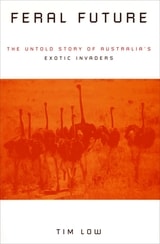
Feral Future
The Untold Story of Australia's Exotic InvadersTim Low
University of Chicago Press, 2002
Australia is far from alone in facing horrific ecological and economic damage from invading plants and animals, and in Low's capable hands, Australia's experiences serve as a wake-up call for all of us. He covers how invasive species like cane toads and pond apple got to Australia (often through misguided but intentional introductions) and what we can do to stop them. He also covers the many pests that Australia has exported to the world, including the paperbark tree (Melaleuca) that infests hundreds of thousands of acres in south Florida.
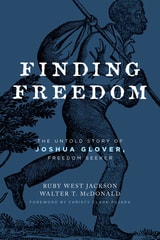
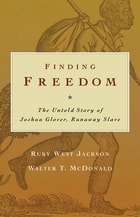
Finding Freedom
The Untold Story of Joshua Glover, Freedom SeekerRuby West Jackson
Wisconsin Historical Society Press, 2022
Finding Freedom
The Untold Story of Joshua Glover, Runaway SlaveWalter T. McDonald
Wisconsin Historical Society Press, 2007
"Shall a man be dragged back to Slavery from our Free Soil, without an open trial of his right to Liberty?" —Handbill circulated in Milwaukee on March 11, 1854
In Finding Freedom, Ruby West Jackson and Walter T. McDonald provide readers with the first narrative account of the life of Joshua Glover, the runaway slave who was famously broken out of jail by thousands of Wisconsin abolitionists in 1854. Employing original research, the authors chronicle Glover's days as a slave in St. Louis, his violent capture and thrilling escape in Milwaukee, his journey on the Underground Railroad, and his 33 years of freedom in rural Canada.
While Jackson and McDonald demonstrate how the catalytic "Glover incident" captured national attention—pitting the proud state of Wisconsin against the Supreme Court and adding fuel to the pre-Civil War fire—their primary focus is on the ordinary citizens, both black and white, with whom Joshua Glover interacted. A bittersweet story of bravery and compassion, Finding Freedom provides the first full picture of the man for whom so many fought, and around whom so much history was made.
Finding Freedom
The Untold Story of Joshua Glover, Runaway SlaveWalter T. McDonald
Wisconsin Historical Society Press, 2012
"Shall a man be dragged back to Slavery from our Free Soil, without an open trial of his right to Liberty?" —Handbill circulated in Milwaukee on March 11, 1854
In Finding Freedom, Ruby West Jackson and Walter T. McDonald provide readers with the first narrative account of the life of Joshua Glover, the runaway slave who was famously broken out of jail by thousands of Wisconsin abolitionists in 1854. Employing original research, the authors chronicle Glover's days as a slave in St. Louis, his violent capture and thrilling escape in Milwaukee, his journey on the Underground Railroad, and his 33 years of freedom in rural Canada.
While Jackson and McDonald demonstrate how the catalytic "Glover incident" captured national attention—pitting the proud state of Wisconsin against the Supreme Court and adding fuel to the pre-Civil War fire—their primary focus is on the ordinary citizens, both black and white, with whom Joshua Glover interacted. A bittersweet story of bravery and compassion, Finding Freedom provides the first full picture of the man for whom so many fought, and around whom so much history was made.
Finding Freedom
The Untold Story of Joshua Glover, Runaway SlaveWalter T. McDonald
Wisconsin Historical Society Press, 2012
"Shall a man be dragged back to Slavery from our Free Soil, without an open trial of his right to Liberty?" —Handbill circulated in Milwaukee on March 11, 1854
In Finding Freedom, Ruby West Jackson and Walter T. McDonald provide readers with the first narrative account of the life of Joshua Glover, the runaway slave who was famously broken out of jail by thousands of Wisconsin abolitionists in 1854. Employing original research, the authors chronicle Glover's days as a slave in St. Louis, his violent capture and thrilling escape in Milwaukee, his journey on the Underground Railroad, and his 33 years of freedom in rural Canada.
While Jackson and McDonald demonstrate how the catalytic "Glover incident" captured national attention—pitting the proud state of Wisconsin against the Supreme Court and adding fuel to the pre-Civil War fire—their primary focus is on the ordinary citizens, both black and white, with whom Joshua Glover interacted. A bittersweet story of bravery and compassion, Finding Freedom provides the first full picture of the man for whom so many fought, and around whom so much history was made.
Firebrands
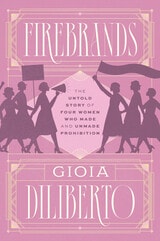
The Untold Story of Four Women Who Made and Unmade ProhibitionGioia Diliberto
University of Chicago Press, 2024
In the popular imagination, the story of Prohibition in America is a story of men and male violence, one full of federal agents fighting gangsters over the sale of moonshine. In contrast, Firebrands is the story of four Jazz Age dynamos—all women –who were forces behind the passage, the enforcement, the defiance, and, ultimately, the repeal of the Eighteenth Amendment. They battled each other directly, and they learned to marshal clout with cowed and hypocritical legislators, almost all of them men. Their clash over Prohibition stands as the first significant exercise of women’s political power since women gained the right to vote, and their influence on the American political scene wouldn’t be equaled for decades.
In Gioia Diliberto’s fresh and timely take on this period of history, we meet Ella Boole, the stern and ambitious leader of the Woman’s Christian Temperance Union, who campaigned fiercely to introduce Prohibition and fought desperately to keep it alive. We also meet Mabel Walker Willebrandt, the most powerful woman in America at the time, who served as the top federal prosecutor charged with enforcing Prohibition. Diliberto tells the story, too, of silent film star Texas Guinan, who ran New York speakeasies backed by the mob and showed that Prohibition was not only absurd but unenforceable. And, she follows Pauline Morton Sabin, a glamorous Manhattan aristocrat who belatedly recognized the cascading evil in Prohibition and mobilized the movement to kill it.
These women led their opposing forces of “Wets” and “Drys” across a teeming landscape of bootleggers, gangsters, federal agents, temperance fanatics, and cowardly politicians, many of them secret drunks. Building on the momentum of suffrage, they forged a path for the activists who followed during the great civil rights battles of the mid-twentieth century. Yet, they have been largely lost to history. In Firebrands, Diliberto finally gives these dynamic figures their due, creating a varied and dramatic portrait of women wielding power, in politics, society, and popular culture.
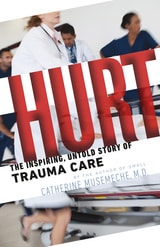
Hurt
The Inspiring, Untold Story of Trauma CareCatherine Musemeche
Dartmouth College Press, 2016
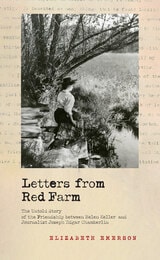
Letters from Red Farm
The Untold Story of the Friendship between Helen Keller and Journalist Joseph Edgar ChamberlinElizabeth Emerson
University of Massachusetts Press, 2021
Informed by previously unpublished letters and extensive research, Letters from Red Farm explores for the first time Keller's deep and enduring friendship with the man who became her literary mentor and friend for over forty years. Written by Chamberlin's great-great granddaughter, this engaging story imparts new insights into Keller's life and personality, introduces the irresistible Chamberlin to a modern public, and follows Keller's burgeoning interest in social activism, as she took up the causes of disability rights, women's issues, and pacifism.
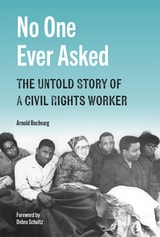
No One Ever Asked
The Untold Story of a Civil Rights WorkerArnold Rochvarg
University of Missouri Press, 2025
Rochvarg, the cousin of the woman around whom the narrative revolves, had for over fifty years been intrigued by the mystery surrounding the seven-year disappearance of his cousin Iris during the 1960s. Once he finally approached her about her rumored involvement in the civil rights movement, she generously shared her experiences with him and arranged for him to meet others with whom she had worked. His book corroborates and enhances the stories he was told through traditional research based on primary and secondary sources.
More than a review of significant events of the mid-1960s, No One Ever Asked is also the story of the challenges and sacrifices of young civil rights workers both Black and white, young persons who not only faced violence and personal harm, but in many cases became estranged from their families because of their involvement in the movement. Rochvarg approaches history from the “bottom-up,” focusing on persons whose stories have never been told but have something to add to an understanding of the history of the movement. Many of them, even sixty years later, have never shared their stories because, as in the case of the central character of this book, no one ever asked them.
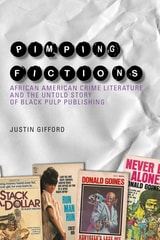
Pimping Fictions
African American Crime Literature and the Untold Story of Black Pulp PublishingJustin Gifford
Temple University Press, 2013
Gifford draws from an impressive array of archival materials to provide a first-of-its-kind literary and cultural history of this distinctive genre. He evaluates the artistic and symbolic representations of pimps, sex-workers, drug dealers, and political revolutionaries in African American crime literature-characters looking to escape the racial containment of prisons and the ghetto.
Gifford also explores the struggles of these black writers in the literary marketplace, from the era of white-owned publishing houses like Holloway House-that fed books and magazines like Players to eager black readers-to the contemporary crop of African American women writers reclaiming the genre as their own.
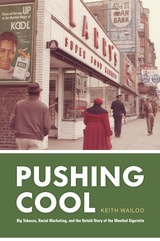
Pushing Cool
Big Tobacco, Racial Marketing, and the Untold Story of the Menthol CigaretteKeith Wailoo
University of Chicago Press, 2021
Police put Eric Garner in a fatal chokehold for selling cigarettes on a New York City street corner. George Floyd was killed by police outside a store in Minneapolis known as “the best place to buy menthols.” Black smokers overwhelmingly prefer menthol brands such as Kool, Salem, and Newport. All of this is no coincidence. The disproportionate Black deaths and cries of “I can’t breathe” that ring out in our era—because of police violence, COVID-19, or menthol smoking—are intimately connected to a post-1960s history of race and exploitation.
In Pushing Cool, Keith Wailoo tells the intricate and poignant story of menthol cigarettes for the first time. He pulls back the curtain to reveal the hidden persuaders who shaped menthol buying habits and racial markets across America: the world of tobacco marketers, consultants, psychologists, and social scientists, as well as Black lawmakers and civic groups including the NAACP. Today most Black smokers buy menthols, and calls to prohibit their circulation hinge on a history of the industry’s targeted racial marketing. In 2009, when Congress banned flavored cigarettes as criminal enticements to encourage youth smoking, menthol cigarettes were also slated to be banned. Through a detailed study of internal tobacco industry documents, Wailoo exposes why they weren’t and how they remain so popular with Black smokers.
School Yearbook
The Untold Story of a Cringey Tradition and Its Digital AfterlifeKate Eichhorn
University of Chicago Press, 2025
We’re all familiar with the embarrassment that washes over us when recalling our high school yearbooks. Questionable fashion choices, gravity-defying hair, a melodramatic quote—what were we thinking? Even as school yearbooks decline in popularity among contemporary teens, they continue to impact our lives in shocking ways. Collected, digitized, aggregated, and recombined in ways that would have been impossible to imagine just a few decades ago, yearbooks are no longer bound personal archives of adolescent memories. In the twenty-first century, they are shaping our lives in surprising and sometimes disturbing ways. And what could be a more fitting afterlife for these cringey books?
In School Yearbook, cultural critic Kate Eichhorn investigates this ubiquitous object. On the surface, school yearbooks are easily dismissed as innocuous collections of embarrassing photographs and cheesy affirmations, but as Eichhorn reveals, there has never been anything innocent about the school yearbook tradition. Since the early twentieth century, yearbooks have circulated as forms of public relations, propaganda, and hate speech. They have been routinely used by police detectives, private investigators, and even the FBI to identify and profile suspects. With over half a million yearbooks now available online, these books have also acquired the power to continue shaping our lives long after graduation. Would-be landlords, employers, and even creditors can now turn to data culled from their embarrassing pages to make judgments about who we are and what we merit.
In a digital era, school yearbooks have acquired the ability to keep judging us in perpetuity. Both timely and insightful, School Yearbook explores how these books have always been used to rank and judge us.
Secret Witness
The Untold Story of the 1967 Bombing in Marshall, MichiganBlaine Pardoe
University of Michigan Press, 2012
Every small town has a moment when the real world abruptly intrudes, shattering the town's notions of itself and its people. For citizens of Marshall, Michigan, that moment came August 18, 1967. Nola Puyear was working downtown at the Tasty Cafe that morning when she received a package. She opened it and was instantly killed in a fiery explosion.
In the months that followed, law enforcement and prosecutors wrestled with a crime that to all appearances was senseless. Evidence recovered from the blown-up restaurant, including a bottle of pills that had been tainted with lye, suggested a concerted plot to murder Mrs. Puyear. But why had someone wanted to kill the well-liked woman, by all accounts a pillar of her close-knit community? For that matter, was Marshall really the quaint paradise it seemed to be?
Secret Witness brings to light startling new evidence and freshly uncovered facts to address these and other questions that, to this day, surround one of Michigan's most brutal murders. Based on extensive interviews with surviving prosecutors, police, and witnesses, Blaine Pardoe re-creates the investigation that pried into Marshall's dark underbelly and uncovered the seamy private lives led by some of the town's citizenry but led to only tenuous theories about the bombing. The book also examines the pivotal role played by the Secret Witness program, an initiative by the Detroit News that offered rewards for anonymous tips related to violent crimes. What's ultimately revealed is the true depth of evil that occurred in Marshall that day. Every small town has dirty little secrets. This time, they were deadly.
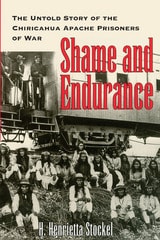
Shame and Endurance
The Untold Story of the Chiricahua Apache Prisoners of WarH. Henrietta Stockel
University of Arizona Press, 2004
First removed from Arizona to Florida, the prisoners were eventually relocated to Mount Vernon Barracks in Alabama, where, in the words of one Apache, "We didn’t know what misery was until they dumped us in those swamps." Pulmonary disease took its toll—by 1894, disease had killed nearly half of the Apaches—and after years of pressure from Indian rights activists and bureaucratic haggling, Fort Sill in Oklahoma was chosen as a more healthful location. Here they were given the opportunity to farm, and here Geronimo, who eventually converted to Christianity, died of pneumonia in 1909 at the age of 89, still a prisoner of war. In the meantime, many Apache children had been removed to Carlisle, Pennsylvania, for education—despite earlier promises that families would not be split up—and most eventually lost their cultural identity.
Henrietta Stockel has combed public records to reconstruct this story of American shame and Native endurance. Unabashedly speaking on behalf of the Apaches, she has framed these documents within a readable narrative to show how exasperated public officials, eager to openly demonstrate their superiority over "savages" who had successfully challenged the American military for years, had little sympathy for the consequences of their confinement. Although the Chiricahua Apaches were not alone in losing their ancestral homelands, they were the only American Indians imprisoned for so long a time in an environment that continually exposed them to illnesses against which they had no immunity, devastating families even more than warfare. Shame and Endurance records events that ought never to be repeated—and tells a story that should never be forgotten.

Somalia - the Untold Story
The War Through the Eyes of Somali WomenEdited by Judith Gardner and Judy El Bushra
Pluto Press, 2004
In this book, Somali women write and talk about the war, their experiences and the unacceptable choices they often faced. They explain clearly, in their own words, the changes, challenges – and sometimes the opportunities – that war brought, and how they coped with them.
Key themes include the slaughter and loss of men, who were the prime target for killings; rape and sexual violence as a weapon of war; changing roles in the family and within the pastoralist economy; women mobilising for peace; and leading social recovery in a war-torn society.
This book is not only an important record of women's experience of war, but also provides researchers and students of gender and conflict with rare first hand accounts highlighting the impact of war on gender relations, and women's struggle for equal political rights in a situation of state collapse.
The Untold Story
Women and Theory in Golden Age TextsMary S. Gossy
University of Michigan Press, 1990
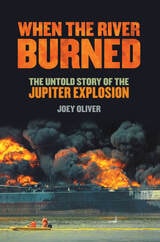
When the River Burned
The Untold Story of the Jupiter ExplosionJoey Oliver
Michigan State University Press, 2026
On September 16, 1990, the tanker ship Jupiter exploded while unloading gasoline at a Bay City pier on the Saginaw River. The blast killed one worker, injured eleven others, and triggered what the U.S. Coast Guard later described as an unprecedented crisis on the Great Lakes. For weeks, the disaster commanded national attention as officials worked to contain the damage and investigate the cause. Then, like so many industrial accidents, the story faded from public memory.
When the River Burned tells the story of this overlooked chapter in Great Lakes maritime history. Drawing on newspaper archives, Coast Guard investigations, and eyewitness accounts, Joey Oliver reconstructs how a series of small oversights—in equipment, procedure, and human judgment—aligned to produce catastrophe.
The book places the Jupiter explosion within a broader history of the Saginaw River, tracing its evolution into a vital artery of Michigan industry. Oliver examines the fragile interdependence of ships, piers, and river traffic, revealing how disasters emerge not from single causes but from the breakdown of complex systems. When the River Burned is not only the account of a deadly tanker explosion; it is a reflection on what caused it, on the safety changes that followed, and on changes that never came.