Results by title

9 books match the query 'Verb phrase'
cover of Argument Realization

Argument Realization

Edited by Miriam Butt and Tracy Holloway King

CSLI, 2001
[more]
cover of Bantu Applicative Constructions

Bantu Applicative Constructions

Sara Pacchiarotti

CSLI, 2019
This book addresses various shortcomings in definitions of “applicative” when compared to what is actually found across languages and proposes a four-way distinction among applicative constructions, especially relevant to Bantu, a large family of languages spoken in Sub-Saharan Africa.
[more]
cover of Beyond Alternations

Beyond Alternations

Laura A. Michaelis and Josef Ruppenhofer

CSLI, 2001

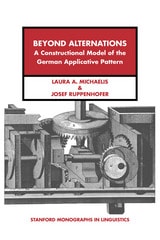
Beyond Alternations provides a unified account of the semantic effects of the German applicative ("be-") construction. Using natural data from a variety
of corpora, the authors propose that this pattern is inherently meaningful and that its meaning provides the basis for creative extensions.
[more]
cover of Complex Predicates

Complex Predicates

Edited by Alex Alsina, Joan Bresnan, and Peter Sells

CSLI, 1996
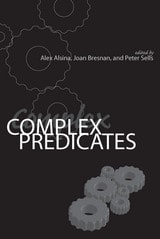
Complex predicates can be defined as predicates which are composed of more than one grammatical element (either morphemes or words), each of which contributes a non-trivial part of the information of the complex predicate. The papers collected in this volume, which were presented at a workshop at Stanford in 1993, represent a variety of approaches to the question of the range and nature of complex predicates, and draw on data from a wide spectrum of languages. This collection develops a better understanding of the range of phenomena that a general theory of complex predicates would have to account for, and to see what kinds of linguistic ideas and methodologies would be necessary for such a task.
[more]
cover of Complex Predicates and Information Spreading in LFG

Complex Predicates and Information Spreading in LFG

Avery D. Andrews and Christopher D. Manning

CSLI, 1999
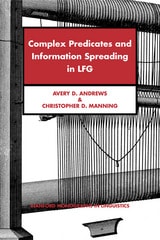
This book provides a simple but precise framework for describing complex predicates and related constructions, and applies it principally to the analysis of complex predicates in Romance, and certain serial verb constructions in Tariana and Miskitu. The authors argue for replacing the projection architecture of LFG with a notion of differential information spreading within a unified feature structure. Another important feature is the use of the conception of argument-structure in Chris Manning's Ergativity to facilitate the description of how complex predicates are assembled. In both of these aspects the result is a framework that preserves the descriptive parsimony of LFG while taking on key ideas from HPSG.
[more]
cover of Complex Predicates in Japanese: A Syntactic and Semantic Study of the Notion 'Word'

Complex Predicates in Japanese

A Syntactic and Semantic Study of the Notion 'Word'

Yo Matsumoto

CSLI, 1996

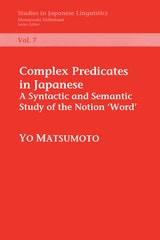
In this thoroughly revised version of 1992 Stanford dissertation, the author presents an extensive discussion of Japanese complex predicates. A broad range of constructions and predicates are discussed, which include predicative complement constructions, light verbs, causative predicates, desiderative predicates, syntactic and lexical compound verbs, and complex motion predicates. A number of new interesting facts are uncovered, and a detailed syntactic and semantic analyses are presented. On the basis of the analyses, the author argues that the notion 'word' must be relativized to at least three different senses: morphological, grammatical (functional), and semantic; and that this observation can be insightfully captured in the theory of Lexical-Functional Grammar. Previous proposals for each type of predicate that involve such mechanisms as argument transfer, incorporation, restructuring, etc. are thoroughly reviewed. Concrete proposals on the constraints on semantic wordhood are also made (an issue rarely discussed in the literature), drawing insights from cognitive linguistics.
[more]
cover of Postverbal Behavior

Postverbal Behavior

Thomas Wasow

CSLI, 2002
Compared to many languages, English has relatively fixed word order, but the ordering among phrases following the verb exhibits a good deal of variation. This monograph explores factors that influence the choice among possible orders of postverbal elements, testing hypotheses using a combination of corpus studies and psycholinguistic experiments. Wasow's final chapters explore how studies of language use bear on issues in linguistic theory, with attention to the roles of quantitative data and Chomsky's arguments against the use of statistics and probability in linguistics.
[more]
cover of Predicative Constructions: From the Fregean to a Montagovian Treatment

Predicative Constructions

From the Fregean to a Montagovian Treatment

Frank Van Eynde

CSLI, 2015

There are multitudes of ways in which predicative constructions can be analyzed. In this book, Frank Van Eynde differentiates between the Fregean and Montagovian treatments of these constructions in order to better understand predicative constructions as a grammatical model. Although he focuses his arguments on English and Dutch, Van Eynde also includes analyses of other Indo-European and non-Indo-European languages in order to better explore phenomena that do not occur in the two primary languages of his study.
[more]
cover of The History of Tense/Aspect/Mood/Voice in the Mayan Verbal Complex

The History of Tense/Aspect/Mood/Voice in the Mayan Verbal Complex

By John S. Robertson

University of Texas Press, 1992

Mayan civilization, renowned for its mathematics, writing, architecture, religion, calendrics, and agriculture, fascinates scholars and a wide lay public as archaeology and glyphic decipherment reveal more of its secrets. In this pathfinding study of the Mayan language family, John S. Robertson explores major changes that have occurred in the core of Mayan grammar from the earliest, reconstructed ancestral language down through the colonial languages to the modern languages that are spoken today.

Building on groundwork already laid in phonological studies and in the study of the pronominal system, Robertson's examination of tense/ aspect/ mood/voice is the next logical step in the general linguistic study of Mayan. Robertson offers careful consideration of all the major subgroups of Mayan, from Yucatecan to Quichean, as they are spoken today. He also draws extensively on colonial documents assembled by bilingual Spanish-Mayan speaking clerics. These documents provide a check on the accuracy of both the reconstructed ancient language, Common Mayan, and the theoretical evolution of the modern languages from this ancestor. The study will also be of value to students of the Maya glyphs, since it discusses the grammatical system that most probably underlies the glyphic representations.

Beyond its obvious interest for Mayan linguistics, the study proposes a theory of language change that will be important for all students of comparative linguistics. Robertson's work sets forth the basic, universal assumptions that provide for an appropriate description of the grammatical systems of all languages. It will be a significant reference for future researchers.

[more]