Results by title
99 books match the query 'Vietnam' and 8 start with a
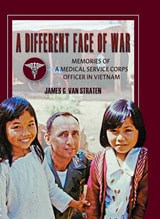
A Different Face of War
Memories of a Medical Service Corps Officer in VietnamJames G. Van Straten
University of North Texas Press, 2015
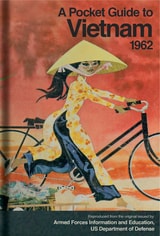
A Pocket Guide to Vietnam, 1962
Edited by The Bodleian Library
Bodleian Library Publishing, 2012
For most Americans in the 1960s, Vietnam was a faraway land of which they had little or no knowledge. Yet soon, hundreds of thousands of young American men and women would find themselves on the other side of the globe, fighting—and, in many cases, living—with the Vietnamese people. To lessen the culture shock, the Department of Defense prepared A Pocket Guide to Vietnam, 1962, a remarkably compact and surprisingly timeless crash course in Vietnamese culture for visitors to this foreign land.
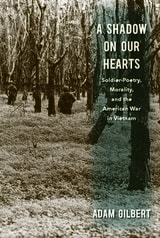
A Shadow on Our Hearts
Soldier-Poetry, Morality, and the American War in VietnamAdam Gilbert
University of Massachusetts Press, 2018
The soldier-poets provide important insights into the ethical dimensions of their physical and psychological surroundings before, during, and after the war. They also offer profound perspectives on the relationships between American soldiers and the Vietnamese people. From firsthand experiences, they reflect on what it meant to be witnesses, victims, and perpetrators of the war's violence. And they advance an uncompromising vision of moral responsibility that indicts a range of culprits for the harms caused by the conflict. Gilbert explores the powerful and perceptive work of these soldier-poets through the lens of morality and presents a radically alternative, deeply personal, and ethically penetrating account of the American war in Vietnam.
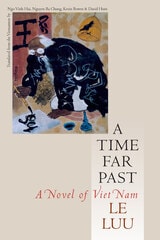
A Time Far Past
A Novel of Viet NamLe Luu
University of Massachusetts Press, 1997
In its intricate sketching of complicated alliances, personal debts, and human interactions, A Time Far Past explores the complex layering of family and village history and Party and feudal authority. It also paints a vivid picture of the vast dislocations in Vietnamese culture caused by the political and military turmoil of the Indochina wars.
A Time Far Past was enormously popular in Vietnam, where it was first published in 1986, selling more than 120,000 copies and winning that country's national prize for fiction.
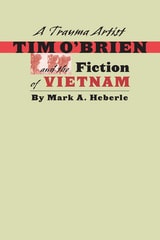
A Trauma Artist
Tim O'Brien and the Fiction of VietnamMark A. Heberle
University of Iowa Press, 2001
A Trauma Artist examines how O'Brien's works variously rewrite his own traumatization during the war in Vietnam as a never-ending fiction that paradoxically "recovers" personal experience by both recapturing and (re)disguising it. Mark Heberle considers O'Brien's career as a writer through the prisms of post-traumatic stress disorder, postmodernist metafiction, and post-World War II American political uncertainties and public violence.
Based on recent conversations with O'Brien, previously published interviews, and new readings of all his works through 1999, this book is the first study to concentrate on the role and representation of trauma as the central focus of all O'Brien's works, whether situated in Vietnam, in post-Vietnam America, or in the imagination of protagonists suspended between the two. By doing so, Heberle redefines O'Brien as a major U.S. writer of the late twentieth century whose representations of self-damaging experiences and narratives of recovery characterize not only the war in Vietnam but also relationships between fathers and sons and men and women in the post-traumatic culture of the contemporary United States.
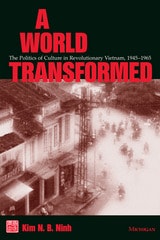
A World Transformed
The Politics of Culture in Revolutionary Vietnam, 1945-1965Kim N. B. Ninh
University of Michigan Press, 2002
The study covers the period from the Vietnamese communists' initial ascent to power in 1945 to the beginning of the escalation of the American involvement in the country's conflict in 1965, by which time a full-fledged socialist state had been in place in North Vietnam for eleven years. Through a nuanced examination of critical intellectual works, A World Transformed presents a complex view of a period fraught with contradictory possibilities and tensions that continue to resonate in Vietnam today. The extensive use of Vietnamese-language materials, access to archival data never before available, and innovative incorporation of literary and historical sources combine to make this study an invaluable depiction of the Vietnamese revolution.
Kim N. B. Ninh is Assistant Director of the Governance, Law, and Civil Society Programs, The Asia Foundation, San Francisco.
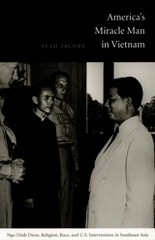
America's Miracle Man in Vietnam
Ngo Dinh Diem, Religion, Race, and U.S. Intervention in Southeast AsiaSeth Jacobs
Duke University Press, 2004
A diplomatic and cultural history, America’s Miracle Man in Vietnam draws on government archives, presidential libraries, private papers, novels, newspapers, magazines, movies, and television and radio broadcasts. Jacobs shows in detail how, in the 1950s, U.S. policymakers conceived of Cold War anticommunism as a crusade in which Americans needed to combine with fellow Judeo-Christians against an adversary dangerous as much for its atheism as for its military might. He describes how racist assumptions that Asians were culturally unready for democratic self-government predisposed Americans to excuse Diem’s dictatorship as necessary in “the Orient.” By focusing attention on the role of American religious and racial ideologies, Jacobs makes a crucial contribution to our understanding of the disastrous commitment of the United States to “sink or swim with Ngo Dinh Diem.”
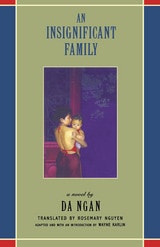
An Insignificant Family
Da Ngan
Northwestern University Press, 2009