Results by title
42 books match the query 'View'
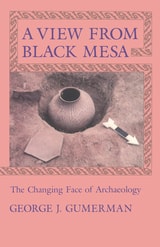
A View From Black Mesa
The Changing Face of ArchaeologyGeorge J. Gumerman
University of Arizona Press, 1984
"In clear and nontechnical language it provides readers with a synopsis of Anasazi prehistory and cultural ecology. ...Gumerman's work is especially useful for anyone seeking an `on-site' introduction to some of the basic techniques and research orientations of modern American archaeology. Highly recommended for students and general readers." —Choice
"It should be read with thoughtful care by the `professional' archaeologist and ethnographer. And it will even more effectively serve the informed general reader, unconcerned with academic minutiae, through its fresh and direct exposition of the procedures, frustrations, and rewards of the calling." —The Kiva
"An outstanding success....a readable book that is suitable for professional archaeologists and the general public as well." —North American Archaeologist
"A readable book that is suitable for professional archaeologists and the general public." —North American Archaeologist

A View from Life's Edge
Discovering What Really Matters with Older Women Across the GlobeCorinne G. Dempsey
Rutgers University Press, 2026
Speaking with nearly one hundred women over the age of eighty in four locations—northern Iceland, south India, a retirement community in California, and a convent in upstate New York—Corinne G. Dempsey finds that, as we near life’s end, we gain clarity about what really matters in life. Women’s stories and reflections, in which sorrow and loss are central to a life well lived, help to expand our sense of what it means to be human.
Drawing on the paradoxical wisdom of world religions and mystical traditions to frame late-life tendencies across cultures, Dempsey portrays these accounts as a corrective to mainstream values that defeat and diminish us. Dempsey encourages us to turn away from ageist fears rather than denying life’s inevitable end. Learning from older women’s perspectives, we might move their edge-of-life views closer to the center.
A View from the Bottom
Asian American Masculinity and Sexual RepresentationNguyen Tan Hoang
Duke University Press, 2014
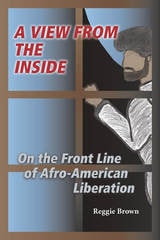
A View from the Inside
On the Front Line of Afro-American LiberationReggie Brown
Southern Illinois University Press, 2017
Brown joined the Black Panther Party and met with Fred Hampton, the Illinois chapter’s deputy chairman, engaging the man to speak at SIU just three weeks before his infamous assassination by Chicago police under orders from the FBI. Soon after, tensions would escalate into violence closer to home. Before his work in Carbondale was over, Brown would survive a terrible betrayal, an explosion that resulted in a month-long coma, the amputation of a leg, and a poisoning that was attempted as he lay in his hospital bed. After Brown’s injuries forced him to withdraw from Carbondale, his group would be falsely accused of shooting a local police officer, and their residence would be attacked with gunfire and tear gas. The narrative also reveals the challenges and struggles he faced in dealing with physical disabilities and the consequences of addiction.
A View from the Inside offers not only a fresh perspective on racial conflicts in southern Illinois during a pivotal era but also reflections on black identity, leadership, drug addiction, and more. In original poetry and rap as well as prose, Brown reveals a fascinating and significant moment in African American history.
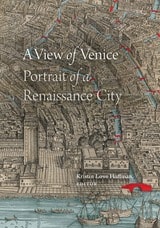
A View of Venice
Portrait of a Renaissance CityKristin Love Huffman, editor
Duke University Press, 2024
Contributors. Karen-edis Barzman, Andrea Bellieni, Patricia Fortini Brown, Valeria Cafà, Stanley Chojnacki, Tracy E. Cooper, Giada Damen, Julia A. DeLancey, Piero Falchetta, Ludovica Galeazzo, Maartje van Gelder, Jonathan Glixon, Richard Goy, Anna Christine Swartwood House, Kristin Love Huffman, Holly Hurlburt, Claire Judde de Larivière, Blake de Maria, Martina Massaro, Cosimo Monteleone, Monique O’Connell, Mary Pardo, Giorgio Tagliaferro, Saundra Weddle, Bronwen Wilson, Rangsook Yoon
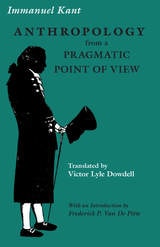
Anthropology from a Pragmatic Point of View
Immanuel Kant. Translated by Victor Lyle Dowdell. Revised and Edited by Hans H. Rudnick
Southern Illinois University Press, 1996
In the fall semester of 1772/73 at the Albertus University of Königsberg, Immanuel Kant, metaphysician and professor of logic and metaphysics, began lectures on anthropology, which he continued until 1776, shortly before his retirement from public life. His lecture notes and papers were first published in 1798, eight years after the publication of the Critique of Judgment, the third of his famous Critiques. The present edition of the Anthropology is a translation of the text found in volume 7 of Kants gesammelte Schriften, edited by Oswald Külpe.
Kant describes the Anthropology as a systematic doctrine of the knowledge of humankind. (He does not yet distinguish between the academic discipline of anthropology as we understand it today and the philosophical.) Kant’s lectures stressed the "pragmatic" approach to the subject because he intended to establish pragmatic anthropology as a regular academic discipline. He differentiates the physiological knowledge of the human race—the investigation of "what Nature makes of man"—from the pragmatic—"what man as a free being makes of himself, what he can make of himself, and what he ought to make of himself." Kant believed that anthropology teaches the knowledge of humankind and makes us familiar with what is pragmatic, not speculative, in relation to humanity. He shows us as world citizens within the context of the cosmos.
Summarizing the cloth edition of the Anthropology, Library Journal concludes: "Kant’s allusions to such issues as sensation, imagination, judgment, (aesthetic) taste, emotion, passion, moral character, and the character of the human species in regard to the ideal of a cosmopolitan society make this work an important resource for English readers who seek to grasp the connections among Kant’s metaphysics of nature, metaphysics of morals, and political theory. The notes of the editor and translator, which incorporate material from Ernst Cassirer’s edition and from Kant’s marginalia in the original manuscript, shed considerable light on the text."

Being Governor
The View from the OfficeThad L. Beyle and Lynn Muchmore, eds.
Duke University Press, 1983
The editors base their data on personal experience; interviews with governors, former governors, and staff; on -site visits; and responses to a series of nineteen surveys of governors and their staff conducted between 1976 and 1981. The research was undertaken by the Center for Policy Research of the National Governors' Association.
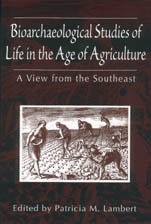
Bioarchaeological Studies of Life in the Age of Agriculture
A View from the SoutheastEdited by Patricia M. Lambert
University of Alabama Press, 2000
Investigations of skeletal remains from key archaeological sites reveal new data and offer insights on prehistoric life and health in the Southeast.
The shift from foraging to farming had important health consequences for prehistoric peoples, but variations in health existed within communities that had made this transition. This new collection draws on the rich bioarchaeological record of the Southeastern United States to explore variability in health and behavior within the age of agriculture. It offers new perspectives on human adaptation to various geographic and cultural landscapes across the entire Southeast, from Texas to Virginia, and presents new data from both classic and little-known sites.
The contributors question the reliance on simple cause-and-effect relationships in human health and behavior by addressing such key bioarchaeological issues as disease history and epidemiology, dietary composition and sufficiency, workload stress, patterns of violence, mortuary practices, and biological consequences of European contact. They also advance our understanding of agriculture by showing that uses of maize were more varied than has been previously supposed.
Representing some of the best work being done today by physical anthropologists, this volume provides new insights into human adaptation for both archaeologists and osteologists. It attests to the heterogeneous character of Southeastern societies during the late prehistoric and early historic periods while effectively detailing the many factors that have shaped biocultural evolution.

Democracy's Rebirth
The View from ChicagoDick Simpson. Foreword by Lori Lightfoot
University of Illinois Press, 2022
With a foreword by Mayor Lori E. Lightfoot.
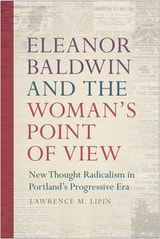
Eleanor Baldwin and the Woman's Point of View
New Thought Radicalism in Portland’s Progressive EraLawrence M. Lipin
Oregon State University Press, 2017
A century before the Occupy movement and the Women’s March, Baldwin spoke truth to power. Imbued with a New Thought spirituality that presumed progressive thought could directly affect material reality, she wrote to move history forward. And yet, the trajectory of history proved as hard to forecast then as now. While her personal story seems to embody a modern progressivism, blending abolition with labor reform and anti-banker activism—positions from which she never wavered—her path grew more complicated as times changed in the aftermath of World War I, when she would advocate on behalf of both the Bolsheviks and the Ku Klux Klan.
In this deeply researched and nuanced account of Eleanor Baldwin’s intellectual journey, historian Larry Lipin reveals how even the most dedicated radical can be overcome by unforeseen events. Eleanor Baldwin and the Woman’s Point of View restores a missing chapter in Portland’s Progressive Era history and rescues this passionate, intriguing, and quixotic character from undeserved obscurity.
Ethnic Identity in Nahua Mesoamerica
The View from Archaeology, Art History, Ethnohistory, and Contemporary EthnographyFrances F Berdan
University of Utah Press, 2008
This book is the first to analyze ethnicity in a single place over a span that covers prehistory, colonial history, and contemporary life. The authors bring to their various case studies data, methodologies, and concepts of their respective fields to show how Nahuan concepts of ethnic identity are not based on the notion of shared descent but rather on conceptions of shared place of origin and common history.
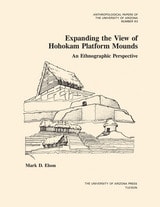
Expanding the View of Hohokam Platform Mounds
An Ethnographic PerspectiveMark D. Elson
University of Arizona Press, 1998
Using this information, he develops a number of important new generalizations about how people used mounds. Elson then applies these data to the study of a prehistoric settlement system in the eastern Tonto Basin of Arizona that contained five platform mounds. He argues that the mounds were used variously as residences and ceremonial facilities by competing descent groups and were an indication of hereditary leadership. They were important in group integration and resource management; after abandonment they served as ancestral shrines. Elson's study provides a fresh approach to an old puzzle and offers new suggestions regarding variability among Hohokam populations. Its innovative use of comparative data and analyses enriches our understanding of both Hohokam culture and other ancient societies.

French Theatre Today
The View from New York, Paris, and AvignonTurk, Edward B.
University of Iowa Press, 2011
@font-face { font-family: "Times";}@font-face { font-family: "Palatino";}p.MsoNormal, li.MsoNormal, div.MsoNormal { margin: 0in 0in 0.0001pt; font-size: 12pt; font-family: "Times New Roman"; }div.Section1 { page: Section1; }
In 2005 literary and film critic Edward Turk immersed himself in New York City’s ACT FRENCH festival, a bold effort to enhance American contact with the contemporary French stage. This dizzying crash course on numerous aspects of current French theatre paved the way for six months of theatregoing in Paris and a month’s sojourn at the 2006 Avignon Festival. In French Theatre Today he turns his yearlong involvement with this rich topic into an accessible, intelligent, and comprehensive overview of contemporary French theatre. Situating many of the nearly 150 stage pieces he attended within contexts and timeframes that stretch backward and forward over a number of years, he reveals French theatre during the first decade of the twenty-first century to be remarkably vital, inclined toward both innovation and concern for its audience, and as open to international influence as it is respectful of national tradition.
French Theatre Today provides a seamless mix of critical analysis with lively description, theoretical considerations with reflexive remarks by the theatremakers themselves, and matters of current French and American cultural politics. In the first part, “New York,” Turk offers close-ups of French theatre works singled out during the ACT FRENCH festival for their presumed attractiveness to American audiences and critics. The second part, “Paris,” depicts a more expansive range of French theatre pieces as they play out on their own soil. In the third part, “Avignon,” Turk captures the subject within a more fluid context that is, most interestingly, both eminently French and resolutely international. The Paris and Avignon chapters contain valuable and well-informed contextual and background information as well as descriptions of the milieus of the Avignon Festival and the various neighborhoods in Paris where he attended performances, information that readers cannot find easily elsewhere. Finally, in the spirit of inclusiveness that characterizes so much new French theatre and to give a representative account of his own experiences as a spectator, Turk rounds out his survey with observations on Paris’s lively opera scene and France’s wealth of circus entertainments, both traditional and newly envisioned
With his shrewd assessments of contemporary French theatre, Turk conveys an excitement and an affection for his topic destined to arouse similar responses in his readers. His book’s freshness and openness will reward theatre enthusiasts who are curious about an aspect of French culture that is inadequately known in this country, veteran scholars and students of contemporary world theatre, and those American theatre professionals who have the ultimate authority and good fortune to determine which new French works will reach audie
From a View to a Death
A NovelAnthony Powell
University of Chicago Press, 2014
From a View to a Death takes us to a dilapidated country estate where an ambitious artist of questionable talent, a family of landed aristocrats wondering where the money has gone, and a secretly cross-dressing squire all commingle among the ruins.
Written from a vantage point both high and necessarily narrow, Powell’s early novels nevertheless deal in the universal themes that would become a substantial part of his oeuvre: pride, greed, and what makes people behave as they do. Filled with eccentric characters and piercing insights, Powell’s work is achingly hilarious, human, and true.
From the Enemy's Point of View
Humanity and Divinity in an Amazonian SocietyEduardo Viveiros de Castro
University of Chicago Press, 1992
Building upon ethnographic description and interpretation, Viveiros de Castro addresses the central aspect of the Arawete's concept of divinity—consumption—showing how its cannibalistic expression differs radically from traditional representations of other Amazonian societies. He situates the Araweté in contemporary anthropology as a people whose vision of the world is complex, tragic, and dynamic, and whose society commands our attention for its extraordinary openness to exteriority and transformation. For the Araweté the person is always in transition, an outlook expressed in the mythology of their gods, whose cannibalistic ways they imitate. From the Enemy's Point of View argues that current concepts of society as a discrete, bounded entity which maintains a difference between "interior" and "exterior" are wholly inappropriate in this and in many other Amazonian societies.
Google and the Myth of Universal Knowledge
A View from EuropeJean-Noël Jeanneney
University of Chicago Press, 2006
The recent announcement that Google will digitize the holdings of several major libraries sent shock waves through the book industry and academe. Google presented this digital repository as a first step towards a long-dreamed-of universal library, but skeptics were quick to raise a number of concerns about the potential for copyright infringement and unanticipated effects on the business of research and publishing.
Jean-Noël Jeanneney, president of France’s Bibliothèque Nationale, here takes aim at what he sees as a far more troubling aspect of Google’s Library Project: its potential to misrepresent—and even damage—the world’s cultural heritage. In this impassioned work, Jeanneney argues that Google’s unsystematic digitization of books from a few partner libraries and its reliance on works written mostly in English constitute acts of selection that can only extend the dominance of American culture abroad. This danger is made evident by a Google book search the author discusses here—one run on Hugo, Cervantes, Dante, and Goethe that resulted in just one non-English edition, and a German translation of Hugo at that. An archive that can so easily slight the masters of European literature—and whose development is driven by commercial interests—cannot provide the foundation for a universal library.
As a leading librarian, Jeanneney remains enthusiastic about the archival potential of the Web. But he argues that the short-term thinking characterized by Google’s digital repository must be countered by long-term planning on the part of cultural and governmental institutions worldwide—a serious effort to create a truly comprehensive library, one based on the politics of inclusion and multiculturalism.
Local Officials and the Struggle to Transform Cities
A View from Post-Apartheid South AfricaEdited by Claire Bénit-Gbaffou
University College London, 2024
Why are even progressive local authorities with the will to improve seldom able to change cities? Why does it seem almost impossible to redress spatial inequalities, deliver and maintain basic services, elevate impoverished areas, and protect marginalized communities? Why do municipalities in the Global South refuse to work with prevailing social informalities, and resort instead to interventions that are known to displace and aggravate the very issues they aim to address?
Local Officials and the Struggle to Transform Cities analyzes these challenges in South African cities, where the brief post-apartheid moment opened a window for progressive city government and made research into state practices both possible and necessary. The book interrogates city officials’ practices through a comparative gaze into other ‘progressive moments’ in large cities in Brazil, the United States, and India. It considers the instruments that these officials invent to implement urban policies, the agency these officials develop, and the constraints they navigate in governing unequal cities. Claire Bénit-Gbaffou captures in this book actual officials’ practices through first-hand experience, state ethnographies, and engaged research. This reveals day-to-day practices that question generalized explanations of state failure in complex urban societies as essential malevolence, contextual weakness, corruption, and inefficiency.
This book opens the black box of the workings of the state, with the hope of opening paths for the construction of progressive policies in contemporary cities.
Media, Geopolitics, and Power
A View from the Global SouthHerman Wasserman
University of Illinois Press, 2018
Herman Wasserman analyzes the debates surrounding South Africa's new media presence against the backdrop of rapidly changing geopolitics. His exploration reveals how South African disputes regarding access to, and representation in, the media reflect the domination and inequality in the global communication sphere. Optimists see post-apartheid media as providing a vital space that encourages exchanges of opinion in a young democracy. Critics argue the public sphere mirrors South Africa's past divisions and privileges the viewpoints of the elite. Wasserman delves into the ways these simplistic narratives obscure the country's internal tensions, conflicts, and paradoxes even as he charts the diverse nature of South African entry into the global arena.
Migration and Ethnicity in Middle Range Societies
A View from the SouthwestTammy Stone
University of Utah Press, 2015
Author Tammy Stone focuses on a number of general deliberations on the archaeology of middle-range society and the prehistory of the American Southwest. This includes the complex dynamics of migration, identity, ethnic interaction, and the ability of archaeologists to identify these patterns in the archaeological record. The integration and ultimate expulsion of a group of Kayenta Anasazi at Point of Pines Pueblo in the Mogollon Highlands of east-central Arizona provides a case study and location where these themes played out. Stone uses a detailed architectural analysis of the pueblo to attain a nuanced and dynamic understanding of migration from the perspective of both the Kayenta migrants and their Mogollon hosts. By examining the choices that individuals, families, and small groups made about identity and alliance from the perspective of both the migrants and host community—the latter being an aspect often missing from analyses of migration—this volume provides never-before-published data on Point of Pines Pueblo and contributes considerably to the study of community dynamics at large.
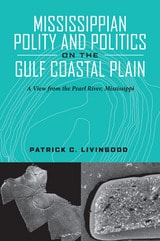
Mississippian Polity and Politics on the Gulf Coastal Plain
A View from the Pearl River, MississippiPatrick Livingood
University of Alabama Press, 2011
The definition of the regional limits of chiefly influence during the Mississippian period in the southeastern United States remains unresolved. In the Gulf Coastal Plain between the Mississippi and Black Warrior rivers, some studies have explored the role that interpolity interactions played in influencing a polity’s social and political complexity through time. It has been argued that the larger, more complex polities were able to preempt the development of more complex political structures among the smaller polities.
Using research at the Pevey (22Lw510) and Lowe-Steen (22Lw511) mound sites on the Pearl River in Lawrence County, Mississippi, this book explores the social and political mechanisms by which these polities may have interacted with each other and the geographic limit to the effects of inter-polity competition. The Pevey site is a nine-mound Mississippian site and Lowe-Steen is a two-mound site located 18 kilometers to the north of Pevey. These sites provide a “missing link” of sorts to explore questions about inter-polity interactions because of their centrality to the study region and their unusual size. By filling a void in the regional dataset, this study allows us to better understand the capacity of the largest polities to negatively effect the political development of their smaller neighbors.
Music
A View from Delft. Selected EssaysEdward T. Cone
University of Chicago Press, 1989
"This selection of [Cone's] writings includes all the most incandescent and influential articles. We should have had such a book long ago."—Joseph Kerman, University of California at Berkeley
Winner of the ASCAP-Deems Taylor Award for 1990
Point of View and the Emotional Arc of Stories
A handbook for writers and storytellersLoren Niemi & Nancy Donoval
Parkhurst Brothers, Inc., 2020
Point of View
Talks on EducationEdward H. Levi
University of Chicago Press, 2007
Rooms with a View
The Stages of Community in the Modern TheaterRichard L. Barr
University of Michigan Press, 1998
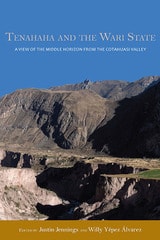
Tenahaha and the Wari State
A View of the Middle Horizon from the Cotahuasi ValleyEdited by Justin Jennings and Willy Yépez Álvarez
University of Alabama Press, 2015
Tenahaha and the Wari State contains a series of essays that challenge current beliefs about the Wari state and suggest a reassessment of this pivotal era in Andean history. In this collection, a picture emerges of Wari power projected across the region’s rugged and formidable topography less as a conquering empire than as a source of ideas, styles, and material culture voluntarily adopted by neighboring peoples.
Much of the previous fieldwork on Wari history took place in the Wari heartland and in Wari strongholds, not areas where Wari power and influence were equivocal. In Tenahaha and the Wari State, editors Justin Jennings and Willy Yépez Álvarez set out to test whether current theories of the Wari state as a cohesive empire were accurate or simply reflective of the bias inherent in studying Wari culture in its most concentrated centers. The essays in this collection examine instead life in the Cotahuasi Valley, an area into which Wari influence expanded during the Middle Horizon period.
Drawing on ten years of exhaustive field work both at the ceremonial site of Tenahaha and in the surrounding valley, Jennings and Yépez Álvarez posit that Cotahuasinos at Tenahaha had little contact with the Wari state. Their excavations and survey in the area tell the story of a region in flux rather than of a people conquered by Wari. In a time of uncertainty, they adopted Wari ideas and culture as ways to cope with change.
The Expense of a View
Polly Buckingham
University of North Texas Press, 2016
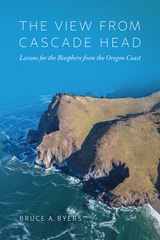
The View From Cascade Head
Lessons for the Biosphere from the Oregon CoastBruce A. Byers
Oregon State University Press, 2020
Cascade Head is Oregon’s only biosphere reserve, part of the international network of biosphere reserves coordinated by UNESCO. Biosphere reserves around the world are laboratories for understanding how humans affect ecosystems and models for how we can heal the human-nature relationship.
The View from Cascade Head illustrates three main lessons: the actions and efforts of committed individuals can make a difference; ecological mysteries still abound despite decades of scientific research; and our worldviews—how we think about our place in nature—shape our individual and collective effect on the ecosystems we inhabit. Byers helps us understand how these lessons apply everywhere and can lead us toward a more sustainable relationship with our home planet.
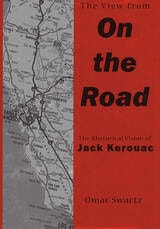
The View From On the Road
The Rhetorical Vision of Jack KerouacOmar Swartz
Southern Illinois University Press, 2000
Through careful analysis of Jack Kerouac’s On the Road, Omar Swartz argues that Kerouac’s influence on American society is largely rhetorical. Kerouac’s significance as a cultural icon can be best understood, Swartz asserts, in terms of traditional rhetorical practices and principles.
To Swartz, Kerouac is a rhetor who symbolically reconstructs his world and offers arguments and encouragements for others to follow. Swartz proposes that On the Road constitutes a “rhetorical vision,” a reality-defining discourse suggesting alternative possibilities for growth and change. Swartz asserts that the reader of Kerouac’s On theRoadbecomes capable of responding to the larger, confusing culture in a strategic manner. Kerouac's rhetorical vision of an alternative social and cultural reality contributes to the identity of localized cultures within the United States.
The View from Afar
Claude Lévi-Strauss
University of Chicago Press, 1992
"Hardly a field remains untouched—sociobiology, linguistics, botany, genetics, psychiatry, esthetics, ecology, politics, neuroscience, education, morality, psychology. . . . It's all breathtaking and alarming, some of it wonderful, some of it ridiculous. . . . At times the experience is exhilarating."—Richard A. Shweder, New York Times Book Review
The View from Madisonville
Protohistoric Western Fort Ancient Interaction PatternsPenelope Ballard Drooker
University of Michigan Press, 1997
Madisonville was one of the key settlements of the Ohio Valley Fort Ancient people and was the subject of James Griffin’s 1943 classic, The Fort Ancient Aspect. It is a site rich in burials and artifacts documenting the earliest European influences. Drooker re-explores a century of excavation to explain how Contact Period events affected Madisonville inhabitants and their links to eastern Fort Ancient, northern Ohio, Iroquoian, Oneota, and Mississipian groups.
The View from Morse Mountain
Climate Change and Resilience on the Maine CoastEdited by Donald C. Dearborn, Joseph Hall, and Laura Sewall
University of Massachusetts Press, 2027
Arguing that resilient coasts emerge from collaborative, cross-disciplinary understanding rather than single-issue solutions
At the Bates-Morse Mountain Conservation Area, climate change impacts are visible to the attentive observer. High tides increasingly flood the causeway across the Sprague River Salt Marsh, large winter storms are reshaping the sand dunes at Seawall Beach, and the offshore waters of the Gulf of Maine are among the fastest-warming on the planet. Environmental change is not new there, nor is the impact of human activity, but different parts of this coastal system are changing at different rates, in different ways. Some components are potentially self-renewing, such as the barrier dune beach, while others, such as Piping Plover populations or the salt marshes, might be restored only with assistance. Unfortunately, other components may already be beyond help: the forest of pitch pines between the dunes and the marsh faces the dual threat of saltwater intrusion below ground and potential burial by migrating sands above.
In The View from Morse Mountain, contributors invite readers into this system through an array of complementary inquiries into bedrock geology, carbon capture by salt marshes, dune movement, the physiology of trees, bird migration, perceptual psychology, and the overlays of Indigenous history and colonial settlement. Fostering adaptability, particularly in coastal systems, requires just such an integrated set of examinations and perspectives. This collection of expert analyses works to encourage place-based curiosity in anyone, both those familiar with this area of Maine and people beyond, helping them recognize both loss and resilience, and to deepen their love for the places they treasure.
Contributors include the volume editors as well as Emily Chandler, Caitlin Cleaver, Isobel Curtis, J. Dykstra Eusden Jr., Brett Huggett, Bev Johnson, Dana Oster, Mike Retelle, and Robert Strong.
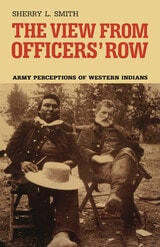
The View from Officers' Row
Army Perceptions of Western IndiansSherry L. Smith
University of Arizona Press, 1990
Capturing military men in contemplation rather than combat, Sherry L. Smith reveals American army officers' views about the Indians against whom they fought in the last half of the nineteenth century. She demonstrates that these officers—and their wives—did not share a monolithic, negative view of their enemies, but instead often developed a great respect for Indians and their cultures. Some officers even came to question Indian policy, expressed misgivings about their personal involvement in the Indian Wars, and openly sympathized with their foe.
The book reviews the period 1848–1890—from the acquisition of the Mexican Cession to the Battle of Wounded Knee—and encompasses the entire trans-Mississippi West. Resting primarily on personal documents drawn from a representative sample of the officer corps at all levels, the study seeks to juxtapose the opinions of high-ranking officers with those of officers of lesser prominence, who were perhaps less inclined to express personal opinions in official reports.
No educated segment of American society had more prolonged contact with Indians than did army officers and their wives, yet not until now has such an overview of their attitudes been presented. Smith's work demolishes the stereotype of the Indian-hating officer and broadens our understanding of the role of the army in the American West.
The View from Prague
The Expectations of World Leaders at the Dawn of the 21st CenturyJirí Musil
Central European University Press, 2007
The View from Somewhere
Undoing the Myth of Journalistic ObjectivityLewis Raven Wallace
University of Chicago Press, 2019
In The View from Somewhere, Lewis Raven Wallace dives deep into the history of “objectivity” in journalism and how its been used to gatekeep and silence marginalized writers as far back as Ida B. Wells. At its core, this is a book about fierce journalists who have pursued truth and transparency and sometimes been punished for it—not just by tyrannical governments but by journalistic institutions themselves. He highlights the stories of journalists who question “objectivity” with sensitivity and passion: Desmond Cole of the Toronto Star; New York Times reporter Linda Greenhouse; Pulitzer Prize-winner Rachel Kaadzi Ghansah; Peabody-winning podcaster John Biewen; Guardian correspondent Gary Younge; former Buzzfeed reporter Meredith Talusan; and many others. Wallace also shares his own experiences as a midwestern transgender journalist and activist who was fired from his job as a national reporter for public radio for speaking out against “objectivity” in coverage of Trump and white supremacy.
With insightful steps through history, Wallace stresses that journalists have never been mere passive observers. Using historical and contemporary examples—from lynching in the nineteenth century to transgender issues in the twenty-first—Wallace offers a definitive critique of “objectivity” as a catchall for accurate journalism. He calls for the dismissal of this damaging mythology in order to confront the realities of institutional power, racism, and other forms of oppression and exploitation in the news industry.
The View from Somewhere is a compelling rallying cry against journalist neutrality and for the validity of news told from distinctly subjective voices.
The View from the Back of the Band
Chris Smith
University of North Texas Press, 2014
The View from the Dugout
The Journals of Red RolfeEdited by William M. Anderson
University of Michigan Press, 2006
-Bill James, in The New Bill James Historical Baseball Abstract, on the journals of Red Rolfe
"Red Rolfe's journal for his years as manager of the Detroit Tigers is the kind of precious source researchers yearn for. In combination with William M. Anderson's well-done text, The View from the Dugout will be of great interest to general readers and of immense value to students of baseball history."
-Charles C. Alexander, author of Breaking the Slump: Baseball in the Depression Era
"Red Rolfe was one of baseball's most astute observers. This is 'inside' baseball from the inside."
-Donald Honig, author of Baseball America, Baseball When the Grass Was Real, and other books in the Donald Honig Best Players of All Time series
"In his lucid journals Red Rolfe has provided an inside look at how an intelligent baseball manager thinks and prepares."
-Ray Robinson, Yankee historian and author of Iron Horse: Lou Gehrig in His Time
Baseball players as a rule aren't known for documenting their experiences on the diamond. Red Rolfe, however, during his time as manager of the Detroit Tigers from 1949 to 1952, recorded daily accounts of each game, including candid observations about his team's performance. He used these observations to coach his players and to gain an advantage by recording strengths, weaknesses, and tendencies of opposing players and managers. Rolfe's journals carry added value considering his own career as an All-Star Yankee third baseman on numerous world champion teams, where he was a teammate of Lou Gehrig and Joe DiMaggio.
Today, in the era of televised broadcasts, networks often wire a manager so that viewers can listen to his spontaneous comments throughout the game. Red Rolfe's journals offer an opportunity to find out what a manager is thinking when no one is around to hear.
William M. Anderson is Director of the Department of History, Arts and Libraries for the State of Michigan. His books include The Detroit Tigers: A Pictorial Celebration of the Greatest Players and Moments in Tigers' History.
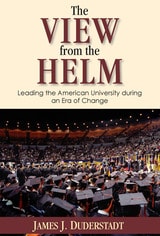
The View from the Helm
Leading the American University during an Era of ChangeJames J. Duderstadt
University of Michigan Press, 2009
Widely regarded as one of the most active and publicly engaged university presidents in modern academia, Duderstadt—who led the University of Michigan from 1988 to 1996—presided over a period of enormous change, not only for his institution, but for universities across the country. His presidency was a time of growth and conflict: of sweeping new affirmative-action and equal-opportunity programs, significant financial expansion, and reenergized student activism on issues from apartheid to codes of student conduct.
Under James Duderstadt’s stewardship, Michigan reaffirmed its reputation as a trailblazer among universities. Part memoir, part history, part commentary, The View from the Helm extracts general lessons from his experiences at the forefront of change in higher education, offering current and future administrators a primer on academic leadership and venturing bold ideas on how higher education should be steered into the twenty-first century.
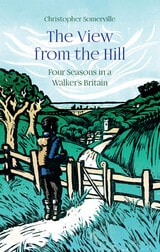
The View from the Hill
Four Seasons in a Walker’s BritainChristopher Somerville
Haus Publishing, 2023
In Christopher Somerville’s workroom is a case of shelves that holds four hundred and fifty notebooks. Their pages are creased and stained with mud, blood, flattened insects, beer glass rings, smears of plant juice, and gallons of sweat. Everything Somerville has written about walking the British countryside has had its origin in these little black and red books.
During the lockdowns and enforced isolation of the COVID-19 pandemic, Somerville began to revisit this treasury of notes, spanning forty years of exploring on foot. The View from the Hill pulls together the best of his written collections, following the cycle of the seasons from a freezing January on the Severn Estuary to the sight of sunrise on Christmas morning from inside a prehistoric burial mound. In between are hundreds of walks to discover toads in a Cumbrian spring, trout in a Hampshire chalk stream, a lordly red stag at the autumn rut on the Isle of Mull, and three thousand geese at full gabble in the wintry Norfolk sky. Somerville’s writing enables readers to enjoy these magnificent walks without stirring from the comfort of home.
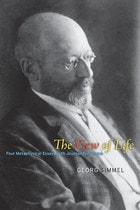
The View of Life
Four Metaphysical Essays with Journal AphorismsGeorg Simmel
University of Chicago Press, 2010
Published in 1918, The View of Life is Georg Simmel’s final work. Famously deemed “the brightest man in Europe” by George Santayana, Simmel addressed diverse topics across his essayistic writings, which influenced scholars in aesthetics, epistemology, and sociology. Nevertheless, certain core issues emerged over the course of his career—the genesis, structure, and transcendence of social and cultural forms, and the nature and conditions of authentic individuality, including the role of mindfulness regarding mortality. Composed not long before his death, The View of Life was, Simmel wrote, his “testament,” a capstone work of profound metaphysical inquiry intended to formulate his conception of life in its entirety.
Now Anglophone readers can at last read in full the work that shaped the argument of Heidegger’s Being and Time and whose extraordinary impact on European intellectual life between the wars was extolled by Jürgen Habermas. Presented alongside these seminal essays are aphoristic fragments from Simmel’s last journal, providing a beguiling look into the mind of one of the twentieth century’s greatest thinkers.
View
Glen Pourciau
Four Way Books, 2017
View from True North
Sara Henning
Southern Illinois University Press, 2018
Winner, George Bogin Memorial Award, 2019
Finalist, Julie Suk Award, 2018
In these edgy poems of witness, Sara Henning’s speaker serves as both conduit and curator of the destructive legacies of alcoholism and multigenerational closeting. Considering the impact of addiction and sexual repression in the family and on its individual members, Henning explores with deft compassion the psychological ramifications of traumas across multiple generations.
With the starling as an unspoken trope for victims who later perpetuate the cycle of abuse, suffering and shame became forces dangerous enough to down airliners. The strands Henning weaves—violent relationships, the destructive effects of long-term closeting, and the pall that shame casts over entire lives—are hauntingly epiphanic. And yet these feverish lyric poems find a sharp beauty in their grieving, where Rolling Stone covers and hidden erotic photographs turn into talismans of regret and empathy. After the revelation that her deceased grandfather was a closeted homosexual “who lived two lives,” Henning considers the lasting effects of shame in regard to the silence, oppression, and erasure of sexual identity, issues that are of contemporary concern to the LGBTQIA community. Even through “the dark / earth encircling us,” Henning’s speaker wonders if there isn’t some way out of a place “where my body / is just another smoke-stung / dirge of survival,” if, in the end, love won’t be victorious.
Part eyewitness testimony, part autoethnography, this book of memory and history, constantly seeking and yearning, is full of poems “too brutal and strange to suffer / [their] way anywhere but home.”
View from the Fazenda
A Tale of the Brazilian HeartlandsEllen Bromfield Geld
Ohio University Press, 2012
“I imagine everyone has a center of gravity,” says Ellen Bromfield Geld. “Something which binds one to the earth and gives sense and direction to what one does.” For Ellen, this center is a writing table before a window that looks out upon groves of pecan trees and mahogany-colored cattle in seas of grass. The place is Fazenda Pau D’Alho, Brazil, where she and her husband, Carson, have lived and farmed since 1961.
Healing the ravaged coffee plantation, rearing five children, exploring the outposts, the Gelds have created a dynamic yet peaceful life far from Ellen’s native Ohio. Their practice of sustainable agriculture, and Ellen’s plea for the preservation of Brazil’s remaining wilderness areas, reflect the legacy of her father, the novelist and farm visionary Louis Bromfield. Their shared vision is crystallized in her account of a cattle drive across the Pantanal, the vast flood plain on Brazil’s side of the Paraguay River. She describes a two-hundred year symbiosis between ranchers and a fragile ecosystem that is being threatened by development.
View from the Fazenda is distilled from fifty years of living in Brazil, weaving daily life on the farm into her quest to understand a nation. It portrays a true melting pot of people who—as conquerers, immigrants, or slaves, their blood and history mingled with those of native Indians—have created the character of Brazil. This huge, diverse county, living in several eras at the same time, is ever changing through its people’s amazing ability to “find a way.”
Ellen Bromfield Geld evokes the land and people of Brazil and offers readers an invigorating glimpse into a soulful life. “It seems to me that being a bit of a poet is perhaps the only way one can survive as a farmer,” she explains. “For in the end, more than anything, farming is a way of life you either love or become bitter enduring.”