Results by title
41 books match the query 'Violence in literature'

American Fantastic
Myths of Violence and RedemptionDerek J. Thiess
University of Wisconsin Press, 2025
Thiess’s interdisciplinary study examines America’s past and present imperial projects, from the Hawaiian Islands to the Eastern Seaboard, as they proliferate in popular story forms. By interrogating American myths, legends, and fantastic narratives across an impressive array of genres, including folk narratives, science fiction, movies, and more, Thiess exposes how the “myth of redemptive violence” manifests in contemporary constructions of America’s fantastic imaginaries.
Armed Ambiguity
Women Warriors in German Literature and Culture in the Age of GoetheJulie Koser
Northwestern University Press, 2016
Armed Ambiguity is a fascinating examination of the tropes of the woman warrior constructed by print culture—including press reports, novels, dramatic works, and lyrical texts—during the decades-long conflict in Europe around 1800.
In it, Julie Koser sheds new light on how women’s bodies became a battleground for competing social, cultural, and political agendas in one of the most pivotal periods of modern history. She traces the women warriors in this work as reflections of the social and political climate in German-speaking lands, and she reveals how literary texts and cultural artifacts that highlight women’s armed insurrection perpetuated the false dichotomy of "public" versus "private" spheres along a gendered fault line. Koser illuminates how reactionary visions of "ideal femininity" competed with subversive fantasies of new femininities in the ideological battle being waged over the restructuring of German society.
Beyond Partition
Gender, Violence and Representation in Postcolonial IndiaDeepti Misri
University of Illinois Press, 2014
Deepti Misri shows how Partition began a history of politicized animosity associated with the differing ideas of ""India"" held by communities and in regions on one hand, and by the political-military Indian state on the other. She moves beyond that formative national event, however, in order to examine other forms of gendered violence in the postcolonial life of the nation, including custodial rape, public stripping, deturbanning, and enforced disappearances. Assembling literary, historiographic, performative, and visual representations of gendered violence against women and men, Misri establishes that cultural expressions do not just follow violence but determine its very contours, and interrogates the gendered scripts underwriting the violence originating in the contested visions of what ""India"" means.
Ambitious and ranging across disciplines, Beyond Partition offers both an overview of and nuanced new perspectives on the ways caste, identity, and class complicate representations of violence, and how such representations shape our understandings of both violence and India.
Bleak Houses
Marital Violence in Victorian FictionLisa Surridge
Ohio University Press, 2005
The Offenses Against the Person Act of 1828 opened magistrates' courts to abused working-class wives. Newspapers in turn reported on these proceedings, and in this way the Victorian scrutiny of domestic conduct began. But how did popular fiction treat “private” family violence? Bleak Houses: Marital Violence in Victorian Fiction traces novelists' engagement with the wife-assault debates in the public press between 1828 and the turn of the century.
Lisa Surridge examines the early works of Charles Dickens and reads Dombey and Son and Anne Brontë's The Tenant of Wildfell Hall in the context of the intense debates on wife assault and manliness in the late 1840s and early 1850s. Surridge explores George Eliot's Janet's Repentance in light of the parliamentary debates on the 1857 Divorce Act. Marital cruelty trials provide the structure for both Wilkie Collins's The Woman in White and Anthony Trollope's He Knew He Was Right.
Locating the New Woman fiction of Mona Caird and the reassuring detective investigations of Sherlock Holmes in the context of late-Victorian feminism and the great marriage debate in the Daily Telegraph, Surridge illustrates how fin-de-siècle fiction brought male sexual violence and the viability of marriage itself under public scrutiny. Bleak Houses thus demonstrates how Victorian fiction was concerned about the wife-assault debates of the nineteenth century, debates which both constructed and invaded the privacy of the middle-class home.
Border Killers
Neoliberalism, Necropolitics, and Mexican MasculinityElizabeth Villalobos
University of Arizona Press, 2024
Villalobos focuses on representations of “border killers” in literature, film, and theater. The author develops a metaphor of “maquilization” to describe the mass-production of masculine violence as a result of neoliberalism. The author demonstrates that the killer is an interchangeable cog in a societal factory of violence whose work is to produce dead bodies. By turning to cultural narratives, Villalobos seeks to counter the sensationalistic and stereotyped media depictions of border residents as criminals. The cultural works she examines instead indict the Mexican state and the global economic system for producing agents of violence.
Focusing on both Mexico’s northern and southern borders, Border Killers uses Achille Mbembe’s concept of necropolitics and various theories of masculinity to argue that contemporary Mexico is home to a form of necropolitical masculinity that has flourished in the neoliberal era and made the exercise of death both profitable and necessary for the functioning of Mexico’s state-cartel-corporate governance matrix.
Chronicling Trauma
Journalists and Writers on Violence and LossDoug Underwood
University of Illinois Press, 2011
To attract readers, journalists have long trafficked in the causes of trauma--crime, violence, warfare--as well as psychological profiling of deviance and aberrational personalities. Novelists, in turn, have explored these same subjects in developing their characters and by borrowing from their own traumatic life stories to shape the themes and psychological terrain of their fiction. In this book, Doug Underwood offers a conceptual and historical framework for comprehending the impact of trauma and violence in the careers and the writings of important journalist-literary figures in the United States and British Isles from the early 1700s to today.
Grounded in the latest research in the fields of trauma studies, literary biography, and the history of journalism, this study draws upon the lively and sometimes breathtaking accounts of popular writers such as Charles Dickens, Ernest Hemingway, Dorothy Parker, Graham Greene, and Truman Capote, exploring the role that trauma has played in shaping their literary works. Underwood notes that the influence of traumatic experience upon journalistic literature is being reshaped by a number of factors, including news media trends, the advance of the Internet, the changing nature of the journalism profession, the proliferation of psychoactive drugs, and journalists' greater self-awareness of the impact of trauma in their work.
The most extensive scholarly examination of the role that trauma has played in the shaping of our journalistic and literary heritage, Chronicling Trauma: Journalists and Writers on Violence and Loss discusses more than a hundred writers whose works have won them fame, even at the price of their health, their families, and their lives.
Colonization, Violence, and Narration in White South African Writing
André Brink, Breyten Breytenbach, and J. M. CoetzeeRosemary Jane Jolly
Ohio University Press, 1995
The representation of pain and suffering in narrative form is an ongoing ethical issue in contemporary South African literature. Can violence be represented without sensationalistic effects, or, alternatively, without effects that tend to be conservative because they place the reader in a position of superiority over the victim or the perpetrator?
Jolly looks at three primary South African authors—André Brink, Breyten Breytenbach, and J. M. Coetzee—to consider violence in the context of apartheid and colonialism and their inherent patriarchies.
Jolly also discusses the violence attendant upon the act of narration in the broader context of critiques of Kafka, Freud, Hegel, the postcolonial critics Jan Mohamed and Bhabha, and feminists such as Susan Suleiman.

Conflict Bodies
The Politics of Rape Representation in the Francophone ImaginaryRégine Michelle Jean-Charles
The Ohio State University Press, 2014
Cultures of War in Graphic Novels
Violence, Trauma, and MemoryProrokova, Tatiana
Rutgers University Press, 2018
Cultures of War in Graphic Novels examines the representation of small-scale and often less acknowledged conflicts from around the world and throughout history. The contributors look at an array of graphic novels about conflicts such as the Boxer Rebellion (1899-1901), the Irish struggle for national independence (1916-1998), the Falkland War (1982), the Bosnian War (1992-1995), the Rwandan genocide (1994), the Israel-Lebanon War (2006), and the War on Terror (2001-). The book explores the multi-layered relation between the graphic novel as a popular medium and war as a pivotal recurring experience in human history. The focus on largely overlooked small-scale conflicts contributes not only to advance our understanding of graphic novels about war and the cultural aspects of war as reflected in graphic novels, but also our sense of the early twenty-first century, in which popular media and limited conflicts have become closely interrelated.
Decolonial Witnessing
Cold War Afterlives in Latin American and Latinx TestimoniosGuadalupe Escobar
University of Texas Press, 2026
Examining the power of testimonios in illuminating political injustice in Latin America from the Cold War to the present.
During the Cold War, testimonio emerged as a powerful genre of political nonfiction in Latin America. Artists created first-person narratives of censorship and state violence, highlighting broader circumstances of oppression carried out by local right-wing oligarchies in collusion with the US empire. Decolonial Witnessing explores the continuing vitality of testimonio in the twenty-first century, as it has evolved into narratives contesting neoliberal dispossession and disposability.
Considering the cultural work of Ana Castillo, Regina José Galindo, Jayro Bustamante, Alberto Ledesma, Javier Zamora, Lila Downs, and others, Guadalupe Escobar shows how artists, authors, musicians, and filmmakers are using testimonial narratives to identify and resist the architecture of post–Cold War militarized democracy. Contemporary testimonios center migrant children, torture abolitionists, Indigenous land defenders—figures whose perspectives and, indeed, presence disrupt dominant paradigms of citizenship. Cast against the law, their stories—their memories—constitute a critical optic on the construction of belonging. In these acts of bearing witness, Escobar locates the possibility of a new, counterhegemonic political imagination.
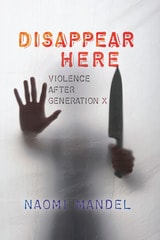
Disappear Here
Violence after Generation XNaomi Mandel
The Ohio State University Press, 2015
Examining developments in media, philosophy, literature, and politics in the years Xers were coming of age, Mandel demonstrates that Generation X’s unique attitude toward violence was formed by developments in home media, personal computing, and reality TV. This attitude, Mandel contends, is key to understanding our current world of media ubiquity, online activism, simulated sensation, and jihad. With chapters addressing both fictional and filmic representations of violence, Mandel studies the work of Bret Easton Ellis, Chuck Palahniuk, Claire Messud, Jess Walter, and Jonathan Safran Foer. A critical and conceptual tour de force, Disappear Here sets forth a new, and necessary, approach to violence, the real, and real violence for the twenty-first century.
Doom Patterns
Latinx Speculations and the Aesthetics of ViolenceMaia Gil'Adí
Duke University Press, 2025
Enemies of All Humankind
Fictions of Legitimate ViolenceSonja Schillings
Dartmouth College Press, 2016
Killer Books
Writing, Violence, and Ethics in Modern Spanish American NarrativeBy Aníbal González
University of Texas Press, 2002
Writing and violence have been inextricably linked in Spanish America from the Conquest onward. Spanish authorities used written edicts, laws, permits, regulations, logbooks, and account books to control indigenous peoples whose cultures were predominantly oral, giving rise to a mingled awe and mistrust of the power of the written word that persists in Spanish American culture to the present day.
In this masterful study, Aníbal González traces and describes how Spanish American writers have reflected ethically in their works about writing's relation to violence and about their own relation to writing. Using an approach that owes much to the recent "turn to ethics" in deconstruction and to the works of Jacques Derrida and Emmanuel Levinas, he examines selected short stories and novels by major Spanish American authors from the late nineteenth through the twentieth centuries: Manuel Gutiérrez Nájera, Manuel Zeno Gandía, Teresa de la Parra, Jorge Luis Borges, Alejo Carpentier, Gabriel García Márquez, and Julio Cortázar. He shows how these authors frequently display an attitude he calls "graphophobia," an intense awareness of the potential dangers of the written word.
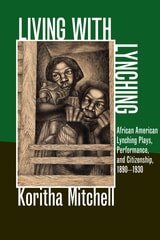
Living with Lynching
African American Lynching Plays, Performance, and Citizenship, 1890-1930Koritha Mitchell
University of Illinois Press, 2012
In closely analyzing the political and spiritual uses of black theatre during the Progressive Era, Mitchell demonstrates that audiences were shown affective ties in black families, a subject often erased in mainstream images of African Americans. Examining lynching plays as archival texts that embody and reflect broad networks of sociocultural activism and exchange in the lives of black Americans, Mitchell finds that audiences were rehearsing and improvising new ways of enduring in the face of widespread racial terrorism. Images of the black soldier, lawyer, mother, and wife helped readers assure each other that they were upstanding individuals who deserved the right to participate in national culture and politics. These powerful community coping efforts helped African Americans band together and withstand the nation's rejection of them as viable citizens.
The Left of Black interview with author Koritha Mitchell begins at 14:00.
An interview with Koritha Mitchell at The Ohio Channel.
Men Who Hate Women and Women Who Kick Their Asses
Stieg Larsson's Millennium Trilogy in Feminist PerspectiveDonna King
Vanderbilt University Press, 2012
These lively and accessible essays expand the conversation in the blogosphere about the novels and films by connecting the controversies about gender roles to social trends in the real world.
Mixed Realism
Videogames and the Violence of FictionTimothy J. Welsh
University of Minnesota Press, 2016
Mixed Realism is about how we interact with media. Timothy J. Welsh shows how videogames, like novels, both promise and trouble experiences of “immersion.” His innovative methodology offers a new understanding of the expanding role of virtuality in contemporary life.
Today’s wired culture is a mixed reality, conducted as exchanges between virtual and material contexts. We make balance transfers at an ATM, update Facebook timelines, and squeeze in sessions of Angry Birds on the subway. However, the “virtual” is still frequently figured as imaginary, as opposed to “real.” The vision of 1990s writers of a future that would pit virtual reality against actual reality has never materialized, yet it continues to haunt cultural criticism. Our ongoing anxiety about immersive media now surrounds videogames, especially “shooter games,” and manifests as a fear that gamers might not know the difference between the virtual world and the real world.
As Welsh notes, this is the paradox of real virtuality. We understand that the media-generated virtualities that fill our lives are not what they represent. But what are they if they are not real? Do they have presence, significance, or influence exceeding their material presence and the user processes that invoke them? What relationships do they establish through and beyond our interactions with them?
Mixed Realism brims with fresh analyses of literary works such as Truman Capote’s In Cold Blood and Mark Z. Danielewski’s House of Leaves, along with sustained readings of controversial videogames such as Super Columbine Massacre and Call of Duty: Modern Warfare 2. Continually connecting the dots between surprising groupings of texts and thinkers, from David Foster Wallace to the cult-classic videogame Eternal Darkness and from Cormac McCarthy to Grand Theft Auto, it offers a fresh perspective on both digital games and contemporary literature.
Murder and Masculinity
Violent Fictions of Twentieth-Century Latin AmericaRebecca E. Biron
Vanderbilt University Press, 2000
The introduction to this study deftly situates Biron's work in relation to previous theoretical arguments on the social and political dimensions of Latin American writing. The five subsequent chapters offer superb analyses of the individual texts. Like their male protagonists who experiment with the psychological and legal extremes of gender division, these narratives risk nonconformity to the laws of genre in their quest for liberation from violent social and literary conventions. In combining elements of detective stories, crime narratives, psychological case studies, and magical or grotesque realism, they offer metafictional commentary on a network of discourses that confuses images of masculinity, national identity, and political autonomy in postcolonial Latin America.
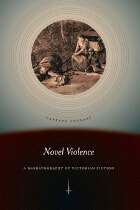
Novel Violence
A Narratography of Victorian FictionGarrett Stewart
University of Chicago Press, 2009
Victorian novels, Garrett Stewart argues, hurtle forward in prose as violent as the brutal human existence they chronicle. In Novel Violence, he explains how such language assaults the norms of written expression and how, in doing so, it counteracts the narratives it simultaneously propels.
Immersing himself in the troubling plots of Charles Dickens, Anne Brontë, George Eliot, and Thomas Hardy, Stewart uses his brilliant new method of narratography to trace the microplots of language as they unfold syllable by syllable. By pinpointing where these linguistic narratives collide with the stories that give them context, he makes a powerful case for the centrality of verbal conflict to the experience of reading Victorian novels. He also maps his finely wrought argument on the spectrum of influential theories of the novel—including those of Georg Lukács and Ian Watt—and tests it against Edgar Allan Poe’s antinovelistic techniques. In the process, Stewart shifts critical focus toward the grain of narrative and away from more abstract analyses of structure or cultural context, revealing how novels achieve their semantic and psychic effects and unearthing, in prose, something akin to poetry.

Passionate Fictions
Gender, Narrative, and Violence in Clarice LispectorMarta Peixoto
University of Minnesota Press, 1994
Passionate Fictions was first published in 1994. Minnesota Archive Editions uses digital technology to make long-unavailable books once again accessible, and are published unaltered from the original University of Minnesota Press editions.
"Clarice Lispector is the premiere Latin American woman prose writer of this century," Suzanne Ruta noted in the New York Times Book Review, "but because she is a woman and a Brazilian, she has remained virtually unknown in the United States." Passionate Fictions provides American readers with a critical introduction to this remarkable writer and offers those who already know Lispector's fiction a deeper understanding of its complex workings.

Performing Violence
Literary and Theatrical Experiments of New Russian DramaBirgit Beumers and Mark Lipovetsky
Intellect Books, 2009
The so-called “New Russian Drama” emerged at the end of the twentieth century, following a long period of decline in dramatic writing in the late Soviet and post-Soviet era. In Performing Violence, Birgit Beumers and Mark Lipovetsky examine the representation of violence in these new dramatic works by young Russian playwrights. Reflecting the disappointment in Yeltsin’s democratic reforms and Putin’s neoconservative politics, the plays focus on political and social representations of violence, its performances, and its justifications.
As the first English-language study of Russian drama and theatre in the twenty-first century, Performing Violence seeks a vantage point for the analysis of brutality in post-Soviet culture. While previous generations had preferred poetry and prose, this new breed of authors—the Presnyakov brothers, Evgeni Grishkovets, and Vasili Sigarev among them—have garnered international recognition for their fierce plays. This book investigates the violent portrayal of the identity crisis of a generation as represented in their theatrical works, and will be a key text for students and scholars of drama, Russian studies, and literature.
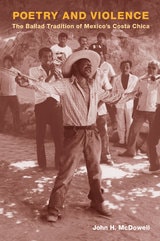
Poetry and Violence
The Ballad Tradition of Mexico's Costa ChicaJohn H. McDowell
University of Illinois Press, 1999
Detailed and rife with social and cultural implications, Poetry and Violence is a compelling commentary on violence as both human experience and communicative action.

Power to Hurt
THE VIRTUES OF ALIENATIONWilliam Monroe
University of Illinois Press, 1998
Chosen as a Choice Magazine's Outstanding Academic Book for 1999.
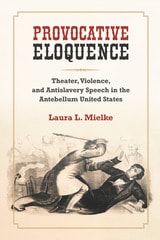
Provocative Eloquence
Theater, Violence, and Antislavery Speech in the Antebellum United StatesLaura L. Mielke
University of Michigan Press, 2019
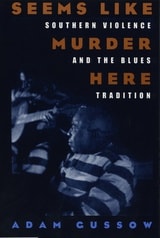
Seems Like Murder Here
Southern Violence and the Blues TraditionAdam Gussow
University of Chicago Press, 2002
Seems Like Murder Here offers a revealing new account of the blues tradition. Far from mere laments about lost loves and hard times, the blues emerge in this provocative study as vital responses to spectacle lynchings and the violent realities of African American life in the Jim Crow South. With brilliant interpretations of both classic songs and literary works, from the autobiographies of W. C. Handy, David Honeyboy Edwards, and B. B. King to the poetry of Langston Hughes and the novels of Zora Neale Hurston, Seems Like Murder Here will transform our understanding of the blues and its enduring power.
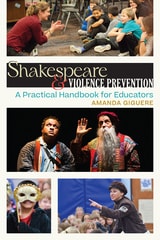
Shakespeare & Violence Prevention
A Practical Handbook for EducatorsAmanda Giguere
University of Wyoming Press, 2025
Framed by examples from Giguere’s work with the Shakespeare & Violence Prevention program, an interdisciplinary outreach project for K–12 schools developed at the University of Colorado Boulder, the text offers helpful entry points, digestible research, and practical exercises to align a violence-prevention curriculum with Shakespeare’s plays. It provides a condensed overview of key findings from violence prevention, clear synopses of the plays, and practicable strategies to implement the program. Guided by firsthand experience with a tried-and-true school program that reaches thousands of K–12 students annually, Giguere shares the Colorado Shakespeare Festival method, which focuses on “upstander” roleplays to practice violence-prevention strategies. Using a clear distillation of Shakespeare studies and violence-prevention research, she shows how the two fields naturally reinforce the concepts of teamwork, empathy, change, and hope.
Shakespeare and Violence Prevention is a new spin on these classic texts that empowers teachers and community leaders to use these tools to create research-guided university engagement programs, theatre company outreach programs, and K–12 student engagement with Shakespeare, even for those without expertise in violence prevention or Shakespeare.
Shock and Yawn
Resisting Banal Terror Through Queer StorytellingMegan Sibbett
The Ohio State University Press, 2026
Building on queer theorists’ critiques of intimate and administrative violence, especially Gloria Anzaldúa’s “intimate terrorism,” Sibbett develops methodologies for conceptualizing and subverting violence aimed at queer, racialized, and gendered bodies in this era of surveillance and increasing authoritarianism. Sibbett addresses book bans, anti-trans legislation, idealized histories of westward expansion, and more, examining materials that include public service announcements, advertising, social media, news reports, poems, interviews, and novels. In so doing, she demonstrates the crucial role queer testimonies—and queer histories and queer futures—play in revealing systemic violence and illuminating the transformative potential of everyday resistance.
Spatial and Discursive Violence in the US Southwest
Rosaura Sánchez and Beatrice Pita
Duke University Press, 2020
THE ECONOMICS OF FANTASY
RAPE IN TWENTIETH-CENTURY LITERATURESharon Stockton
The Ohio State University Press, 2006
It is important to make clear that the genre of rape story studied here presumes a white masculine subject and a white feminine object. Stockton makes the case that the aestheticized rape narrative reveals particular things about the way white masculinity represents itself. Plotting violent sexual fantasy on the grid of economic concerns locates masculine agency in relation to an explicitly contingent material system of power, value, and order. It is in this way that The Economics of Fantasy discloses the increased desperation with which the body has been made to carry ideology under systems of advanced capitalism.

The Culture of Violence
Essays on Tragedy and HistoryFrancis Barker
University of Chicago Press, 1993
Central to his argument is the contention that, contrary to post-Enlightenment humanist, liberal and conservative thought, 'culture' does not necessarily stand in opposition to political inequality and social injustice, but may be complicit with the oppressive exercise of power.
The book focuses on Shakespearean tragedy and on the historicism and culturalism of much present-day cultural theory. Barker's analysis moves dialectically backwards and forwards between these two moments in order to illuminate aspects of early modern culture, and to critique the ways in which the complicity between culture and violence has been occluded. Rejecting the tendency of both modernism and post-modernism to homogenise historical time, Barker argues for a genuinely new, 'diacritical' understanding of the violence of history.
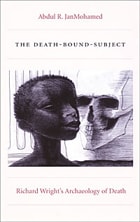
The Death-Bound-Subject
Richard Wright's Archaeology of DeathAbdul R. JanMohamed
Duke University Press, 2005
Drawing on psychoanalytic, Marxist, and phenomenological analyses, and on Orlando Patterson’s notion of social death, JanMohamed develops comprehensive, insightful, and original close readings of Wright’s major publications: his short-story collection Uncle Tom’s Children; his novels Native Son, The Outsider, Savage Holiday, and The Long Dream; and his autobiography Black Boy/American Hunger. The Death-Bound-Subject is a stunning reevaluation of the work of a major twentieth-century American writer, but it is also much more. In demonstrating how deeply the threat of death is involved in the formation of black subjectivity, JanMohamed develops a methodology for understanding the presence of the death-bound-subject in African American literature and culture from the earliest slave narratives forward.
The Making of a Terrorist
On Classic German RoguesJeffrey Champlin
Northwestern University Press, 2014
In The Making of a Terrorist, Jeffrey Champlin examines key figures from three canonical texts from the German-language literature of the late eighteenth and early nineteenth centuries: Goethe’s Gotz von Berlichingen, Schiller’s Die Rauber, and Kleist’s Michael Kohlhaas. Champlin situates these readings within a larger theoretical and historical context, exploring the mechanics, aesthetics, and poetics of terror while explicating the emergence of the terrorist personality in modernity. In engaging and accessible prose, Champlin explores the ethical dimensions of violence and interrogates an ethics of textual violence.
The Oedipus Casebook
Reading Sophocles' Oedipus the KingMark R. Anspach
Michigan State University Press, 2019
The Right to Difference
Interculturality and Human Rights in Contemporary German LiteratureNicole Coleman
University of Michigan Press, 2021
The Right to Difference examines novels that depict human rights violations in order to explore causes of intergroup violence within diverse societies, using Germany as a test case. In these texts, the book shows that an exaggeration of difference between minority and majority groups leads to violence. Germany has become increasingly diverse over the past decades due to skilled labor migration and refugee movements. In light of this diversity, this book’s approach transcends a divide between migrant and post-migrant German literature on the one hand and a national literature on the other hand. Addressing competing definitions of national identity as well as the contest between cultural homogeneity and diversity, the author redefines the term “intercultural literature.” It becomes not a synonym for authors who do not belong to a national literature, such as migrant writers, but a way of reading literature with an intercultural lens.
This book builds a theory of intercultural literature that focuses on the multifaceted nature of identity, in which ethnicity represents only one of many characteristics defining individuals. To develop intercultural competence, one needs to adopt a complex image of individuals that allows for commonalities and differences by complicating the notion of sharp contrasts between groups. Revealing the affective allegiances formed around other characteristics (gender, profession, personal motivations, relationships, and more) allows for similarities that grouping into large, homogeneous, and seemingly exclusive entities conceals. Eight novels analyzed in this book remember and reveal human rights violations, such as genocide, internment and torture, violent expulsion, the reasons for fleeing a country, dangerous flight routes and the difficulty of settling in a new country. Some of these novels allow for affective identification with diverse characters and cast the protagonists as individuals with plural perspectives and identities rather than monolithic members of one large national or ethnic group, whereas others emphasize the commonalities of all people.
Ultimately, the author makes the case for German Studies to contribute to an antiracist approach to diversity by redefining what it means to be German and establishing difference as a fundamental human right.
The Spaces of Violence
James R. Giles
University of Alabama Press, 2006
Exploring the landscapes, cultures, and psychological spaces where violence takes root in contemporary American fiction.
The Spaces of Violence is an insightful work of literary criticism in which James R. Giles investigates the complex relationship between violence and space in contemporary American fiction. Through close readings of novels by influential writers including Russell Banks, Cormac McCarthy, Lewis Nordan, Dorothy Allison, Don DeLillo, Denis Johnson, Sherman Alexie, Robert Stone, and Bret Easton Ellis, Giles demonstrates how violence is shaped by the physical, social, and psychological environments in which it occurs.
Drawing on spatial and cultural theory, Giles argues that these novels inhabit a distinctive "fourthspace," a realm existing at the margins of mainstream society where violence permeates everyday life and destabilizes traditional boundaries of identity, community, and morality. Whether set in rural landscapes, urban centers, suburban communities, football stadiums, or transient spaces such as highways and bus stations, the works examined reveal how environments become intertwined with systems of power, alienation, trauma, and destruction.
The book concludes by extending its analysis to representations of violence within family structures, highlighting the far-reaching effects of social and cultural fragmentation. Offering a sophisticated framework for understanding violence in literature, The Spaces of Violence is an important contribution to contemporary literary and cultural studies.
Times of Trouble
Violence in Russian Literature and CultureEdited by Marcus C. Levitt and Tatyana Novikov
University of Wisconsin Press, 2007
From the country that has added to our vocabulary such colorful terms as "purges," "pogroms," and "gulag," this collection investigates the conspicuous marks of violence in Russian history and culture.
Russians and non-Russians alike have long debated the reasons for this endemic violence. Some have cited Russia's huge size, unforgiving climate, and exposed geographical position as formative in its national character, making invasion easy and order difficult. Others have fixed the blame on cultural and religious traditions that spurred internecine violence or on despotic rulers or unfortunate episodes in the nation's history, such as the Mongol invasion, the rule of Ivan the Terrible, or the "Red Terror" of the revolution. Even in contemporary Russia, the specter of violence continues, from widespread mistreatment of women to racial antagonism, the product of a frustrated nationalism that manifests itself in such phenomena as the wars in Chechnya.
Times of Trouble is the first in English to explore the problem of violence in Russia. From a variety of perspectives, essays investigate Russian history as well as depictions of violence in the visual arts and in literature, including the works of Fyodor Dostoevsky, Isaac Babel, Mikhail Lermontov, and Nina Sadur. From the Mongol invasion to the present day, topics include the gulag, genocide, violence against women, anti-Semitism, and terrorism as a tool of revolution.
Violence and Grace
Exceptional Life between Shakespeare and ModernityNichole E. Miller
Northwestern University Press, 2014
In Violence and Grace, Nichole Miller establishes a conceptual link between early modern English drama and twentieth-century political theology, both of which emerge from the experience of political crisis. Miller’s analyses accordingly undertake to retrieve for political theology the relations between gender, sexuality, and the political aesthetics of violence on the early modern stage, addressing the plays of Marlowe, Middleton, and especially Shakespeare. In doing so, she expands our understanding of drama’s continuing theoretical impact.
Violence and Miracle in the Fourteenth Century
Private Grief and Public SalvationMichael E. Goodich
University of Chicago Press, 1995
Rescue miracles offer a wide range of voices rarely heard in medieval history, from women and children to peasants and urban artisans. They tell of salvation not just from the ravages of nature and war, but from the vagaries of a violent society—crime, unfair judicial practices, domestic squabbles, and communal or factional conflict. The stories speak to a collapse of confidence in decaying institutions, from the law to the market to feudal authority. Particularly, the miraculous escapes documented during the Hundred Years' War, the Italian communal wars, and other conflicts are vivid testimony to the end of aristocratic warfare and the growing victimization of noncombatants.
Miracles, Goodich finds, represent the transcendent and unifying force of faith in a time of widespread distress and the hopeless conditions endured by the common people of the Middle Ages. Just as the lives of the saints, once dismissed as church propaganda, have become valuable to historians, so have rescue miracles, as evidence of an underlying medieval mentalite. This work expands our knowledge of that state of mind and the grim conditions that colored and shaped it.
Violence and Naming
On Mexico and the Promise of LiteratureBy David E. Johnson
University of Texas Press, 2019
Reclaiming the notion of literature as an institution essential for reflecting on the violence of culture, history, and politics, Violence and Naming exposes the tension between the irreducible, constitutive violence of language and the reducible, empirical violation of others. Focusing on an array of literary artifacts, from works by journalists such as Elena Poniatowska and Sergio González Rodríguez to the Zapatista communiqués to Roberto Bolaño's The Savage Detectives and 2666, this examination demonstrates that Mexican culture takes place as a struggle over naming—with severe implications for the rights and lives of women and indigenous persons.
Through rereadings of the Conquest of Mexico, the northern Mexican feminicide, the Zapatista uprising in Chiapas, the disappearance of the forty-three students at Iguala in 2014, and the 1999 abortion-rights scandal centering on “Paulina,” which revealed the tenuousness of women’s constitutionally protected reproductive rights in Mexico, Violence and Naming asks how societies can respond to violence without violating the other. This essential question is relevant not only to contemporary Mexico but to all struggles for democracy that promise equality but instead perpetuate incessant cycles of repression.
Violent Modernists
The Aesthetics of Destruction in Twentieth-Century German LiteratureKai Evers
Northwestern University Press, 2013
Kai Evers’s Violent Modernists: The Aesthetics of Destruction in Twentieth-Century German Literature develops a new understanding of German modernism that moves beyond the oversimplified dichotomy of an avant-garde prone to aggression on the one hand and a modernism opposed to violence on the other. Analyzing works by Robert Musil, Franz Kafka, Karl Kraus, Walter Benjamin, Elias Canetti, and others, Evers argues that these authors are among the most innovative thinkers on violence and its impact on contemporary concepts of the self, history, and society.

Visions of Violence
German Avant-Gardes After FascismRichard Langston
Northwestern University Press, 2007
An extreme faction of aesthetic modernity intent on bulldozing contemporary life, the avant-garde has regularly employed visions of violence in their push for societal and cultural renewal. But in the shadow of unparalleled war and genocide, such aesthetic violence lost its force. This book explores the reconfiguration of the avant-garde in response to the violent transformation of European reality. Citing the emergence of independent avant-garde practitioners in the place of the previous collective, Richard Langston considers six individual exemplars of Germany’s post-fascist avant-garde—works that span the last six decades: painter, writer, and filmmaker Peter Weiss’s appropriation of French surrealism in the fifties; writer Dieter Wellershoff’s coterie of “new realists”; artist Wolf Vostell’s mediation and conflation of the experiences of the Auschwitz trials and the Vietnam War; poet and novelist Dieter Brinkmann’s collages from the seventies; the multimedia displacements of Alexander Kluge; and the performative engagements of dramatists Christoph Schlingensief and Rene Pollesch.
Taking stock of the evolution of Germany’s post-fascist avant-gardes, Langston’s book shows how the movement from Weiss to Pollesch exhibits the problems that both modernity and postmodernity pose for an aesthetic engagement of Germany’s violent past.