Results by title
10 books match the query 'War and literature'
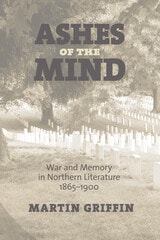
Ashes of the Mind
War and Memory in Northern Literature, 1865-1900Martin Griffin
University of Massachusetts Press, 2009
The memory of the American Civil War took many forms over the decades after the conflict ended: personal, social, religious, and political. It was also remembered and commemorated by poets and fiction writers who understood that the war had bequeathed both historical and symbolic meanings to American culture. Although the defeated Confederacy became best known for producing a literature of nostalgia and an ideological defensiveness intended to protect the South's own version of history, authors loyal to the Union also confronted the question of what the memory of the war signified, and how to shape the literary response to that individual and collective experience.
In Ashes of the Mind, Martin Griffin examines the work of five Northerners—three poets and two fiction writers—who over a period of four decades tried to understand and articulate the landscape of memory in postwar America, and in particular in that part of the nation that could, with most justification, claim the victory of its beliefs and values. The book begins with an examination of the rhetorical grandeur of James Russell Lowell's Harvard Commemoration Ode, ranges across Herman Melville's ironic war poetry, Henry James's novel of North-South reconciliation, The Bostonians, and Ambrose Bierce's short stories, and ends with the bitter meditation on race and nation presented by Paul Laurence Dunbar's elegy “Robert Gould Shaw.” Together these texts reveal how a group of representative Northern writers were haunted in different ways by the memory of the
conflict and its fraught legacy.
Griffin traces a concern with individual and community loss, ambivalence toward victory, and a changing politics of commemoration in the writings of Lowell, Melville, James, Bierce, and Dunbar. What links these very different authors is a Northern memory of the war that became more complex and more compromised as the century went on, often replacing a sense of justification and achievement with a perception of irony and failed promise.
Fighting Over There
U.S. War Making and Contemporary Refugee LiteratureAlaina Kaus
University of Massachusetts Press, 2023
U.S. foreign policy has long been built on a dichotomy of an irreplaceable “here” and an expendable “there.” In his 2003 announcement of the military campaign in Iraq, George W. Bush declared that we would fight in the Middle East so we wouldn’t have to fight “on the streets of our cities.” But what do the millions of people who live over “there” have to say about U.S. interventions and the displacement they provoke?
In this pathbreaking study, Alaina Kaus analyzes literature by and about refugees who fled Southeast Asia, Central America, the Caribbean, North Africa, and the Middle East, in the wake of U.S. military occupation and economic intervention. Narratives by authors such as Lan Cao, Viet Thanh Nguyen, Demetria Martínez, Héctor Tobar, Dave Eggers, Mohsin Hamid, and Riverbend reveal contradictions in the human rights pledges that undergird U.S. foreign policy, which promote freedom while authorizing intervention and displacement, and favor market-based solutions over social justice and racial equality.
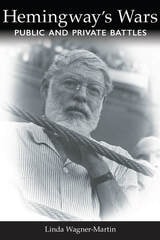
Hemingway's Wars
Public and Private BattlesLinda Wagner-Martin
University of Missouri Press, 2017
Linda Wagner-Martin has written or edited more than sixty books including Ernest Hemingway, A Literary Life. She is Frank Borden Hanes Professor Emerita at the University of North Carolina-Chapel Hill and a winner of the Jay B. Hubbell Medal for Lifetime Achievement.
Lessons from Sarajevo
A War Stories PrimerJim Hicks
University of Massachusetts Press, 2013
Hicks explores the limitations of the sentimental tradition in war representation and asks how the work of artists and writers can help us to move beyond the constraints of that tradition. Ranging from Walt Whitman's writings on the Civil War to the U.S. wars in Iraq and Afghanistan, and focusing on the innovative and creative artistic expressions arising out of the wars of the former Yugoslavia, Hicks examines how war has been perceived, described, and interpreted. He analyzes the limitations on knowledge caused by perspective and narrative position and looks closely at the distinct yet overlapping roles of victims, observers, and aggressors. In the end, he concludes, war stories today should be valued according to the extent they make it impossible for us to see these positions as assigned in advance, and immutable.
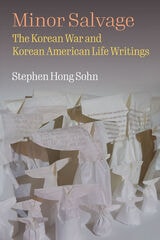
Minor Salvage
The Korean War and Korean American Life WritingsStephen Hong Sohn
University of Michigan Press, 2022
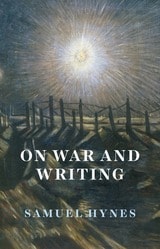
On War and Writing
Samuel Hynes
University of Chicago Press, 2018
Samuel Hynes knows war personally: he served as a Marine Corps pilot in the Pacific Theater during World War II, receiving the Distinguished Flying Cross. He has spent his life balancing two careers: pilot and professor of literature. Hynes has written a number of major works of literary criticism, as well as a war-memoir, Flights of Passage, and several books about the World Wars. His writing is sharp, lucid, and has provided some of the most expert, detailed, and empathetic accounts of a disappearing generation of fighters and writers.
On War and Writing offers for the first time a selection of Hynes’s essays and introductions that explore the traditions of war writing from the twentieth century to the present. Hynes takes as a given that war itself—the battlefield uproar of actual combat—is unimaginable for those who weren’t there, yet we have never been able to turn away from it. We want to know what war is really like: for a soldier on the Somme; a submariner in the Pacific; a bomber pilot over Germany; a tank commander in the Libyan desert. To learn, we turn again and again to the memories of those who were there, and to the imaginations of those who weren’t, but are poets, or filmmakers, or painters, who give us a sense of these experiences that we can’t possibly know.
The essays in this book range from the personal (Hynes’s experience working with documentary master Ken Burns, his recollections of his own days as a combat pilot) to the critical (explorations of the works of writers and artists such as Thomas Hardy, E. E. Cummings, and Cecil Day-Lewis). What we ultimately see in On War and Writing is not military history, not the plans of generals, but the feelings of war, as young men expressed them in journals and poems, and old men remembered them in later years—men like Samuel Hynes.
Poets Beyond the Barricade
Rhetoric, Citizenship, and Dissent after 1960Dale M. Smith
University of Alabama Press, 2012
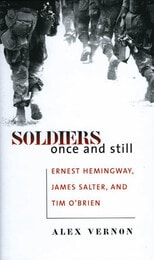
Soldiers Once and Still
Ernest Hemingway, James Salter, and Tim O'BrienAlex Vernon
University of Iowa Press, 2007
Hemingway, Salter, and O’Brien form the core of Soldiers Once and Still because each represents a different warring generation of twentieth-century America: World War I with Hemingway, World War II and Korea with Salter, and Vietnam with O’Brien. Each author also represents a different literary voice of the twentieth century, from modern to mid-century to postmodern, and each presents a different battlefield experience: Hemingway as noncombatant, Salter as air force fighter pilot, and O’Brien as army grunt.
War’s pervasive influence on the individual means that, for veterans-turned-writers like Hemingway, Salter, and O’Brien, the war experience infiltrates their entire body of writing—their works can be seen not only as war literature but also as veterans’ literature. As such, their entire postwar oeuvre, regardless of whether an individual work explicitly addresses the war or the military, is open to Vernon’s exploration of war, society, gender, and literary history.
Vernon’s own experiences as a soldier, a veteran, a writer, and a critic inform this enlightening critique of American literature, offering students and scholars of American literature and war studies an invaluable tool for understanding war’s effects on the veteran writer and his society.
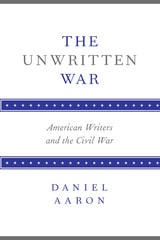
The Unwritten War
American Writers and the Civil WarDaniel Aaron
University of Alabama Press, 2003
In The Unwritten War, Daniel Aaron examines the literary output of American writers—major and minor—who treated the Civil War in their works. He seeks to understand why this devastating and defining military conflict has failed to produce more literature of a notably high and lasting order, why there is still no "masterpiece" of Civil War fiction.
In his portraits and analyses of 19th- and some 20th-century writers, Aaron distinguishes between those who dealt with the war only marginally—Henry Adams, Henry James, William Dean Howells, Mark Twain-and those few who sounded the war's tragic import—Herman Melville, Walt Whitman, and William Faulkner. He explores the extent to which the war changed the direction of American literature and how deeply it entered the consciousness of American writers. Aaron also considers how writers, especially those from the South, discerned the war's moral and historical implications.
The Unwritten War was originally published by Alfred A. Knopf in 1973. The New Republic declared, [This book's] major contribution will no doubt be to American literary history. In this respect it resembles Edmund Wilson's Patriotic Gore and is certain to become an indispensable guide for anyone who wants to explore the letters, diaries, journals, essays, novels, short stories, poems-but apparently no plays-which constitute Civil War literature. The mass of material is presented in a systematic, luminous, and useful way.
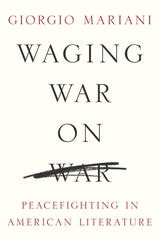
Waging War on War
Peacefighting in American LiteratureGiorgio Mariana
University of Illinois Press, 2015
Giorgio Mariani rigorously engages with the essential question of what makes a text explicitly anti-war. Ranging from Emerson and Joel Barlow to Maxine Hong Kingston and Tim O'Brien, Waging War on War explores why sustained attempts at identifying the anti-war text's formal and philosophical features seem to always end at an impasse. Mariani moves a step beyond to construct a theoretical model that invites new inquiries into America's nonviolent, nonconformist tradition even as it challenges the ways we study U.S. warmaking and the cultural reactions to it. In the process, he shows how the ideal of nonviolence and a dislike of war have been significant, if nonhegemonic, features of American culture since the nation's early days.
Ambitious and nuanced, Waging War on War at last defines anti-war literature while exploring the genre's role in an assertive peacefighting project that offered--and still offers--alternatives to violence.