Results by title
10 books match the query 'War poetry, American'
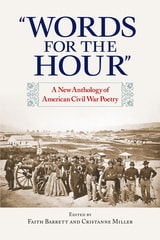
"Words for the Hour"
A New Anthology of American Civil War PoetryFaith Barrett
University of Massachusetts Press, 2005
“Words for the Hour” presents a readable and illuminating account of the Civil War, told through the words of poets North and South. From bathos to profound philosophical meditation and sorrow, the range of these poems illuminates the complexity of their era while also revealing the continuing power of this turning point in American history to speak to readers in the present day.
The volume is divided into three parts, each offering a different perspective on the poetry generated by the war. Part I samples the extraordinary range of poems written immediately preceding and during the war and published in popular periodicals, providing a kind of poetic newspaper account as one might have read it then—from the early days of optimistically heralded victory on both sides, through the mounting casualties and brutal deaths of the long middle years, to the war's conclusion and President Lincoln's assassination. Viewing the struggle from many different vantage points gives the reader access to the ways that people from various backgrounds experienced the trajectory of the war. Civilians and soldiers, free blacks and proponents of slavery, women and men from Massachusetts and Virginia and from recently admitted states and barely developed territories, writers with their eyes on the national political stage and those focused on personal domestic issues: these are the multiple voices of America responding to the war.
Part II includes substantial selections of poems by writers who published extensively in response to the conflict, providing more complex and comprehensive perceptions of the war. These poets include not just well-known figures such as Walt Whitman, Herman Melville, and John Greenleaf Whittier, but also African American poets George Moses Horton and Frances Ellen Watkins Harper and Southern poets Henry Timrod and Sarah Piatt.
Part III offers poems by two poets who did not publish during their lifetimes, but had strong imaginative responses to the conflict, thus giving a sense of the long reach of the war as a defining national experience. One of these two poets (Emily Dickinson) is now renowned while the other (Obadiah Ethelbert Baker) is first published in this volume.
“Words for the Hour” is indeed “new” among anthologies of Civil War poetry not only in its wide range of poems by popular, anonymous, and now canonical poets but also in its informational apparatus. A historical timeline listing major battles and events of the war begins the volume, and historical photographs or lithographs introduce each section of poems. The book also includes a substantial introduction, a glossary of important names and terminology relevant to understanding the poems, and biographical sketches for all the poets whose work is included.
A Shadow on Our Hearts
Soldier-Poetry, Morality, and the American War in VietnamAdam Gilbert
University of Massachusetts Press, 2018
The soldier-poets provide important insights into the ethical dimensions of their physical and psychological surroundings before, during, and after the war. They also offer profound perspectives on the relationships between American soldiers and the Vietnamese people. From firsthand experiences, they reflect on what it meant to be witnesses, victims, and perpetrators of the war's violence. And they advance an uncompromising vision of moral responsibility that indicts a range of culprits for the harms caused by the conflict. Gilbert explores the powerful and perceptive work of these soldier-poets through the lens of morality and presents a radically alternative, deeply personal, and ethically penetrating account of the American war in Vietnam.
Coming Out of War
Poetry, Grieving, and the Culture of the World WarsJanis P. Stout
University of Alabama Press, 2005
World War I is widely considered “the Great War” and World War II, “the Good War.” Janis Stout thinks of them as two parts of a whole that continues to engage historians and literary scholars searching for an understanding of both the actual war experiences and the modern culture of grief they embody. In Coming Out of War: Poetry, Grieving, and the Culture of the World Wars Stout argues that poetry, of all the arts, most fully captures and conveys those cultural responses.
While probing the work of such well known war poets as Rupert Brooke, Wilfred Owen, and Randall Jarrell, Stout also highlights the impact of the wars on lesser studied, but equally compelling, sources such as the music of Charles Ives and Cole Porter, Aaron Copland and Irving Berlin. She challenges the commonplace belief that war poetry came only from the battlefield and was written only by men by examining the wartime writings of women poets such as Rose Macaulay, Marianne Moore, Elizabeth Bishop, and Gwendolyn Brooks. She also challenges the assumption that World War II did not produce poetry of distinction by studying the work of John Ciardi, Karl Shapiro, Louis Simpson, Robert Frost, and Wallace Stevens. While emphasizing aesthetic continuity between the wars, Stout stresses that the poetry that emerged from each displays a greater variety than is usually recognized.
A final chapter considers Benjamin Britten’s War Requiem as a culmination and embodiment of the anti-war tradition in 20th-century poetry and music, and speculates on the reasons why, despite their abundance and eloquence, these expressions of grief and opposition to war have effected so little change.
Fourteen Landing Zones
Approaches to Vietnam War LiteraturePhilip K. Jason
University of Iowa Press, 1991
It is in the spirit of the LZ that the essayists in Fourteen Landing Zones approach the writings of the Vietnam War. These fourteen diverse and powerful works by some of today's leading critics in Vietnam studies begin to answer the question of how we will filter the writings of the Vietnam War—including fiction, poetry, drama, and memoirs. What will survive the process of critical acclaim and societal affirmation—and why? Included is an incisive introduction by Jason that provides an overview of the burgeoning body of Vietnam War literature and its peculiar life in the literary and academic marketplace. This strong, often emotional volume will be of particular importance to all those interested in the literature of the Vietnam War, contemporary literature, and contemporary culture and history.

Hearts and Minds
Bodies, Poetry, and Resistance in the Vietnam EraMichael Bibby
Rutgers University Press, 1996
The early 1960s to the mid-1970s was one of the most turbulent periods in American history. The U.S. military was engaged in its longest, costliest overseas conflict, while the home front was torn apart by riots, protests, and social activism. In the midst of these upheavals, an underground and countercultural press emerged, giving activists an extraordinary forum for a range of imaginative expressions. Poetry held a prominent place in this alternative media. The poem was widely viewed by activists as an inherently anti-establishment form of free expression, and poets were often in the vanguards of political activism.
Hearts and Minds is the first book-length study of the poems of the Black Liberation, Women's Liberation, and GI Resistance movements during the Vietnam era. Drawing on recent cultural and literary theories, Bibby investigates the significance of images, tropes, and symbols of human bodies in activist poetry. Many key political slogans of the period––"black is beautiful," "off our backs"––foreground the body. Bibby demonstrates that figurations of bodies marked important sites of social and political struggle.
Although poetry played such an important role in Vietnam-era activism, literary criticism has largely ignored most of this literature. Bibby recuperates the cultural-historical importance of Vietnam-era activist poetry, highlighting both its relevant contexts and revealing how it engaged political and social struggles that continue to motivate contemporary history. Arguing for the need to read cultural history through these "underground" texts, Hearts and Minds offers new grounds for understanding the recent history of American poetry and the role poetry has played as a medium of imaginative political expression.
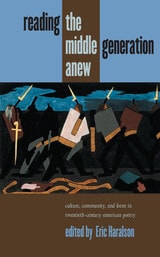
Reading the Middle Generation Anew
Culture, Community, and Form in Twentieth-Century American PoetryEric Haralson
University of Iowa Press, 2006
In addition to having worked during the broad middle of the last century, these poets constitute the center of twentieth-century American poetry in the larger sense, refuting invidious connotations of “middle” as coming after the great moderns and being superseded by a proliferating postmodern experimentation. This middle generation mediates the so-called American century and its prodigious body of poetry, even as it complicates historical and aesthetic categorizations.
Taking diverse formal and thematic angles on these poets—deconstructionist, biographical-historical, and more formalist accounts—this book re-examines their between-ness and ambivalence: their various positionings and repositionings in aesthetic, political, and personal matters. The essays study the interplay between these writers and such shifting formations as religious discourse, consumerism, militarism and war, the ideology of America as “nature’s nation,” and U.S. race relations and ethnic conflicts. Reading the Middle Generation Anew also shows the legacy of the middle generation, the ways in which their lives and writings continue to be a shaping force in American poetry. This fresh and invigorating collection will be of great interest to literary scholars and poets.
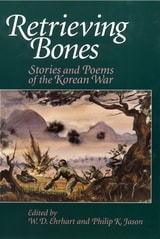
Retrieving Bones
Stories and Poems of the Korean WarEhrhart, W. D.
Rutgers University Press, 1999
The Korean War was a major event in American history. It marked an abrupt end to the euphoria Americans felt in the wake of victory in World War II and turned out to be the harbinger of disaster in Vietnam a decade later.
Though three years of brutal fighting resulted in millions of casualties, the final truce line of 1953 corresponded almost exactly to the positions the opponents held when the fighting began. Back home, the returning veterans met with little interest in or appreciation of what they had endured. Consequently, literary responses to the Korean War did not find an eager readership. Few people, it seemed, wanted to read about what they perceived as a backwater war that possessed neither grand scale nor apparent nobility, a war that ended not with a bang, but a whimper.
Yet an important literature has come out of the Korean War. As we mark the fiftieth anniversary of the war, these writings are well worth our attention. Many of the twelve stories and fifty poems assembled in Retrieving Bones have long been out of print and are almost impossible to find in any other source. The editors have enhanced this collection by providing maps, a chronology of the Korean War, and annotated lists of novels, works of nonfiction, and films. In a detailed introduction, Ehrhart and Jason discuss the milestones of the Korean War and place each fiction writer and poet represented into historical and literary contexts.
Among the writers and poets are
· James Lee Burke
· Eugene Burdick
· William Chamberlain
· Rolando Hinojosa
· Reg Saner
· Vern Sneider
· Stanford Whitmore
· Keith Wilson

Search and Clear
Critical Responses to Selected Literature and Films of the Vietnam WarWilliam J. Searle
University of Wisconsin Press, 1988
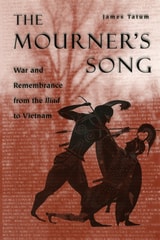
The Mourner's Song
War and Remembrance from the Iliad to VietnamJames Tatum
University of Chicago Press, 2002
Tatum's touchstone throughout is the Iliad, not just one of the earliest war poems, but also one of the most powerful examples of the way poetry can be a tribute to and consolation for what is lost in war. Reading the Iliad alongside later works inspired by war, Tatum reveals how the forms and processes of art convert mourning to memorial. He examines the role of remembrance and the distance from war it requires; the significance of landscape in memorialization; the artifacts of war that fire the imagination; the intimate relationship between war and love and its effects on the ferocity with which soldiers wage battle; and finally, the idea of memorialization itself. Because all survivors suffer the losses of war, Tatum's is a story of both victims and victors, commanders and soldiers, women and men. Photographs of war memorials in Vietnam, France, and the United States beautifully augment his testimonials.
Eloquent and deeply moving, The Mourner's Song will speak to anyone interested in the literature of war and the relevance of the classics to our most pressing contemporary needs.
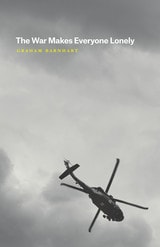
The War Makes Everyone Lonely
Graham Barnhart
University of Chicago Press, 2019
Evoking the landscapes and surroundings of war, as well as its effects on both US military service members and civilians in war-stricken countries, The War Makes Everyone Lonely is a challenging, nuanced look at the ways American violence is exported, enacted, and obscured by a writer poised to take his place in the long tradition of warrior-poets.