Results by title
1295 books match the query 'Women authors' and 106 start with a

A Chorus for Peace
A Global Anthology of Poetry by WomenMarilyn Arnold
University of Iowa Press, 2002
Women poets from around the world are gathered here to raise their voices together, to speak out against violence and its calamitous effect upon the human soul. Yet there is also a thread of resilience here, an undercurrent of hope that points to the human ability to move on, to build a new life out of a shattered past.
Each poem addresses difficult issues concerning conflict and the lives of women. Some are spirited statements that demonstrate courage even in brutal circumstances; others rage at the perpetrators of war or simply mourn their losses. Together, these works reveal a deep consciousness of both the effects of violence and the human ability to move forward.
The women whose poems appear in this collection stand for peace. Many of them have seen war and strife on fronts both national and domestic; and they write graphically and poignantly, and sometimes ironically, about conflicts external and internal that tear up their lives and the lives of their families and neighbors. They write about the victims of war and oppression: bewildered and brutalized children, bereft wives and mothers, raped and mutilated women, tormented prisoners and soldiers. And they write about victims of a seemingly failed society and victims of struggling or failed human relationships.
At the same time, these writers are also crying for peace, searching for peace, and occasionally finding peace. In their search, they point the way for the rest of us.
A Companion to Margaret More Roper Studies
Life Records, Essential Texts, and Critical EssaysElizabeth McCutcheon
Catholic University of America Press, 2022
Margaret More Roper is the learned daughter of St. Thomas More, the Catholic martyr; their lives are closely linked to each other and to early sixteenth-century changes in politics and religion and the social upheaval and crises of conscience that they brought. Specifically, Roper's major works - her translation of Erasmus's commentary on the Lord's Prayer and the long dialogue letter between More and Roper on conscience - highlight two major preoccupations of the period: Erasmian humanism and More's last years, which led to his death and martyrdom.
Roper was one of the most learned women of her time and a prototype of the woman writer in England, and this edited volume is a tribute to her life, writings, and place among early women authors. It combines comprehensive and convenient joining of biographical, textual, historical, and critical components within a single volume for the modern reader. There is no comparable study in print, and it fills a significant gap in studies of early modern women writers.
A Companion to the Works of Elizabeth Strout
Katherine Montwieler
Ohio University Press, 2022
A Conjoined Book
Aftermath and Become Tree, Become BirdKarla Kelsey
Omnidawn, 2014
A Constant Journey
The Fiction of Monique WittigErika Ostrovsky
Southern Illinois University Press, 1991
From the creation of a neuter pronoun in her earliest work, L’Opoponax, to the confusion of genres in her most recent fiction, Virgile, non, Monique Wittig uses literary subversion and invention to accomplish what Erika Ostrovsky appropriately defines as renversement, the annihilation of existing literary canons and the creation of highly innovative constructs.
Erika Ostrovsky explores those aspects of Wittig’s work that best illustrate her literary approach. Among the countless revolutionary devices that Wittig uses to achieve renversement are the feminization of masculine gender names, the reorganization of myth patterns, and the replacement of traditional punctuation with her own system of grammatical emphasis and separation. It is the unexpected quantity and quality of such literary devices that make reading Monique Wittig’s fiction a fresh and rewarding experience. Such literary devices have earned Wittig the acclaim of her critics and peers—Marguerite Duras, Mary McCarthy, Alain Robbe-Grillet, Nathalie Sarraute, and Claude Simon, to name a few.
While analyzing the intrinsic value of each of Wittig’s fictions separately, Erika Ostrovsky traces the progressive development of Wittig’s major literary devices as they appear and reappear in her fictions. Ostrovsky maintains that the seeds of those innovations that appear in Wittig’s most recent texts can be found as far back as L’Opoponax. This evidence of progression supports Ostrovsky’s theory that clues to Wittig’s future endeavors can be found in her past.
A Crown of Hornets
Marcia Pelletiere
Four Way Books, 2019

A Desire for Women
Relational Psychoanalysis, Writing, and Relationships between WomenJuhasz, Suzanne
Rutgers University Press, 2003
Uniquely weaving together psychoanalytic, feminist, queer, and literary theory as well as memoir to examine the value and meaning of relationships between women, Juhasz explores the writings of adult daughters, mothers, and lovers to consider how language both traces and shapes the contours of experience. She emphasizes the initial bond between mother and infant as the bedrock of identity formation, a process involving love, recognition, desire, and language, and shows how that relationship serves as source and model for all future loves.
Juhasz's lucid prose unravels the meaningful yet overlooked intricacies of the relationships that inflect much of women's writing in the twentieth century.
A Fine Yellow Dust
Laura Apol
Michigan State University Press, 2021
A Genealogy of the Gentleman
Women Writers and Masculinity in the Eighteenth CenturyMary Beth Harris
University of Delaware Press, 2024

A Love Letter to This Bridge Called My Back
Edited by gloria j. wilson, Joni B. Acuff, and Amelia M. Kraehe
University of Arizona Press, 2022
In A Love Letter, creators illuminate, question, and respond to current politics, progressive struggles, transformations, acts of resistance, and solidarity, while also offering readers a space for renewal and healing. The central theme of the original Bridge is honored, exposing the lived realities of women of color at the intersections of race, class, gender, ethnicity, and sexuality, advancing those early conversations on what it means to be Third World feminist conscious.
A Love Letter recognizes the challenges faced by women of color in a twenty-first-century world of climate and economic crises, increasing gun violence, and ever-changing social media constructs for women of color. It also retains the clarion call Bridge set in motion, as Moraga wrote: “A theory in the flesh means one where the physical realities of our lives—our skin color, the land or concrete we grew up on, our sexual longing—all fuse to create a politic born of necessity.”
A Magnificent Loneliness
Allison Benis White
Four Way Books, 2025
“I remember // once, turning to leave, a black purse over her shoulder. . .” Oneiric and surreal as always, Allison Benis White attempts to mediate, if not make sense of, inconceivable bereavement in her fifth collection of poetry. “A black purse, / over her living shoulder, Love said nothing to me.”
Ethereal, airy, and spare at once, A Magnificent Loneliness is a dialogue with ghosts. White, whose previous work won the Rilke Prize and the Four Way Books Levis Prize judged by Claudia Rankine, assembles these pages as an ekphrastic and epistolary record of her solitary journey through loss. These poems relate to artwork, the history of artistic practice, and inherited lore to broker an oblique and piecewise conversation concerning pain too vast to articulate all at once. “I don’t know how to love the world but to love / her leaving.” These lyrical iterations represent White’s attempts to comprehend the individual suffering of being alive, and to metabolize the grief of women’s epidemic disappearance, literal and spiritual, through sickness and despair. Through those efforts, she illuminates a magnificent loneliness—the privilege of being alive to our anguish, of missing someone dearly because someone dear existed—and a reason for not yet departing that struggle. “How to leave / the world but to turn to leave her— / but to turn my head back / to see her.”
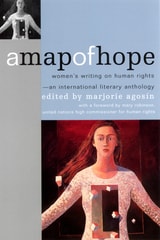
A Map of Hope
Women's Writing on Human Rights—An International Literary AnthologyAgosín, Marjorie
Rutgers University Press, 1999
The first international anthology to explore women’s human rights from a literary perspective.
More than half a century after the United Nations Declaration of Human Rights, women throughout the world still struggle for social and political justice. Many fight back with the only tools of resistance they possess—words. A Map of Hope presents a collection of 77 extraordinary literary works documenting the ways women writers have spoken out about human rights issues.
Writers young and old, known and unknown, explore the dimensions of terror, the unspeakable atrocities of war, and the possibilities of resistance and refusal against all odds. Their poems, essays, memoirs, and brief histories examine issues that affect the condition of women in war, prison camps, exile, and as victims of domestic and political violence.
A Map of Hope presents diverse women writers who have created a literature of global consciousness and justice. Their works give a face, an image, and a human dimension to the dehumanization of human rights violations. The collection allows readers to hear voices that have decided to make a difference. It goes beyond geography and ethnic groups; writers from around the globe are united by the universal dimensions of horror and deprivation, as well as the unique common struggle for justice and solidarity.
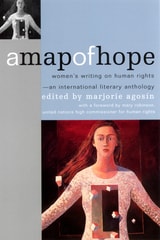
A Map of Hope
Women's Writing on Human Rights—An International Literary AnthologyAgosín, Marjorie
Rutgers University Press, 1999
The first international anthology to explore women’s human rights from a literary perspective.
More than half a century after the United Nations Declaration of Human Rights, women throughout the world still struggle for social and political justice. Many fight back with the only tools of resistance they possess—words. A Map of Hope presents a collection of 77 extraordinary literary works documenting the ways women writers have spoken out about human rights issues.
Writers young and old, known and unknown, explore the dimensions of terror, the unspeakable atrocities of war, and the possibilities of resistance and refusal against all odds. Their poems, essays, memoirs, and brief histories examine issues that affect the condition of women in war, prison camps, exile, and as victims of domestic and political violence.
A Map of Hope presents diverse women writers who have created a literature of global consciousness and justice. Their works give a face, an image, and a human dimension to the dehumanization of human rights violations. The collection allows readers to hear voices that have decided to make a difference. It goes beyond geography and ethnic groups; writers from around the globe are united by the universal dimensions of horror and deprivation, as well as the unique common struggle for justice and solidarity.
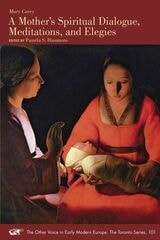
A Mother’s Spiritual Dialogue, Meditations, and Elegies
Mary Carey
Iter Press, 2023
Lady Mary Carey (c. 1609–c. 1680) was a noblewoman who examined her life and expressed her views in a handwritten manuscript that she intended for self-reflection and for sharing with restricted audiences of family and friends, rather than for print publication. Her poetry and prose, composed and revised between 1650 and 1658, were important enough to her inner circle, however, that her autograph manuscript was carefully copied by another hand in 1681. In addition to providing us with key insights into women’s multidimensional roles as wives, widows, and mothers during the seventeenth century in England, Carey’s work teaches us a great deal about a woman’s deepest emotional and spiritual states while confronting the hardships of life—from the fears of childbearing to the sorrows over child loss to the terrors of war.
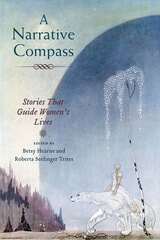
A Narrative Compass
Stories that Guide Women's LivesEdited by Betsy Hearne and Roberta Seelinger Trites
University of Illinois Press, 2008
Each of us has a narrative compass, a story that has guided our lifework. In this extraordinary collection, women scholars from a variety of disciplines identify and examine the stories that have inspired them, haunted them, and shaped their research, from Little House on the Prairie to Little Women, from the fairy tales of Hans Christian Andersen and Alice's Adventures in Wonderland to Nancy Drew, Mary Jane, and even the Chinese memoir Jottings from the Transcendant's Abode at Mt. Youtai. Telling the "story of her story" leads each of the essayists to insights about her own approach to studying narratives and to a deeper, often surprising, understanding of the power of imagination.
Contributors are Deyonne Bryant, Minjie Chen, Cindy L. Christiansen, Beverly Lyon Clark, Karen Coats, Wendy Doniger, Bonnie Glass-Coffin, Betsy Hearne, Joanna Hearne, Ann Hendricks, Rania Huntington, Christine Jenkins, Kimberly Lau, Pamela Riney-Kehrberg, Maria Tatar, Ebony Elizabeth Thomas, Roberta Seelinger Trites, Claudia Quintero Ulloa, and Ofelia Zepeda.
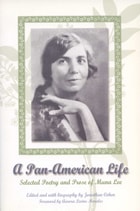
A Pan-American Life
Selected Poetry and Prose of Muna LeeMuna Lee; Edited and with biography by Jonathan M. Cohen
University of Wisconsin Press, 2004
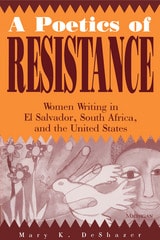
A Poetics of Resistance
Women Writing in El Salvador, South Africa, and the United StatesMary DeShazer
University of Michigan Press, 1994
Engaging the works of critics such as Chandra Mohanty, Barbara Harlow, Claribel Alegria, Albie Sachs, and Audre Lorde, among others, Mary DeShazer reconceptualizes traditional notions of resistance and literature and the relationship between them. She argues that women’s voices have been underrepresented in previous analyses of Third World resistance poetry, and that when examined collectively, their work reveals overtly gendered concerns that distinguish it from that of their male counterparts.
DeShazer defines resistance as an active quest for justice and a means of collective empowerment. She looks at the diasporic consciousness of exiled and dislocated women, examines the tensions between claims of identity and claims of difference, and explores the ways in which gender and struggle connect women across nationalities and historical imperatives. Her analysis of Salvadoran and South African women’s poetry reveal the ways in which poetic conventions can be seen as “political declarations of privilege,” casting a new light on women’s resistance poetry in the United States.
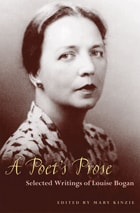
A Poet’s Prose
Selected Writings Of Louise BoganLouise Bogan
Ohio University Press, 2005
Although best known as a master of the formal lyric poem, Louise Bogan (1897–1970) also published fiction and what would now be called lyrical essays. A Poet’s Prose: Selected Writings of Louise Bogan showcases her devotion to compression, eloquence, and sharp truths.
Louise Bogan was poetry reviewer for the New Yorker for thirty-eight years, and her criticism was remarkable for its range and effect. Bogan was responsible for the revival of interest in Henry James and was one of the first American critics to notice and review W. H. Auden. She remained intellectually and emotionally responsive to writers as different from one another as Caitlin Thomas, Dorothy Richardson, W. B. Yeats, André Gide, and Rainer Maria Rilke.
Bogan’s short stories appeared regularly in magazines during the 1930s, penetrating the social habits of the city as well as the loneliness there. The autobiographical element in her fiction and journals, never entirely confessional, spurred some of her finest writing. The distinguished poet and critic Mary Kinzie provides in A Poet’s Prose a selection of Bogan's best criticism, prose meditations, letters, journal entries, autobiographical essays, and published and unpublished fiction.
Louise Bogan won the Bollingen Prize in 1954 for her collected poems. She is the subject of the Pulitzer Prize-winning biography by Elizabeth Frank, Louise Bogan: A Portrait.
A Reader's Guide to the Novels of Louise Erdrich
Peter G. Beidler & Gay Barton
University of Missouri Press, 2006
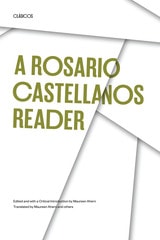
A Rosario Castellanos Reader
An Anthology of Her Poetry, Short Fiction, Essays, and DramaBy Rosario Castellanos
University of Texas Press, 1988
Thinker, writer, diplomat, feminist Rosario Castellanos was emerging as one of Mexico's major literary figures before her untimely death in 1974. This sampler of her work brings together her major poems, short fiction, essays, and a three-act play, The Eternal Feminine. Translated with fidelity to language and cultural nuance, many of these works appear here in English for the first time, allowing English-speaking readers to see the depth and range of Castellanos' work.
In her introductory essay, "Reading Rosario Castellanos: Contexts, Voices, and Signs," Maureen Ahern presents the first comprehensive study of Castellanos' work as a sign or signifying system. This approach through contemporary semiotic theory unites literary criticism and translation as an integral semiotic process. Ahern reveals how Castellanos integrated women's images, bodies, voices, and texts to feminize her discourse and create a plurality of new signs/messages about women in Mexico. Describing this process in The Eternal Feminine, Castellanos observes, "...it's not good enough to imitate the models proposed for us that are answers to circumstances other than our own. It isn't even enough to discover who we are. We have to invent ourselves."
A Social Edition of the Devonshire Manuscript (BL MS Add 17,492)
Edited by Raymond Siemens, Karin Armstrong, and Constance Crompton
Iter Press, 2015
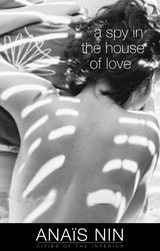
A Spy in the House of Love
Anaïs Nin
Ohio University Press, 2014
Although Anaïs Nin found in her diaries a profound mode of self-creation and confession, she could not reveal this intimate record of her experiences during her lifetime. Instead, she turned to literary fiction, transforming her private writings into artfully crafted novels that explore female desire, identity, and emotional complexity.
A Spy in the House of Love is a classic of psychological and women’s fiction, centered on Sabina, a woman torn between her longing for artistic freedom, romantic adventure, and sensual fulfillment, and the social expectations that constrain her. Moving through a bohemian, Parisian-inspired world, Sabina navigates multiple relationships in her search for passion, meaning, and self-understanding.
Written at a time when Nin’s own life was shaped by conflicting loyalties and intense relationships, the novel offers a deeply introspective exploration of love, infidelity, erotic longing, and self-discovery. As Sabina confronts her inner divisions, she asks a timeless question: can one indulge the fantasies and restless pursuit of desire without facing profound emotional consequences?
A landmark of modernist literature and feminist writing, A Spy in the House of Love remains a powerful, evocative portrait of a woman’s inner life—ideal for readers of classic literary fiction, experimental narrative, and character-driven novels about relationships and desire.
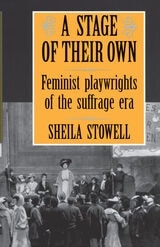
A Stage of Their Own
Feminist Playwrights of the Suffrage EraSheila Stowell
University of Michigan Press, 1994
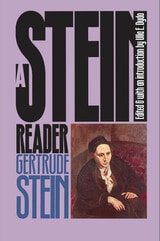
A Stein Reader
Gertrude Stein
Northwestern University Press, 1993
A Stein Reader includes unpublished work, such as the portrait "Article"; shows the astonishing stylistic change in the neglected "A Long Gay Book"; draws attention to the many unknown plays such as "Reread Another;" and offers fascinating portraits of Matisse, Picasso, and Sitwell. Illuminating headnotes bring out connections between pieces and provide invaluable keys to Stein's motifs and thought patterns.
A Story Larger than My Own
Women Writers Look Back on Their Lives and CareersEdited by Janet Burroway
University of Chicago Press, 2014
Kumin, who went on to win the Pulitzer Prize for poetry, was part of a groundbreaking generation of women writers who came of age during the midcentury feminist movement. By challenging the status quo and ultimately finding success for themselves, they paved the way for future generations of writers. In A Story Larger than My Own, Janet Burroway brings together Kumin, Julia Alvarez, Jane Smiley, Erica Jong, and fifteen other accomplished women of this generation to reflect on their writing lives.
The essays and poems featured in this collection illustrate that even writers who achieve critical and commercial success experience a familiar pattern of highs and lows over the course of their careers. Along with success comes the pressure to sustain it, as well as a constant search for subject matter, all too frequent crises of confidence, the challenges of a changing publishing scene, and the difficulty of combining writing with the ordinary stuff of life—family, marriage, jobs. The contributors, all now over the age of sixty, also confront the effects of aging, with its paradoxical duality of new limitations and newfound freedom.
Taken together, these stories offer advice from experience to writers at all stages of their careers and serve as a collective memoir of a truly remarkable generation of women.
A Sybil Society
PoemsKatherine Factor
University of Nevada Press, 2022
In a time when only a select few are prosperous, A Sybil Society paints a portrait of the present moment and unveils a restless truth. The collection is fearless in the face of convention and gives readers a sense of devastating sorrow in a world gone mad.
A Tawdry Place of Salvation
The Art of Jane BowlesEdited by Jennie Skerl
Southern Illinois University Press, 1997
Through these essays—which deal with Bowles’s published as well as her unpublished work—Skerl seeks to generate serious critical attention for an important but neglected female experimental writer of the mid-twentieth century and to celebrate her originality, power, and craft.
Based in disciplines and theoretical approaches that range from feminist criticism to Middle Eastern studies, from postmodernism to queer theory, and from Victorianism to the Beat Generation, the essayists naturally approach Bowles’s fiction and drama from a wide variety of critical perspectives. All of these essays are unpublished and written for this volume.
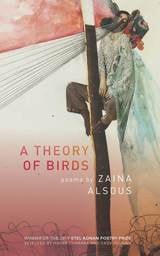
A Theory of Birds
PoemsZaina Alsous
University of Arkansas Press, 2019
Winner of the 2019 Etel Adnan Poetry Prize
Inside the dodo bird is a forest, Inside the forest
a peach analog, Inside the peach analog a woman, Inside
the woman a lake of funerals
This layering of bird, woman, place, technology, and ceremony, which begins this first full-length collection by Zaina Alsous, mirrors the layering of insights that marks the collection as a whole. The poems in A Theory of Birds draw on inherited memory, historical record, critical theory, alternative geographies, and sharp observation. In them, birds—particularly extinct species—become metaphor for the violences perpetrated on othered bodies under the colonial gaze.
Putting ecological preservation in conversation with Arab racial formation, state vernacular with the chatter of birds, Alsous explores how categorization can be a tool for detachment, domination, and erasure. Stretching their wings toward de-erasure, these poems—their subjects and their logics—refuse to stay put within a single category. This is poetry in support of a decolonized mind.
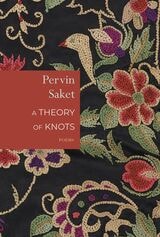
A Theory of Knots
Pervin Saket
Seagull Books, 2026
These lyric, unsparing poems stitch together a story of identity, belonging, and dissolution.
A Theory of Knots explores the loops of how identity and belonging are constructed, broken, resurrected, and dissolved. In sections, knots weave DNA and cords, memory and mythology, home and tongue; they draw on desire, Zoroastrian rituals, tradition and transgression, and the legacies of womanhood, asking what connects us, and at what cost.
As layers of identity are examined, Pervin Saket's poems return to language: heirloom, hazard, half-truth. Soon enough, language is both subject and suspect; having exposed the artificial nature of our truths, the poems confront the artificial nature of language itself. At the end, poetry reaches the wilderness of earth, collapses upon itself, dissolving on the page—untangling the final knot.

A Timeshare
Margaret Ross
Omnidawn, 2015
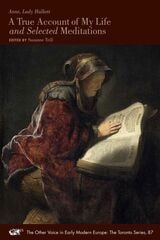
A True Account of My Life and Selected Meditations
Lady Anne Halkett
Iter Press, 2022
Born in the early 1620s, Anne, Lady Halkett (née Murray) grew up on the fringes of the English court during a period of increasing political tension. From 1644 to 1699, Halkett recorded her personal and political experiences in both England and Scotland in a series of manuscript meditations and an autobiographical narrative called A True Account of My Life. Royalism, romance, and contemporary religious debates are central to Halkett’s vivid portrayal of her life as a single woman, wife, mother, and widow. Collectively, the materials edited here offer the opportunity to explore how Halkett’s meditational practice informed her life writing in the only version of her writings to date available in a fully modernized edition. The forty-four meditations in this volume redefine the importance of Halkett’s contribution to seventeenth-century life writing.
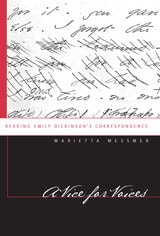
A Vice for Voices
Reading Emily Dickinson's CorrespondenceMarietta Messmer
University of Massachusetts Press, 2009
Concentrating on Dickinson's exchanges with childhood friends, as well as with Susan Gilbert Dickinson, Elizabeth Holland, Austin Dickinson, Thomas Wentworth Higginson, and the mysterious "Master," Marietta Messmer explores the poet's gradual shift from writing confessional letters to developing her unique "vice for voices" by creating fictionalized epistolary personae. While radically challenging nineteenth-century letter-writing conventions, these personae also subvert the narrowly circumscribed roles available to women at that time. Messmer shows how Dickinson used this double-voiced mode of correspondence to manipulate and interrogate a variety of male-dominated, "authorized" literary, religious, and sociocultural discourses.
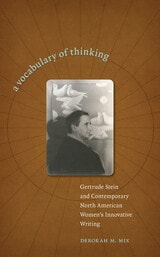
A Vocabulary of Thinking
Gertrude Stein and Contemporary North American Women's Innnovative WritingDeborah M. Mix
University of Iowa Press, 2007
Arguing that these authors have received relatively little attention because of the difficulty in categorizing them, Mix brings the writing of women of color, lesbians, and collaborative writers into the discussion of experimental writing. Thus, rather than exploring conventional lines of influence, she departs from earlier scholarship by using Stein and her work as a lens through which to read the ways these authors have renegotiated tradition, authority, and innovation.
Building on the tradition of experimental or avant-garde writing in the United States, Mix questions the politics of the canon and literary influence, offers close readings of previously neglected contemporary writers whose work doesn't fit within conventional categories, and by linking genres not typically associated with experimentalism-lyric, epic, and autobiography-challenges ongoing reevaluations of innovative writing.
A Voice
Selected PoemsAnzhelina Polonskaya
Northwestern University Press, 2004
Drawn from her most recent Russian collections, A Voice: Selected Poems explores the poet's ongoing fascinations—desolate places, long journeys, a synesthesia of sensory stimulation, and the presence of death. Also on display is her Chekhovian gift for unexpected closure. This is a promising English-language debut from a poet already gaining international attention.

A more perfect Union
Teri Ellen Cross Davis
The Ohio State University Press, 2021
In the tender, sensual, and bracing poems of a more perfect Union, Teri Ellen Cross Davis reclaims the experience of living and mothering while Black in contemporary America, centering Black women’s pleasure by wresting it away from the relentless commodification of the White gaze. Cross Davis deploys stunning emotional range to uplift the mundane, interrogate the status quo, and ultimately create her own goddesses. Parenting, lust, household chores—all are fair game for Cross Davis’s gimlet eye. Whether honoring her grief for Prince’s passing while examining his role in midwifing her sexual awakening or contemplating travel and the gamble of being Black across this wide world, these poems tirelessly seek a path out of the labyrinth to hope.
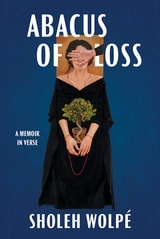
Abacus of Loss
A Memoir in VerseSholeh Wolpé
University of Arkansas Press, 2022
lbert Einstein said, “Not everything that can be counted counts, and not everything that counts can be counted.” It is in this vein that Sholeh Wolpé’s mesmerizing memoir in verse unfolds. In this lyrical and candid work, her fifth collection of poems, Wolpé invokes the abacus as an instrument of remembering. Through different countries and cultures, she carries us bead by bead on a journey of loss and triumph, love and exile. In the end, the tally is insight, not numbers, and we arrive at a place where nothing is too small for gratitude.
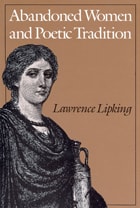
Abandoned Women and Poetic Tradition
Lawrence Lipking
University of Chicago Press, 1988
Above the Birch Line
PoemsPia Taavila-Borsheim
Gallaudet University Press, 2021
Activist Sentiments
Reading Black Women in the Nineteenth CenturyP. Gabrielle Foreman
University of Illinois Press, 2009
Activist Sentiments takes as its subject women who in fewer than fifty years moved from near literary invisibility to prolific productivity. Grounded in primary research and paying close attention to the historical archive, this book offers against-the-grain readings of the literary and activist work of Harriet Jacobs, Harriet Wilson, Frances E. W. Harper, Victoria Earle Matthews and Amelia E. Johnson.
Part literary criticism and part cultural history, Activist Sentiments examines nineteenth-century social, political, and representational literacies and reading practices. P. Gabrielle Foreman reveals how Black women's complex and confrontational commentary–often expressed directly in their journalistic prose and organizational involvement--emerges in their sentimental, and simultaneously political, literary production.
Adobe Odes
Pat Mora
University of Arizona Press, 2006
From family gossip and beauty secrets, to women darning hand-me-downs, to reluctant hands carrying bodies across borders, Mora traverses the tangled threads of culture, community, family, gender, and injustice. Her vivid observations together with her deft handling of symmetry and meter make her poetry uniquely insightful, subtle, and elegant. Sprinkled with Spanish and plenty of spice, each ode is a sensory flurry of mind and body. Together they make a cauldron of flavorful, simmering language. They are meant to be savored as they slowly stir the soul.
Africa Wo/Man Palava
The Nigerian Novel by WomenChikwenye Okonjo Ogunyemi
University of Chicago Press, 1995
Ogunyemi uses the novels to trace a Nigerian women's literary tradition that reflects an ideology centered on children and community. Of prime importance is the paradoxical Mammywata figure, the independent, childless mother, who serves as a basis for the new woman in these novels. Ogunyemi tracks this figure through many permutations, from matriarch to exile to woman writer, her multiple personalities reflecting competing loyalties—to self and other, children and nation. Such fragmented personalities characterize the postcolonial condition in their writing. Mapping geographies of pain and endurance, the work opens a space for addressing the palava between different groups of people. Valuable as the first sustained critical study of a substantial but little known body of literature, this book also counters the shortcomings of prevailing "masculinist" theories of black literature in a powerful narrative of the Nigerian world.
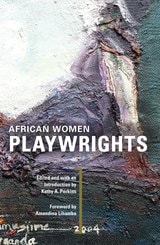
African Women Playwrights
Edited and with an Introduction by Kathy A. Perkins. Foreword by Amandina Lihamb
University of Illinois Press, 2008
This anthology consists of nine plays by a diverse group of women from throughout the African continent. The plays focus on a wide range of issues, such as cultural differences, AIDS, female circumcision, women's rights to higher education, racial and skin color identity, prostitution as a form of survival for young girls, and nonconformist women resisting old traditions. In addition to the plays themselves, this collection includes commentaries by the playwrights on their own plays, and editor Kathy A. Perkins provides additional commentary and a bibliography of published and unpublished plays by African women.
The playwrights featured are Ama Ata Aidoo, Violet R. Barungi, Tsitsi Dangarembga, Nathalie Etoke, Dania Gurira, Andiah Kisia, Sindiwe Magona, Malika Ndlovu (Lueen Conning), Juliana Okoh, and Nikkole Salter.
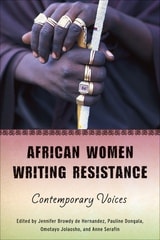
African Women Writing Resistance
An Anthology of Contemporary VoicesJennifer Browdy de Hernandez
University of Wisconsin Press, 2010
Contributors include internationally recognized authors and activists such as Wangari Maathai and Nawal El Saadawi, as well as a host of vibrant new voices from all over the African continent and from the African diaspora. Interdisciplinary in scope, this collection provides an excellent introduction to contemporary African women’s literature and highlights social issues that are particular to Africa but are also of worldwide concern. It is an essential reference for students of African studies, world literature, anthropology, cultural studies, postcolonial studies, and women’s studies.
Outstanding Book, selected by the Public Library Association
Best Books for High Schools, Best Books for Special Interests, and Best Books for Professional Use, selected by the American Association of School Libraries
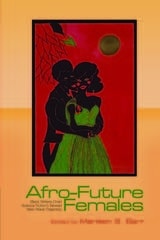
Afro-Future Females
Black Writers Chart Science Fiction's Newest New-Wave TrajectoryMarleen S. Barr
The Ohio State University Press, 2008
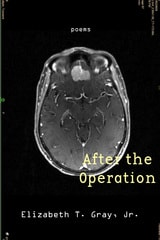
After the Operation
Elizabeth T. Gray
Four Way Books, 2025
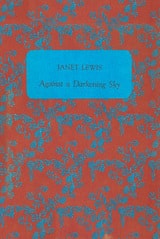
Against a Darkening Sky
Janet Lewis
Ohio University Press, 1985
Against a Darkening Sky was originally published in 1943. Set in a semirural community south of San Francisco, it is the story of an American mother of the mid-1930s and the sustaining influence she brings, through her own profound strength and faith, to the lives of her four growing children.
Scottish by birth, but long a resident of America, Mary Perrault is married to a Swiss-French gardener. Their life in South Encina, though anything but lavish, is gay, serene, and friendly. As their children mature and the world outside, less peaceful and secure than the Perrault home, begins to threaten the equilibrium of their tranquil lives, Mrs. Perrault becomes increasingly aware of a moral wilderness rising from the physical wilderness which her generation has barely conquered.
Her struggle to influence, while not invading the lives of her children, is the focus of this novel of family life during the Depression years.
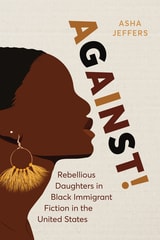
Against!
Rebellious Daughters in Black Immigrant Fiction in the United StatesAsha Jeffers
The Ohio State University Press, 2025
Against! is the first book-length study of Afro-Caribbean and African immigrant and second-generation writing in the United States. In it, Asha Jeffers evaluates the relationship between Blackness and immigranthood in the US as depicted through the recurring theme of rebellious Black immigrant daughters. Considering the work of Paule Marshall, Edwidge Danticat, Chimamanda Ngozi Adichie, and Taiye Selasi, Jeffers untangles how rebellion is informed by race, gender, ethnicity, and migration status.
Immigrant and second-generation writers mobilize often complicated familial relationships to comment on a variety of political, social, and psychic contexts. Jeffers argues that rather than categorizing Black migrants as either immediately fully integrated into an African American experience or seeing them as another category altogether that is unbound by race, Marshall, Danticat, Adichie, and Selasi identify the unstable position of Black migrants within the American racial landscape. By highlighting the diverse ways Black migrants and their children negotiate this position amid the dual demands of the respectability politics imposed on African Americans and the model-minority myth imposed on immigrants, Jeffers reveals the unsteady nature of US racial categories.
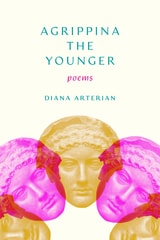
Agrippina the Younger
PoemsDiana Arterian
Northwestern University Press, 2025
A poetic journey through the past of the Roman Empress Agrippina looks toward the future
Agrippina the Younger follows one woman’s study of another, separated by thousands of miles and two millennia but bound by a shared sense of powerlessness. Agrippina was a daughter in a golden political family, destined for greatness—but she hungered for more power than women were allowed. Exhausted by the misogyny of the present, Diana Arterian reaches into the past to try to understand the patriarchal systems of today. In lyric verse and prose poems, she traces Agrippina’s rise, interrogating a life studded with intrigue, sex, murder, and manipulation. Arterian eagerly pursues Agrippina through texts, ruins, and films, exhuming the hidden details of the ancient noblewoman’s life. These poems consider the valences of patriarchy, power, and the archive to try to answer the question: How do we recover a woman erased by history?
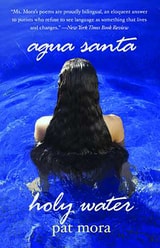
Agua Santa / Holy Water
Pat Mora
University of Arizona Press, 2007
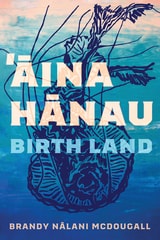
Aina Hanau / Birth Land
Brandy Nalani McDougall
University of Arizona Press, 2023
‘Āina Hānau / Birth Land is a powerful collection of new poems by Kanaka ʻŌiwi (Native Hawaiian) poet Brandy Nālani McDougall. ‘Āina hānau—or the land of one’s birth—signifies identity through intimate and familial connections to place and creates a profound bond between the people in a community. McDougall’s poems flow seamlessly between ‘Ōlelo Hawai‘i and English, forming rhythms and patterns that impress on the reader a deep understanding of the land. Tracing flows from the mountains to the ocean, from the sky to the earth, and from ancestor to mother to child, these poems are rooted in the rich ancestral and contemporary literature of Hawaiʻi —moʻolelo, moʻokūʻauhau, and mele —honoring Hawaiian ʻāina, culture, language, histories, aesthetics, and futures.
The poems in Āina Hānau / Birth Land cycle through sacred and personal narratives while exposing and fighting ongoing American imperialism, settler colonialism, militarism, and social and environmental injustice to protect the ʻāina and its people. The ongoing environmental crisis in Hawaiʻi, inextricably linked to colonialism and tourism, is captured with stark intensity as McDougall writes, Violence is what we settle for / because we’ve been led to believe / green paper can feed us / more than green land. The experiences of birth, motherhood, miscarriage, and the power of Native Hawaiian traditions and self-advocacy in an often dismissive medical system is powerfully narrated by the speaker of the titular poem, written for McDougall’s daughters.
‘Āina Hānau reflects on what it means to be from and belong to an ʻāina hānau, as well as what it means to be an ‘āina hānau, as all mothers serve as the first birth lands for their children.