Results by title
8 books match the query 'Women political candidates'

A Thousand Steps to Parliament
Constructing Electable Women in MongoliaManduhai Buyandelger
University of Chicago Press, 2022
Mongolia has often been deemed an “island of democracy,” commended for its rapid adoption of free democratic elections in the wake of totalitarian socialism. The democratizing era, however, brought alongside it a phenomenon that Manduhai Buyandelger terms “electionization”—a restructuring of elections from time-grounded events into a continuous neoliberal force that governs everyday life beyond the electoral period. In this way, electoral campaigns have come to substitute for the functions of governing, from social welfare to the private sector, requiring an accumulation of wealth and power beyond the reach of most women candidates. In A Thousand Steps to Parliament, Buyandelger shows how successful women candidates instead use strategies of self-polishing to cultivate charisma and a reputation for being oyunlag, or intellectful. This carefully crafted identity can be called the “electable self”: treating their bodies and minds as pliable and renewable, women candidates draw from the same practices of neoliberalism that have unsustainably commercialized elections. By tracing the complicated, contradictory paths to representation that women in Mongolia must walk, A Thousand Steps to Parliament holds a mirror up to democracies the world over, revealing an urgent need to grapple with the encroaching effects of neoliberalism in our global political systems.
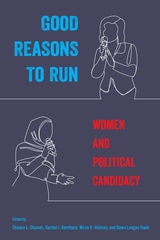
Good Reasons to Run
Women and Political CandidacyEdited by Shauna L. Shames, Rachel I. Bernhard, Mirya R. Holman, and Dawn Langan Teele
Temple University Press, 2020
After the 2016 U.S. Presidential election, a large cohort of women emerged to run for office. Their efforts changed the landscape of candidates and representation. However, women are still far less likely than men to seek elective office, and face biases and obstacles in campaigns. (Women running for Congress make twice as many phone calls as men to raise the same contributions.)
The editors and contributors to Good Reasons to Run, a mix of scholars and practitioners, examine the reasons why women run—and do not run—for political office. They focus on the opportunities, policies, and structures that promote women’s candidacies. How do nonprofits help recruit and finance women as candidates? And what role does money play in women’s campaigns?
The essays in Good Reasons to Run ask not just who wants to run, but how to activate and encourage such ambition among a larger population of potential female candidates while also increasing the diversity of women running for office.
Navigating Gendered Terrain
Stereotypes and Strategy in Political CampaignsKelly Dittmar
Temple University Press, 2014
Navigating Gendered Terrain addresses how gender is used to shape how campaigns are waged by influencing insider perceptions of and decisions about effective campaign messages, images, and tactics within party and political contexts. Dittmar uses survey information and interviews with candidates, political consultants, and other campaign professionals to reveal how gender-informed advertising, websites, and overall presentation to voters respond to stereotypes and perceptions of female and male candidates.
She closes her book by offering a feminist interpretation of women as candidates and explaining how the unintended outcomes of political campaigns reinforce prevailing ideas about gender and candidacy.
Parité!
Sexual Equality and the Crisis of French UniversalismJoan Wallach Scott
University of Chicago Press, 2005
During the 1990s, le mouvement pour la parité successfully campaigned for women's inclusion in elective office with an argument that is unprecedented in the annals of feminism. The paritaristes insisted that if the abstract individual were thought of as sexed, then sexual difference would no longer be a relevant consideration in politics. Scott insists that this argument was neither essentialist nor separatist; it was not about women's special qualities or interests. Instead, parité was rigorously universalist—and for that reason was both misunderstood and a source of heated debate.
Selecting Women, Electing Women
Political Representation and Candidate Selection in Latin AmericaMagda Hinojosa
Temple University Press, 2012
Selecting Women, Electing Women is a groundbreaking book that examines how the rules for candidate selection affect women’s political representation in Latin America. Focusing particularly on Chile and Mexico, Magda Hinojosa presents counterintuitive assumptions about factors that promote the election of women. She argues that primaries—which are regularly thought of as the most democratic process for choosing candidates—actually produce fewer female nominees than centralized and seemingly exclusionary candidate selection procedures.
Hinojosa astutely points out the role of candidate selection processes in explaining variation in women’s representation that exists both across and within political parties. Selecting Women, Electing Women makes critical inroads to the study of gender and politics, candidate selection, and Latin American politics.
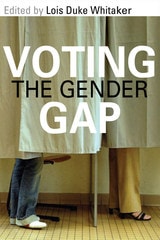
Voting the Gender Gap
Edited by Lois Duke Whitaker
University of Illinois Press, 2007
This book concentrates on the gender gap in voting--the difference in the proportion of women and men voting for the same candidate. Evident in every presidential election since 1980, this polling phenomenon reached a high of 11 percentage points in the 1996 election. The contributors discuss the history, complexity, and ways of analyzing the gender gap; the gender gap in relation to partisanship; motherhood, ethnicity, and the impact of parental status on the gender gap; and the gender gap in races involving female candidates. Voting the Gender Gap analyzes trends in voting while probing how women's political empowerment and gender affect American politics and the electoral process.
Contributors are Susan J. Carroll, Erin Cassese, Cal Clark, Janet M. Clark, M. Margaret Conway, Kathleen A. Dolan, Laurel Elder, Kathleen A. Frankovic, Steven Greene, Leonie Huddy, Mary-Kate Lizotte, Barbara Norrander, Margie Omero, and Lois Duke Whitaker.
Where Women Run
Gender and Party in the American StatesKira Sanbonmatsu
University of Michigan Press, 2010
“Kira Sanbonmatsu has done a masterful job of linking the representation of women in elective office to the activities of party organizations in the states. She combines qualitative and quantitative data to show how women are navigating the campaign process to become elected leaders and the changing role of party organizations in their recruitment and election. It is a significant contribution to the study of representative democracy.”
--Barbara Burrell, Northern Illinois University
“Sanbonmatsu has produced an excellent study that will invigorate research on the role of political parties and the recruitment of women candidates. Using a variety of methods and data sources, she has crafted a tightly constructed, clearly argued, and exceedingly well-written study. A commendable and convincing job.”
--Gary Moncrief, Boise State University
“Sanbonmatsu offers important insights in two neglected areas of American politics: the role of political parties in recruiting candidates and the continued under-representation of women in elected office. Connecting the two subjects through careful qualitative and statistical methods, insightful interpretation of the literature and interesting findings, the book is a significant new addition to scholarship on parties, gender, and political recruitment.”
--Linda Fowler, Dartmouth College
Kira Sanbonmatsu is Associate Professor of Political Science at Rutgers University and Senior Scholar at the Eagleton Institute of Politics’ Center for American Women and Politics (CAWP). She was previously associate professor at Ohio State University. She is the author of Democrats, Republicans, and the Politics of Women’s Place.
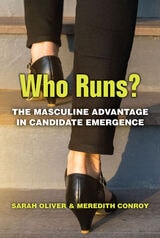
Who Runs?
The Masculine Advantage in Candidate EmergenceSarah Oliver and Meredith Conroy
University of Michigan Press, 2020
Meredith Conroy and Sarah Oliver focus on the candidate emergence process (recruitment, perceived qualifications, and ambition), and investigate the affects of individuals’ gender personality on these variables to improve theories of women’s underrepresentation in government. They argue that since politics and masculinity are congruent, we should observe more precise variation in the candidate emergence process along gender differences, than along sex differences in isolation. Individuals who are more masculine will be more likely to be recruited, perceive of themselves as qualified, and express political ambition, than less masculine individuals. This differs from studies that look at sex differences, because it accepts that some women defy gender norms and break into politics. By including a measure of gender personality we can more fully grapple with women’s progress in American politics, and consider whether this progress rests on masculine behaviors and attributes. Who Runs? The Masculine Advantage in Candidate Emergence explores this possibility and the potential ramifications.