Results by title
43 books match the query 'Women social reformers'
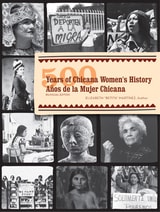
500 Years of Chicana Women's History / 500 Años de la Mujer Chicana
Bilingual EditionMartínez, Elizabeth "
Rutgers University Press, 2008
The history of Mexican Americans spans more than five centuries and varies from region to region across the United States. Yet most of our history books devote at most a chapter to Chicano history, with even less attention to the story of Chicanas.
500 Years of Chicana Women’s History offers a powerful antidote to this omission with a vivid, pictorial account of struggle and survival, resilience and achievement, discrimination and identity. The bilingual text, along with hundreds of photos and other images, ranges from female-centered stories of pre-Columbian Mexico to profiles of contemporary social justice activists, labor leaders, youth organizers, artists, and environmentalists, among others. With a distinguished, seventeen-member advisory board, the book presents a remarkable combination of scholarship and youthful appeal.
In the section on jobs held by Mexicanas under U.S. rule in the 1800s, for example, readers learn about flamboyant Doña Tules, who owned a popular gambling saloon in Santa Fe, and Eulalia Arrilla de Pérez, a respected curandera (healer) in the San Diego area. Also covered are the “repatriation” campaigns” of the Midwest during the Depression that deported both adults and children, 75 percent of whom were U.S.–born and knew nothing of Mexico. Other stories include those of the garment, laundry, and cannery worker strikes, told from the perspective of Chicanas on the ground.
From the women who fought and died in the Mexican Revolution to those marching with their young children today for immigrant rights, every story draws inspiration. Like the editor’s previous book, 500 Years of Chicano History (still in print after 30 years), this thoroughly enriching view of Chicana women’s history promises to become a classic.
A Milwaukee Woman's Life on the Left
The Autobiography of Meta BergerMeta Berger
Wisconsin Historical Society Press, 2001
A Sister's Memories
The Life and Work of Grace Abbott from the Writings of Her Sister, Edith AbbottEdited by John Sorensen
University of Chicago Press, 2015
A Sister’s Memories is the inspiring story of Grace Abbott (1878–1939), as told by her sister and social justice comrade, Edith Abbott (1876–1957). Edith recalls in vivid detail the Nebraska childhood, impressive achievements, and struggles of her sister who, as head of the Immigrants’ Protective League and the U.S. Children’s Bureau, championed children’s rights from the slums of Chicago to the villages of Appalachia. Grace’s crusade can perhaps be best summed up in her well-known credo: “Justice for all children is the high ideal in a democracy.” Her efforts saved the lives of thousands of children and immigrants and improved those of millions more. These trailblazing social service works led the way to the creation of the Social Security Act and UNICEF and caused the press to nickname her “The Mother of America’s 43 Million Children.” She was the first woman in American history to be nominated to the presidential cabinet and the first person to represent the United States at a committee of the League of Nations.
Edited by Abbott scholar John Sorensen, A Sister’s Memories is destined to become a classic. It shapes the diverse writings of Edith Abbott into a cohesive narrative for the first time and fills in the gaps of our understanding of Progressive Era reforms. Readers of all backgrounds will find themselves engrossed by this history of the unstoppable, pioneer feminist Abbott sisters.
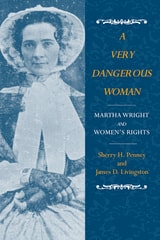
A Very Dangerous Woman
Martha Wright and Women's RightsSharon H. Penney
University of Massachusetts Press, 2004
In telling Wright's story, the authors make good use of her lively letters to her family, friends, and colleagues, including Susan B. Anthony and Elizabeth Cady Stanton. These letters reveal Wright's engaging wit and offer an insider's view of nineteenth-century reform and family life. Her correspondence with slaveholding relatives in the South grew increasingly contentious with the approach of the Civil War. One nephew became a hero of the Confederacy with his exploits at the Battle of Fredericksburg, and her son in the Union artillery was seriously wounded at Gettysburg while repelling Pickett's Charge.
Wright's life never lacked for drama. She survived a shipwreck, spent time at a frontier fort, experienced the trauma of the deaths of a fiancé, her first husband, and three of her seven children, and navigated intense conflicts within the women's rights and abolition movements. Throughout her tumultuous career, she drew on a reservoir of humor to promote her ideas and overcome the many challenges she faced. This accessible biography, written with the general reader in mind, does justice to her remarkable life.
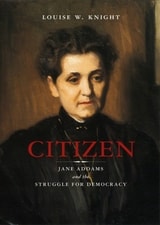
Citizen
Jane Addams and the Struggle for DemocracyLouise W. Knight
University of Chicago Press, 2005
Citizen covers the first half of Addams's life, from 1860 to 1899. Knight recounts how Addams, a child of a wealthy family in rural northern Illinois, longed for a life of larger purpose. She broadened her horizons through education, reading, and travel, and, after receiving an inheritance upon her father's death, moved to Chicago in 1889 to co-found Hull House, the city's first settlement house. Citizen shows vividly what the settlement house actually was—a neighborhood center for education and social gatherings—and describes how Addams learned of the abject working conditions in American factories, the unchecked power wielded by employers, the impact of corrupt local politics on city services, and the intolerable limits placed on women by their lack of voting rights. These experiences, Knight makes clear, transformed Addams. Always a believer in democracy as an abstraction, Addams came to understand that this national ideal was also a life philosophy and a mandate for civic activism by all.
As her story unfolds, Knight astutely captures the enigmatic Addams's compassionate personality as well as her flawed human side. Written in a strong narrative voice, Citizen is an insightful portrait of the formative years of a great American leader.
“Knight’s decision to focus on Addams’s early years is a stroke of genius. We know a great deal about Jane Addams the public figure. We know relatively little about how she made the transition from the 19th century to the 20th. In Knight’s book, Jane Addams comes to life. . . . Citizen is written neither to make money nor to gain academic tenure; it is a gift, meant to enlighten and improve. Jane Addams would have understood.”—Alan Wolfe, New York Times Book Review
“My only complaint about the book is that there wasn’t more of it. . . . Knight honors Addams as an American original.”—Kathleen Dalton, Chicago Tribune

Creating the New Woman
The Rise of Southern Women's Progressive Culture in Texas, 1893-1918Judith N. McArthur
University of Illinois Press, 1998
Regionally distinct yet influenced by national trends, women's progressive culture in Texas offers a valuable opportunity to analyze the evolution of women's voluntary associations, their challenges to southern conventions of race and class, and their quest for social change and political power.
Judith McArthur traces how general concerns of national progressive organizations about pure food, prostitution, and education reform shaped programs at the state and local levels. Southern women differed from their Northern counterparts by devising new approaches to settlement work and taking advantage of World War I to challenge southern gender and racial norms. McArthur's original analysis details how women in Texas succeeded in securing partial voting rights before passage of the Nineteenth Amendment. She also provides valuable comparisons between North and South, among various southern states, and between black and white, and male and female, progressives.

Elizabeth Packard
A Noble FightLinda V. Carlisle
University of Illinois Press, 2010
Fighting for Equality
A Life of May Wright SewallRay E. Boomhower
Indiana Historical Society Press, 2007
Fire Dreams
Making Black Feminist Liberation in the SouthLaura McTighe, with Women With A Vision
Duke University Press, 2024
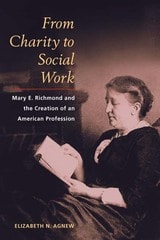
From Charity to Social Work
Mary E. Richmond and the Creation of an American ProfessionElizabeth N. Agnew
University of Illinois Press, 2003
Orphaned at a young age and largely self-educated, Richmond initially entered charity work as a means of self-support, but came to play a vital role in transforming philanthropy--previously seen as a voluntary expression of individual altruism--into a valid, organized profession. Her career took her from charity organization leadership in Baltimore and Philadelphia to an executive position with the prestigious Russell Sage Foundation in New York City.
Richmond's progressive civic philosophy of social work was largely informed by the social gospel movement. She strove to find practical applications of the teachings of Christianity in response to the social problems that accompanied rapid industrialization, urbanization, and poverty. At the same time, her tireless efforts and personal example as a woman created an appealing, if ambiguous, path for other professional women. A century later her legacy continues to echo in social work and welfare reform.
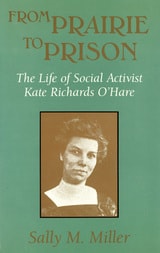
From Prairie to Prison
The Life of Social Activist Kate Richards O'HareSally M. Miller
University of Missouri Press, 1993
This is the first full-length biography of the woman who crusaded tirelessly for women, workers, and children, and became the most celebrated socialist woman from the West.
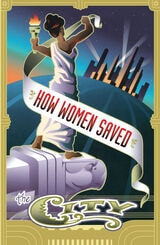
How Women Saved The City
Daphne Spain
University of Minnesota Press, 2001
Reclaims the lost history of women’s contributions to the development of American cities
In the days between the Civil War and World War I, women rarely worked outside the home, rarely went to college, and, if our histories are to be believed, rarely put their mark on the urban spaces unfolding around them. And yet, as this book clearly demonstrates, women did play a key role in shaping the American urban landscape.
To uncover the contribution of women to urban development during this period, Daphne Spain looks at the places where women participated most actively in public life—voluntary organizations like the Young Women’s Christian Association, the Salvation Army, the College Settlements Association, and the National Association of Colored Women. In the extensive building projects of these associations—boarding houses, vocational schools, settlement houses, public baths, and playgrounds—she finds clear evidence of a built environment created by women. Exploring this environment, Spain reconstructs the story of the "redemptive places" that addressed the real needs of city dwellers—especially single women, African-Americans, immigrants, and the poor—and established an environment in which newcomers could learn to become urban Americans.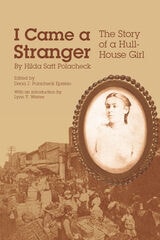
I Came a Stranger
The Story of a Hull-House GirlHilda Satt Polacheck
University of Illinois Press, 1989

Inventing Loreta Velasquez
Confederate Soldier Impersonator, Media Celebrity, and Con ArtistWilliam C. Davis
Southern Illinois University Press, 2016
This groundbreaking biography reveals a woman quite different from the public persona she promoted. In her bestselling memoir, The Woman in Battle, Velasquez claimed she was an emphatic Confederate patriot, but in fact she never saw combat. Instead, during the war she manufactured bullets for the Union and persuaded her Confederate husband to desert the Army.
After the Civil War ended, she wore many masks, masterminding ambitious confidence schemes worth millions, such as creating a phony mining company, conning North Carolina residents to back her financially in a fake immigration scheme, and attracting investors to build a railroad across western Mexico. With various husbands, Velasquez sought her fortune both in the American West and in the Klondike, though her endeavors cost one husband his life. She also became a social reformer advocating on behalf of better prison conditions, the Cuban revolt against Spain, and the plight of Cuban refugees. Further, Velasquez was one of the first women to venture into journalism and presidential politics. Always a sensational press favorite, she displayed throughout her life an uncanny ability to manipulate popular media and to benefit from her fame in a way that prefigured celebrities of our own time, including using her testimony in a Congressional inquiry about Civil War counterfeiting as a means of promoting her latest business ventures.
So little has been known of Velasquez’s real life that some postmodern scholars have glorified her as a “woman warrior” and used her as an example in cross-gender issues and arguments concerning Hispanic nationalism. Davis firmly refutes these notions by bringing the historical Velasquez to the surface. The genuine story of Velasquez’s life is far more interesting than misguided interpretations and her own fanciful inventions.
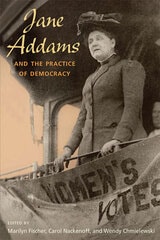
Jane Addams and the Practice of Democracy
Edited by Marilyn Fischer, Carol Nackenoff, and Wendy Chmielewski
University of Illinois Press, 2008
Using a rich array of newly available sources and contemporary methodologies from many disciplines, the ten original essays in this volume give a fresh appraisal of Addams as a theorist and practitioner of democracy. In an increasingly interdependent world, Addams's life work offers resources for activists, scholars, policy makers, and theorists alike. This volume demonstrates how scholars continue to interpret Addams as a model for transcending disciplinary boundaries, generating theory out of concrete experience, and keeping theory and practice in close and fruitful dialogue.
Contributors are Harriet Hyman Alonso, Victoria Bissell Brown, Wendy Chmielewski, Marilyn Fischer, Shannon Jackson, Louise W. Knight, Carol Nackenoff, Karen Pastorello, Wendy Sarvasay, Charlene Haddock Seigfried, and Camilla Stivers.

Jane Addams, a Writer's Life
Katherine Joslin
University of Illinois Press, 2003
Jane Addams, a Writer's Life is an expansive, revealing, and refreshing reexamination of the renowned reformer as an imaginative writer. Jane Addams is best known for her groundbreaking social work at Hull-House, the force of her efforts toward Progressive political and social reform, and the bravery of her commitment to pacifism, for which she received the Nobel Peace Prize. Katherine Joslin moves beyond this history to present Addams as a literary figure, one whose writing employed a synthesis of fictional and analytical prose that appealed to a wide audience.
Joslin traces Addams's style from her early works, Philanthropy and Social Progress and her contributions to Hull House Maps and Papers, influenced by Florence Kelley, to her modernist and experimental last books, The Second Twenty Years at Hull-House and My Friend, Julia Lathrop, placing Addams in the context of other Chicago writers including Theodore Dreiser, Upton Sinclair, Harriet Monroe, Frank Norris and James T. Farrell. Joslin's close readings showcase Addams's distinguishing literary devices, such as using stories about people rather than sociological argument to make moral points. As Joslin pursues the argument that Addams's power as a public figure stemmed from the success of her books and essays, Addams herself emerges as a literary woman.
Jane Addams
A BIOGRAPHYJames Weber LinnIntroduction by Anne Firor Scott
University of Illinois Press, 1935
James Weber Linn's life of this forceful public figure offers a rare glimpse of the private Addams, from her childhood and schooling through her first efforts in public service and her rise to a position of national influence. Linn's biography is based on Addams's personal papers, which she turned over to him before she died: files of her manuscripts, published and unpublished, along with all of her letters and papers, from her first valentine to her last speech. Out of this treasure trove, in combination with Addams's substantial published works, he has written a unique life of his aunt, beautifully illuminating her private reflections and inner strength as well as her formidable public persona.

Jane Addams
The Most Dangerous Woman in AmericaMarlene Targ Brill
Ohio University Press, 2024
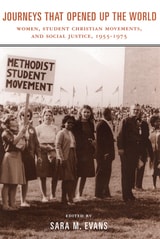
Journeys that Opened up the World
Women, Student Christian Movements, and Social Justice, 1955-1975Evans, Sara M.
Rutgers University Press, 2003
For thousands of young women in the 1950s and 1960s, involvement with the student Christian movement (SCM) changed their worldviews. Religious organizations fostered women’s leadership at a time when secular groups like Students for a Democratic Society, and the Left in general, relegated most female participants to stereotypical roles.
The SCM introduced young women to activism in other parts of the country and around the world. As leaders, thinkers, and organizers, they encountered the social realities of poverty and racial prejudice and worked to combat them. The SCM took women to Selma and Montgomery, to Africa and Latin America, and to a lifelong commitment to work for social justice.

Kindred Nature
Victorian and Edwardian Women Embrace the Living WorldBarbara T. Gates
University of Chicago Press, 1999
Some of these women discovered previously unknown species, others wrote and illustrated natural histories or animal stories, and still others educated women, the working classes, and children about recent scientific advances. A number of women also played pivotal roles in the defense of animal rights by protesting overhunting, vivisection, and habitat destruction, even as they demanded their own rights to vote, work, and enter universities.
Kindred Nature shows the enormous impact Victorian and Edwardian women had on the natural sciences and the environmental movement, and on our own attitudes toward nature and human nature.
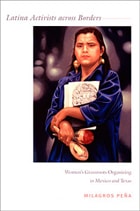
Latina Activists across Borders
Women's Grassroots Organizing in Mexico and TexasMilagros Peña
Duke University Press, 2007
Drawing on interviews with the leaders of more than two dozen women’s NGOs in Michoacán and El Paso/Ciudad Juárez, Peña examines the influence of the Roman Catholic Church and liberation theology on Latina activism, and she describes how activist affiliations increasingly cross ethnic, racial, and class lines. Women’s NGOs in Michoacán put an enormous amount of energy into preparations for the 1995 United Nations–sponsored World Conference on Women in Beijing, and they developed extensive activist networks as a result. As Peña demonstrates, activists in El Paso/Ciudad Juárez were less interested in the Beijing conference; they were intensely focused on issues related to immigration and to the murders and disappearances of scores of women in Ciudad Juárez. Ultimately, Peña’s study highlights the consciousness-raising work done by NGOs run by and for Mexican and Mexican American women: they encourage Latinas to connect their personal lives to the broader political, economic, social, and cultural issues affecting them.
Lydia Maria Child
A Radical American LifeLydia Moland
University of Chicago Press, 2022
By 1830, Lydia Maria Child had established herself as something almost unheard of in the American nineteenth century: a beloved and self-sufficient female author. Best known today for the immortal poem “Over the River and through the Wood,” Child had become famous at an early age for spunky self-help books and charming children’s stories. But in 1833, Child shocked her readers by publishing a scathing book-length argument against slavery in the United States—a book so radical in its commitment to abolition that friends abandoned her, patrons ostracized her, and her book sales plummeted. Yet Child soon drew untold numbers to the abolitionist cause, becoming one of the foremost authors and activists of her generation.
Lydia Maria Child: A Radical American Life tells the story of what brought Child to this moment and the extraordinary life she lived in response. Through Child’s example, philosopher Lydia Moland asks questions as pressing and personal in our time as they were in Child’s: What does it mean to change your life when the moral future of your country is at stake? When confronted by sanctioned evil and systematic injustice, how should a citizen live? Child’s lifetime of bravery, conviction, humility, and determination provides a wealth of spirited guidance for political engagement today.
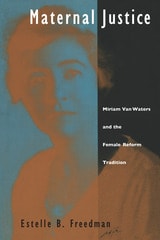
Maternal Justice
Miriam Van Waters and the Female Reform TraditionEstelle B. Freedman
University of Chicago Press, 1996
Estelle B. Freedman draws from Van Waters's diaries, letters, and personal papers to recreate her complex personal life, unveiling the disparity between Van Waters's public persona and her agonized private soul. With the power and elegance of a novel, Maternal Justice illuminates this historical context, casting light on the social welfare tradition, on women's history, on the American feminist movement, and on the history of sexuality.
"Maternal Justice is as much a work of history as it is biography, bringing to life not only a remarkable woman but also the complex political and social milieu within which she worked and lived."—Kelleher Jewett, The Nation
"This sympathetic biography reclaims Van Waters for history."—Publishers Weekly
"The Van Waters legacy, as Freedman gracefully presents, is that she cared about the lives of women behind bars. It is a strikingly unfashionable sentiment today."—Jane Meredith Adams, San Francisco Chronicle Book Review, Editor's Recommended Selection
"This finely crafted biography is both an engrossing read and a richly complicated account of a reformer whose work . . . bridged the eras of voluntarist charitable activism and professional social service."—Sherri Broder, Women's Review of Books
"This is a sympathetic, highly personal biography, revealing of both the author's responses to her subject's life and, in considerable detail, Van Waters's family traumas, illnesses, and love affairs."—Elizabeth Israels Perry, Journal of American History
Mothers and the Mexican Antinuclear Power Movement
Velma García-Gorena
University of Arizona Press, 1999
In Mothers and the Mexican Antinuclear Power Movement, Velma García-Gorena traces the protest movement against the Mexican government's Laguna Verde nuclear plant, outlining the movement's formation, development, and decline. Documenting the movement's key players and turning points in superb detail, she interweaves important historical narrative with a deft examination of the events, framing her analysis in terms of social movement literature. In a departure from the more conventional New Social Movements approach to analyzing antinuclear movements, García-Gorena demonstrates how, in many ways, movements of this kind are not so new and how a modified "political process" approach fits much better. With a sophisticated application of various social movements' paradigms, García-Gorena incorporates perspectives such as resource mobilization, political process paradigms, and feminist theory.
Timely, well written, and thoroughly researched, Mothers and the Mexican Antinuclear Power Movement fills a major gap in the literature on grassroots environmental movements in Latin America. Both rich in empirical detail and convincing in its conclusions, this study provides a broader understanding of Mexican social movements and the quest for democracy in developing countries.
Muslim Women Activists in North America
Speaking for OurselvesEdited by Katherine Bullock
University of Texas Press, 2005
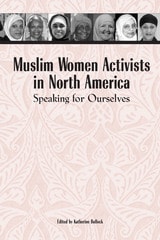
In the eyes of many Westerners, Muslim women are hidden behind a veil of negative stereotypes that portray them as either oppressed, subservient wives and daughters or, more recently, as potential terrorists. Yet many Muslim women defy these stereotypes by taking active roles in their families and communities and working to create a more just society. This book introduces eighteen Muslim women activists from the United States and Canada who have worked in fields from social services, to marital counseling, to political advocacy in order to further social justice within the Muslim community and in the greater North American society.
Each of the activists has written an autobiographical narrative in which she discusses such issues as her personal motivation for doing activism work, her views on the relationship between Islam and women's activism, and the challenges she has faced and overcome, such as patriarchal cultural barriers within the Muslim community or racism and discrimination within the larger society. The women activists are a heterogeneous group, including North American converts to Islam, Muslim immigrants to the United States and Canada, and the daughters of immigrants. Young women at the beginning of their activist lives as well as older women who have achieved regional or national prominence are included. Katherine Bullock's introduction highlights the contributions to society that Muslim women have made since the time of the Prophet Muhammad and sounds a call for contemporary Muslim women to become equal partners in creating and maintaining a just society within and beyond the Muslim community.

My Friend, Julia Lathrop
Jane Addams
University of Illinois Press, 1935
The memoir reveals a great deal about the influence of Hull-House on the social and political history of the early twentieth century. An introduction by long-time Addams scholar Anne Firor Scott provides a broader account of women's work in voluntary associations.
Obliged to Help
Adolphine Fletcher Terry and the Progressive SouthStephanie Bayless
Butler Center for Arkansas Studies, 2011
Political Woman
FlorenceSharon Strom
Temple University Press, 2001
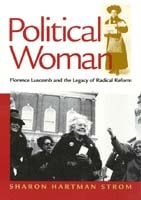
Politcal Women counters the traditional narratives that place men at the center of political thinking and history. Showing how three generations of Luscomb's family had set the stage for her activism, this biography presents her story against the backdrop of Boston's politics and larger struggles for social justice. Luscomb participated in every significant social reform movement of her time -- from securing women's right to vote and supporting trade unionism to advocating an end to the war in Vietnam. Luscomb also ran for public office; she was narrowly defeated when she ran for Boston's city council in 1922. Although unsuccessful as a third-party candidate for Congress (in 1936 and 1950) and for Governor of Massachusetts (in 1952), she was one of the few women of her time to seek office. Independent, athletic, and spirited, she apparently never thought that traditional gender prescriptions applied to her. A practicing architect before the First World War, an exuberant hiker all her life, and a member in collective-living arrangements, Luscomb enjoyed a life of rich experiences and sustaining relationships.
In Florence Luscomb's biography, Sharon Hartman Strom suggests that although women were excluded from the activities and sites associated with conventional politics until recently, they did political work that gave purpose to their lives and affected political thinking in their communities, states, and ultimately the nation.

Progressive Women in Conservative Times
Racial Justice, Peace, and FeminismSusan Lynn
Rutgers University Press, 1992
Susan Lynn explores women's progressive social reform efforts in the 1940s and 1950s, an era when women activists promoted a postwar vision of a society based on an expanded welfare state, a powerful labor movement, a strong tradition of civil liberties, racial equality, and a peaceful international order. Lynn focuses on two organizations, the YWCA and the American Friends Service Committee, to explore this agenda.
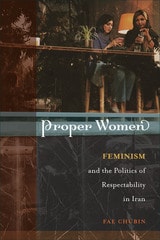
Proper Women
Feminism and the Politics of Respectability in IranFae Chubin
Temple University Press, 2024
Chubin brings attention to the varying class, ethnic, religious, and national identities of NGO staff and clients that shaped their differing understandings of oppression and justice. Her examination of the tensions within the organization reveals why the efforts of the NGO workers failed to gain purchase among the intended beneficiaries.
Proper Women concludes by encouraging feminist activists to not only examine the role of local politics and transnational connections in shaping their definitions of empowerment, but also consider the advantages of a justice-enhancing practice as opposed to justice monism for their target populations.
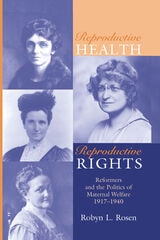
REPRODUCTIVE HEALTH, REPRODUCTIVE RIGHTS
REFORMERS & THE POLITICS OF MATERNAL WELFARE, 1917–1940Robyn L. Rosen
The Ohio State University Press, 2003
In the early twentieth century, shifting attitudes and new public health standards brought an unprecedented interest in and effort to regulate issues affecting reproduction and maternity. Maternal and infant health, nutrition, and medical care came under scrutiny, as did the issue of birth control. While the prior gained public support, the latter remained controversial. Though some reformers saw birth control as an important part of maternal welfare, others sought to separate it from more popular reforms. The careers of the four prominent but usually neglected reformers (Elizabeth Lowell Putnam, Ethel Sturges Dummer, Mary Ware Dennett, and Blanche Ames) examined in this book embody the struggle to define and resolve these tensions.
The study of these reformers offers a new perspective on more recognized leaders in the arena of reproductive health and rights, especially the U.S. Children's Bureau and Margaret Sanger. Putnam's elitism contextualizes the class politics of the Bureau, underscoring its sensitivity to the vulnerable and its innovative approach to public health. Dummer reminds us of roads not taken by policy makers in the Bureau, accentuating the differences between a child-centered and a woman-centered agenda. Dennett highlights the obstacles to women reformers in the formal political sphere, while Ames's penchant toward maternalism and compromise also led to difficulties. Together, they illustrate the complexities of formulating an effective approach to securing reproductive rights and health.
Refounding Democracy through Intersectional Activism
How Progressive Era Feminists Redefined Who We Are, and What It Means TodayWendy Sarvasy
Temple University Press, 2024
Sarvasy shows how these activists worked to incorporate women by combining political democracy with the creation of a welfare state. They embedded this nation-state project within a new humanitarian transnational level as they evolved their multileveled social citizenship.
Refounding Democracy through Intersectional Activism demonstrates how a theory-activist dynamic played out in experimental socializing spaces and democratic conversations. It offers an inspirational method for intersectional activists today.
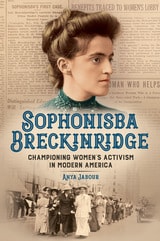
Sophonisba Breckinridge
Championing Women's Activism in Modern AmericaAnya Jabour
University of Illinois Press, 2019
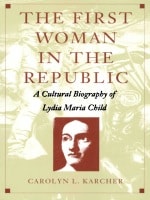
The First Woman in the Republic
A Cultural Biography of Lydia Maria ChildCarolyn L. Karcher
Duke University Press, 1998
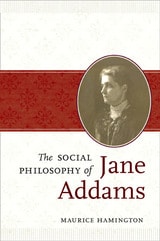
The Social Philosophy of Jane Addams
Maurice Hamington
University of Illinois Press, 2009
Although there has been a resurgence of scholarly interest in Jane Addams, much of the recent literature has dwelt more on her extraordinary and pioneering life than on the philosophical contribution of her twelve books and hundreds of published articles. This study is the first book-length work to focus entirely on Addams as a philosopher, a moral and political theorist who was steeped in the classic American Pragmatist tradition but who transcended that tradition to emphasize the significance of gender, race, and class.
Exploring Addams's contribution to epistemology, ethics, and feminist theory, Maurice Hamington sets the intellectual framework for Addams's social philosophy by discussing her influences, her particular brand of feminism, and finally her unique analytical perspective, which she described as "sympathetic knowledge." The book also investigates how Addams applied her social philosophy to issues of politics, women's rights, prostitution, business ethics, education, and religion.
Addams's philosophical work remains relevant to current feminist ethical discourse, and The Social Philosophy of Jane Addams leads to an understanding of a cosmopolitan theorist who eschewed ideological stances in favor of intermediary steps toward social progress.
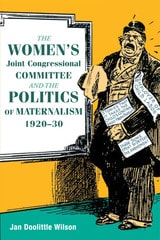
The Women's Joint Congressional Committee and the Politics of Maternalism, 1920-30
Jan Doolittle Wilson
University of Illinois Press, 2006
Jan Doolittle Wilson offers the first comprehensive history of the umbrella organization founded by former suffrage leaders in order to coordinate activities around women's reform. Encompassing nearly every major national women's organization of its time, the Women's Joint Congressional Committee (WJCC) evolved into a powerful lobbying force for the legislative agendas of more than twelve million women. Critics and supporters alike came to recognize it as "the most powerful lobby in Washington."
Examining the WJCC's most consequential and contentious campaigns, Wilson traces how the group's strategies, rhetoric, and success generated congressional and grassroots support for their far-reaching, progressive reforms. But the committee's early achievements sparked a reaction by big business that challenged and ultimately limited the programs these women envisioned. Using the WJCC as a lens, Wilson analyzes women's political culture during the 1920s. She also sheds new light on the initially successful ways women lobbied for social legislation, the limitations of that process for pursuing class-based reforms, and the enormous difficulties the women soon faced in trying to expand public responsibility for social welfare.
A volume in the series Women in American History, edited by Anne Firor Scott, Susan Armitage, Susan K. Cahn, and Deborah Gray White
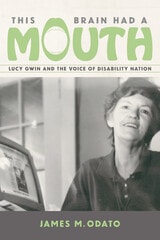
This Brain Had a Mouth
Lucy Gwin and the Voice of Disability NationJames M. Odato
University of Massachusetts Press, 2021
In this engrossing biography, James M. Odato provides an intimate portrait of Gwin, detailing how she forged her own path into activism. After an automobile accident left her with a brain injury, Gwin became a tireless advocate for the equal rights of people she termed "dislabled." More than just a publisher, she fought against corruption in the rehabilitation industry, organized for the group Not Dead Yet, and much more. With Gwin's story at the center, Odato introduces readers to other key disability rights activists and organizations, and supplies context on current contentious topics such as physician-assisted suicide. Gwin's impact on disability rights was monumental, and it is time her story is widely known.
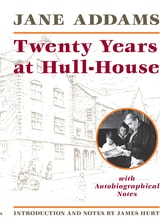
Twenty Years at Hull-House
Jane Addams, with Autobiographical Notes. Introduction and Notes by James Hurt.
University of Illinois Press, 1990
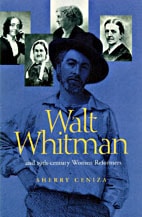
Walt Whitman and Nineteenth-Century Women Reformers
Sherry Ceniza
University of Alabama Press, 1999
WINNER OF THE ELIZABETH AGEE PRIZE IN AMERICAN LITERATURE
Examining Whitman’s poetic development through the documented influence of nineteenth‑century women reformers.
Walt Whitman and 19th-Century Women Reformers documents Whitman's friendships with women during the 1850s, the decade of Whitman's most creative period. The book reveals startling connections between the first three editions of Leaves of Grass and the texts generated by the women he knew during this period, many of whom were radical activists in the women's rights movement.
Sherry Ceniza argues that Whitman's editions of Leaves became progressively more radically 'feminist' as he followed the women's rights movement during the 1850s and that he was influenced by what he called the 'true woman of the new aggressive type . . . woman under the new dispensation.' Ceniza documents the progression of the National Woman's Rights movement through the lives and writings of three of its leaders- Abby Hills Price, Paulina Wright Davis, and Ernestine L. Rose. By juxtaposing the texts written by these women with Leaves, Ceniza shows that Whitman used many of the same arguments and rhetorical gestures as his female activist friends.
The book also discusses the influence of women engaged in women's rights outside the National Woman's Rights organization. And Ceniza's opening chapter is devoted to a fresh interpretation of the life and thought of another strong-minded woman who influenced the poet's writing-Louisa Van Velsor Whitman, Walt Whitman's mother.
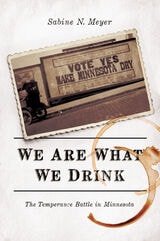
We Are What We Drink
The Temperance Battle in MinnesotaSabine N. Meyer
University of Illinois Press, 2015
Meyer examines the ever-shifting ways that ethnicity, gender, class, religion, and place interacted with each other during the long temperance battle in Minnesota. Her deconstruction of Irish and German ethnic positioning with respect to temperance activism provides a rare interethnic history of the movement. At the same time, she shows how women engaged in temperance work as a way to form public identities and reforges the largely neglected, yet vital link between female temperance and suffrage activism. Relatedly, Meyer reflects on the continuities and changes between how the movement functioned to construct identity in the heartland versus the movement's more often studied roles in the East. She also gives a nuanced portrait of the culture clash between a comparatively reform-minded Minneapolis and dynamic anti-temperance forces in whiskey-soaked St. Paul--forces supported by government, community, and business institutions heavily invested in keeping the city wet.
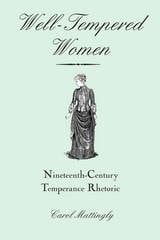
Well-Tempered Women
Nineteenth-Century Temperance RhetoricCarol Mattingly
Southern Illinois University Press, 2000
In this richly illustrated study, Carol Mattingly examines the rhetoric of the temperance movement, the largest political movement of women in the nineteenth century.
Tapping previously unexplored sources, Mattingly uncovers new voices and different perspectives, thus greatly expanding our knowledge of temperance women in particular and of nineteenth-century women and women's rhetoric in general. Her scope is broad: she looks at temperance fiction, newspaper accounts of meetings and speeches, autobiographical and biographical accounts, and minutes of national and state temperance meetings.
The women's temperance movement was first and foremost an effort by women to improve the lives of women. Twentieth-centuty scholars often dismiss temperance women as conservative and complicit in their own oppression. As Mattingly demonstrate, however, the opposite is true: temperance women made purposeful rhetorical choices in their efforts to improve the lives of women. They carefully considered the life circumstances of all women and sought to raise consciousness and achieve reform in an effective manner. And they were effective, gaining legal, political, and social improvements for women as they became the most influential and most successful group of women reformers in the nineteenth and early twentieth centuries.
Mattingly finds that, for a large number of women who were unhappy with their status in the nineteenth century, the temperance movement provided an avenue for change. Examining the choices these women made in their efforts to better conditions for women, Mattingly looks first at oral rhetoric among nineteenth-century temperance women. She examines the early temperance speeches of activists like Susan B. Anthony and Elizabeth Cady Stanton, who later chose to concentrate their effort in the suffrage organizations, and those who continued to work on behalf of women primarily through the temperance topic, such as Amelia Bloomer and Clarina Howard Nichols. Finally, she examines the rhetoric of members of the Woman’s Christian Temperance Union—the largest organization of women in the nineteenth century.
Mattingly then turns to the rhetoric from perspectives outside those of mainstream, middle-class women. She focuses on racial conflicts and alliances as an increasingly diverse membership threatened the unity and harmony in the WCTU. Her primary source for this discussion is contemporary newspaper accounts of temperance speeches.
Fiction by temperance writers also proves to be a fertile source for Mattingly's investigation. Insisting on greater equality between men and women, this fiction candidly portrayed injustice toward women. Through the temperance issue, Mattingly discovers, women could broach otherwise clandestine topics openly. She also finds that many of the concerns of nineteenth-century temperance women are remarkably similar to concerns of today’s feminists.
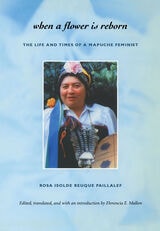
When a Flower Is Reborn
The Life and Times of a Mapuche FeministRosa Isolde Reuque Paillalef, Edited, translated, and with an introduction by Florencia E. Mallon
Duke University Press, 2002
A leading activist during the Pinochet dictatorship, Reuque—a woman, a Catholic, and a Christian Democrat—often felt like an outsider within the male-dominated, leftist Mapuche movement. This sense of herself as both participant and observer allows for Reuque’s trenchant, yet empathetic, critique of the Mapuche ethnic movement and of the policies regarding indigenous people implemented by Chile’s post-authoritarian government. After the 1990 transition to democratic rule, Reuque collaborated with the government in the creation of the Indigenous Development Corporation (CONADI) and the passage of the Indigenous Law of 1993. At the same time, her deepening critiques of sexism in Chilean society in general, and the Mapuche movement in particular, inspired her to found the first Mapuche feminist organization and participate in the 1996 International Women’s Conference in Beijing. Critical of the democratic government’s inability to effectively address indigenous demands, Reuque reflects on the history of Mapuche activism, including its disarray in the early 1990s and resurgence toward the end of the decade, and relates her hopes for the future.
An important reinvention of the testimonial genre for Latin America’s post-authoritarian, post-revolutionary era, When a Flower Is Reborn will appeal to those interested in Latin America, race and ethnicity, indigenous people’s movements, women and gender, and oral history and ethnography.
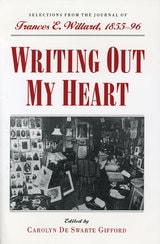
Writing Out My Heart
Selections from the Journal of Frances E. Willard, 1855-96Edited by Carolyn De Swarte Gifford
University of Illinois Press, 1995
Frances E. Willard's powerful leadership of the Woman's Christian Temperance Union (WCTU) made her one of the most commanding figures in the reform movements of the nineteenth century. World renowned and a force to be reckoned with, Willard grappled publicly and private with difficult issues, including temperance, slavery, women's rights, and her own sexuality. These selections from her forty-nine-volume journal reveal the private and confidential side of Willard for the first time. She comes to life in these pages--a person of character, passion, and self-determination who came to represent the woman of the dawning era.
Supplemented by an in-depth introduction and generous annotations, Writing Out My Heart sheds new light on an extraordinary individual and the lives of women in nineteenth-century America.