Results by title
24 books match the query 'Written communication'
(Inter)views
Cross-Disciplinary Perspectives on Rhetoric and LiteracyGary A. Olson
Southern Illinois University Press, 1991
This book contains interviews with psychologist Mary Field Belenky, linguist and philosopher of language Noam Chomsky, French deconstructionist Jacques Derrida, international literacy scholar Paulo Freire, distinguished anthropologist Clifford Geertz, philosopher Richard Rorty, and cultural critic Gayatri Chakravorty Spivak (all of whose work has influenced the discipline of rhetoric and composition) followed by essay responses from notable scholars in rhetoric and composition.

A Rhetoric of Doing
Essays on Written Discourse in Honor of James L. KinneavyEdited by Stephen P. Witte, Neil Nakadate, and Roger D. Cherry
Southern Illinois University Press, 1992
Concerned with both the nature and the practice of discourse, the eighteen essays collected here treat rhetoric as a dynamic enterprise of inquiry, exploration, and application, and in doing so reflect James L. Kinneavy’s firm belief in the vital relationship between theory and practice, his commitment to a spirit of accommodation and assimilation that promotes the development of ever more powerful theories and ever more useful practices.
A thorough introduction provides the reader with clear summaries of the essays by leading-edge theorists, researchers, and teachers of writing and rhetoric. A "field context" for the ideas presented in this book is provided through the division of the various chapters into four major sections that focus on classical rhetoric and rhetorical theory in historical contexts; on dimensions of discourse theory, aspects of discourse communities, and the sorts of knowledge people access and use in producing written texts; on writing in school-related contexts; and on several dimensions of nonacademic writing. A fifth section contains a bibliographic survey and an appreciation of James Kinneavy’s work. The exceptional range of these essays makes A Rhetoric of Doing an ecumenical examination of the current state of mind in rhetoric and written communication, a survey and description of what discourse and those in the field of discourse are, in fact, doing.
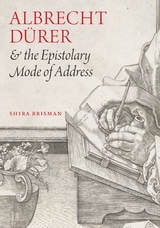
Albrecht Dürer and the Epistolary Mode of Address
Shira Brisman
University of Chicago Press, 2016
In the early modern period, before the establishment of a reliable postal system, letters faced risks of interception and delay. During the Reformation, the printing press threatened to expose intimate exchanges and blur the line between public and private life. Exploring the complex travel patterns of sixteenth-century missives, Brisman explains how these issues of sending and receiving informed Dürer’s artistic practices. His success, she contends, was due in large part to his development of pictorial strategies—an epistolary mode of address—marked by a direct, intimate appeal to the viewer, an appeal that also acknowledged the distance and delay that defers the message before it can reach its recipient. As images, often in the form of prints, coursed through an open market, and artists lost direct control over the sale and reception of their work, Germany’s chief printmaker navigated the new terrain by creating in his images a balance between legibility and concealment, intimacy and public address.
Classics from Papyrus to the Internet
An Introduction to Transmission and ReceptionBy Jeffrey M. Hunt, R. Alden Smith, and Fabio Stok
University of Texas Press, 2017
Winner, PROSE Award, Classics, Association of American Publishers (AAP), 2018
Writing down the epic tales of the Trojan War and the wanderings of Odysseus in texts that became the Iliad and the Odyssey was a defining moment in the intellectual history of the West, a moment from which many current conventions and attitudes toward books can be traced. But how did texts originally written on papyrus in perhaps the eighth century BC survive across nearly three millennia, so that today people can read them electronically on a smartphone?
Classics from Papyrus to the Internet provides a fresh, authoritative overview of the transmission and reception of classical texts from antiquity to the present. The authors begin with a discussion of ancient literacy, book production, papyrology, epigraphy, and scholarship, and then examine how classical texts were transmitted from the medieval period through the Renaissance and the Enlightenment to the modern era. They also address the question of reception, looking at how succeeding generations responded to classical texts, preserving some but not others. This sheds light on the origins of numerous scholarly disciplines that continue to shape our understanding of the past, as well as the determined effort required to keep the literary tradition alive. As a resource for students and scholars in fields such as classics, medieval studies, comparative literature, paleography, papyrology, and Egyptology, Classics from Papyrus to the Internet presents and discusses the major reference works and online professional tools for studying literary transmission.
Contemporary Perspectives on Cognition and Writing
Patricia Portanova
University Press of Colorado, 2017
Co-Published with CSU Open Press
Since the 1980s, even as international writing scholars have embraced cognitive science, the number of studies building on research in writing and cognition has decreased in the United States. Despite this decline, significant interest and ongoing research in this critical area continues. Contemporary Perspectives on Cognition and Writing explores the historical context of cognitive studies, the importance to our field of studies in neuroscience, the applicability of habits of mind, and the role of cognition in literate development and transfer. These works—each of which offers a timely contribution to research, teaching, and learning in the composition classroom—are book-ended by a foreword and afterword by cognition and writing pioneers John Hayes and Linda Flower. This collection, as a result, offers a historical marker of where we were in cognitive studies and where we might go.

Culture and Identity in Early Modern Europe (1500-1800)
Essays in Honor of Natalie Zemon DavisBarbara B. Diefendorf and Carla Hesse, Editors
University of Michigan Press, 1993
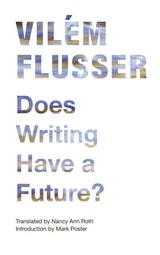
Does Writing Have a Future?
Vilém Flusser
University of Minnesota Press, 2010
Confirming Flusser’s status as a theorist of new media in the same rank as Marshall McLuhan, Jean Baudrillard, Paul Virilio, and Friedrich Kittler, the balance of this book teases out the nuances of these developments. To find a common denominator among texts and practices that span millennia, Flusser looks back to the earliest forms of writing and forward to the digitization of texts now under way. For Flusser, writing—despite its limitations when compared to digital media—underpins historical consciousness, the concept of progress, and the nature of critical inquiry. While the text as a cultural form may ultimately become superfluous, he argues, the art of writing will not so much disappear but rather evolve into new kinds of thought and expression.
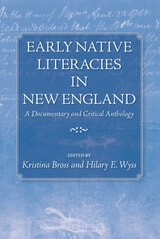
Early Native Literacies in New England
A Documentary and Critical AnthologyKristina Bross
University of Massachusetts Press, 2008
Designed as a corrective to colonial literary histories that have excluded Native voices, this anthology brings together a variety of primary texts produced by the Algonquian peoples of New England during the seventeenth, eighteenth, and very early nineteenth centuries. Included among these written materials and objects are letters, signatures, journals, baskets, pictographs, confessions, wills, and petitions, each of which represents a form of authorship. Together they demonstrate the continuing use of traditional forms of memory and communication and the lively engagement of Native peoples with alphabetic literacy during the colonial period. Each primary text is accompanied by an essay that places it in context and explores its significance.
Written by leading scholars in the field, these readings draw on recent trends in literary analysis, history, and anthropology to provide an excellent overview of the field of early Native studies. They are also intended to provoke discussion and open avenues for further exploration by students and other interested readers. Above all, the texts and commentaries gathered in this volume provide an opportunity to see Native American literature as a continuity of expression that reflects choices made long before contact and colonization, rather than as a nineteenth—or even twentieth-century invention.
Contributors include Heidi Bohaker, Heather Bouwman, Joanna Brooks, Kristina Bross, Stephanie Fitzgerald, Sandra Gustafson, Laura Arnold Leibman, Kevin McBride, David Murray, Laura Murray, Jean O'Brien, Ann Marie Plane, Philip Round, Jodi Schorb, David Silverman, and Hilary E. Wyss.
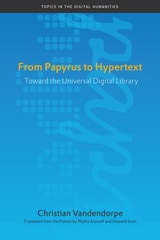
From Papyrus to Hypertext
Toward the Universal Digital LibraryChristian Vandendorpe. Translated by Phyllis Aronoff & Howard Scott.
University of Illinois Press, 2008
Surveying the conventions of reading and writing that have appeared and disappeared in the Internet's wake, Vandendorpe considers various forms of organization, textual design, the use (and distrust) of illustrations, and styles of reference and annotation. He also examines the novel components of digital texts, including hyperlinks and emoticons, and looks at emergent, collaborative genres such as blogs and wikis, which blur the distinction between author and reader. Looking to the future, reading and writing will continue to evolve based on the current, contested trends of universal digitization and accessibility.
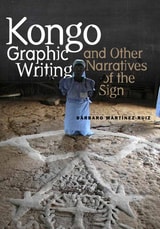
Kongo Graphic Writing and Other Narratives of the Sign
Barbaro Martinez-Ruiz
Temple University Press, 2013
Author Bárbaro Martínez-Ruiz, a practitioner of the Palo Monte devotional arts, illustrates with graphics and rock art how the Bakongo’s ideographic and pictographic signs are used to organize daily life, enable interactions between humans and the natural and spiritual worlds, and preserve and transmit cosmological and cosmogonical belief systems.
Exploring cultural diffusion and exchange, collective memory and identity, Kongo Graphic Writing and Other Narratives of the Sign artfully brings together analyses of the complex interconnections among Kongo traditions of religion, philosophy and visual/gestural communication on both sides of the African Atlantic world.

Language, Power, and Ideology in Brunei Darussalam
Mis Sea#99Geoffrey C. Gunn
Ohio University Press, 1996
Literacy as Involvement
The Acts of Writers, Readers, and TextsDeborah Brandt
Southern Illinois University Press, 1990
In Literacy as Involvement, Deborah Brandt examines the cultural and social roots of the acts of reading and writing. The book asks, for example, whether literacy is a natural growth of or a radical shift from orality. It questions the contrary views that literacy is either the learning of the conventions of language or is better understood as heightened social ability. Finally, it raises the possibility that knowing how to read and write is actually understanding how we respond during the acts of reading and writing.
This examination of literacy as process is also offered as a critique of prevailing theories of literacy advanced by such scholars as Walter J. Ong, S.J., David Olson, and E. D. Hirsch. They depict literacy as a textual experience that is socially and linguistically detached. Brandt critically examines the underlying assumptions from research on writing processes and argues that they call for a major reformation of prevailing conceptions of literacy. Specifically, she analyzes several expository texts from a process perspective to establish the interaction of reader and writer in even the most seemingly formal and detached writing. In her conclusion, Brandt brings together the major findings of her study to address pressing literacy issues, including the problem of illiteracy in our schools.
Material Culture of Writing
edited by Cydney Alexis and Hannah J. Rule
University Press of Colorado, 2022
The collection features scholars across the disciplines—such as art, art history, English, museum studies, and writing studies—who work as teachers, historians, museum curators/conservators, and faculty. Each chapter features methods and questions from contributors’ own disciplines while at the same time speaking to writing studies’ interest in writers, writing identity, and writing practice. The authors in this volume also work with a variety of methodologies, including literary analysis, archival research, and qualitative research, providing models for the types of research possible using a material culture studies framework. The collection is organized into three sections—Writing Identity, Writing Work, Writing Genre—each with a contextualizing introduction from the editors that introduces the chapters themselves and imagines possible directions for writing studies research facilitated by material culture studies.
The Material Culture of Writing serves as an accessible introduction to work in material culture studies for writing studies scholars, graduate students, and undergraduates, especially as it makes a distinctive contribution to writing studies in its material culture studies approach. Because of the interdisciplinarity of material culture studies and this volume’s contributors, this collection will appeal to a wide range of scholars and readers, including those interested in writing studies, the history of the book, print culture, genre studies, archival methods, and authorship studies.
Contributors: Cydney Alexis, Debby Andrews, Diane Ehrenpreis, Keri Epps, Desirée Henderson, Kevin James, Jenny Krichevsky, Anne Mackay, Emilie Merrigan, Laura R. Micciche, Hannah J. Rule, Kate Smith
Paper Knowledge
Toward a Media History of DocumentsLisa Gitelman
Duke University Press, 2014
Private, the Public, and the Published
Reconciling Private Lives and Public Rhetoricedited by Barbara Couture & Thomas Kent
Utah State University Press, 2004
At the 2003 "Rock the Vote" debate, one of the questions posed by a student to the eight Democratic candidates for the presidential nomination was "have you ever used marijuana?" Amazingly, all but one of the candidates voluntarily answered the question. Add to this example the multiple ways in which we now see public intrusion into private lives (security cameras, electronic access to personal data, scanning and "wanding" at the airport) or private self-exposure in public forums (cell phones, web cams, confessional talk shows, voyeuristic "reality" TV). That matters so private could be treated as legitimate--in some cases even vital--for public discourse indicates how intertwined the realms of private and public have become in our era. Reverse examples exist as well. Around the world, public authorities look the other way while individual rights are abused--calling it a private matter--or officials appeal to sectarian morés to justify discrimination in public policies.
The authors of The Private, the Public, and the Published feel that scholarship needs to explore and understand this phenomenon, and needs to address it in the college classroom. There are consequences of conflating public and private, they argue--consequences that have implications especially for what is known as the public good. The changing distinctions between "private" and "public," and the various practices of private and public expression, are explored in these essays with an eye toward what they teach us about those consequences and implications.

Public Lettering
Script, Power, and CultureArmando Petrucci
University of Chicago Press, 1993
buildings, commercial graphics, signs, epitaphs on tombstones,
graffiti—is a fixture of urban life. In Public
Lettering, Armando Petrucci reconstructs the history of
public writing in the West and traces its social functions
from the eleventh century through the modern period.
Taking the city of Rome as a case study, Petrucci begins
with a consideration of the first civic inscriptions after
ancient times. Substantial chapters on the uses of public
writing in the industrial revolution and the early twentieth
century prepare the way for his provocative discussions of
public lettering in the the contexts of fascism, post-war
radicalism, and the student revolutions of 1968 and 1977.
Throughout, Petrucci is concerned with the relations
between the functions and styles of letters and the places
where they appear. Writing, he argues, is one of the
instruments of public power; display lettering is often the
image and mirror of power itself, making the social use of
written forms a type of conquest. Because of Rome's role as
a “World-City,” Petrucci's interdisciplinary study has
wide-ranging implications for our understanding of the social
function of graphic design.
Resisting Texts
Authority and Submission in Constructions of MeaningPeter L. Shillingsburg
University of Michigan Press, 1998
Shillingsburg argues that as humans we are and always will be interested in the past, in what was meant, in what was revealed inadvertently by a text--and that is all to the good. But we learn more and can compare notes better when we understand the principles that govern the ways we read. Resisting Texts approaches crucial questions about the practice of textual editing and literary criticism by posing questions in the form "If we take such and such to be the goal of our reading, then what will follow from that assumption?"
With humor and a lively imagination, Shillingsburg takes the reader on a fresh theoretical investigation of communication, understanding and misunderstanding, and textual satisfactions, drawing examples from Thackeray, Wordsworth, Melville, and others.
Resisting Texts will appeal to all who enjoy the varieties of critical approaches to the written word.
Peter L. Shillingsburg is Professor of English, University of North Texas.
The History and Power of Writing
Henri-Jean Martin
University of Chicago Press, 1994
Traversing four millennia, Martin offers a chronicle of writing as a cultural system, a means of communication, and a history of technologies. He shows how the written word originated, how it spread, and how it figured in the evolution of civilization. Using as his center the role of printing in making the written way of thinking dominant, Martin examines the interactions of individuals and cultures to produce new forms of "writing" in the many senses of authorship, language rendition, and script.
Martin looks at how much the development of writing owed to practical necessity, and how much to religious and social systems of symbols. He describes the precursors to writing and reveals their place in early civilization as mnemonic devices in service of the spoken word. The tenacity of the oral tradition plays a surprisingly important part in this story, Martin notes, and even as late as the eighteenth century educated individuals were trained in classical rhetoric and preferred to rely on the arts of memory. Finally, Martin discusses the changes to writing wrought by the electronic revolution, offering invaluable insights into the influence these new technologies have had on children born into the computer age.
The Marvelous Clouds
Toward a Philosophy of Elemental MediaJohn Durham Peters
University of Chicago Press, 2015
When we speak of clouds these days, it is as likely that we mean data clouds or network clouds as cumulus or stratus. In their sharing of the term, both kinds of clouds reveal an essential truth: that the natural world and the technological world are not so distinct. In The Marvelous Clouds, John Durham Peters argues that though we often think of media as environments, the reverse is just as true—environments are media.
Peters defines media expansively as elements that compose the human world. Drawing from ideas implicit in media philosophy, Peters argues that media are more than carriers of messages: they are the very infrastructures combining nature and culture that allow human life to thrive. Through an encyclopedic array of examples from the oceans to the skies, The Marvelous Clouds reveals the long prehistory of so-called new media. Digital media, Peters argues, are an extension of early practices tied to the establishment of civilization such as mastering fire, building calendars, reading the stars, creating language, and establishing religions. New media do not take us into uncharted waters, but rather confront us with the deepest and oldest questions of society and ecology: how to manage the relations people have with themselves, others, and the natural world.
A wide-ranging meditation on the many means we have employed to cope with the struggles of existence—from navigation to farming, meteorology to Google—The Marvelous Clouds shows how media lie at the very heart of our interactions with the world around us. Peters’s book will not only change how we think about media but provide a new appreciation for the day-to-day foundations of life on earth that we so often take for granted.
The Politics of Appalachian Rhetoric
Amanda E Hayes
West Virginia University Press, 2018
In exploring the ways that Appalachian people speak and write, Amanda E. Hayes raises the importance of knowing and respecting communication styles within a marginalized culture. Diving deep into the region’s historical roots—especially those of the Scotch-Irish and their influence on her own Appalachian Ohio—Hayes reveals a rhetoric with its own unique logic, utility, and poetry.
Hayes also considers the headwinds against Appalachian rhetoric, notably ideologies about poverty and the biases of the school system. She connects these to challenges that Appalachian students face in the classroom and pinpoints pedagogical and structural approaches for change.
Throughout, Hayes blends conventional scholarship with autobiography, storytelling, and language, illustrating Appalachian rhetoric’s validity as a means of creating and sharing knowledge.

The Work in the World
Geographical Practice and the Written WordMichael R. Curry
University of Minnesota Press, 1996
The Work in the World was first published in 1996. Minnesota Archive Editions uses digital technology to make long-unavailable books once again accessible, and are published unaltered from the original University of Minnesota Press editions.
The writing or reading or buying or selling or judging of a written work is always at the same time the act of making a place-or making places. The author creates a special sort of place for his ideas; the reader, for her engagement with the author; the bookseller, for the notion of books as property to be categorized and sold; and so on. In this book, Michael R. Curry develops a geography of this process, a theory of the nature of space and places in written work.
The Work in the World focuses on a paradox at the heart of this project: Although the written work is inextricably bound up in the construction of the places in which it is written, read, published, circulated, and cited, it nonetheless denies the importance of places. As the product of modern modes of knowledge, technology, and intellectual property, written work seems to say instead that only the encompassing universal space of ideas, objects, and commodities matters.
Distinctive for the way it views theories in geography and science as fundamentally embedded in written works, The Work in the World argues eloquently that the philosophical questions raised by theories can only be addressed within the broader context of the work.
Michael R. Curry is associate professor of geography at the University of California, Los Angeles.
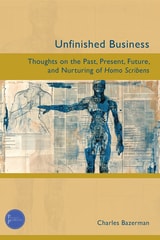
Unfinished Business
Thoughts on the Past, Present, Future, and Nurturing of Homo ScribensCharles Bazerman
University Press of Colorado, 2024
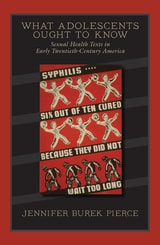
What Adolescents Ought to Know
Sexual Health Texts in Early Twentieth-Century AmericaJennifer Burek Pierce
University of Massachusetts Press, 2011
In 1901, Dr. Alfred Fournier committed an act both simple and revolutionary: he wrote ForOur Sons, When They Turn 18, a sexual and reproductive health treatise based on his clinical work at a leading Paris hospital. If this booklet aided adolescent understanding of health, it also encouraged reformers around the world to publish. By 1913, countless works on venereal disease prevention were available to adolescents.
During this period, authors wrestled with how to make still-developing scientific information available to a reader also in the process of maturing. What would convince a young person to avoid acting on desire? What norms should be employed in these arguments, when social and legal precedents warned against committing ideas about sex to print? How, in other words, could information about sex be made both decent and compelling? Health reformers struggled with these challenges as doctors' ability to diagnose diseases such as syphilis outpaced the production of medicines that could restore health. In this context, information represented the best and truest prophylactic. When publications were successful, from the perspective of information dissemination, they were translated and distributed worldwide.
What Adolescents Ought to Know explores the evolution of these printed materials—from a single tract, written by a medical researcher and given free to anyone, to a thriving commercial enterprise. It tells the story of how sex education moved from private conversation to purchased text in early twentieth-century America.
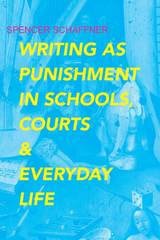
Writing as Punishment in Schools, Courts, and Everyday Life
Spencer Schaffner
University of Alabama Press, 2019
Writing tends to be characterized as a positive aspect of literacy that helps us to express our thoughts, to foster interpersonal communication, and to archive ideas. However, there is a vast array of evidence that emphasizes the counterbelief that writing has the power to punish, shame, humiliate, control, dehumanize, fetishize, and transform those who are subjected to it. In Writing as Punishment in Schools, Courts, and Everyday Life, Spencer Schaffner looks at many instances of writing as punishment, including forced tattooing, drunk shaming, court-ordered letters of apology, and social media shaming, with the aim of bringing understanding and recognition to the coupling of literacy and subjection.
Writing as Punishment in Schools, Courts, and Everyday Life is a fascinating inquiry into how sinister writing can truly be and directly questions the educational ideal that powerful writing is invariably a public good. While Schaffner does look at the darker side of writing, he neither vilifies nor supports the practice of writing as punishment. Rather, he investigates the question with humanistic inquiry and focuses on what can be learned from understanding the many strange ways that writing as punishment is used to accomplish fundamental objectives in everyday life.
Through five succinct case studies, we meet teachers, judges, parents, sex traffickers, and drunken partiers who have turned to writing because of its presumed power over writers and readers. Schaffner provides careful analysis of familiar punishments, such as schoolchildren copying lines, and more bizarre public rituals that result in ink-covered bodies and individuals forced to hold signs in public.
Schaffner argues that writing-based punishment should not be dismissed as benign or condemned as a misguided perversion of writing, but instead should be understood as an instrument capable of furthering both the aims of justice and degradation.