Results by title
5 books match the query 'Xenophon'
On Tyranny
Leo Strauss
University of Chicago Press, 2000
On Tyranny is Leo Strauss's classic reading of Xenophon's dialogue, Hiero or Tyrannicus, in which the tyrant Hiero and the poet Simonides discuss the advantages and disadvantages of exercising tyranny. This edition includes a translation of the dialogue, a critique of the commentary by the French philosopher Alexandre Kojève, Strauss's restatement of his position in light of Kojève's comments, and finally, the complete Strauss-Kojève correspondence.
"Through [Strauss's] interpretation Xenophon appears to us as no longer the somewhat dull and flat author we know, but as a brilliant and subtle writer, an original and profound thinker. What is more, in interpreting this forgotten dialogue, Strauss lays bare great moral and political problems that are still ours." —Alexandre Kojève, Critique
"On Tyranny is a complex and stimulating book with its 'parallel dialogue' made all the more striking since both participants take such unusual, highly provocative positions, and so force readers to face substantial problems in what are often wholly unfamiliar, even shocking ways." —Robert Pippin, History and Theory
"Every political scientist who tries to disentangle himself from the contemporary confusion over the problems of tyranny will be much indebted to this study and inevitably use it as a starting point."—Eric Voegelin, The Review of Politics
Leo Strauss (1899-1973) was the Robert Maynard Hutchins Distinguished Service Professor of Political Science at the University of Chicago.
[more]
On Tyranny
Corrected and Expanded Edition, Including the Strauss-Kojève CorrespondenceLeo Strauss
University of Chicago Press, 2013
On Tyranny is Leo Strauss’s classic reading of Xenophon’s dialogue Hiero, or Tyrannicus, in which the tyrant Hiero and the poet Simonides discuss the advantages and disadvantages of exercising tyranny. Included are a translation of the dialogue from its original Greek, a critique of Strauss’s commentary by the French philosopher Alexandre Kojève, and the complete correspondence between the two.
This revised and expanded edition introduces important corrections throughout and expands Strauss’s restatement of his position in light of Kojève’s commentary to bring it into conformity with the text as it was originally published in France.
[more]
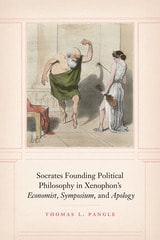
Socrates Founding Political Philosophy in Xenophon's "Economist", "Symposium", and "Apology"
Thomas L. Pangle
University of Chicago Press, 2020
The oeuvre of the Greek historian Xenophon, whose works stand with those of Plato as essential accounts of the teachings of Socrates, has seen a new surge of attention after decades in the shadows. And no one has done more in recent years to spearhead the revival than Thomas L. Pangle. Here, Pangle provides a sequel to his study of Xenophon’s longest account of Socrates, the Memorabilia, expanding the scope of inquiry through an incisive treatment of Xenophon’s shorter Socratic dialogues, the Economist, the Symposium, and the Apology of Socrates to the Jury. What Pangle reveals is that these three depictions of Socrates complement and, in fact, serve to complete the Memorabilia in meaningful ways.
Unlike the Socrates of Plato, Xenophon’s Socrates is more complicated and human, an individual working out the problem of what it means to live well and virtuously. While the Memorabilia defends Socrates by stressing his likeness to conventionally respectable gentlemen, Xenophon’s remaining Socratic texts offer a more nuanced characterization by highlighting how Socrates also diverges from conventions of gentlemanliness in his virtues, behaviors, and peculiar views of quotidian life and governmental rule. One question threads through the three writings: Which way of life best promotes human existence, politics, and economics—that of the Socratic political philosopher with his philosophic virtues or that of the gentleman with his familial, civic, and moral virtues? In uncovering the nuances of Xenophon’s approach to the issue in the Economist, Symposium, and Apology, Pangle’s book cements the significance of these writings for the field and their value for shaping a fuller conception of just who Socrates was and what he taught.
Unlike the Socrates of Plato, Xenophon’s Socrates is more complicated and human, an individual working out the problem of what it means to live well and virtuously. While the Memorabilia defends Socrates by stressing his likeness to conventionally respectable gentlemen, Xenophon’s remaining Socratic texts offer a more nuanced characterization by highlighting how Socrates also diverges from conventions of gentlemanliness in his virtues, behaviors, and peculiar views of quotidian life and governmental rule. One question threads through the three writings: Which way of life best promotes human existence, politics, and economics—that of the Socratic political philosopher with his philosophic virtues or that of the gentleman with his familial, civic, and moral virtues? In uncovering the nuances of Xenophon’s approach to the issue in the Economist, Symposium, and Apology, Pangle’s book cements the significance of these writings for the field and their value for shaping a fuller conception of just who Socrates was and what he taught.
[more]
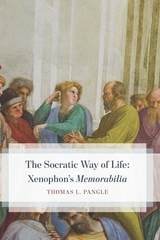
The Socratic Way of Life
Xenophon’s “Memorabilia”Thomas L. Pangle
University of Chicago Press, 2018
The Socratic Way of Life is the first English-language book-length study of the philosopher Xenophon’s masterwork. In it, Thomas L. Pangle shows that Xenophon depicts more authentically than does Plato the true teachings and way of life of the citizen philosopher Socrates, founder of political philosophy.
In the first part of the book, Pangle analyzes Xenophon’s defense of Socrates against the two charges of injustice upon which he was convicted by democratic Athens: impiety and corruption of the youth. In the second part, Pangle analyzes Xenophon’s account of how Socrates’s life as a whole was just, in the sense of helping through his teaching a wide range of people. Socrates taught by never ceasing to raise, and to progress in answering, the fundamental and enduring civic questions: what is pious and impious, noble and ignoble, just and unjust, genuine statesmanship and genuine citizenship. Inspired by Hegel’s and Nietzsche’s assessments of Xenophon as the true voice of Socrates, The Socratic Way of Life establishes the Memorabilia as the groundwork of all subsequent political philosophy.
In the first part of the book, Pangle analyzes Xenophon’s defense of Socrates against the two charges of injustice upon which he was convicted by democratic Athens: impiety and corruption of the youth. In the second part, Pangle analyzes Xenophon’s account of how Socrates’s life as a whole was just, in the sense of helping through his teaching a wide range of people. Socrates taught by never ceasing to raise, and to progress in answering, the fundamental and enduring civic questions: what is pious and impious, noble and ignoble, just and unjust, genuine statesmanship and genuine citizenship. Inspired by Hegel’s and Nietzsche’s assessments of Xenophon as the true voice of Socrates, The Socratic Way of Life establishes the Memorabilia as the groundwork of all subsequent political philosophy.
[more]
Xenophon's Socrates
Leo Strauss
St. Augustine's Press, 2004
[more]