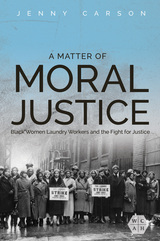
A Matter of Moral Justice: Black Women Laundry Workers and the Fight for Justice
University of Illinois Press, 2021
Cloth: 978-0-252-04390-1 | Paper: 978-0-252-08589-5 | eISBN: 978-0-252-05280-4 (standard)
Library of Congress Classification HD8039.L32U593 2021
Dewey Decimal Classification 331.478166713097
Cloth: 978-0-252-04390-1 | Paper: 978-0-252-08589-5 | eISBN: 978-0-252-05280-4 (standard)
Library of Congress Classification HD8039.L32U593 2021
Dewey Decimal Classification 331.478166713097
ABOUT THIS BOOK | AUTHOR BIOGRAPHY | REVIEWS | TOC
ABOUT THIS BOOK
A long-overlooked group of workers and their battle for rights and dignity
Like thousands of African American women, Charlotte Adelmond and Dollie Robinson worked in New York’s power laundry industry in the 1930s. Jenny Carson tells the story of how substandard working conditions, racial and gender discrimination, and poor pay drove them to help unionize the city’s laundry workers. Laundry work opened a door for African American women to enter industry, and their numbers allowed women like Adelmond and Robinson to join the vanguard of a successful unionization effort. But an affiliation with the powerful Congress of Industrial Organizations (CIO) transformed the union from a radical, community-based institution into a bureaucratic organization led by men. It also launched a difficult battle to secure economic and social justice for the mostly women and people of color in the plants. As Carson shows, this local struggle highlighted how race and gender shaped worker conditions, labor organizing, and union politics across the country in the twentieth century.
Like thousands of African American women, Charlotte Adelmond and Dollie Robinson worked in New York’s power laundry industry in the 1930s. Jenny Carson tells the story of how substandard working conditions, racial and gender discrimination, and poor pay drove them to help unionize the city’s laundry workers. Laundry work opened a door for African American women to enter industry, and their numbers allowed women like Adelmond and Robinson to join the vanguard of a successful unionization effort. But an affiliation with the powerful Congress of Industrial Organizations (CIO) transformed the union from a radical, community-based institution into a bureaucratic organization led by men. It also launched a difficult battle to secure economic and social justice for the mostly women and people of color in the plants. As Carson shows, this local struggle highlighted how race and gender shaped worker conditions, labor organizing, and union politics across the country in the twentieth century.
Meticulous and engaging, A Matter of Moral Justice examines the role of African American and radical women activists and their collisions with labor organizing and union politics.
See other books on: African American & Black | Fight for | Labor & Industrial Relations | Labor unions | Matter
See other titles from University of Illinois Press