
 A SCHOLARLY BOOK REPOSITORY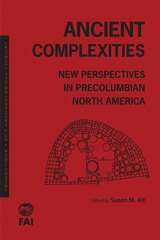
Edited by Susan M. Alt
Foundations of Archaeological Inquiry
Jim Skibo, Series Editor
Anthropology and Archaeology
Many archaeologists have long been frustrated with the traditional, reductionist representation of complexity. Yet, even after years of debate, there seem to be never ending disagreements over the complexity of places like Chaco Canyon, Cahokia, and Poverty Point. This matters, because there are political and scholarly implications to calling any place or people more or less complex. In North America especially, given historical biases and the mound-builder myth, archaeologists need to rethink complexity as they seek to explain the past.
Based on a Society of American Archaeology symposium, Ancient Complexities offers a current overview of what is meant by cultural complexity and how archaeologists study the development of complex societies in North America. Taking a critical look at how accepted definitions of complexity have bounded our thinking about ancient societies, this volume presents new theoretical perspectives and states a case for the need for different definitions in order to move this discussion ahead.
This collection by scholars of North American archaeology is a must read for anyone wishing to be abreast of the most current dialogue on complexity taking place in modern archaeology.
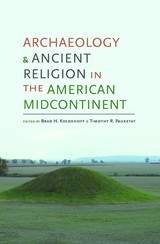
Across North America, huge data accumulations derived from decades of cultural resource management studies, combined with old museum collections, provide archaeologists with unparalleled opportunities to explore new questions about the lives of ancient native peoples. For many years the topics of technology, economy, and political organization have received the most research attention, while ritual, religion, and symbolic expression have largely been ignored. This was often the case because researchers considered such topics beyond reach of their methods and data.
In Archaeology and Ancient Religion in the American Midcontinent, editors Brad H. Koldehoff and Timothy R. Pauketat and their contributors demonstrate that this notion is outdated through their analyses of a series of large datasets from the midcontinent, ranging from tiny charred seeds to the cosmic alignments of mounds, they consider new questions about the religious practices and lives of native peoples. At the core of this volume are case studies that explore religious practices from the Cahokia area and surrounding Illinois uplands. Additional chapters explore these topics using data collected from sites and landscapes scattered along the Mississippi and Ohio River valleys.
This innovative work facilitates a greater appreciation for, and understanding of, ancient native religious practices, especially their seamless connections to everyday life and livelihood. The contributors do not advocate for a reduced emphasis on technology, economy, and political organization; rather, they recommend expanding the scope of such studies to include considerations of how religious practices shaped the locations of sites, the character of artifacts, and the content and arrangement of sites and features. They also highlight analytical approaches that are applicable to archaeological datasets from across the Americas and beyond.
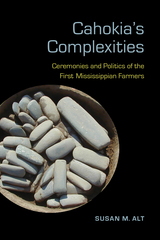
The reasons for the rise and fall of early cities and ceremonial centers around the world have been sought for centuries. In the United States, Cahokia has been the focus of intense archaeological work to explain its mysteries. Cahokia was the first and exponentially the largest of the Mississippian centers that appeared across the Midwest and Southeast after AD 1000. Located near present-day East St. Louis, Illinois, the central complex of Cahokia spanned more than 12 square kilometers and encompassed more than 120 earthen mounds.
As one of the foremost experts on Cahokia, Susan M. Alt addresses long-standing considerations of eastern Woodlands archaeology—the beginnings, character, and ending of Mississippian culture (AD 1050–1600)—from a novel theoretical and empirical vantage point. Through this case study on farmers’ immigration and resettling, Alt’s narrative reanalyzes the relationship between administration and diversity, incorporating critical new discoveries and archaeological patterns from outside of Cahokia.
Alt examines the cultural landscape of the Cahokia flood plain and the layout of one extraordinary upland site, Grossman, as an administrative settlement where local farmers might have seen or participated in Cahokian rituals and ceremonies involving a web of ancestors, powers, and places. Alt argues that a farming district outside the center provides definitive evidences of the attempted centralized administration of a rural hinterland.
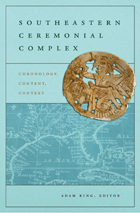
A timely, comprehensive reevaluation of the Southeastern Ceremonial Complex.
One of the most venerable concepts in Southeastern archaeology is that of the Southern Cult. The idea has its roots in the intensely productive decade (archaeologically) of the 1930s and is fundamentally tied to yet another venerable concept—Mississippian culture. The last comprehensive study of the melding of these two concepts into the term Southeastern Ceremonial Complex (SECC) is more than two decades old, yet our understanding of the objects, themes, and artistic styles associated with the SECC have changed a great deal. New primary data have come to light that bear directly on the complex, requiring a thorough reanalysis of both concepts and dating. Recent publications have ignited many debates about the dating and the nature of the SECC.
This work presents new data and new ideas on the temporal and social contexts, artistic styles, and symbolic themes included in the complex. It also demonstrates that engraved shell gorgets, along with other SECC materials, were
produced before A.D. 1400.
READERS
Browse our collection.
PUBLISHERS
See BiblioVault's publisher services.
STUDENT SERVICES
Files for college accessibility offices.
RECENTLY PUBLISHED



UChicago Accessibility Resources
home | accessibility | search | about | contact us
BiblioVault ® 2001 - 2026
The University of Chicago Press