
 A SCHOLARLY BOOK REPOSITORY
Browse by Title
3 books by Wu, Hui
3 books by Wu, Hui
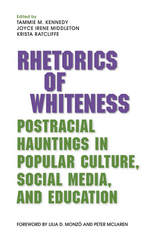
Rhetorics of Whiteness
Postracial Hauntings in Popular Culture, Social Media, and Education
Edited by Tammie M. Kennedy, Joyce Irene Middleton, Krista Ratcliffe, with a foreword by Lilia D. Monzó and Peter McLaren
Southern Illinois University Press, 2017
Winner, CCCC Outstanding Book Award in the Edited Collection Category, 2018
With the election of our first black president, many Americans began to argue that we had finally ended racism, claiming that we now live in a postracial era. Yet near-daily news reports regularly invoke white as a demographic category and recount instances of racialized violence as well as an increased sensitivity to expressions of racial unrest. Clearly, American society isn’t as color-blind as people would like to believe. In Rhetorics of Whiteness: Postracial Hauntings in Popular Culture, Social Media, and Education, contributors reveal how identifications with racialized whiteness continue to manifest themselves in American culture.
The sixteen essays that comprise this collection not only render visible how racialized whiteness infiltrates new twenty-first-century discourses and material spaces but also offer critical tactics for disrupting this normative whiteness. Specifically, contributors examine popular culture (novels, films, TV), social media (YouTube, eHarmony, Facebook), education (state law, the textbook industry, dual credit programs), pedagogy (tactics for teaching via narratives, emotional literacy, and mindfulness) as well as cultural theories (concepts of racialized space, anti-dialogicism, and color blindness). Offering new approaches to understanding racialized whiteness, this volume emphasizes the importance of a rhetorical lens for employing whiteness studies’ theories and methods to identify, analyze, interpret, and interrupt representations of whiteness.
Although whiteness studies has been waning as an active research field for the past decade, the contributors to Rhetorics of Whiteness assert that it hasn’t lost its relevancy because racialized whiteness and issues of systemic racism persist in American society and culture today. Few whiteness studies texts have been published in rhetoric and composition in the past decade, so this collection should quickly become mandatory reading. By focusing on common, yet often overlooked, contemporary examples of how racialized whiteness haunts U.S. society, Rhetorics of Whiteness serves as a valuable text for scholars in the field as well as anyone else interested in the topic.
With the election of our first black president, many Americans began to argue that we had finally ended racism, claiming that we now live in a postracial era. Yet near-daily news reports regularly invoke white as a demographic category and recount instances of racialized violence as well as an increased sensitivity to expressions of racial unrest. Clearly, American society isn’t as color-blind as people would like to believe. In Rhetorics of Whiteness: Postracial Hauntings in Popular Culture, Social Media, and Education, contributors reveal how identifications with racialized whiteness continue to manifest themselves in American culture.
The sixteen essays that comprise this collection not only render visible how racialized whiteness infiltrates new twenty-first-century discourses and material spaces but also offer critical tactics for disrupting this normative whiteness. Specifically, contributors examine popular culture (novels, films, TV), social media (YouTube, eHarmony, Facebook), education (state law, the textbook industry, dual credit programs), pedagogy (tactics for teaching via narratives, emotional literacy, and mindfulness) as well as cultural theories (concepts of racialized space, anti-dialogicism, and color blindness). Offering new approaches to understanding racialized whiteness, this volume emphasizes the importance of a rhetorical lens for employing whiteness studies’ theories and methods to identify, analyze, interpret, and interrupt representations of whiteness.
Although whiteness studies has been waning as an active research field for the past decade, the contributors to Rhetorics of Whiteness assert that it hasn’t lost its relevancy because racialized whiteness and issues of systemic racism persist in American society and culture today. Few whiteness studies texts have been published in rhetoric and composition in the past decade, so this collection should quickly become mandatory reading. By focusing on common, yet often overlooked, contemporary examples of how racialized whiteness haunts U.S. society, Rhetorics of Whiteness serves as a valuable text for scholars in the field as well as anyone else interested in the topic.
[more]
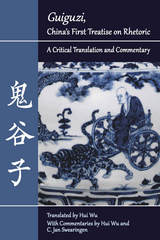
"Guiguzi," China's First Treatise on Rhetoric
A Critical Translation and Commentary
Translated by Hui Wu / With Commentaries by Hui Wu and C. Jan Swearingen
Southern Illinois University Press, 2016
When Gorgias, Plato, and Aristotle were discussing and defining rhetoric in ancient Greece, many students in China, including Sun Bin, a descendent of Sun Tzu, who wrote The Art of War, were learning the techniques of persuasion from Guiguzi, “the Master of the Ghost Valley.” This pre–Qin dynasty recluse provided the basis for what is considered the earliest Chinese treatise devoted entirely to the art of persuasion. Called Guiguzi after its author, this translation of the received text provides an indigenous rhetorical theory and key persuasive strategies, some of which are still used by those involved in decision making and negotiations in China today. In “Guiguzi,” China’s First Treatise on Rhetoric, Hui Wu and C. Jan Swearingen present a new critical translation of this foundational work, which has great historical significance for the study of Chinese rhetoric and communication and yet is little known to Western readers.
Wu’s translation includes footnotes that incorporate both past and present scholarly commentary, and is accompanied by a prefatory introduction that situates Guiguzi in the sociopolitical and cultural realities of ancient China, and a glossary of rhetorical terms used in the treatise. Swearingen presents a comparative study suggesting the similarities and differences between emerging Greek and Chinese rhetorics during the same period, including the cultural contexts of warring states and emergent empires that surrounded each.
“Guiguzi,” China’s First Treatise on Rhetoric combines a new translation of a historically significant text with scholarly analysis and critical apparatus that will contribute to the emerging global understanding of Chinese rhetoric and communication.
Wu’s translation includes footnotes that incorporate both past and present scholarly commentary, and is accompanied by a prefatory introduction that situates Guiguzi in the sociopolitical and cultural realities of ancient China, and a glossary of rhetorical terms used in the treatise. Swearingen presents a comparative study suggesting the similarities and differences between emerging Greek and Chinese rhetorics during the same period, including the cultural contexts of warring states and emergent empires that surrounded each.
“Guiguzi,” China’s First Treatise on Rhetoric combines a new translation of a historically significant text with scholarly analysis and critical apparatus that will contribute to the emerging global understanding of Chinese rhetoric and communication.
[more]
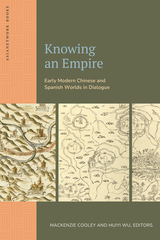
Knowing an Empire
Early Modern Chinese and Spanish Worlds in Dialogue
Edited by Mackenzie Cooley and Huiyi Wu
Lever Press, 2025
Knowing an Empire: Early Modern Chinese and Spanish Worlds in Dialogue unveils how these two vast empires, separated by thousands of miles, developed comparable systems to gather, order, and wield knowledge about their local worlds in the process of empire-building. From the sixteenth to the eighteenth centuries, officials in both empires compiled large quantities of structured data on the climate, topography, natural products, languages, religions, and more of their locales, creating a vision of their empires as diverse yet unified. Through a new methodology of “juxtapositional comparison,” the book reads the difangzhi 地方志 (local gazetteers) of China and the relaciones geográficas of the Spanish world in parallel.
Knowing an Empire does not see the conveyance of information across an empire as a top-down process with an active center as a knowledge-maker. Instead, it amplifies a blend of voices that speak as much to imperial bureaucracy as to the rich local and Indigenous cultures, revealing these two early modern empires as diverse polities whose equilibria were constantly rebalanced among local powers. Comprised of 18 chapters, this edited collection reflects on the historical evolution and inner structures of the imperial epistemologies, as well as the many ways historians today read difangzhi and relaciones geográficas to understand the spatial, natural, and social order in both the Chinese and the Spanish empires. At once a comparative and a connected history, it places Chinese and Spanish imperial knowledge in the globalizing early modern world, highlighting the migration of people, goods, and ideas and revealing how these wide-ranging influences are reflected—or not—in the difangzhi and the relaciones. The book concludes by broadening our scope beyond China and Spain to reflect how other early modern empires, such as the Portuguese, failed to develop such systematized imperial genres.
With contributions from leading scholars across Latin American and Asian Studies, this book synthesizes political, environmental, and socio-economic history with historical anthropology to highlight parallel governance and knowledge structures. The contributors challenge conventional binaries of Western versus Eastern, and colonial versus non-colonial, presenting a nuanced perspective of early modern empires as dynamic, interconnected entities through the shared challenges of scale, diversity, and increasing globalization. Through these dialogues, Knowing an Empire illuminates the complex entanglement of ruling and understanding. This groundbreaking collection offers a highly innovative and dialogic approach to comparative studies of empires, with major implications for Asian, European, Latin American, transnational, and global history.
Knowing an Empire does not see the conveyance of information across an empire as a top-down process with an active center as a knowledge-maker. Instead, it amplifies a blend of voices that speak as much to imperial bureaucracy as to the rich local and Indigenous cultures, revealing these two early modern empires as diverse polities whose equilibria were constantly rebalanced among local powers. Comprised of 18 chapters, this edited collection reflects on the historical evolution and inner structures of the imperial epistemologies, as well as the many ways historians today read difangzhi and relaciones geográficas to understand the spatial, natural, and social order in both the Chinese and the Spanish empires. At once a comparative and a connected history, it places Chinese and Spanish imperial knowledge in the globalizing early modern world, highlighting the migration of people, goods, and ideas and revealing how these wide-ranging influences are reflected—or not—in the difangzhi and the relaciones. The book concludes by broadening our scope beyond China and Spain to reflect how other early modern empires, such as the Portuguese, failed to develop such systematized imperial genres.
With contributions from leading scholars across Latin American and Asian Studies, this book synthesizes political, environmental, and socio-economic history with historical anthropology to highlight parallel governance and knowledge structures. The contributors challenge conventional binaries of Western versus Eastern, and colonial versus non-colonial, presenting a nuanced perspective of early modern empires as dynamic, interconnected entities through the shared challenges of scale, diversity, and increasing globalization. Through these dialogues, Knowing an Empire illuminates the complex entanglement of ruling and understanding. This groundbreaking collection offers a highly innovative and dialogic approach to comparative studies of empires, with major implications for Asian, European, Latin American, transnational, and global history.
[more]
READERS
Browse our collection.
PUBLISHERS
See BiblioVault's publisher services.
STUDENT SERVICES
Files for college accessibility offices.
RECENTLY PUBLISHED




UChicago Accessibility Resources
home | accessibility | search | about | contact us
BiblioVault ® 2001 - 2025
The University of Chicago Press