
 A SCHOLARLY BOOK REPOSITORY
19 start with B start with B


Drawing on perspectives from anthropology and social theory, this book explores the quotidian routines of debt collection in nineteenth-century capitalism. It focuses on Switzerland, an exemplary case of liberal rule. Debt collection and bankruptcy relied on received practices until they were standardized in a Swiss federal law in 1889. The vast array of these practices was summarized by the idiomatic Swiss legal term “Rechtstrieb” (literally, “law drive”). Analyzing these forms of summary justice opens a window to the makeshift economies and the contested political imaginaries of nineteenth-century everyday life. Ultimately, the book advances an empirically grounded and theoretically informed history of quotidian legal practices in the everyday economy; it is an argument for studying capitalism from the bottom up.
Eighteenth-century antislavery writers attacked the slave trade as "barbaric traffic"--a practice that would corrupt the mien and manners of Anglo-American culture to its core. Less concerned with slavery than with the slave trade in and of itself, these writings expressed a moral uncertainty about the nature of commercial capitalism. This is the argument Philip Gould advances in Barbaric Traffic. A major work of cultural criticism, the book constitutes a rethinking of the fundamental agenda of antislavery writing from pre-revolutionary America to the end of the British and American slave trades in 1808.
Studying the rhetoric of various antislavery genres--from pamphlets, poetry, and novels to slave narratives and the literature of disease--Gould exposes the close relation between antislavery writings and commercial capitalism. By distinguishing between good commerce, or the importing of commodities that refined manners, and bad commerce, like the slave trade, the literature offered both a critique and an outline of acceptable forms of commercial capitalism. A challenge to the premise that objections to the slave trade were rooted in modern laissez-faire capitalism, Gould's work revises--and expands--our understanding of antislavery literature as a form of cultural criticism in its own right.

An incisive look at a pervasive presence in our lives, Behind the Search Box places the search engine industry’s rise and ongoing success within an original political economy of digital capitalism.
What would a world without money look like? This book is a lively thought experiment that deepens our understanding of how money is the driver of political power, environmental destruction and social inequality today, arguing that it has to be abolished rather than repurposed to achieve a postcapitalist future.
Grounded in historical debates about money, Anitra Nelson draws on a spectrum of political and economic thought and activism, including feminism, ecoanarchism, degrowth, permaculture, autonomism, Marxism and ecosocialism. Looking to Indigenous rights activism and the defense of commons, an international network of activists engaged in a fight for a money-free society emerges.
Beyond Money shows that, by organizing around post-money versions of the future, activists have a hope of creating a world that embodies their radical values and visions.
'A fascinating portal into arguments about why we need to get beyond money' - Harry Cleaver
What would a world without money look like? This book is a lively thought experiment that deepens our understanding of how money is the driver of political power, environmental destruction and social inequality today, arguing that it has to be abolished rather than repurposed to achieve a postcapitalist future.
Grounded in historical debates about money, Anitra Nelson draws on a spectrum of political and economic thought and activism, including feminism, ecoanarchism, degrowth, permaculture, autonomism, Marxism and ecosocialism. Looking to Indigenous rights activism and the defense of commons, an international network of activists engaged in a fight for a money-free society emerges.
Beyond Money shows that, by organizing around post-money versions of the future, activists have a hope of creating a world that embodies their radical values and visions.
In the light of the deepening crisis of capitalism and continued non-Western capitalist accumulation, Henry Heller re-examines the debates surrounding the transition from feudalism to capitalism in Europe and elsewhere.
Focusing on arguments about the origin, nature and sustainability of capitalism, Heller offers a new reading of the historical evidence and a critical interrogation of the transition debate. He advances the idea that capitalism must be understood as a political as well as an economic entity. This book breathes new life into the scholarship, taking issue with the excessively economistic approach of Robert Brenner, which has gained increasing support over the last ten years. It concludes that the future of capitalism is more threatened than ever before.
The new insights in this book make it essential reading for engaged students and scholars of political economy and history.
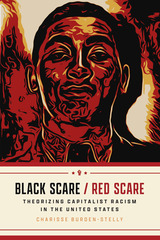
In the early twentieth century, two panics emerged in the United States. The Black Scare was rooted in white Americans’ fear of Black Nationalism and dread at what social, economic, and political equality of Black people might entail. The Red Scare, sparked by communist uprisings abroad and subversion at home, established anticapitalism as a force capable of infiltrating and disrupting the American order. In Black Scare / Red Scare, Charisse Burden-Stelly meticulously outlines the conjoined nature of these state-sanctioned panics, revealing how they unfolded together as the United States pursued capitalist domination. Antiradical repression, she shows, is inseparable from anti-Black oppression, and vice versa.
Beginning her account in 1917—the year of the Bolshevik Revolution, the East St. Louis Race Riot, and the Espionage Act—Burden-Stelly traces the long duration of these intertwined and mutually reinforcing phenomena. She theorizes two bases of the Black Scare / Red Scare: US Capitalist Racist Society, a racially hierarchical political economy built on exploitative labor relationships, and Wall Street Imperialism, the violent processes by which businesses and the US government structured domestic and foreign policies to consolidate capital and racial domination. In opposition, Radical Blackness embodied the government’s fear of both Black insurrection and Red instigation. The state’s actions and rhetoric therefore characterized Black anticapitalists as foreign, alien, and undesirable. This reactionary response led to an ideology that Burden-Stelly calls True Americanism, the belief that the best things about America were absolutely not Red and not Black, which were interchangeable threats.
Black Scare / Red Scare illuminates the anticommunist nature of the US and its governance, but also shines a light on a misunderstood tradition of struggle for Black liberation. Burden-Stelly highlights the Black anticapitalist organizers working within and alongside the international communist movement and analyzes the ways the Black Scare/Red Scare reverberates through ongoing suppression of Black radical activism today. Drawing on a range of administrative, legal, and archival sources, Burden-Stelly incorporates emancipatory ideas from several disciplines to uncover novel insights into Black political minorities and their legacy.
Moving beyond studies of representations and images of the body, Lowe focuses on the intersection of body practices, language, and the Social to describe concretely the reality of a lived body. His strongly synthetic work brings together Marxist critique, semiotics, Foucaultian discourse analysis, and systems and communications theory to examine those practices that construct the body under late capitalism: habits of work and consumption, the ways we give birth and raise children, socialization, mental and physical healing, reconstructions and contestations of sexuality and gender. Lowe draws upon a wide range of sources, including government and labor studies and statistics, diagnostic and statistical manuals on mental illness, computer manuals, self-help books, and guides to work-related stress disorders, to illustrate the transformation of the body into a nexus of exchange value in postmodern society.

What makes somebody a Loser, a person doomed to unfulfilled dreams and humiliation? Nobody is born to lose, and yet failure embodies our worst fears. The Loser is our national bogeyman, and his history over the past two hundred years reveals the dark side of success, how economic striving reshaped the self and soul of America.
From colonial days to the Columbine tragedy, Scott Sandage explores how failure evolved from a business loss into a personality deficit, from a career setback to a gauge of our self-worth. From hundreds of private diaries, family letters, business records, and even early credit reports, Sandage reconstructs the dramas of real-life Willy Lomans. He unearths their confessions and denials, foolish hopes and lost faith, sticking places and changing times. Dreamers, suckers, and nobodies come to life in the major scenes of American history, like the Civil War and the approach of big business, showing how the national quest for success remade the individual ordeal of failure.
Born Losers is a pioneering work of American cultural history, which connects everyday attitudes and anxieties about failure to lofty ideals of individualism and salesmanship of self. Sandage's storytelling will resonate with all of us as it brings to life forgotten men and women who wrestled with The Loser--the label and the experience--in the days when American capitalism was building a nation of winners.

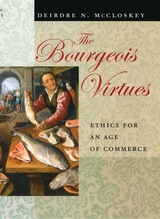
McCloskey’s sweeping, charming, and even humorous survey of ethical thought and economic realities—from Plato to Barbara Ehrenreich—overturns every assumption we have about being bourgeois. Can you be virtuous and bourgeois? Do markets improve ethics? Has capitalism made us better as well as richer? Yes, yes, and yes, argues McCloskey, who takes on centuries of capitalism’s critics with her erudition and sheer scope of knowledge. Applying a new tradition of “virtue ethics” to our lives in modern economies, she affirms American capitalism without ignoring its faults and celebrates the bourgeois lives we actually live, without supposing that they must be lives without ethical foundations.
High Noon, Kant, Bill Murray, the modern novel, van Gogh, and of course economics and the economy all come into play in a book that can only be described as a monumental project and a life’s work. The Bourgeois Virtues is nothing less than a dazzling reinterpretation of Western intellectual history, a dead-serious reply to the critics of capitalism—and a surprising page-turner.
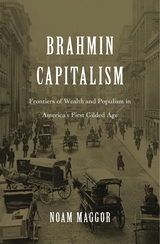
Tracking the movement of finance capital toward far-flung investment frontiers, Noam Maggor reconceives the emergence of modern capitalism in the United States. Brahmin Capitalism reveals the decisive role of established wealth in the transformation of the American economy in the decades after the Civil War, leading the way to the nationally integrated corporate capitalism of the twentieth century.
Maggor’s provocative history of the Gilded Age explores how the moneyed elite in Boston—the quintessential East Coast establishment—leveraged their wealth to forge transcontinental networks of commodities, labor, and transportation. With the decline of cotton-based textile manufacturing in New England and the abolition of slavery, these gentleman bankers traveled far and wide in search of new business opportunities and found them in the mines, railroads, and industries of the Great West. Their investments spawned new political and social conflict, in both the urbanizing East and the expanding West. In contests that had lasting implications for wealth, government, and inequality, financial power collided with more democratic visions of economic progress.
Rather than being driven inexorably by technologies like the railroad and telegraph, the new capitalist geography was a grand and highly contentious undertaking, Maggor shows, one that proved pivotal for the rise of the United States as the world’s leading industrial nation.


Business as Usual reveals how American capitalism has been promoted in the most ephemeral of materials: public service announcements, pamphlets, educational films, and games—what Caroline Jack calls “sponsored economic education media.” These items, which were funded by corporations and trade groups who aimed to “sell America to Americans,” found their way into communities, classrooms, and workplaces, and onto the airwaves, where they promoted ideals of “free enterprise” under the cloaks of public service and civic education. They offered an idealized vision of US industrial development as a source of patriotic optimism, framed business management imperatives as economic principles, and conflated the privileges granted to corporations by the law with foundational political rights held by individuals. This rhetoric remains dominant—a harbinger of the power of disinformation that so besets us today. Jack reveals the funding, production, and distribution that together entrenched a particular vision of corporate responsibility—and, in the process, shut out other hierarchies of value and common care.
READERS
Browse our collection.
PUBLISHERS
See BiblioVault's publisher services.
STUDENT SERVICES
Files for college accessibility offices.
RECENTLY PUBLISHED







UChicago Accessibility Resources
home | accessibility | search | about | contact us
BiblioVault ® 2001 - 2026
The University of Chicago Press