
 A SCHOLARLY BOOK REPOSITORY
14 start with B start with B
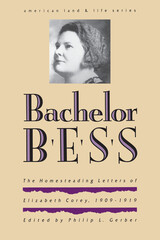
In July 1909 twenty-one-year-old Elizabeth Corey left her Iowa farm to stake her claim to a South Dakota homestead. Over the next ten years, as she continued her schoolteaching career and carved out a home for herself in this inhospitable territory, she sent a steady stream of letters to her family back in Iowa. From the edge of modern America, Bess wrote long, gossipy accounts—"our own continuing adventure story," according to her brother Paul—of frontier life on the high plains west of the Missouri River. Irrepressible, independent-minded, and evidently fearless, the self-styled Bachelor Bess gives us a firsthand, almost daily account of her homesteading adventures. We can all stake a claim in her energetic letters.

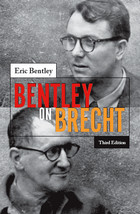
Winner of 2006 International Association of Theatre Critics Thalia Prize
Winner of 2006 Village Voice OBIE Awards Lifetime Achievement Award
Since their first meeting in Santa Monica, California in 1942, Eric Bentley has been Bertolt Brecht's other, offstage voice. Just as Brecht reshaped modern theater, Bentley's writings on Brecht helped shape his reputation in the United States and the rest of the world. Bentley on Brecht represents a lifetime of critical and personal thoughts on both Brecht as friend and Brecht as influential literary figure. Brought together in this volume are Brecht-Bentley correspondence, Bentley's personal recollections of his years with Brecht, including Charles Laughton's production of Galileo, Brecht's testimony before the House Un-American Activities Committee, and Bentley's analysis of Brecht's plays.

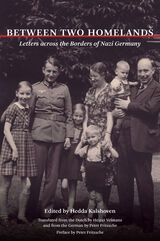
In 1920, at the age of thirteen, Irmgard Gebensleben first traveled from Germany to The Netherlands on a "war-children transport." She would later marry a Dutch man and live and raise her family there while keeping close to her German family and friends through the frequent exchange of letters. Yet during this period geography was not all that separated them. Increasing divergence in political opinions and eventual war between their countries meant letters contained not only family news but personal perspectives on the individual, local, and national choices that would result in the most destructive war in history.
This important collection, first assembled by Irmgard Gebensleben's daughter Hedda Kalshoven, gives voice to ordinary Germans in the Weimar Republic and the Third Reich and in the occupied Netherlands. The correspondence between Irmgard, her friends, and four generations of her family delve into their most intimate and candid thoughts and feelings about the rise of National Socialism. The responses to the German invasion and occupation of the Netherlands expose the deeply divided loyalties of the family and reveal their attempts to bridge them. Of particular value to historians, the letters evoke the writers' beliefs and their understanding of the events happening around them.
This first English translation of Ik denk zoveel aan jullie: Een briefwisseling tussen Nederland en Duitsland 1920-1949, has been edited, abridged, and annotated by Peter Fritzsche with the assent and collaboration of Hedda Kalshoven. After the book's original publication the diary of Irmgard's brother and loyal Wehrmacht soldier, Eberhard, was discovered and edited by Hedda Kalshoven. Fritzsche has drawn on this important additional source in his preface.

The early letters were written before Niedecker's marriage and at a time when the poet had "more trees for friends than people." In these letters from Black Hawk Island, Niedecker sought a community of fellow poets. The following period, the Milwaukee years, form the bulk of the collection and saw the establishment of Niedecker's identity as a poet. From the city of "point-top towers," she wrote Corman frequently about poetry, other poets, current events, and daily life. After her return in 1969 to Black Hawk Island, relieved of earlier anxieties over publication, she was confidently at work on her sequences, her most serious poetic undertaking.
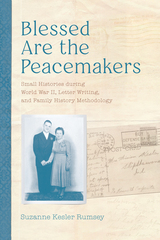
Where family letters become history, and ordinary lives reveal the untold story of World War II.
In the summer of 2013, Suzanne Kesler Rumsey discovered hundreds of letters exchanged between her late grandparents, Miriam and Benjamin Kesler. The letters, written between 1941 and 1946, were filled with typical wartime sentiments: love and longing, anguish at being apart, uncertainty about the war and the country’s future, and attempts at humor to keep their spirits up. What is unusual about their story is that Ben Kesler was not writing from a theater of war. Instead, Ben, a member of the Dunkard Brethren Church, was a conscientious objector. He, along with about 12,000 other men, opted to join the Civilian Public Service (CPS) and contribute to “work of national importance” at one of the 218 CPS camps around the country.
In Blessed Are the Peacemakers: Small Histories during World War II, Letter Writing, and Family History Methodology, Rumsey has mined not only her grandparents’ letters but also archival research on CPS camps and historical data from several Mennonite and Brethren archives to recapture the narrative of Ben’s service at two different camps and of Miriam’s struggle to support herself and her husband financially at the young age of seventeen. Ben and Miriam’s life during the war was extraordinarily ordinary, spanning six years of unrecognized and humble work for their country. Ben was not compensated for his work in the camps, and Miriam stayed home and worked as a day laborer, as a live-in maid, as a farmhand, and in the family butcher shop in order to earn enough money to support them both. Small histories like that of her grandparents, Rumsey argues, provide a unique perspective on significant political and historical moments.
Blessed Are the Peacemakers also explores the rhetorical functions of letter writing as well as the methodology of family history writing. Ben and Miriam’s letters provide an apt backdrop to examine the genre, a relatively understudied mode of literacy. Rumsey situates the young couple’s correspondence within ars dictaminis, the art of letter writing, granting new insights into the genre and how personal accounts shape our understanding of historical events.
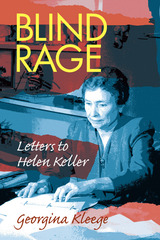
As a young blind girl, Georgina Kleege repeatedly heard the refrain, “Why can’t you be more like Helen Keller?” Kleege’s resentment culminates in her book Blind Rage: Letters to Helen Keller, an ingenious examination of the life of this renowned international figure using 21st-century sensibilities. Kleege’s absorption with Keller originated as an angry response to the ideal of a secular saint, which no real blind or deaf person could ever emulate. However, her investigation into the genuine person revealed that a much more complex set of characters and circumstances shaped Keller’s life.
Blind Rage employs an adroit form of creative nonfiction to review the critical junctures in Keller’s life. The simple facts about Helen Keller are well-known: how Anne Sullivan taught her deaf-blind pupil to communicate and learn; her impressive career as a Radcliffe graduate and author; her countless public appearances in various venues, from cinema to vaudeville, to campaigns for the American Foundation for the Blind. But Kleege delves below the surface to question the perfection of this image. Through the device of her letters, she challenges Keller to reveal her actual emotions, the real nature of her long relationship with Sullivan, with Sullivan’s husband, and her brief engagement to Peter Fagan. Kleege’s imaginative dramatization, distinguished by her depiction of Keller’s command of abstract sensations, gradually shifts in perspective from anger to admiration. Blind Rage criticizes the Helen Keller myth for prolonging an unrealistic model for blind people, yet it appreciates the individual who found a practical way to live despite the restrictions of her myth.

"[Brassaï] is probably the only photographer—at least in France—to have acquired such a vast audience and mastered his material to such a degree that he can express himself with a flexibility and apparent ease that is almost literary in its nature."—Jean Gallien, Photo-Monde
"The letters that Brassaï wrote to his parents between 1920 and 1940 chronicle the sometimes painful stages by which this gifted man hauled himself from penury to celebrity."—Peter Hamilton, Times Literary Supplement
"In these proud, protective, occasionally conscience-stricken missives, the young man full of eager dreams emerges as one of the century's pioneering photographers, revered for his lushly atmospheric portraits of Paris after dark."—Elle
"A fascinating insight into how a bright individual slowly found his calling."—Christine Schwartz Hartley, New York Times Book Review
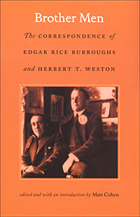
The Burroughs-Weston letters trace a fascinating personal and business relationship that evolved as the two men and their wives embarked on joint capital ventures, traveled frequently, and navigated the difficult waters of child-rearing, divorce, and aging. Brother Men includes never-before-published images, annotations, and a critical introduction in which Cohen explores the significance of the sustained, emotional male friendship evident in the letters. Rich with insights related to visual culture and media technologies, consumerism, the history of the family, the history of authorship and readership, and the development of the West, these letters make it clear that Tarzan was only one small part of Edgar Rice Burroughs’s broad engagement with modern culture.
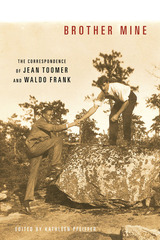
The friendship of Jean Toomer and Waldo Frank was one of the most emotionally intense, racially complicated, and aesthetically significant relationships in the history of American literary modernism. Waldo Frank was an established white writer who advised and assisted the younger African American Jean Toomer as he pursued a literary career. They met in 1920, began corresponding regularly in 1922, and were estranged by the end of 1923, the same year that Toomer published his ambitiously modernist debut novel, Cane.
While individual letters between Frank and Toomer have been published separately on occasion, they have always been presented out of context. This volume presents for the first time their entire correspondence in chronological order, comprising 121 letters ranging from 200 to 800 words each. Kathleen Pfeiffer annotates and introduces the letters, framing the correspondence and explaining the literary and historical allusions in the letters themselves.
Reading like an epistolary novel, Brother Mine captures the sheer emotional force of the story that unfolds in these letters: two men discover an extraordinary friendship, and their intellectual and emotional intimacy takes shape before our eyes. This unprecedented collection preserves the raw honesty of their exchanges, together with the developing drama of their ambition, their disappointments, their assessment of their world, and ultimately, the betrayal that ended the friendship.
READERS
Browse our collection.
PUBLISHERS
See BiblioVault's publisher services.
STUDENT SERVICES
Files for college accessibility offices.
RECENTLY PUBLISHED




UChicago Accessibility Resources
home | accessibility | search | about | contact us
BiblioVault ® 2001 - 2026
The University of Chicago Press