
 A SCHOLARLY BOOK REPOSITORY
14 start with B start with B
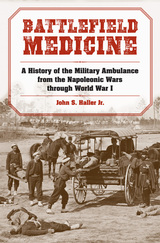
In this first history of the military ambulance, historian John S. Haller Jr. documents the development of medical technologies for treating and transporting wounded soldiers on the battlefield. Noting that the word ambulance has been used to refer to both a mobile medical support system and a mode of transport, Haller takes readers back to the origins of the modern ambulance, covering their evolution in depth from the late eighteenth century through World War I.
The rising nationalism, economic and imperial competition, and military alliances and arms races of the nineteenth and early twentieth centuries figure prominently in this history of the military ambulance, which focuses mainly on British and American technological advancements. Beginning with changes introduced by Dominique-Jean Larrey during the Napoleonic Wars, the book traces the organizational and technological challenges faced by opposing armies in the Crimean War, the American Civil War, the Franco-Prussian War, and the Philippines Insurrection, then climaxes with the trench warfare that defined World War I. The operative word is "challenges" of medical care and evacuation because while some things learned in a conflict are carried into the next, too often, the spasms of war force its participants to repeat the errors of the past before acquiring much needed insight.
More than a history of medical evacuation systems and vehicles, this exhaustively researched and richly illustrated volume tells a fascinating story, giving readers a unique perspective of the changing nature of warfare in the nineteenth and early twentieth centuries.
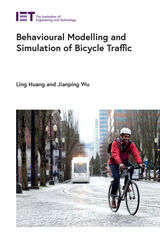

Bike lanes are aspirational projects—that is, they speak to a series of dreams about what North American cities could be, especially in and around an environmentalist and Europhilic vision (the latter having a very long history in the Americas). But the creation of bike lanes maps onto preexisting modes of transport and forms of racial and spatial inequality. Bike lane advocacy in North American cities has in many ways replicated the weak social ties that characterize these spaces.
Amsterdam’s oft-cited bike lanes are integrated within a system of regional trains, buses, and subways, allowing riders to park their bikes and engage in multimodal commuting. However, in American settings, these projects have been slow to launch, in part because of the aversion that middle-class and wealthy North Americans have toward public transport. This aversion is uneven, but public transport remains much more the preserve of working people and people of color in these cities.
Recent controversial bike lane initiatives in Mexico City and Vancouver show how such projects not only create uproar among monied urbanites but may actually displace entire modes of transportation used primarily by marginalized residents (especially in the case of Mexico City), when the wish to imitate European models defeats efforts to see a North American city for what it is. In comparing Mexico City and Vancouver, Bike Lanes Are the End of Us traces how bike lane politics collide with distinct racial, spatial, and infrastructural realities to produce “green” reforms that can reinforce existing inequalities just as readily as they promise greater mobility.

Bike Lust roars straight into the world of women bikers and offers us a ride. In this adventure story that is also an insider’s study of an American subculture, Barbara Joans enters as a passenger on the back of a bike, but soon learns to ride her own. As an anthropologist she untangles the rules, rituals, and rites of passage of the biker culture. As a new member of that culture, she struggles to overcome fear, physical weakness, and a tendency to shoot her mouth off—a tendency that very nearly gets her killed.
Bike Lust travels a landscape of contradictions. Outlaws still chase freedom on the highway, but so do thousands of riders of all classes, races, and colors. Joans introduces us to the women who ride the rear—the biker chick, the calendar slut straddling the hot engine, the back-seat Betty at the latest rally, or the underage groupie at the local run. But she also gives us the first close look at women who ride in their own right, on their own bikes, as well as a new understanding of changing world of male bikers. These are ordinary women’s lives made extraordinary, adding a dimension of courage to the sport not experienced by males, risking life and limb for a glimpse of the very edge of existence. This community of riders exists as a primal tribute to humanity's lust for freedom.
Praise for the first edition:
"A fascinating book [and] a sympathetic look at the man who glued General Motors together and in the process made Flint one of the great industrial centers of America."
---Detroit Free Press
"It is refreshing to report that Billy Durant is one of the best researched books dealing with an automotive giant."
---Antique Automobile
"Billy Durant fills in a masterly way the only important void remaining concerning the work of the motorcar pioneers."
---Richard Crabb, author of Birth of a Giant: The Men and Incidents That Gave America the Motorcar
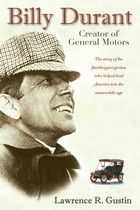
What explains Billy Durant's powerful influence on the auto industry during its early days? And why, given Durant's impact, has he been nearly forgotten for decades?
In search of answers to these questions, Lawrence Gustin interviewed Durant's widow, who provided a wealth of previously unpublished autobiographical notes, letters, and personal papers. Gustin also interviewed two of Durant's personal secretaries and others who had known and worked with the man who created General Motors. The result is the amazing account of the mastermind behind what would become, as the twentieth century progressed, the world's largest company.

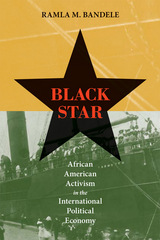
This book describes how the first African American mass political organization was able to gain support from throughout the African diaspora to finance the Black Star Line, a black merchant marine that would form the basis of an enclave economy after World War I. Ramla M. Bandele explores the concept of diaspora itself and how it has been applied to the study of émigré and other ethnic networks.
In characterizing the historical and political context of the Black Star Line, Bandele analyzes the international political economy during 1919-25 and considers the black politics of the era, focusing particularly on Marcus Garvey's Universal Negro Improvement Association for its creation of the Black Star Line. She offers an in-depth case study of the Black Star Line as an instance of the African diaspora attempting to link communities and carry out a transnational political and economic project. Arguing that ethnic networks can be legitimate actors in international politics and economics, Bandele also suggests, however, that activists in any given diaspora do not always function as a unit.


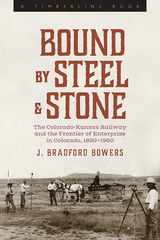
Offering the Colorado-Kansas Railway as an example of how shortline railroads helped to integrate the rural landscape with the larger urban and economic world, Bowers reveals the constant adaptations driven by changing economic forces and conditions. He puts the railway in context of the wider environmental and political landscapes, the growing quarrying and mining business, the expansion of agriculture and irrigation, Progressive-era political reforms, and land development. In the new frontier of enterprise in the early twentieth-century American West, the railroad highlights the successes and failures of the men inspired to pursue these new opportunities as well as the story of one woman who held these fragile industries together well into the second half of the twentieth century.
Bound by Steel and Stone is an insightful addition to the history of industrialization and economic development in Colorado and the American West.

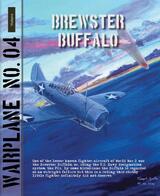
This book presents an overview of the development and operational use of the Buffalo with many photos including a number not published before.
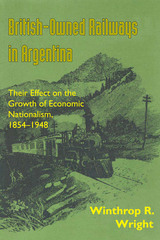
During the nineteenth century, British-owned railways grew under the protection of an Argentine ruling elite that considered railways both instruments and symbols of progress. Under this program of support for foreign enterprise, Argentina had by 1914 built the largest railway network in Latin America.
During the first decades of the twentieth century, the railways were successful in following a policy of calculated disregard for Argentine interests in general. However, following the end of World War I, the British economic empire began to decline and Argentine economic nationalism grew. A number of popularistic political movements incorporated economic nationalism into their platforms, and even among the ruling elite there were signs of increasing nationalistic sentiment.
Although most studies of economic nationalism have emphasized the importance of the middle-class Radical party in the rise of xenophobia, Winthrop R. Wright's study shows that antiforeign economic nationalism was not entirely a reaction to the conservative elite. Between 1932 and 1938 the nationalistic programs of General Agustin Justo's government—basically a conservative regime—led the British interests to decide to sell their holdings. The British govemment had arrived at a position of supporting the economic withdrawal of the large British-owned firms long before Juan D. Perón appeared on the political scene.
Perón combined traditional Argentine economic nationalism with his own scheme to gain power over all elements in Argentina. His solution to the railway problem, although more dramatically executed, did not differ greatly from that of the conservative Justo. Perón purchased the railways outright in 1947–1948, but his use of nationalism was in reality covering his own inability to outbargain Britain and the United States following the conclusion of World War II.
READERS
Browse our collection.
PUBLISHERS
See BiblioVault's publisher services.
STUDENT SERVICES
Files for college accessibility offices.
RECENTLY PUBLISHED





UChicago Accessibility Resources
home | accessibility | search | about | contact us
BiblioVault ® 2001 - 2026
The University of Chicago Press