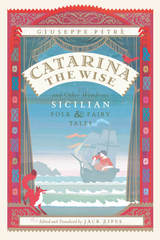
front cover of Catarina the Wise and Other Wondrous Sicilian Folk and Fairy Tales
Catarina the Wise and Other Wondrous Sicilian Folk and Fairy Tales
Collected by Giuseppe Pitrè
University of Chicago Press, 2017
Well, gentlemen, here’s a tale that people have told time and again . . . .

So begins the title story in this collection of fifty Sicilian folk and fairy tales edited and translated by noted folklore scholar Jack Zipes. But while some of the stories may sound as if they’ve been told time and again—such as variations on Cinderella and Puss in Boots—many will enchant English-language readers and storytellers for the first time. From “The Pot of Basil” to “The Talking Belly,” “The Little Mouse with the Stinky Tail” to “Peppi, Who Wandered out into the World,” the stories in Catarina the Wise range from simple tales of getting a new dress or something good to eat to fantastical plots for outwitting domineering husbands, rescuing impoverished fathers, or attracting wealthy suitors (frequently the Prince of Portugal). Many feature strong, clever women (usually daughters who become queen). Many are funny; many are wise. Some are very, very strange.

As Zipes relates, the true story of their origins is as extraordinary as the tales themselves. Born to a poor family of sailors in Palermo, Giuseppe Pitrè would go on to serve with Garibaldi, become a traveling country doctor, and gather one of the most colossal collections of folk and fairy tales of the nineteenth century. But while his work as a folklorist rivaled that of the Brothers Grimm, Pitrè remains a relative unknown. Catarina the Wise highlights some of the most delectable stories at the heart of his collection. Featuring new, original illustrations, this book is a beautiful, charming treasure for any fan of story, storytelling, and heroines and heroes living happily ever after—sometimes.
[more]

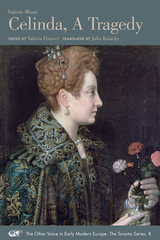
front cover of Celinda, A Tragedy
Celinda, A Tragedy
A Bilingual Edition
Valeria Miani
Iter Press, 2010
Valeria Miani’s Celinda (1611), the only female-authored secular tragedy of early modern Italy, is here made available for the first time in a modern edition. Miani’s tale of the doomed love of the Lydian princess Celinda for the cross-dressed Persian prince Autilio/ Lucinia offers a striking example of the explorative attitude to gender identity that is such a marked characteristic of Italian drama in this period, both within the erudite and the commedia dell’arte tradition. Accompanied by Julia Kisacky’s sensitive translation, and with a valuable contextualizing introduction by Valeria Finucci, this edition of Celinda makes an important contribution to our understanding of women’s place within Italian literary culture in a period increasingly recognized as exceptional for the range and quality of femaleauthored writing it produced.
—Virginia Cox
Professor of Italian, New York University

[more]

front cover of Cesare Pavese and America
Cesare Pavese and America
Life, Love, and Literature
Lawrence G. Smith
University of Massachusetts Press, 2008
When he committed suicide at age forty-one, Cesare Pavese (1908–1950) was one of Italy's best-known writers. A poet, novelist, literary critic, and translator, he had been profoundly influenced in his early years by American literature. But later he grew disaffected with American culture, coming to see it as materialistic and shallow. This book, the first full-length English-language study of Pavese in twenty years, examines his life and the evolution of his views of America through a chronological reading of his works.
[more]

front cover of Claiming a Tradition
Claiming a Tradition
Italian American Women Writers
Mary Jo Bona
Southern Illinois University Press, 1999
Mary Jo Bona reconstructs the literary history and examines the narrative techniques of eight Italian American women's novels from 1940 to the present. Largely neglected until recently, these women's family narratives compel a reconsideration of what it means to be a woman and an ethnic in America.


Bona discusses the novels in pairs according to their focus on Italian American life. She first examines the traditions of italianitá (a flavor of things Italian) that inform and enhance works of fiction. The novelists in that tradition were Mari Tomasi (Like Lesser Gods, 1949) and Marion Benasutti (No Steady Job for Papa, 1966).


Bona then turns to later novels that highlight the Italian American belief in the family's honor and reputation. Conflicts between generations, specifically between autocratic fathers and their children, are central to Octavia Waldo's 1961 A Cup of the Sun and Josephine Gattuso Hendin's 1988 The Right Thing to Do.


Even when writers choose to steer away from the familial focus, Bona notes, their developmental narratives trace the reintegration of characters suffering from a crisis of cultural identity. Relating the characters' struggles to their relationship to the family, Bona examines Diana Cavallo's 1961 A Bridge of Leaves and Dorothy Bryant's 1978 Miss Giardino.


Bona then discusses two innovative novels— Helen Barolini's 1979 Umbertina and Tina De Rosa's 1980 Paper Fish— both of which feature a granddaughter who invokes her grandmother, a godparent figure. Through Barolini's feminist and De Rosa's modernist perspectives, both novels present a young girl developing artistically.


Closing with a discussion of the contemporary terrain Italian American women traverse, Bona examines such topics as sexual identity when it meets cultural identity and the inclusion of italianitá when Italian American identity is not central to the story. Italian American women writers, she concludes, continue in the 1980s and 1990s to focus on the interplay between cultural identity and women's development.
[more]

front cover of Class
Class
Andrea Cavalletti
Seagull Books, 2019
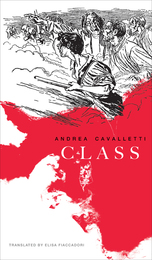
In 1936, Walter Benjamin defined the revolutionary class as being in opposition to a dense and dangerous crowd, prone to fear of the foreign, and under the spell of anti-Semitic madness. Today, in formations great or small, that sad figure returns—the hatred of minorities is rekindled and the pied-pipers of the crowd stand triumphant.

Class, by Andrea Cavalletti, is a striking montage of diverse materials—Marx and Jules Verne, Benjamin and Gabriel Tarde. In it, Cavalletti asks whether the untimely concept of class is once again thinkable. Faced with new pogroms and state racism, he challenges us to imagine a movement that would unsettle and eventually destroy the crowd.
[more]

front cover of The Complete Danteworlds
The Complete Danteworlds
A Reader's Guide to the Divine Comedy
Guy P. Raffa
University of Chicago Press, 2009

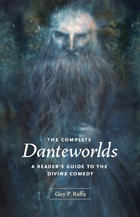
Dante Alighieri’s Divine Comedy has, despite its enormous popularity and importance, often stymied readers with its multitudinous characters, references, and themes. But until the publication in 2007 of Guy Raffa’s guide to the Inferno, students lacked a suitable resource to help them navigate Dante’s underworld. With this new guide to the entire Divine Comedy, Raffa provides readers—experts in the Middle Ages and Renaissance, Dante neophytes, and everyone in between—with a map of the entire poem, from the lowest circle of Hell to the highest sphere of Paradise.

Based on Raffa’s original research and his many years of teaching the poem to undergraduates, The CompleteDanteworlds charts a simultaneously geographical and textual journey, canto by canto, region by region, adhering closely to the path taken by Dante himself through Hell, Purgatory, and Paradise. This invaluable reference also features study questions, illustrations of the realms, and regional summaries. Interpreting Dante’s poem and his sources, Raffa fashions detailed entries on each character encountered as well as on many significant historical, religious, and cultural allusions.
[more]

front cover of Complete Poems
Complete Poems
A Bilingual Edition
Veronica Gambara
Iter Press, 2014
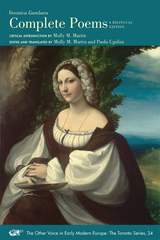
Veronica Gambara (1485–1550) was one of the most celebrated lyric poets of early sixteenth-century Italy. Equally significant to Gambara’s literary repute was her political standing as the dowager Countess of Correggio. Though she never published a collected edition of her poetry, Gambara produced an extensive oeuvre of vernacular verse that has been extensively anthologized. This book presents the first complete bilingual edition of Gambara’s verse. It sheds light on the unique interrelationship between Gambara’s cultural currency and her political power, as she drew on her literary talent to participate in the political arena to emerge as one of the first women poet-rulers of the Early Modern Italian tradition.
[more]

front cover of The Complete Poems of Michelangelo
The Complete Poems of Michelangelo
Michelangelo
University of Chicago Press, 1998
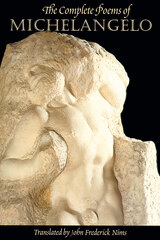
There is no artist more celebrated than Michelangelo. Yet the magnificence of his achievements as a visual artist often overshadow his devotion to poetry. Michelangelo used poetry to express what was too personal to display in sculpture or painting. John Frederick Nims has brought the entire body of Michelangelo's verse, from the artist's ardent twenties to his anguished and turbulent eighties, to life in English in this unprecedented collection. The result is a tantalizing glimpse into a most fascinating mind.

"Wonderful. . . . Nims gives us Michelangelo whole: the polymorphous love sonneteer, the political allegorist, and the solitary singer of madrigals."—Kirkus Reviews

"A splendid, fresh and eloquent translation. . . . Nims, an eminent poet and among the best translators of our time, conveys the full meaning and message of Michelangelo's love sonnets and religious poems in fluently rhymed, metrical forms."—St. Louis Post-Dispatch

"The best so far. . . . Nims is best at capturing the sound and sense of Michelangelo's poetic vocabulary."—Choice

"Surely the most compelling translations of Michelangelo currently available in English."—Ronald L. Martinez, Washington Times
[more]

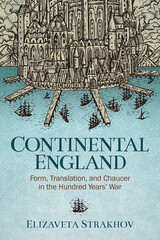
front cover of Continental England
Continental England
Form, Translation, and Chaucer in the Hundred Years’ War
Elizaveta Strakhov
The Ohio State University Press, 2022
Scholars have often viewed the Hundred Years’ War (c. 1337–1453) between England and France as sharpening animosity and isolationism. Further, medievalists have often characterized translator–source relationships as adversarial. In Continental England, Elizaveta Strakhov develops a new model, reparative translation, as a corrective to both formulations. Zeroing in on formes fixes poetry—and Chaucer as a leading practitioner—she shows that translation played two essential, interrelated roles: it became a channel for rebuilding fragmented communities, and it restored unity to Francophone cultural landscapes fractured by war. Further, used in particular to express England’s aspirational relationship to Francophone culture despite the ongoing war, translation became the means by which England negotiated a new vision of itself as Continental rather than self-contained. Chaucer’s own translation work and fusion of Francophone and Italian humanist influences in his poetry rendered him a paradigmatic figure for England’s new bid for Continental relevance. Interpreting Chaucer’s posthumous canonization as a direct result of reparative translation, Strakhov shows how England’s transition from island to Continental constituent problematizes our contemporary understandings of nation-bound authors and canons.
[more]

front cover of Convent Paradise
Convent Paradise
Arcangela Tarabotti
Iter Press, 2020
The radical Venetian writer Arcangela Tarabotti (1604–1652), compelled against her will to become a nun, is well known for her scathing attacks on patriarchal institutions for forcing women into convents. Convent Paradise (1643), Tarabotti’s first published work, instead invites the reader into the cloister to experience not only the trials of enclosure, but also its spiritual joys. In stark contrast to her other works, Convent Paradise aims to celebrate the religious culture that colored every aspect of Tarabotti’s experience as a seventeenth-century Venetian and a nun. At the same time, this nuanced exploration of monastic life conveys a markedly feminist spirituality. Tarabotti’s meditative portrait of the convent enriches our understanding of her own life and writing, while also providing a window into a spiritual destiny shared by thousands of early modern women.

The Other Voice in Early Modern Europe - The Toronto Series volume 73
[more]


Send via email Share on Facebook Share on Twitter