
 A SCHOLARLY BOOK REPOSITORY
119 start with D start with D


The first full biography of Reagan's famous Surgeon General, who put science before politics—cutting smoking by 25%, leading the fight against AIDS, and shocking both liberals and conservatives on abortion.
When Ronald Reagan chose C. Everett Koop to be Surgeon General of the United States in 1981, liberal politicians, women's groups, and even the public health community opposed the nomination because of his conservative social views and strong anti-abortion beliefs. By the time he left office in 1989, the same people who had vilified him as “Dr. Kook” were singing his praises, and many conservative politicians and activists who had championed his nomination were criticizing him as a traitor. He had also become “the only surgeon general [who was] a household name,” according to the Associated Press, because of his ubiquitous media exposure around the HIV/AIDS crisis, his unique look, and his savvy with the press. How had Koop remade himself and this once major government office, which sounded grand but in the 1960s had been stripped to a minor advisory role?
As Nigel M. de S. Cameron shows, Koop was, above all, guided in his decisions by his unwavering physician’s commitment to saving lives. Even in the face of political pressures and what many expected to be his personal beliefs, he focused on science and public health. On smoking, abortion, and AIDS he openly defied Republican politicians and alienated New Right conservatives because his reading of the science did not support their ideologies. It was this adherence to science, health, and office that led him to refuse to campaign on abortion, seek compromise on the disabled “Baby Doe” case, relentlessly go after Big Tobacco, and finally reach out to the gay community as AIDS and fear of AIDS exploded. Both supporters and detractors consistently misjudged him.
This first full biography of Koop draws on thousands of documents and hundreds of interviews with family, friends, and colleagues to tell the story of the precocious boy from Brooklyn who was already the world’s most celebrated pediatric surgeon when he became Surgeon General and one of the most recognizable public figures in late-20th century America. Koop remains a sterling example—to both left and right—of how public officials should conduct themselves.

When the American reporter Henry Morton Stanley stepped out of the jungle in 1871 and doffed his pith helmet to the Scottish missionary-explorer Dr. David Livingstone, his greeting was to take on mythological proportions. But do any of us really know what his words meant at the time--and what they have come to mean since?
Far from meeting in a remote thicket in "Darkest Africa," Stanley met Livingstone in the middle of a thriving Muslim community. The news of their encounter was transmitted around the globe, and Livingstone instantly became one of the world's first international celebrities.
This book shows how urgently a handshake between a Briton and an American was needed to heal the rift between the two countries after the American Civil War. It uncovers for the first time the journeys that Livingstone's African servants made around Britain after his death, and it makes a case for Stanley's immense influence on the idea of the modern at the dawn of the twentieth century. Drawing on films, children's books, games, songs, cartoons, and TV shows, this book reveals the many ways our culture has remembered Stanley's phrase, while tracking the birth of an Anglo-American Christian imperialism that still sets the world agenda today.
Dr. Livingstone, I Presume? is a story of conflict and paradox that also takes us into the extraordinary history of British engagement with Africa. Clare Pettitt shows both the bleakest side of imperialism and the strange afterlife of a historical event in popular mythmaking and music hall jokes.
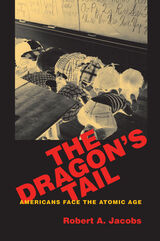
When President Harry Truman introduced the atomic bomb to the world in 1945, he described it as a God-given harnessing of “the basic power of the universe.” Six days later a New York Times editorial framed the dilemma of the new Atomic Age for its readers: “Here the long pilgrimage of man on Earth turns towards darkness or towards light.” American nuclear scientists, aware of the dangers their work involved, referred to one of their most critical experiments as “tickling the dragon's tail.”
Even after Hiroshima and Nagasaki, most Americans may not have been sure what an atomic bomb was or how it worked. But they did sense that it had fundamentally changed the future of the human race. In this book, Robert Jacobs analyzes the early impact of nuclear weapons on American culture and society. He does so by examining a broad range of stories, or “nuclear narratives,” that sought to come to grips with the implications of the bomb's unprecedented and almost unimaginable power.
Beginning with what he calls the “primary nuclear narrative,” which depicted atomic power as a critical agent of social change that would either destroy the world or transform it for the better, Jacobs explores a variety of common themes and images related to the destructive power of the bomb, the effects of radiation, and ways of surviving nuclear war. He looks at civil defense pamphlets, magazines, novels, and films to recover the stories the U.S. government told its citizens and soldiers as well as those presented in popular culture.
According to Jacobs, this early period of Cold War nuclear culture—from 1945 to the banning of above-ground testing in 1963—was distinctive for two reasons: not only did atmospheric testing make Americans keenly aware of the presence of nuclear weapons in their lives, but radioactive fallout from the tests also made these weapons a serious threat to public health, separate from yet directly linked to the danger of nuclear war.
Throughout the seventeenth century, early modern play readers and playgoers copied dramatic extracts (selections from plays and masques) into their commonplace books, verse miscellanies, diaries, and songbooks. Dramatic Extracts in Seventeenth-Century English Manuscripts: Watching, Reading, Changing Plays is the first to examine these often overlooked texts, which reveal what early modern audiences and readers took, literally and figuratively, from plays. As this under-examined archival evidence shows, play readers and playgoers viewed plays as malleable and modular texts to be altered, appropriated, and, most importantly, used. These records provide information that is not available in other forms about the popularity and importance of early modern plays, the reasons plays appealed to their audiences, and the ideas in plays that most interested audiences.
Tracing the course of dramatic extracting from the earliest stages in the 1590s, through the prolific manuscript circulation at the universities, to the closure and reopening of the theatres, Estill gathers these microhistories to create a comprehensive overview of seventeenth-century dramatic extracts and the culture of extracting from plays. Dramatic Extracts in Seventeenth-Century English Manuscripts: Watching, Reading, Changing Plays explores new archival evidence (from John Milton’s signature to unpublished university plays) while also analyzing the popularity of perennial favorites such as Shakespeare’s The Tempest. The study of dramatic extracts is the study of particulars: particular readers, particular manuscripts, particular plays or masques, particular historic moments. As D. F. McKenzie puts it, “different readers [bring] the text to life in different ways.” By providing careful analyses of these rich source texts, this book shows how active play-viewing and play-reading (that is, extracting) ultimately led to changing the plays themselves, both through selecting and manipulating the extracts and positioning the plays in new contexts.
Published by University of Delaware Press. Distributed worldwide by Rutgers University Press.
In The Dreamer and the Dream: Afrofuturism and Black Religious Thought, Roger A. Sneed illuminates the interplay of Black religious thought with science fiction narratives to present a bold case for Afrofuturism as an important channel for Black spirituality. In the process, he challenges the assumed primacy of the Black church as the arbiter of Black religious life. Incorporating analyses of Octavia Butler’s Parable books, Janelle Monáe’s Afrofuturistic saga, Star Trek’s Captain Benjamin Sisko, Marvel’s Black Panther, and Sun Ra and the Nation of Islam, Sneed demonstrates how Afrofuturism has contributed to Black visions of the future. He also investigates how Afrofuturism has influenced religious scholarship that looks to Black cultural production as a means of reimagining Blackness in the light of the sacred. The result is an expansive new look at the power of science fiction and Afrofuturism to center the diversity of Black spirituality.
Honorable Mention, 2019-2020 Research Society for American Periodicals Book Prize
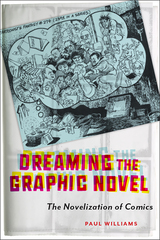
The term “graphic novel” was first coined in 1964, but it wouldn’t be broadly used until the 1980s, when graphic novels such as Watchmen and Maus achieved commercial success and critical acclaim. What happened in the intervening years, after the graphic novel was conceptualized yet before it was widely recognized?
Dreaming the Graphic Novel examines how notions of the graphic novel began to coalesce in the 1970s, a time of great change for American comics, with declining sales of mainstream periodicals, the arrival of specialty comics stores, and (at least initially) a thriving underground comix scene. Surveying the eclectic array of long comics narratives that emerged from this fertile period, Paul Williams investigates many texts that have fallen out of graphic novel history. As he demonstrates, the question of what makes a text a ‘graphic novel’ was the subject of fierce debate among fans, creators, and publishers, inspiring arguments about the literariness of comics that are still taking place among scholars today.
Unearthing a treasure trove of fanzines, adverts, and unpublished letters, Dreaming the Graphic Novel gives readers an exciting inside look at a pivotal moment in the art form’s development.
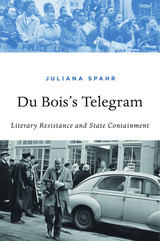
In 1956 W. E. B. Du Bois was denied a passport to attend the Présence Africaine Congress of Black Writers and Artists in Paris. So he sent the assembled a telegram. “Any Negro-American who travels abroad today must either not discuss race conditions in the United States or say the sort of thing which our State Department wishes the world to believe.” Taking seriously Du Bois’s allegation, Juliana Spahr breathes new life into age-old questions as she explores how state interests have shaped U.S. literature. What is the relationship between literature and politics? Can writing be revolutionary? Can art be autonomous, or is escape from nations and nationalisms impossible?
Du Bois’s Telegram brings together a wide range of institutional forces implicated in literary production, paying special attention to three eras of writing that sought to defy political orthodoxies by contesting linguistic conventions: avant-garde modernism of the early twentieth century; social-movement writing of the 1960s and 1970s; and, in the twenty-first century, the profusion of English-language works incorporating languages other than English. Spahr shows how these literatures attempted to assert their autonomy, only to be shut down by FBI harassment or coopted by CIA and State Department propagandists. Liberal state allies such as the Ford and Rockefeller foundations made writers complicit by funding multiculturalist works that celebrated diversity and assimilation while starving radical anti-imperial, anti-racist, anti-capitalist efforts.
Spahr does not deny the exhilarations of politically engaged art. But her study affirms a sobering reality: aesthetic resistance is easily domesticated.
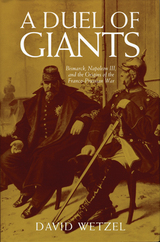
Combining impeccable scholarship and literary elegance, David Wetzel depicts the drama of machinations and passions that exploded in a war that forever changed the face of European history.

In 1944, as the end of World War II approached, an important series of talks were held to plan the formation of postwar international institutions. The meetings, which included debates on a variety of issues, were a first step toward the creation of the United Nations, whose establishment followed some months after. The site for the conversations was Dumbarton Oaks in Washington, D.C., a research institute administered by Harvard University.
In 1994, the “Dumbarton Oaks Conference, 1944–1994” brought together scholars and policymakers who had studied international organizations or had played important roles in them. A half century later, the world had evolved in ways that would have been unimaginable to many attendees of either the original conversations or the conference. This reissue of the conference proceedings, coinciding with the seventy-fifth anniversary of the United Nations in 2020, may assist readers who wish to familiarize themselves with the conditions that motivated the meetings in 1944.

"How much history can be communicated by pressure on a guitar string?" Robert Palmer wondered in Deep Blues. Greil Marcus answers here: more than we will ever know. It is the history in the riff, in the movie or novel or photograph, in the actor's pose or critic's posturing--in short, the history in cultural happenstance--that Marcus reveals here, exposing along the way the distortions and denials that keep us oblivious if not immune to its lessons.
Whether writing about the Beat Generation or Umberto Eco, Picasso's Guernica or the massacre in Tiananmen Square, The Manchurian Candidate or John Wayne's acting, Eric Ambler's antifascist thrillers or Camille Paglia, Marcus uncovers the histories embedded in our cultural moments and acts, and shows how, through our reading of the truths our culture tells and those it twists and conceals, we situate ourselves in that history and in the world. Rarely has a history lesson been so exhilarating. With the startling insights and electric style that have made him our foremost writer on American music, Marcus brings back to life the cultural events that have defined us and our time, the social milieu in which they took place, and the individuals engaged in them. As he does so, we see that these cultural instances--as lofty as The Book of J, as humble as a TV movie about Jan and Dean, as fleeting as a few words spoken at the height of the Berkeley Free Speech Movement, as enduring as a Paleolithic painting--often have more to tell us than the master-narratives so often passed off as faultless representations of the past.
Again and again Marcus skewers the widespread assumption that history exists only in the past, that it is behind us, relegated to the dustbin. Here we see instead that history is very much with us, being made and unmade every day, and unless we recognize it our future will be as cramped and impoverished as our present sense of the past.
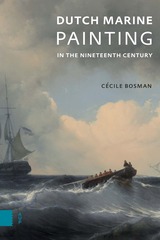
It turns out that throughout the nineteenth century, marine painting was seen in Dutch art circles as a vehicle for patriotism. This kind of cultural nationalism was rooted in the country's historical connection with the water and, in particular, the glorification of the Netherlands as a seafaring nation. An enduring myth that is now the subject of intense public debate. This beautifully illustrated book fills a gap in art and cultural-historical knowledge of marine painting, while offering an insightful look at the still influential nineteenth century.
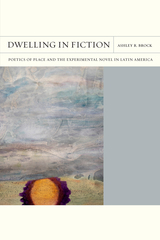
The radical formal experiments undertaken by writers across Latin America in the mid-twentieth century introduced friction, opacity, and self-reflexivity to the very act of reading. Dwelling in Fiction: Poetics of Place and the Experimental Novel in Latin America explores the limitations and the possibilities of literature for conveying place-specific forms of life. Focusing on authors such as José María Arguedas, João Guimarães Rosa, and Juan José Saer, who are often celebrated for universalizing regional themes, Ashley R. Brock brings a new critical lens to Latin American writers who were ambivalent toward their era’s “boom.”
Beyond mere resistance to or critique of the commodification and political instrumentalization of rural topics and types, this countertrend of critical regionalism positions readers themselves as outsiders, pushing them to engage their senses, to train their attention, and to learn to dwell in unknown textual landscapes. Dwelling in Fiction draws on a transnational community of thinkers and writers to show how their midcentury aesthetic practices of sensorial pedagogy anticipate contemporary turns toward affect, embodiment, decoloniality, and ecological thought.
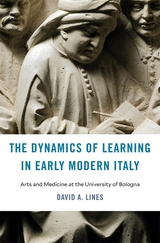
A pathbreaking history of early modern education argues that Europe’s oldest university, often seen as a bastion of traditionalism, was in fact a vibrant site of intellectual innovation and cultural exchange.
The University of Bologna was among the premier universities in medieval Europe and an international magnet for students of law. However, a long-standing historiographical tradition holds that Bologna—and Italian university education more broadly—foundered in the early modern period. On this view, Bologna’s curriculum ossified and its prestige crumbled, due at least in part to political and religious pressure from Rome. Meanwhile, new ways of thinking flourished instead in humanist academies, scientific societies, and northern European universities.
David Lines offers a powerful counternarrative. While Bologna did decline as a center for the study of law, he argues, the arts and medicine at the university rose to new heights from 1400 to 1750. Archival records show that the curriculum underwent constant revision to incorporate contemporary research and theories, developed by the likes of René Descartes and Isaac Newton. From the humanities to philosophy, astronomy, mathematics, and medicine, teaching became more systematic and less tied to canonical texts and authors. Theology, meanwhile, achieved increasing prominence across the university. Although this religious turn reflected the priorities and values of the Catholic Reformation, it did not halt the creation of new scientific chairs or the discussion of new theories and discoveries. To the contrary, science and theology formed a new alliance at Bologna.
The University of Bologna remained a lively hub of cultural exchange in the early modern period, animated by connections not only to local colleges, academies, and libraries, but also to scholars, institutions, and ideas throughout Europe.
Through a modified Kantian approach to epistemology and philosophy of science, this book opposes both Quinean naturalistic holism and the post-Kuhnian conceptual relativism that has dominated recent literature in science studies. Focussing on the development of "scientific philosophy" from Kant to Rudolf Carnap, along with the parallel developments taking place in the sciences during the same period, the author articulates a new dynamical conception of relativized a priori principles. This idea applied within the physical sciences aims to show that rational intersubjective consensus is intricately preserved across radical scientific revolutions or "paradigm-shifts and how this is achieved.

In Dysfluent in Fiction, Riley McGuire unspools a literary history of vocal disability in the nineteenth century, arguing that this underexamined literary trope helps us to understand vocal hierarchies that still structure our present. Adopting the term “dysfluency” to show departure from normative expectations of pace, pitch, and fluency, McGuire reveals how dysfluent speech populates an enormous number of nineteenth-century texts and played a formative role in the lives of some of the period’s most influential writers.
Dysfluent in Fiction examines anglophone literature during the long nineteenth century in both England and America by authors such as William Makepeace Thackeray, Charlotte Brontë, Lewis Carroll, Mary Elizabeth Braddon, and Frederick Douglass. Examples of dysfluencies across genres include lisping lovers, a baby-talking fairy, a mute detective, various disabilities in narratives of enslavement, and more. These representations show how disabled speech was both stigmatized and celebrated in ways that clarify our contemporary response to the spectrum of human articulation and that are a vocal corollary to current notions of neurodiversity. Dysfluency’s power, McGuire contends, lies in its denial that a single mode of articulation is possible, let alone desirable.
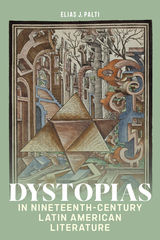
How did nineteenth-century Latin American novelists respond to moments when history itself seemed to come undone? Rather than treating dystopia as a futuristic genre, Palti traces its emergence from concrete political crises in Mexico, Argentina, and Brazil, as writers confronted national defeat, dictatorship, and revolutionary uncertainty. Reading Mexican fiction written after the U.S. occupation; Argentine texts produced under Juan Manuel de Rosas, including works by Esteban Echeverría, Domingo F. Sarmiento, and José Mármol; and Brazilian novels from the transition from Empire to Republic, with particular attention to Machado de Assis, the book shows how narrative form begins to falter. Plots stall, identities fragment, and stories resist closure. These breakdowns constitute early dystopian modes—atopia-atropia, heterotopia, and transtopia—through which literature registers the collapse of historical intelligibility. By locating dystopia in narrative form rather than theme, Palti offers a rich new account of literature under political catastrophe.
Published by Bucknell University Press. Distributed worldwide by Rutgers University Press.
READERS
Browse our collection.
PUBLISHERS
See BiblioVault's publisher services.
STUDENT SERVICES
Files for college accessibility offices.
RECENTLY PUBLISHED


UChicago Accessibility Resources
home | accessibility | search | about | contact us
BiblioVault ® 2001 - 2026
The University of Chicago Press