
 A SCHOLARLY BOOK REPOSITORY
21 start with D start with D
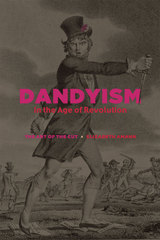
In Dandyism in the Age of Revolution, Elizabeth Amann shows that in France, England, and Spain, daring dress became a way of taking a stance toward the social and political upheaval of the period. France is the centerpiece of the story, not just because of the significance of the Revolution but also because of the speed with which its politics and fashions shifted. Dandyism in France represented an attempt to recover a political center after the extremism of the Terror, while in England and Spain it offered a way to reflect upon the turmoil across the Channel and Pyrenees. From the Hair Powder Act, which required users of the product to purchase a permit, to the political implications of the feather in Yankee Doodle’s hat, Amann aims to revise our understanding of the origins of modern dandyism and to recover the political context from which it emerged.
In 1960, University of Illinois professor Leo Koch wrote a public letter condoning premarital sex. He was fired. Four years later, a professor named Revilo Oliver made white supremacist remarks and claimed there was a massive communist conspiracy. He kept his job.
Matthew Ehrlich revisits the Koch and Oliver cases to look at free speech, the legacy of the 1960s, and debates over sex and politics on campus. The different treatment of the two men marked a fundamental shift in the understanding of academic freedom. Their cases also embodied the stark divide over beliefs and values--a divide that remains today. Ehrlich delves into the issues behind these academic controversies and places the events in the context of a time rarely associated with dissent, but in fact a harbinger of the social and political upheavals to come.
An enlightening and entertaining history, Dangerous Ideas on Campus illuminates how the university became a battleground for debating America's hot-button issues.
Winner of the 2024 BFE Book Prize (British Forum for Ethnomusicology)
Older people negotiating dance routines, intimacy, and racialized differences provide a focal point for an ethnography of danzón in Veracruz, the Mexican city closely associated with the music-dance genre. Hettie Malcomson draws upon on-site research with semi-professional musicians and amateur dancers to reveal how danzón connects, and does not connect, to blackness, joyousness, nostalgia, ageing, and romance. Challenging pervasive utopian views of danzón, Malcomson uses the idea of ambivalence to explore the frictions and opportunities created by seemingly contrary sentiments, ideas, sensations, and impulses. Interspersed with experimental ethnographic vignettes, her account takes readers into black and mestizo elements of local identity in Veracruz, nostalgic and newer styles of music and dance, and the friendships, romances, and rivalries at the heart of regular danzón performance and its complex social world.
Fine-grained and evocative, Danzón Days journeys to one of the genre’s essential cities to provide new perspectives on aging and romance and new explorations of nostalgia and ambivalence.
"Dark Journey is a superb piece of scholarship, a book that all students of southern and African-American history will find valuable and informative."--David J. Garrow, Georgia Historical Quarterly

Gregory Sholette, a politically engaged artist, argues that imagination and creativity in the art world originate thrive in the non-commercial sector shut off from prestigious galleries and champagne receptions. This broader creative culture feeds the mainstream with new forms and styles that can be commodified and used to sustain the few artists admitted into the elite.
This dependency, and the advent of inexpensive communication, audio and video technology, has allowed this 'dark matter' of the alternative art world to increasingly subvert the mainstream and intervene politically as both new and old forms of non-capitalist, public art. This book is essential for anyone interested in interventionist art, collectivism, and the political economy of the art world.
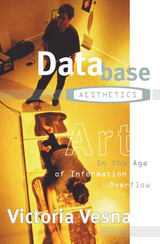
Database Aesthetics examines the database as cultural and aesthetic form, explaining how artists have participated in network culture by creating data art. The essays in this collection look at how an aesthetic emerges when artists use the vast amounts of available information as their medium. Here, the ways information is ordered and organized become artistic choices, and artists have an essential role in influencing and critiquing the digitization of daily life.
Contributors: Sharon Daniel, U of California, Santa Cruz; Steve Deitz, Carleton College; Lynn Hershman Leeson, U of California, Davis; George Legrady, U of California, Santa Barbara; Eduardo Kac, School of the Art Institute of Chicago; Norman Klein, California Institute of the Arts; John Klima; Lev Manovich, U of California, San Diego; Robert F. Nideffer, U of California, Irvine; Nancy Paterson, Ontario College of Art and Design; Christiane Paul, School of Visual Arts in New York; Marko Peljhan, U of California, Santa Barbara; Warren Sack, U of California, Santa Cruz; Bill Seaman, Rhode Island School of Design; Grahame Weinbren, School of Visual Arts, New York.
Victoria Vesna is a media artist, and professor and chair of the Department of Design and Media Arts at the University of California, Los Angeles.
A bold new theory of cyberwar argues that militarized hacking is best understood as a form of deconstruction
From shadowy attempts to steal state secrets to the explosive destruction of Iranian centrifuges, cyberwar has been a vital part of statecraft for nearly thirty years. But although computer-based warfare has been with us for decades, it has changed dramatically since its emergence in the 1990s, and the pace of change is accelerating.
In Deconstruction Machines, Justin Joque inquires into the fundamental nature of cyberwar through a detailed investigation of what happens at the crisis points when cybersecurity systems break down and reveal their internal contradictions. He concludes that cyberwar is best envisioned as a series of networks whose constantly shifting connections shape its very possibilities. He ultimately envisions cyberwar as a form of writing, advancing the innovative thesis that cyber attacks should be seen as a militarized form of deconstruction in which computer programs are systems that operate within the broader world of texts.
Throughout, Joque addresses hot-button subjects such as technological social control and cyber-resistance entities like Anonymous and Wikileaks while also providing a rich, detailed history of cyberwar. Deconstruction Machines provides a necessary new interpretation of deconstruction and timely analysis of media, war, and technology.

Press introduces the primary debate in this confrontation as a choice between political centralization and decentralization. Do citizens faced with environmental crises tend to look first to a centralized leadership for solutions or do they tend to respond at a more local and grassroots level? What is the role of technical expertise in this process and how does it effect public participation in these matters? Do confrontations over environmental issues increase support for a more fully democratic decisionmaking process? Representing social, political, and economic challenges to democracy, these and other questions are then investigated empirically through analyses of case studies. Focusing on two recent controversies in the western United States, ancient-forest logging in Oregon and California and hazardous waste management in California, and drawing on in-depth interviews with individuals involved, Press clarifies the relationship between environmentalism and democracy and explores the characteristics of "new" democratic forms of environmental policymaking.
Revealing a need for a more decentralized process and increased individual and collective action in response to environmental crises, Democratic Dilemmas in the Age of Ecology will be of interest to a wide range of audiences, from scholars concerned with applications of democratic theory, to activists and policymakers seeking to change or implement environmental policy.
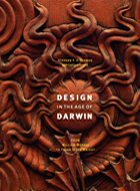
Charles Darwin’s monumental The Origin of Species, published in 1859, forever changed the landscape of natural science. The scientific world of the time had already established the principle of the “intelligent design” of a Creator; the art world had spent centuries devoting itself to the celebration of such a Designer’s creation. But the language of the book, and its implications, were stunning, and the ripples Darwin made when he rocked the boat spread outward: if he could question the Designer, what effect might there be on the art world, and on mortal designers’ renderings of Creation.
Published in partnership with the Mary and Leigh Block Museum of Art to accompany its exhibit, this catalog of essays and more than fifty color exhibition plates invokes these two senses of “intelligent design”—one from the debates between science and theology and the other from the world of art, particularly architecture and the decorative arts. The extensive exhibition includes furniture, metalware, glassware, textiles, and designs on loan from public and private collections in the United States and England. Among the artwork included are items from William Morris, C. R. Ashbee, Christopher Dresser, C. F. A. Voysey, Frank Lloyd Wright, and Louis Sullivan. Through these pieces and the accompanying examinations, the book explores how popular conceptions of the theory of evolution were used or rejected by British and American artists in the years that followed Darwin’s publication.
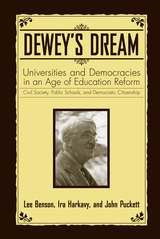
This timely, persuasive, and hopeful book reexamines John Dewey's idea of schools, specifically community schools, as the best places to grow a democratic society that is based on racial, social, and economic justice. The authors assert that American colleges and universities bear a responsibility for-and would benefit substantially from-working with schools to develop democratic schools and communities.
Dewey's Dream opens with a reappraisal of Dewey's philosophy and an argument for its continued relevance today. The authors-all well-known in education circles-use illustrations from over 20 years of experience working with public schools in the University of Pennsylvania's local ecological community of West Philadelphia, to demonstrate how their ideas can be put into action. By emphasizing problem-solving as the foundation of education, their work has awakened university students to their social responsibilities. And while the project is still young, it demonstrates that Dewey's "Utopian ends" of creating optimally participatory democratic societies can lead to practical, constructive school, higher education and community change, development, and improvement.

This book delves into new political-economic structures as expressed through political communication to explain the rise of authoritarian capitalism, nationalism and right-wing ideology throughout the world. Christian Fuchs does this through updating Marxist theory and the Frankfurt School's critical theory. He re-invigorates the works on authoritarianism of Franz L. Neumann, Theodor W. Adorno, Erich Fromm, Herbert Marcuse, Max Horkheimer, Wilhelm Reich, Leo Lowenthal and Klaus Theweleit in the age of Trump and Twitter.
In the age of big data and social media, Digital Demagogue studies the expressions of ideology, nationalism and authoritarianism today and discusses prospects for overcoming capitalism and renewing the Left.
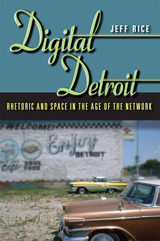
Since the 1967 riots that ripped apart the city, Detroit has traditionally been viewed either as a place in ruins or a metropolis on the verge of rejuvenation. In Digital Detroit: Rhetoric and Space in the Age of the Network, author Jeff Rice goes beyond the notion of Detroit as simply a city of two ideas. Instead he explores the city as a web of multiple meanings which, in the digital age, come together in the city’s spaces to form a network that shapes the writing, the activity, and the very thinking of those around it.
Rice focuses his study on four of Detroit’s most iconic places—Woodward Avenue, the Maccabees Building, Michigan Central Station, and 8 Mile—covering each in a separate chapter. Each of these chapters explains one of the four features of network rhetoric: folksono(me), the affective interface, response, and decision making. As these rhetorical features connect, they form the overall network called Digital Detroit. Rice demonstrates how new media, such as podcasts, wikis, blogs, interactive maps, and the Internet in general, knit together Detroit into a digital network whose identity is fluid and ever-changing. In telling Detroit’s spatial story, Rice deftly illustrates how this new media, as a rhetorical practice, ultimately shapes understandings of space in ways that computer applications and city planning often cannot. The result is a model for a new way of thinking and interacting with space and the imagination, and for a better understanding of the challenges network rhetorics pose for writing.
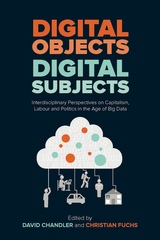
This volume explores activism, research and critique in the age of digital subjects and objects and Big Data capitalism after a digital turn said to have radically transformed our political futures. Optimists assert that the ‘digital’ promises: new forms of community and ways of knowing and sensing, innovation, participatory culture, networked activism, and distributed democracy. Pessimists argue that digital technologies have extended domination via new forms of control, networked authoritarianism and exploitation, dehumanization and the surveillance society. Leading international scholars present varied interdisciplinary assessments of such claims – in theory and via dialogue – and of the digital’s impact on society and the potentials, pitfalls, limits and ideologies, of digital activism. They reflect on whether computational social science, digital humanities and ubiquitous datafication lead to digital positivism that threatens critical research or lead to new horizons in theory and society.
An electronic version of this book is freely available, thanks to the support of libraries working with Knowledge Unlatched. KU is a collaborative initiative designed to make high quality books Open Access for the public good. More information about the initiative and details about KU’s Open Access programme can be found at www.knowledgeunlatched.org.
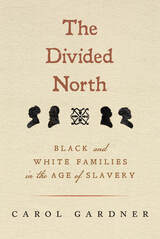
Reuben Ruby and Nathaniel Gordon II were born eleven months apart in 1798 and 1799 and spent much of their boyhoods roaming the noisy, bustling waterfront of Portland, Maine. They lived just blocks from one another, attended school together, and went to the same church with their families. But they were worlds apart, separated by family, culture, and race. Reuben Ruby was Black and Nathaniel Gordon was White.
The Rubys became prominent antislavery activists, equal rights advocates, and operatives on the Underground Railroad. Their neighbors, the Gordons, became well-to-do ship masters, owners, and merchants: among them, the most notorious American slave ship captain of the century, Nathaniel Gordon III. As activists, sea captains, businessmen, prospectors, and politicians, members of these two families traveled to New York, California, Texas, Louisiana, Africa, Haiti, and Brazil, where their experiences were shaped by their racial identities. At home in the “Free North,” they faced social and political divisions nearly as sharp as those they encountered elsewhere.
To understand the issues that divided nineteenth-century America—and, in many ways, still divide the nation—few have looked to the far North. In this compelling narrative history and intimate dual-family biography, Carol Gardner traces the Rubys and Gordons as they navigate the turbulent 1800s. As families and individuals, they demonstrate that the North was a critical proving ground for American notions of freedom and equality, as telling as any town, plantation, or battlefield in the South. Their experiences help reveal what it meant to live in a free state during the age of slavery, with all the promise, disappointment, irony, and hope that the notion entailed.
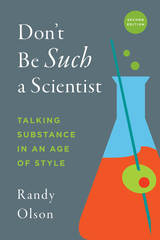
The time is right for a new edition of Olson’s revolutionary work. In Don’t Be Such a Scientist, Second Edition, Olson renews his call for communication that stays true to the facts while tapping into something more primordial, more irrational, and ultimately more human. In more than 50 pages of new material, Olson brings his pioneering message to this new age, providing tools for speaking out in anti-science era and squaring off against members of the scientific establishment who resist needed change.
Don’t Be Such a Scientist, Second Edition is a cutting and irreverent manual to making your voice heard in an age of attacks on science. Invaluable for anyone looking to break out of the boxes of academia or research, Olson’s writing will inspire readers to “make science human”—and to enjoy the ride along the way.
After nearly a decade on the defensive, the world of science is about to be restored to its rightful place. But is the American public really ready for science? And is the world of science ready for the American public?
Scientists wear ragged clothes, forget to comb their hair, and speak in a language that even they don't understand. Or so people think. Most scientists don't care how they are perceived, but in our media-dominated age, style points count.
Enter Randy Olson. Fifteen years ago, Olson bid farewell to the science world and shipped off to Hollywood ready to change the world. With films like Flock of Dodos: The Evolution-Intelligent Design Circus (Tribeca '06, Showtime) and Sizzle: A Global Warming Comedy (Outfest '08), he has tried to bridge the cultural divide that has too often left science on the outside looking in.
Now, in his first book, Olson, with a Harvard Ph.D. and formerly a tenured professor of marine biology at the University of New Hampshire, recounts the lessons from his own hilarious-and at times humiliating-evolution from science professor to Hollywood filmmaker. In Don't Be Such a Scientist, he shares the secrets of talking substance in an age of style. The key, he argues, is to stay true to the facts while tapping into something more primordial, more irrational, and ultimately more human.
In a book enlivened by a profane acting teacher who made Olson realize that "nobody wants to watch you think," he offers up serious insights and poignant stories. You'll laugh, you may cry, and as a communicator you'll certainly learn the importance of not only knowing how to fulfill, but also how to arouse.
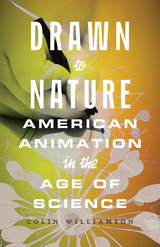
How twentieth-century developments in science influenced the aesthetics of the burgeoning American cartoon
What do technical renderings of plant cells in trees have to do with Disney’s animated opus Fantasia? Quite a bit, as it turns out: such emergent scientific models and ideas about nature were an important inspiration for Disney’s groundbreaking animated realism. In Drawn to Nature, Colin Williamson presents a vivid portrait of how developments in biology, physics, and geology between 1900 and the long 1960s influenced not just Disney but the American cartoon industry as a whole.
Drawing on original research on the scientific appetites of animators and studios such as Winsor McCay, the Fleischer Brothers, Walt Disney, and United Productions of America, Williamson opens new avenues for understanding the history and aesthetics of cartoons. Interrogating the differences between art and science and reconsidering the realms of dream, magic, and fantasy as they pertain to pop culture, he yields novel proposals for bridging longstanding divides between animation, live-action cinema, and the history of science.
Drawn to Nature not only illuminates the extent to which animators have drawn on scientific insights, it also considers seriously how commercial animations themselves participate in scientific discourse. It revises and revitalizes our existing narratives about the history of American animation to uncover the many ways science informs our collective cultural imagination.
READERS
Browse our collection.
PUBLISHERS
See BiblioVault's publisher services.
STUDENT SERVICES
Files for college accessibility offices.
RECENTLY PUBLISHED



UChicago Accessibility Resources
home | accessibility | search | about | contact us
BiblioVault ® 2001 - 2026
The University of Chicago Press