
 A SCHOLARLY BOOK REPOSITORY
9 start with D start with D
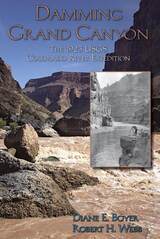
In 1923, America paid close attention, via special radio broadcasts, newspaper headlines, and cover stories in popular magazines, as a government party descended the Colorado to survey Grand Canyon. Fifty years after John Wesley Powell's journey, the canyon still had an aura of mystery and extreme danger. At one point, the party was thought lost in a flood.
Something important besides adventure was going on. Led by Claude Birdseye and including colorful characters such as early river-runner Emery Kolb, popular writer Lewis Freeman, and hydraulic engineer Eugene La Rue, the expedition not only made the first accurate survey of the river gorge but sought to decide the canyon's fate. The primary goal was to determine the best places to dam the Grand. With Boulder Dam not yet built, the USGS, especially La Rue, contested with the Bureau of Reclamation over how best to develop the Colorado River. The survey party played a major role in what was known and thought about Grand Canyon.
The authors weave a narrative from the party's firsthand accounts and frame it with a thorough history of water politics and development and the Colorado River. The recommended dams were not built, but the survey both provided base data that stood the test of time and helped define Grand Canyon in the popular imagination.
Also by Robert Webb: Lee's Ferry
Winner, Book Prize in Latin American Studies, Colonial Section of Latin American Studies Association (LASA), 2016
ALAA Book Award, Association for Latin American Art/Arvey Foundation, 2016
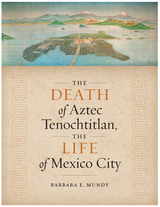
The capital of the Aztec empire, Tenochtitlan, was, in its era, one of the largest cities in the world. Built on an island in the middle of a shallow lake, its population numbered perhaps 150,000, with another 350,000 people in the urban network clustered around the lake shores. In 1521, at the height of Tenochtitlan’s power, which extended over much of Central Mexico, Hernando Cortés and his followers conquered the city. Cortés boasted to King Charles V of Spain that Tenochtitlan was “destroyed and razed to the ground.” But was it?
Drawing on period representations of the city in sculptures, texts, and maps, The Death of Aztec Tenochtitlan, the Life of Mexico City builds a convincing case that this global capital remained, through the sixteenth century, very much an Amerindian city. Barbara E. Mundy foregrounds the role the city’s indigenous peoples, the Nahua, played in shaping Mexico City through the construction of permanent architecture and engagement in ceremonial actions. She demonstrates that the Aztec ruling elites, who retained power even after the conquest, were instrumental in building and then rebuilding the city. Mundy shows how the Nahua entered into mutually advantageous alliances with the Franciscans to maintain the city's sacred nodes. She also focuses on the practical and symbolic role of the city’s extraordinary waterworks—the product of a massive ecological manipulation begun in the fifteenth century—to reveal how the Nahua struggled to maintain control of water resources in early Mexico City.
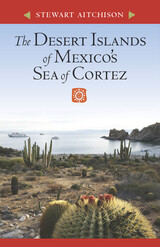
The Desert Islands of Mexico’s Sea of Cortez is one of the few books devoted to the biogeography of this remarkable part of the world. The book explores the geologic origin of the gulf and its islands, presents some of the basics of island biogeography, details insular life—including residents of the intertidal zone —and provides a brief outlook for preserving this area. More than a simple guidebook, Aitchison’s writing will take both actual and armchair travelers through a gripping tale of natural history.
Like the rest of our fragile planet, the Sea of Cortez and its islands are threatened by humans. Overfishing has eliminated or greatly diminished many fish stocks, and dams on rivers that once flowed into the gulf prevent certain nutrients from reaching the sea. The tenuousness of this area makes the book’s extraordinary photographs and the firsthand descriptions by a well-known teacher, writer, and photographer all the more compelling.
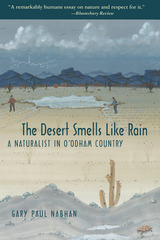
In this work, Gary Paul Nabhan brings O’odham voices to the page at every turn. He writes elegantly of how they husband scant water supplies, grow crops, and utilize edible wild foods. Woven through his account are coyote tales, O’odham children’s impressions of the desert, and observations of the political problems that come with living on both sides of an international border. Nabhan conveys the everyday life and extraordinary perseverance of these desert people.
This edition includes a new preface written by the author, in which he reflects on his gratitude for the O’odham people who shared their knowledge with him. He writes about his own heritage and connections to the desert, climate change, and the border. He shares his awe and gratitude for O’odham writers and storytellers who have been generous enough to share stories with those of us from other cultural traditions so that we may also respect and appreciate the smell of the desert after a rain.
Longtime residents of the Sonoran Desert, the Tohono O'odham people have spent centuries living off the land—a land that most modern citizens of southern Arizona consider totally inhospitable. Ethnobotanist Gary Nabhan has lived with the Tohono O'odham, long known as the Papagos, observing the delicate balance between these people and their environment. Bringing O'odham voices to the page at every turn, he writes elegantly of how they husband scant water supplies, grow crops, and utilize wild edible foods. Woven through his account are coyote tales, O'odham children's impressions of the desert, and observations on the political problems that come with living on both sides of an international border. Whether visiting a sacred cave in the Baboquivari Mountains or attending a saguaro wine-drinking ceremony, Nabhan conveys the everyday life and extraordinary perseverance of these desert people in a book that has become a contemporary classic of environmental literature.
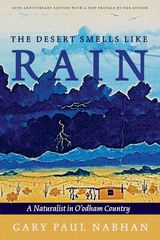
In this work, Gary Paul Nabhan brings O’odham voices to the page at every turn. He writes elegantly of how they husband scant water supplies, grow crops, and utilize edible wild foods. Woven through his account are coyote tales, O’odham children’s impressions of the desert, and observations of the political problems that come with living on both sides of an international border. Nabhan conveys the everyday life and extraordinary perseverance of these desert people.
This edition includes a new preface written by the author, in which he reflects on his gratitude for the O’odham people who shared their knowledge with him. He writes about his own heritage and connections to the desert, climate change, and the border. He shares his awe and gratitude for O’odham writers and storytellers who have been generous enough to share stories with those of us from other cultural traditions so that we may also respect and appreciate the smell of the desert after a rain.
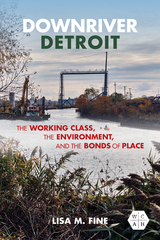
Lisa M. Fine examines important moments in the ongoing efforts of the area’s citizens to create a humane and habitable environment. Her analysis shows how people preserved wetlands and the river by working through sportsmen’s organizations, appealing to state agencies, and forming grassroots movements. Fueled by enduring connections to place, local unions fought a proposed nuclear power plant in the 1950s. Years later, steel workers facing the steamroller of deindustrialization tried to preserve their communities by purchasing their own company. The ties that bind gave a unique character to activism in the Downriver region, challenging stereotypes of working-class attitudes toward the environment.
A creative merger of labor and environmental history, Downriver Detroit shows that working people have a right to live in and protect the places they love.
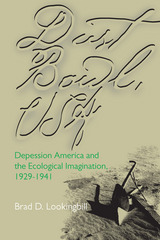
Whether romantic or tragic, accounts of the dramatic events surrounding the North American Dust Bowl of the “dirty thirties” unearthed anxieties buried deep in America’s ecological imagination. Moreover, the images of a landscape of fear remain embedded in the national consciousness today. In vivid form, the aesthetic of suffering captured in Dorothea Lange’s photographs and Woody Guthrie’s folk songs created the myths and memories of the Depression generation.
Dust Bowl, USA is a critical examination of the stories that grew out of the Dust Bowl experience. Across the nation, newspapers, magazines, books, films, and songs produced imagery of blight for local and mass audiences. As new technology, irrigation innovations, and conservation programs were introduced on a wide scale during the 1930s, the saga of the frontier continued to unfold through accounts of dust, drought, and desertification.
In piercing the myths brought forth in legends, lore, allegories, and anecdotes, Brad Lookingbill provides a revelatory insight into the history of the cultural narratives that have come to define an era.
READERS
Browse our collection.
PUBLISHERS
See BiblioVault's publisher services.
STUDENT SERVICES
Files for college accessibility offices.
RECENTLY PUBLISHED



UChicago Accessibility Resources
home | accessibility | search | about | contact us
BiblioVault ® 2001 - 2026
The University of Chicago Press