
 A SCHOLARLY BOOK REPOSITORY
20 start with D start with D
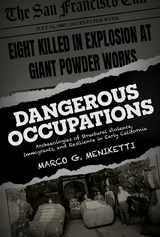
Addresses structural violence through history and archaeology of immigrant workers
Dangerous Occupations: Archaeologies of Structural Violence, Immigrants, and Resilience in Early California is an impactful work of historical archaeology combined with social history that addresses structural violence in key California industries from the Gold Rush in 1849 until 1920. Monopolistic industries, such as railroading, mining, timbering, explosive manufacturing, lime production, meatpacking, textile milling, and fishing/whaling, relied on immigrant laborers who were recruited and perceived as expendable. Restrictive laws and lack of employment opportunities based on bigotry often forced immigrants into the most dangerous occupations. In the days before workmen’s compensation insurance and strict labor safety laws, laborers often risked their health and even their lives for employment.
Marco G. Meniketti’s analysis comes from examining excavation of labor camps and housing, landscape studies, bioarchaeological data, architectural footprints, and archival sources. Each chapter offers a case study of industries to exemplify structural violence and its broader consequences among various immigrant labor groups, such as Chinese, Scandinavian, Irish, Italian, Chilean, Cornish, and Portuguese. The narrative includes a historical overview of the industries, identifies who the immigrant laborers were and how they came to be there, examines the dangers and health risks of their jobs, and details their living conditions and daily life, including foodways, leisure, and efforts to treat their job-inflicted maladies. Dangerous Occupations introduces a new generation of readers to how immigrants built the West Coast and at what great cost.

A foundational figure in modern labor history, David Montgomery both redefined and reoriented the field. This collection of Montgomery’s most important published and unpublished articles and essays draws from the historian’s entire five-decade career.
Taken together, the writings trace the development of Montgomery’s distinct voice and approach while providing a crucial window into an era that changed the ways scholars and the public understood working people’s place in American history. Three overarching themes and methods emerge from these essays: that class provided a rich reservoir of ideas and strategies for workers to build movements aimed at claiming their democratic rights; that capital endured with the power to manage the contours of economic life and the capacities of the state but that workers repeatedly and creatively mounted challenges to the terms of life and work dictated by capital; and that Montgomery’s method grounded his gritty empiricism and the conceptual richness of his analysis in the intimate social relations of production and of community, neighborhood, and family life.
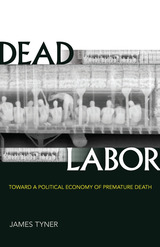
A groundbreaking consideration of death from capitalism, from the seventeenth to the twenty-first century
From a 2013 Texas fertilizer plant explosion that killed fifteen people and injured 252 to a 2017 chemical disaster in the wake of Hurricane Harvey, we are confronted all too often with industrial accidents that reflect the underlying attitude of corporations toward the lives of laborers and others who live and work in their companies’ shadows. Dead Labor takes seriously the myriad ways in which bodies are commodified and profits derived from premature death. In doing so it provides a unique perspective on our understanding how life and death drive the twenty-first-century global economy.
James Tyner tracks a history from the 1600s through which premature death and mortality became something calculable, predictable, manageable, and even profitable. Drawing on a range of examples, including the criminalization of migrant labor, medical tourism, life insurance, and health care, he explores how today we can no longer presume that all bodies undergo the same processes of life, death, fertility, and mortality. He goes on to develop the concept of shared mortality among vulnerable populations and examines forms of capital exploitation that have emerged around death and the reproduction of labor.
Positioned at the intersection of two fields—the political economy of labor and the philosophy of mortality—Dead Labor builds on Marx’s notion that death (and truncated life) is a constant factor in the processes of labor. Considering premature death also as a biopolitical and bioeconomic concept, Tyner shows how racialized and gendered bodies are exposed to it in unbalanced ways within capitalism, and how bodies are then commodified, made surplus and redundant, and even disassembled in order to accumulate capital.

Historians overwhelmingly have blamed the demise of Reconstruction on Southerners' persistent racism. Heather Cox Richardson argues instead that class, along with race, was critical to Reconstruction's end. Northern support for freed blacks and Reconstruction weakened in the wake of growing critiques of the economy and calls for a redistribution of wealth.
Using newspapers, public speeches, popular tracts, Congressional reports, and private correspondence, Richardson traces the changing Northern attitudes toward African-Americans from the Republicans' idealized image of black workers in 1861 through the 1901 publication of Booker T. Washington's Up from Slavery. She examines such issues as black suffrage, disenfranchisement, taxation, westward migration, lynching, and civil rights to detect the trajectory of Northern disenchantment with Reconstruction. She reveals a growing backlash from Northerners against those who believed that inequalities should be addressed through working-class action, and the emergence of an American middle class that championed individual productivity and saw African-Americans as a threat to their prosperity.
The Death of Reconstruction offers a new perspective on American race and labor and demonstrates the importance of class in the post-Civil War struggle to integrate African-Americans into a progressive and prospering nation.

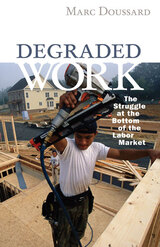
Critics on the left and the right typically agree that globalization, the loss of manufacturing jobs, and the expansion of the service sector have led to income inequality and rising numbers of low-paying jobs with poor working conditions.
In Degraded Work, Marc Doussard demonstrates that this decline in wages and working conditions is anything but the unavoidable result of competitive economic forces. Rather, he makes the case that service sector and other local-serving employers have boosted profit with innovative practices to exploit workers, demeaning their jobs in new ways—denying safety equipment, fining workers for taking scheduled breaks, requiring unpaid overtime—that go far beyond wage cuts. Doussard asserts that the degradation of service work is a choice rather than an inevitability, and he outlines concrete steps that can be taken to help establish a fairer postindustrial labor market.
Drawing on fieldwork in Chicago, Degraded Work examines changes in two industries in which inferior job quality is assumed to be intrinsic: residential construction and food retail. In both cases, Doussard shows how employers degraded working conditions as part of a successful and intricate strategy to increase profits. Arguing that a growing service sector does not have to mean growing inequality, Doussard proposes creative policy and organizing opportunities that workers and advocates can use to improve job quality despite the overwhelming barriers to national political action.

The workers of today’s digital factory include those in Amazon warehouses, delivery drivers, Chinese gaming workers, Filipino content moderators, and rural American search engine optimizers. Repetitive yet stressful, boring yet often emotionally demanding, these jobs require little formal qualification, but can demand a large degree of skills and knowledge. This work is often hidden behind the supposed magic of algorithms and thought to be automated, but it is in fact highly dependent on human labor.
The workers of today’s digital factory are not as far removed from a typical auto assembly line as we might think. Moritz Altenried takes us inside today’s digital factories, showing that they take very different forms, including gig economy platforms, video games, and Amazon warehouses. As Altenried shows, these digital factories often share surprising similarities with factories from the industrial age. As globalized capitalism and digital technology continue to transform labor around the world, Altenried offers a timely and poignant exploration of how these changes are restructuring the social division of labor and its geographies as well as the stratifications and lines of struggle.
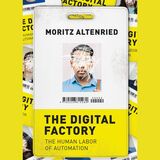
This is an auto-narrated audiobook edition of this book.
The Digital Factory reveals the hidden human labor that supports today’s digital capitalism.
The workers of today’s digital factory include those in Amazon warehouses, delivery drivers, Chinese gaming workers, Filipino content moderators, and rural American search engine optimizers. Repetitive yet stressful, boring yet often emotionally demanding, these jobs require little formal qualification, but can demand a large degree of skills and knowledge. This work is often hidden behind the supposed magic of algorithms and thought to be automated, but it is in fact highly dependent on human labor.
The workers of today’s digital factory are not as far removed from a typical auto assembly line as we might think. Moritz Altenried takes us inside today’s digital factories, showing that they take very different forms, including gig economy platforms, video games, and Amazon warehouses. As Altenried shows, these digital factories often share surprising similarities with factories from the industrial age. As globalized capitalism and digital technology continue to transform labor around the world, Altenried offers a timely and poignant exploration of how these changes are restructuring the social division of labor and its geographies as well as the stratifications and lines of struggle.

How popular debates about the so-called digital generation mediate anxieties about labor and life in twenty-first-century America
“The children are our future” goes the adage, a proclamation that simultaneously declares both anxiety as well as hope about youth as the next generation. In The Digital Is Kid Stuff, Josef Nguyen interrogates this ambivalence within discussions about today’s “digital generation” and the future of creativity, an ambivalence that toggles between the techno-pessimism that warns against the harm to children of too much screen time and a techno-utopianism that foresees these “digital natives” leading the way to innovation, economic growth, increased democratization, and national prosperity.
Nguyen engages cultural histories of childhood, youth, and creativity through chapters that are each anchored to a particular digital media object or practice. Nguyen narrates the developmental arc of a future creative laborer: from a young kid playing the island fictions of Minecraft, to an older child learning do-it-yourself skills while reading Make magazine, to a teenager posting selfies on Instagram, to a young adult creative laborer imagining technological innovations using design fiction.
Focusing on the constructions and valorizations of creativity, entrepreneurialism, and technological savvy, Nguyen argues that contemporary culture operates to assuage profound anxieties about—and to defuse valid critiques of—both emerging digital technologies and the precarity of employment for “creative laborers” in twenty-first-century neoliberal America.

Call center employees once blended skill and emotional intelligence to solve customer problems while the workplace itself encouraged camaraderie and job satisfaction. Ten years after telecom industry deregulation, management had isolated the largely female workforce in cubicles, imposed quotas to sell products, and installed surveillance systems that tracked every call and keystroke.
Debbie J. Goldman explores how call center employees and their union fought for good, humane jobs in the face of degraded working conditions and lowered wages. As the workforce coalesced to resist the changes, it demanded the Communications Workers of America (CWA) fight for safe and secure good-paying jobs. But trends in technology, capitalism, and corporate governance--combined with the decline of unions--narrowed the negotiating options for workers. Goldman describes how the actions of workers, management, and policymakers shaped the social impact of the new digital technologies and gave new form to the telecommunications industry in a time of momentous change.
Perceptive and nuanced, Disconnected tells an overlooked story of service workers in a time of change.
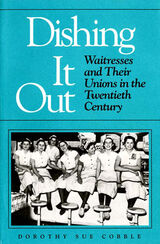
Back when SOS or Adam and Eve on a raft were things to order if you were hungry but a little short on time and money, nearly one-fourth of all waitresses belonged to unions. By the time their movement peaked in the 1940s and 1950s, the women had developed a distinctive form of working-class feminism, simultaneously pushing for equal rights and pay and affirming their need for special protections.
Dorothy Sue Cobble shows how sexual and racial segregation persisted in wait work, but she rejects the idea that this was caused by employers' actions or the exclusionary policies of male trade unionists. Dishing It Out contends that the success of waitress unionism was due to several factors: waitresses, for the most part, had nontraditional family backgrounds, and most were primary wage-earners. Their close-knit occupational community and sex-separate union encouraged female assertiveness and a decidedly unromantic view of men and marriage. Cobble skillfully combines oral interviews and extensive archival records to show how waitresses adopted the basic tenets of male-dominated craft unions but rejected other aspects of male union culture. The result is a book that will expand our understanding of feminism and unionism by including the gender conscious perspectives of working women.
A revealing look at the decline in formal employment in favor of hiring contractors, freelancers, temps, and marginal workers, who are excluded from traditional benefits and career ladders.
Companies cannot exist without workers, but they are increasingly reluctant to have employees. Instead of providing the benefits and protections that have traditionally come with employee status, businesses are turning to tactics that let them treat people as interchangeable parts, to be used and discarded as needed. Drawing on an original survey of over 6,000 workers, Disposable Workers reveals the striking extent of this transformation across the occupational hierarchy, affecting everyone from janitors to nurses.
Paul Osterman identifies three distinct categories of disposable workers: contractors, freelancers, and marginal employees. The marginal category, unique to Osterman’s analysis, describes workers who are employees from a narrow legal standpoint but are held at arm’s length by their firm—left without job security, skill training, or opportunities for promotion. Many low-wage service workers toil in marginal jobs, but so do white-collar professionals such as adjunct university faculty and staff attorneys at law firms. When the three categories are added up, they account for more than 35 percent of the American workforce.
Not all disposable workers object to their arrangements. But most contractors and marginal employees would prefer standard employment, and there is a significant cost to their current status. In response, Disposable Workers offers a range of policy recommendations, including mechanisms to prevent over-reliance on contracting and freelancing as well as reforms to improve job quality for part-timers and marginal employees. As the deconstruction of employment affects more and more workers, the importance of such measures will only grow.

The issue of immigration is one of the most hotly debated topics in the national arena, with everyone from right-wing pundits like Sarah Palin to alternative rockers like Zack de la Rocha offering their opinion. The traditional immigrant narrative that gained popularity in the nineteenth and twentieth centuries continues to be used today in describing the process of the “Americanization” of immigrants. Yet rather than acting as an accurate representation of immigrant experiences, this common narrative of the “American Dream” attempts to ideologically contain those experiences within a story line that promotes the idea of achieving success through hard work and perseverance.
In Domestic Disturbances, Irene Mata dispels the myth of the “shining city on the hill” and reveals the central truth of hidden exploitation that underlies the great majority of Chicana/Latina immigrant stories. Influenced by the works of Latina cultural producers and the growing interdisciplinary field of scholarship on gender, immigration, and labor, Domestic Disturbances suggests a new framework for looking at these immigrant and migrant stories, not as a continuation of a literary tradition, but instead as a specific Latina genealogy of immigrant narratives that more closely engage with the contemporary conditions of immigration. Through examination of multiple genres including film, theatre, and art, as well as current civil rights movements such as the mobilization around the DREAM Act, Mata illustrates the prevalence of the immigrant narrative in popular culture and the oppositional possibilities of alternative stories.
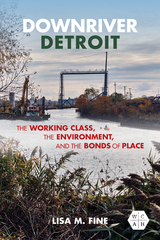
Lisa M. Fine examines important moments in the ongoing efforts of the area’s citizens to create a humane and habitable environment. Her analysis shows how people preserved wetlands and the river by working through sportsmen’s organizations, appealing to state agencies, and forming grassroots movements. Fueled by enduring connections to place, local unions fought a proposed nuclear power plant in the 1950s. Years later, steel workers facing the steamroller of deindustrialization tried to preserve their communities by purchasing their own company. The ties that bind gave a unique character to activism in the Downriver region, challenging stereotypes of working-class attitudes toward the environment.
A creative merger of labor and environmental history, Downriver Detroit shows that working people have a right to live in and protect the places they love.
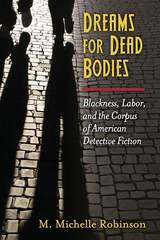
The author constructs an interracial genealogy of detective fiction to create a nuanced picture of the ways that black and white authors appropriated and cultivated literary conventions that coalesced in a recognizable genre at the turn of the twentieth century. These authors tinkered with detective fiction’s puzzle-elements to address a variety of historical contexts, including the exigencies of chattel slavery, the erosion of working-class solidarities by racial and ethnic competition, and accelerated mass production. Dreams for Dead Bodies demonstrates that nineteenth- and early twentieth-century American literature was broadly engaged with detective fiction, and that authors rehearsed and refined its formal elements in literary works typically relegated to the margins of the genre. By looking at these margins, the book argues, we can better understand the origins and cultural functions of American detective fiction.
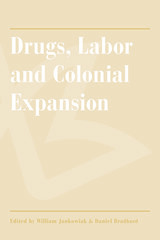
This book explores how Europeans introduced and used drugs in colonial contexts for the exploitation and placation of indigenous labor. Combining history and anthropology, it examines the role of drugs in trade and labor during the age of western colonial expansion. From considering the introduction of alcohol in the West African slave trade to the use of coca as a labor enhancer in the Andes, these original contributions examine both the encouragement of drug use by colonial powers and the extent to which local peoples' previous experience with psychoactive substances shaped their use of drugs introduced by Europeans.
The authors show that drugs possessed characteristics that made them a particularly effective means for propagating trade or increasing the extent and intensity of labor. In the early stages of European expansion, drugs were introduced to draw people, quite literally, into relations of dependency with European trade partners. Over time, the drugs used to intensify the amount and duration of labor shifted from alcohol, opium, and marijuana—which were used to overcome the drudgery and discomfort of physical labor—to caffeine-based stimulants, which provided a more alert workforce.
Valuable not only for its ethnographic detail but also for its broader insight into the nature of capitalist expansion, this collection reveals the surprising consistency of drug use in the colonial process. Drugs, Labor and Colonial Expansion is a book rich with cross-cultural insights that ranges widely across disciplines to provide a new and needed look at the colonial experience.
READERS
Browse our collection.
PUBLISHERS
See BiblioVault's publisher services.
STUDENT SERVICES
Files for college accessibility offices.
RECENTLY PUBLISHED






UChicago Accessibility Resources
home | accessibility | search | about | contact us
BiblioVault ® 2001 - 2026
The University of Chicago Press