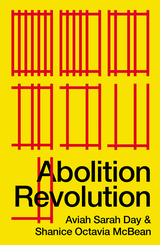
front cover of Abolition Revolution
Abolition Revolution
Aviah Day
Pluto Press, 2022
An introductory guide to the roots and contemporary context of, and resistance to carceral politics in Britain


George Floyd's murder in Minneapolis triggered abolitionist shockwaves. Calls to defund the police found receptive ears around the world. Shortly after, Sarah Everard's murder by a serving police officer sparked a national abolitionist movement in Britain. But to abolish the police, prisons and borders, we must confront the legacy of Empire.

Abolition Revolution is a guide to abolitionist politics in Britain, drawing out rich histories of resistance from rebellion in the colonies to grassroots responses to carceral systems today. The authors argue that abolition is key to reconceptualising revolution for our times - linking it with materialist feminisms, anti-capitalist class struggle, internationalist solidarity and anti-colonialism.

Perfect for reading groups and activist meetings, this is an invaluable book for those new to abolitionist politics - whilst simultaneously telling a passionate and authoritative story about the need for abolition and revolution in Britain and globally.
[more]

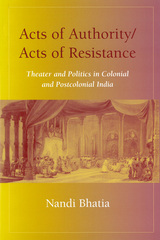
front cover of Acts of Authority/Acts of Resistance
Acts of Authority/Acts of Resistance
Theater and Politics in Colonial and Postcolonial India
Nandi Bhatia
University of Michigan Press, 2004
Despite its importance to literary and cultural texts of resistance, theater has been largely overlooked as a field of analysis in colonial and postcolonial studies. Acts of Authority/Acts of Resistance seeks to address that absence, as it uniquely views drama and performance as central to the practice of nationalism and anti-colonial resistance.

Nandi Bhatia argues that Indian theater was a significant force in the struggle against oppressive colonial and postcolonial structures, as it sought to undo various schemes of political and cultural power through its engagement with subjects derived from mythology, history, and available colonial models such as Shakespeare. Bhatia's attention to local histories within a postcolonial framework places performance in a global and transcultural context. Drawing connections between art and politics, between performance and everyday experience, Bhatia shows how performance often intervened in political debates and even changed the course of politics.

One of the first Western studies of Indian theater to link the aesthetics and the politics of that theater, Acts of Authority/Acts of Resistance combines in-depth archival research with close readings of dramatic texts performed at critical moments in history. Each chapter amplifies its themes against the backdrop of specific social conditions as it examines particular dramatic productions, from The Indigo Mirror to adaptations of Shakespeare plays by Indian theater companies, illustrating the role of theater in bringing nationalist, anticolonial, and gendered struggles into the public sphere.

Nandi Bhatia is Associate Professor of English at the University of Western Ontario. 
[more]

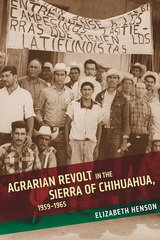
front cover of Agrarian Revolt in the Sierra of Chihuahua, 1959–1965
Agrarian Revolt in the Sierra of Chihuahua, 1959–1965
Elizabeth Henson
University of Arizona Press, 2019
The early 1960s are remembered for the emergence of new radical movements influenced by the Cuban Revolution. One such protest movement rose in the Mexican state of Chihuahua. With large timber companies moving in on the forested sierra highlands, campesinos and rancheros did not sit by as their lands and livelihoods were threatened. Continuing a long history of agrarian movements and local traditions of armed self-defense, they organized and demanded agrarian rights.

Thousands of students joined the campesino protests in long-distance marches, land invasions, and direct actions that transcended political parties and marked the participants’ emergence as political subjects. The Popular Guerrilla Group (GPG) took shape from sporadic armed conflicts in the sierra. Early victories in the field encouraged the GPG to pursue more ambitious targets, and on September 23, 1965, armed farmers, agricultural workers, students, and teachers attacked an army base in Madera, Chihuahua. This bold move had deadly consequences.

With a sympathetic yet critical eye, historian Elizabeth Henson argues that the assault undermined and divided the movement that had been in its cradle, sacrificing the most militant, audacious, and serious of a generation at a time when such sacrifices were more frequently observed. Henson shows how local history merged with national tensions over one-party rule, the unrealized promises of the Mexican Revolution, and international ideologies.

[more]

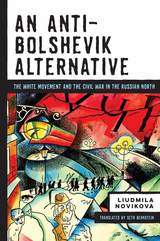
front cover of An Anti-Bolshevik Alternative
An Anti-Bolshevik Alternative
The White Movement and the Civil War in the Russian North
Liudmila Novikova, Translated by Seth Bernstein
University of Wisconsin Press, 2018
The traditional narrative of the Russian Civil War is one of revolution against counterrevolution, Bolshevik Reds against Tsarist Whites. Liudmila Novikova convincingly demonstrates, however, that the struggle was not between a Communist future and a Tsarist past; instead, it was a bloody fight among diverse factions of a modernizing postrevolutionary state. Focusing on the sparsely populated Arkhangelsk region in northern Russia, she shows that the anti-Bolshevik government there, which held out from 1918 to early 1920, was a revolutionary alternative bolstered by broad popular support.

Novikova draws on declassified archives and sources in both Russia and the West to reveal the White movement in the north as a complex social and political phenomenon with a distinct regional context. She documents the politics of the Northern Government and its relations with the British and American forces who had occupied the ports of Murmansk and Arkhangelsk at the end of World War I. As the civil war continued, the increasing involvement of the local population transformed the conflict into a ferocious "people's war" until remaining White forces under General Yevgeny Miller evacuated the region in February 1920.
[more]

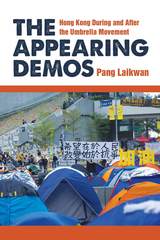
front cover of The Appearing Demos
The Appearing Demos
Hong Kong During and After the Umbrella Movement
Pang Laikwan
University of Michigan Press, 2020
As the waves of Occupy movements gradually recede, we soon forget the political hope and passions these events have offered. Instead, we are increasingly entrenched in the simplified dichotomies of Left and Right, us and them, hating others and victimizing oneself. Studying Hong Kong’s Umbrella Movement, which might be the largest Occupy movement in recent years, The Appearing Demos urges us to re-commit to democracy at a time when democracy is failing on many fronts and in different parts of the world.
 
The 79-day-long Hong Kong Umbrella Movement occupied major streets in the busiest parts of the city, creating tremendous inconvenience to this city famous for capitalist order and efficiency. It was also a peaceful collective effort of appearance, and it was as much a political event as a cultural one. The urge for expressing an independent cultural identity underlined both the Occupy movement and the remarkably rich cultural expressions it generated. While understanding the specificity of Hong Kong’s situations, The Appearing Demos also comments on some global predicaments we are facing in the midst of neoliberalism and populism. It directs our attention from state-based sovereignty to city-based democracy, and emphasizes the importance of participation and cohabitation. The book also examines how the ideas of Hannah Arendt are useful to those happenings much beyond the political circumstances that gave rise to her theorization. The book pays particular attention to the actual intersubjective experiences during the protest. These experiences are local, fragile, and sometimes inarticulable, therefore resisting rationality and debates, but they define the fullness of any individual, and they also make politics possible. Using the Umbrella Movement as an example, this book examines the “freed” political agents who constantly take others into consideration in order to guarantee the political realm as a place without coercion and discrimination. In doing so, Pang Laikwan demonstrates how politics means neither to rule nor to be ruled, and these movements should be defined by hope, not by goals.
[more]

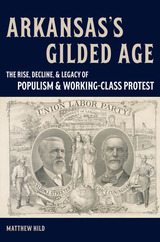
front cover of Arkansas’s Gilded Age
Arkansas’s Gilded Age
The Rise, Decline, and Legacy of Populism and Working-Class Protest
Matthew Hild
University of Missouri Press, 2018
This book is the first devoted entirely to an examination of working-class activism, broadly defined as that of farmers’ organizations, labor unions, and (often biracial) political movements, in Arkansas during the Gilded Age. On one level, Hild argues for the significance of this activism in its own time: had the Arkansas Democratic Party not resorted to undemocratic, unscrupulous, and violent means of repression, the Arkansas Union Labor Party would have taken control of the state government in the election of 1888. He also argues that the significance of these movements lasted beyond their own time, their influence extending into the biracial Southern Tenant Farmers’ Union of the 1930s, the civil rights movement of the 1950s and 1960s, and even today’s Farmers’ Union and the United Mine Workers of America.

The story of farmer and labor protest in Arkansas during the late nineteenth century offers lessons relevant to contemporary
working-class Americans in what some observers have called the “new Gilded Age.”
[more]

logo for Pluto Press
Arms and the People
Popular Movements and the Military from the Paris Commune to the Arab Spring
Edited by Mike Gonzalez and Houman Barekat
Pluto Press, 2012
Looking at a range of global historical experiences, Arms and the People examines the relationship between mass movements and military institutions. Some argue that it is impossible to achieve and protect a revolution without the support of the army, but how can the support of the army be won?

Arms and the People explores the impact of profound social polarisation on the internal cohesion of the state’s ‘armed bodies of men’ and on the contested loyalties of soldiers. The different contributors examine a series of historical moments in which a crisis in the military institution has reflected a deeper social crisis which has penetrated that institution and threatened to disable it.

With a range of international contributors who have either studied or been directly involved in such social upheavals, Arms and the People is a pioneering contribution to the study of revolutionary change and will appeal to students and academics in history, politics and sociology.
[more]

front cover of The Art of Moral Protest
The Art of Moral Protest
Culture, Biography, and Creativity in Social Movements
James M. Jasper
University of Chicago Press, 1997
In The Art of Moral Protest, James Jasper integrates diverse examples of protest—from nineteenth-century boycotts to recent movements—into a distinctive new understanding of how social movements work. Jasper highlights their creativity, not only in forging new morals but in adopting courses of action and inventing organizational forms.

"A provocative perspective on the cultural implications of political and social protest."—Library Journal
[more]

front cover of The Art of Protest
The Art of Protest
Culture and Activism from the Civil Rights Movement to the Present
T.V. Reed
University of Minnesota Press, 2019

A second edition of the classic introduction to arts in social movements, fully updated and now including Black Lives Matter, Occupy Wall Street, and new digital and social media forms of cultural resistance


The Art of Protest, first published in 2006, was hailed as an “essential” introduction to progressive social movements in the United States and praised for its “fluid writing style” and “well-informed and insightful” contribution (Choice Magazine). Now thoroughly revised and updated, this new edition of T. V. Reed’s acclaimed work offers engaging accounts of ten key progressive movements in postwar America, from the African American struggle for civil rights beginning in the 1950s to Occupy Wall Street and Black Lives Matter in the twenty-first century. 

Reed focuses on the artistic activities of these movements as a lively way to frame progressive social change and its cultural legacies: civil rights freedom songs, the street drama of the Black Panthers, revolutionary murals of the Chicano movement, poetry in women’s movements, the American Indian Movement’s use of film and video, anti-apartheid rock music, ACT UP’s visual art, digital arts in #Occupy, Black Lives Matter rap videos, and more. 

Through the kaleidoscopic lens of artistic expression, Reed reveals how activism profoundly shapes popular cultural forms. For students and scholars of social change and those seeking to counter reactionary efforts to turn back the clock on social equality and justice, the new edition of The Art of Protest will be both informative and inspiring.

[more]

front cover of The Art of Protest
The Art of Protest
Culture and Activism from the Civil Rights Movement to the Streets of Seattle
T.V. Reed
University of Minnesota Press, 2005
Imagine the civil rights movement without freedom songs and the politics of women's movements without poetry. Or, more difficult yet, imagine an America unaffected by the cultural expressions and forms of the twentieth-century social movements that have shaped our nation. The first broad overview of social movements and the distinctive cultural forms that express and helped shape them, The Art of Protest shows the vital importance of these movements to American culture. In comparative accounts of movements beginning with the African American civil rights movement of the 1950s and 1960s and running through the Internet-driven movement for global justice ("Will the revolution be cybercast?") of the twenty-first century, T. V. Reed enriches our understanding of protest and its cultural expression. Reed explores the street drama of the Black Panthers, the revolutionary murals of the Chicano movement, the American Indian Movement's use of film and video, rock music and the struggles against famine and apartheid, ACT UP's use of visual art in the campaign against AIDS, and the literature of environmental justice. Throughout, Reed employs the concept of culture in three interrelated ways: by examining social movements as sub- or countercultures; by looking at poetry, painting, music, murals, film, and fiction in and around social movements; and by considering the ways in which the cultural texts generated by resistance movements have reshaped the contours of the wider American culture. The United States is a nation that began with a protest. Through the kaleidoscopic lens of artistic and cultural expression, Reed reveals how activism continues to remake our world.
[more]

logo for Pluto Press
Articulating Dissent
Protest and the Public Sphere
Pollyanna Ruiz
Pluto Press, 2014

Articulating Dissent analyses the new communicative strategies of coalition protest movements and how these impact on a mainstream media unaccustomed to fractured articulations of dissent.

Pollyanna Ruiz shows how coalition protest movements against austerity, war and globalisation build upon the communicative strategies of older single issue campaigns such as the anti-criminal justice bill protests and the women’s peace movement. She argues that such protest groups are dismissed in the mainstream for not articulating a ‘unified position’ and explores the way in which contemporary protesters stemming from different traditions maintain solidarity.

Articulating Dissent investigates the ways in which this diversity, so inherent in coalition protest, affects the movement of ideas from the political margins to the mainstream. In doing so this book offers an insightful and original analysis of the protest coalition as a developing political form.

[more]


Send via email Share on Facebook Share on Twitter