
 A SCHOLARLY BOOK REPOSITORY
6 start with D start with D


Long before the Supreme Court ruled that impoverished defendants in criminal cases have a right to free counsel, Philadelphia’s public defenders were working to ensure fair trials for all. In 1934, when penniless defendants were routinely railroaded through the courts without ever seeing a lawyer, Philadelphia attorney Francis Fisher Kane helped create the Voluntary Defender Association, supported by charity and free from political interference, to represent poor people accused of crime.
When the Supreme Court’s 1963 decision Gideonv. Wainwright mandated free counsel for indigent defendants, the Defender (as it is now known) became more essential than ever, representing at least 70 percent of those caught in the machinery of justice in the city. Its groundbreaking work in juvenile advocacy, homicide representation, death-row habeas corpus petitions, parole issues, and alternative sentencing has earned a national reputation.
In The Defender, Edward Madeira, past president of the Defender’s Board of Directors, and former Philadelphia Inquirer journalist Michael Schaffer chart the 80-plus-year history of the organization as it grew from two lawyers in 1934 to a staff of nearly 500 in 2015.
This is a compelling story about securing justice for those who need it most.
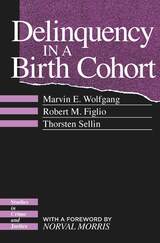
This study of a birth cohort was not originally meant to be etiological or predictive. Yet the data bearing on this cohort of nearly ten thousand boys born in 1945 and living in Philadelphia gave rise to a model for prediction of delinquency, and thus to the possibility for more efficient planning of programs for intervention. It is expert research yielding significant applications and, though largely statistical, the analysis is accessible to readers without mathematical training.
"No serious scholar of the methods of preventing and treating juvenile delinquency can properly ignore this book."—LeRoy L. Lamborn, Law Library Journal
"The magnitude of [this] study is awesome. . . . It should be a useful guide for anyone interested in the intricacies of cohort analysis."—Gary F. Jensen, American Journal of Sociology
"A book the student of juvenile delinquency will find invaluable."—Criminologist

Rebecca Yamin adds three new chapters that showcase several major discoveries from recent finds including unmarked early eighteenth-century burial grounds, one of which associated with the first African Methodist Episcopal (AME) Church, in the oldest part of the city; a nineteenth-century working-class neighborhood built along the path of what is now Route I-95 and was once home to Native American life; and the remains of two taverns found on the site of the current Museum of the American Revolution.
Yamin describes the research and state-of-the-art techniques used to study these exciting discoveries. In chronicling the value of looking into a city’s past, Digging in the City of Brotherly Love brings to life the people who lived in the early city and the people in the present who study them.

How did this struggle between the city and MOVE go from memos and meetings to tear gas and bombs? And how does the mandate to defend public order become a destructive force? Sifting through the hearings that followed the deadly encounter, Robin Wagner-Pacifici reconstructs the conflict between MOVE and the city of Philadelphia. Against this richly nuanced account, in which the participants—from the mayor and the police officers to members of MOVE and their neighbors—offer opposing versions of their aims, assumptions, and strategies, Wagner-Pacifici develops a compelling analysis of the relation between definition and action, between language and violence.
Was MOVE simply a radical, black separatist group with an alternative way of life? Or was it a terrorist cult that held a neighborhood and politicians hostage to its offensive language and bizarre behavior? Wagner-Pacifici shows how competing definitions of MOVE led to different strategies for managing the conflict. In light of the shockingly similar, and even more deadly, 1993 Branch Davidian disaster in Waco, Texas, such an analysis becomes imperative. Indeed, for those who hope to understand—and, finally, to forestall—the moment when language and violence are inexorably drawn together, this book demands attention.
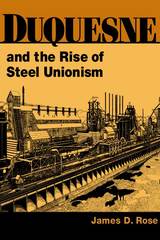
Dismissed as a flimsy front for management interests, industrial unions nonetheless carved out a role in the Carnegie Steel Company empire and then at U.S. Steel. James D. Rose examines the pivotal role played by these company-sponsored employee representation plans (ERPs) at the legendary steel works in Duquesne, Pennsylvania.
As Rose reveals, ERPs matured from tools of the company into worker-led organizations that represented the interests of the mills' skilled tradesmen and workers. ERPs and management created a sophisticated bargaining structure. Meanwhile, the independent trade union gave way to the Steel Workers Organizing Committee (SWOC), a professionalized organization that expended huge resources on companywide unionization. Yet even when the SWOC secured a collective bargaining agreement in 1937, it failed to sign up a majority of the Duquesne workforce.
Sophisticated and persuasive, Duquesne and the Rise of Steel Unionism confirms that what people did on the shop floor played a critical role in the course of steel unionism.
READERS
Browse our collection.
PUBLISHERS
See BiblioVault's publisher services.
STUDENT SERVICES
Files for college accessibility offices.
RECENTLY PUBLISHED



UChicago Accessibility Resources
home | accessibility | search | about | contact us
BiblioVault ® 2001 - 2026
The University of Chicago Press