
 A SCHOLARLY BOOK REPOSITORY
12 start with E start with E
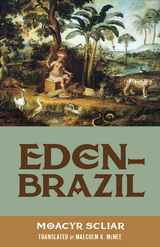
Adamastor is a freshly divorced, frustrated bureaucrat trying to reinvent his life. Richie is a young, struggling actor. Together with Ernesto, a rakish, expat Argentine showman, they create Eden-Brazil, an ecotourism destination in a stunning swath of coastal rainforest. Inspired to provide visitors with the ultimate return to nature, they decide to stage the biblical story of the Garden of Eden, complete with Adam, Eve, snake, apple, the works. But recreating an earthly paradise as something more than another roadside attraction is no easy feat. In this charming, tragicomic tale, Moacyr Scliar employs his signature humor and talent for crisp storytelling, weaving together a playfully serious parable of environmentalist ideals clashing with the realities of local politics, global consumer culture, and competing visions of authentic nature.

With a little initiative and very little startup money, an outgoing individual might sell you a number of delights and conveniences familiar to city dwellers—from cold water bottles while you’re sitting in traffic to a popsicle from a cart on a summer afternoon in the park. Such vendors form a significant share of the workforce in São Paulo, Brazil, but their ubiquity belies perpetual struggle. Some have the right to practice their trade; others do not. All of them strive to make it—or stay afloat.
In The Edge of the Law, sociologist Jacinto Cuvi introduces us to the world of street vendors and teases out the relationship between the construction of legality and the experience of citizenship. As São Paulo’s city government undertakes a large-scale plan to cancel street vending licenses and evict street vendors, Cuvi reveals how the rights of informal workers can be revoked or withheld and how the lines can be redrawn between work that is “legal” and work that takes place under constant fear of law enforcement. Alongside the mechanics of disenfranchisement, Cuvi captures the lived experience of criminalization, dissecting the distribution of (shallow) rights among vendors who continually reinvent strategies to eke out a living while dealing with the constraints and pressures of informal citizenship at the edge of the law.
The first of a closely linked trio of essays is by Paul Johnson, and offers a new interpretation of the Brazilian community gathered at Canudos and its massacre in 1896–97, carried out as a joint churchstate mission and spectacle. In the second essay, Pamela Klassen argues that the colonial churchstate relationship of Canada came into being through local and national practices that emerged as Indigenous nations responded to and resisted becoming “possessions” of colonial British America. Finally, Winnifred Sullivan’s essay begins with reflection on the increased effort within the United States to ban Bibles and scriptural references from death penalty courtrooms and jury rooms; she follows with a consideration of the political theological pressure thereby placed on the jury that decides between life and death. Through these three inquiries, Ekklesia takes up the familiar topos of “church and state” in order to render it strange.
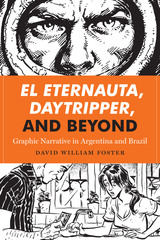
El Eternauta, Daytripper, and Beyond examines the graphic narrative tradition in the two South American countries that have produced the medium’s most significant and copious output. Argentine graphic narrative emerged in the 1980s, awakened by Héctor Oesterheld’s groundbreaking 1950s serial El Eternauta. After Oesterheld was “disappeared” under the military dictatorship, El Eternauta became one of the most important cultural texts of turbulent mid-twentieth-century Argentina. Today its story, set in motion by an extraterrestrial invasion of Buenos Aires, is read as a parable foretelling the “invasion” of Argentine society by a murderous tyranny. Because of El Eternauta, graphic narrative became a major platform for the country’s cultural redemocratization. In contrast, Brazil, which returned to democracy in 1985 after decades of dictatorship, produced considerably less analysis of the period of repression in its graphic narratives. In Brazil, serious graphic narratives such as Fábio Moon and Gabriel Bá’s Daytripper, which explores issues of modernity, globalization, and cross-cultural identity, developed only in recent decades, reflecting Brazilian society’s current and ongoing challenges.
Besides discussing El Eternauta and Daytripper, David William Foster utilizes case studies of influential works—such as Alberto Breccia and Juan Sasturain’s Perramus series, Angélica Freitas and Odyr Bernardi’s Guadalupe, and others—to compare the role of graphic narratives in the cultures of both countries, highlighting the importance of Argentina and Brazil as anchors of the production of world-class graphic narrative.

The Elementary Forms of Corruption is an ethnographic history of rural Brazilians’ shifting moral imagination in the context of their country’s recent corruption scandals and political crises. The book explores how Brazil’s cosmopolitan models of corruption, both left-wing and right-wing varieties, found their way to a small sertanejo (hinterland) municipality in the northeast, where people understood corruption very differently. Reckoning with both the leftist Workers’ Party, which sought to liberate sertanejos from patron-client relations, and the New Right populists who sought to stamp out the “communists” threatening the patriarchal family, the people of the sertanejo made recourse to older ideas about corruption—such as the betrayal of kinship obligations and communal trust—to decipher and shape national politics.
Challenging the discipline’s current aversion to generalizable, analytic categories that are useful for comparison across cultures or historical periods, The Elementary Forms of Corruption posits a general framework for understanding corruption at its most elementary level: the degradation of a moral gradient through the transgressive rechanneling of those currencies (e.g., gifts, favors) that sustain communal bonds when properly directed.
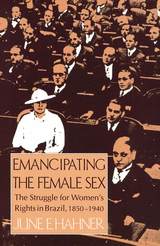
Hahner traces the history of Brazilian women’s fight for emancipation from its earliest manifestations in the mid-nineteenth century to the successful conclusion of the suffrage campaign in the 1930s. Drawing on interviews with surviving Brazilian suffragists and contemporary feminists as well as manuscripts and printed documents, Hahner explores the strategies and ideological positions of Brazilian feminists. In focusing on urban upper- and middle-class women, from whose ranks the leadership for change arose, she examines the relationship between feminism and social change in Brazil’s complex and highly stratified society.

2024 Best Book Award, National Communication Association, Ethnography Division
2024 Roberto Reis Book Prize, First Book category, Brazilian Studies Association
2024 Outstanding Book Award, National Communication Association, Critical and Cultural Studies Division
2024 International and Intercultural Best Book Award, National Communication Association, International and Intercultural Division
How disenfranchised Black Brazilians use hip-hop to reinvigorate the Black radical tradition.
Known as Black Rome, Salvador da Bahia, Brazil, is a predominantly Black city. The local art, food, and dance are closely linked to the population’s African roots. Yet many Black Brazilian residents are politically and economically disenfranchised. Bryce Henson details a culture of resistance and activism that has emerged in response, expressed through hip-hop and the social relations surrounding it.
Based on years of ethnographic research, Emergent Quilombos illuminates how Black hip-hop artists and their circles contest structures of anti-Black racism by creating safe havens and alternative social, cultural, and political systems that serve Black people. These artists valorize and empower marginalized Black peoples through song, aesthetics, media, visual art, and community action that emphasize diasporic connections, ancestrality, and Black identifications in opposition to the anti-Black Brazilian nation. In the process, Henson argues, the Salvador hip-hop scene has reinvigorated and reterritorialized a critical legacy of Black politicocultural resistance: the quilombo, maroon communities of Black fugitives who refused slavery as a way of life, gathered away from the spaces of their oppression, protected their communities, and nurtured Black life in all its possibilities.

A study of how Latin poetry shaped colonial aspirations in sixteenth- to eighteenth-century South and Central America.
Accompanying Iberian colonizers to the Americas, Virgil’s Aeneid inspired generations of colonial elites to write their own epic poems in Latin—priming imaginations for Spanish and Portuguese rule in the Americas. In Empire’s Companion, Erika Valdivieso recovers this lost strain of poetry for classicists and early Americanists alike. Each chapter introduces readers to a new poem that adapts Virgil for a different geographic context. These epics, Valdivieso argues, show elites working to reshape the New World in their own image, drawing on Virgil to think about the conquest of Indigenous peoples, to form new ideas about the globe, and to consider the shifting power dynamics between America and Europe. A powerful corrective to prevailing ideas about the reception of Virgil in the Americas, Empire’s Companion reveals the imperial potential of the Aeneid in the hands of governing elites.

Envisioning Brazil is a comprehensive and sweeping assessment of Brazilian studies in the United States. Focusing on synthesis and interpretation and assessing trends and perspectives, this reference work provides an overview of the writings on Brazil by United States scholars since 1945.
"The Development of Brazilian Studies in the United States," provides an overview of Brazilian Studies in North American universities. "Perspectives from the Disciplines" surveys the various academic disciplines that cultivate Brazilian studies: Portuguese language studies, Brazilian literature, art, music, history, anthropology, Amazonian ethnology, economics, politics, and sociology. "Counterpoints: Brazilian Studies in Britain and France" places the contributions of U.S. scholars in an international perspective. "Bibliographic and Reference Sources" offers a chronology of key publications, an essay on the impact of the digital age on Brazilian sources, and a selective bibliography.
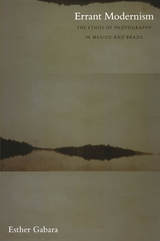
Gabara argues that Brazilian and Mexican modernists deliberately made photography err: they made this privileged medium of modern representation simultaneously wander and work against its apparent perfection. They flouted the conventions of mainstream modernism so that their aesthetics registered an ethical dimension. Their photographic modernism strayed, dragging along the baggage of modernity lived in a postcolonial site. Through their “errant modernism,” avant-garde writers and photographers critiqued the colonial history of Latin America and its twentieth-century formations.
READERS
Browse our collection.
PUBLISHERS
See BiblioVault's publisher services.
STUDENT SERVICES
Files for college accessibility offices.
RECENTLY PUBLISHED







UChicago Accessibility Resources
home | accessibility | search | about | contact us
BiblioVault ® 2001 - 2026
The University of Chicago Press