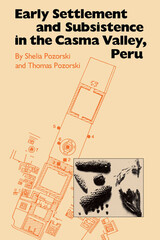
front cover of Early Settlement and Subsistence in the Casma Valley, Peru
Early Settlement and Subsistence in the Casma Valley, Peru
Shelia Pozorski
University of Iowa Press, 1987
The Casma Valley of Peru’s north central coast contains the largest New World structure of its time period---2500 to 200 BC---as well as one of the densest concentrations of early sites. In this detailed and thought-provoking volume, Sheila and Thomas Pozorski date each major early site, assess this important valley’s diet and subsistence changes through time, and begin to reconstruct the development of Casma Valley society.Fifteen sites are surveyed, including Pampa de las Llamas-Moxeke, the earliest planned city in the New World. The Pozorskis then synthesize their own fieldwork and previous work in the Casma Valley to chart its development during the critical time when civilization was emerging. The result: a scenario which is somewhat revolutionary in the context of more traditional views of Andean prehistory.Early Settlement and Subsistence in the Casma Valley, Peru adds substantially to the growing body of evidence that the earliest development of Andean civilization occurred on the coast rather than in the highlands. This volume presents comparative data for students of emerging civilizations worldwide and will be of value not only to Andean and New World archaeologists but also to everyone interested in the emergence of complex societies.
[more]

front cover of Earth Beings
Earth Beings
Ecologies of Practice across Andean Worlds
Marisol de la Cadena
Duke University Press, 2015
Earth Beings is the fruit of Marisol de la Cadena's decade-long conversations with Mariano and Nazario Turpo, father and son, runakuna or Quechua people. Concerned with the mutual entanglements of indigenous and nonindigenous worlds, and the partial connections between them, de la Cadena presents how the Turpos' indigenous ways of knowing and being include and exceed modern and nonmodern practices. Her discussion of indigenous political strategies—a realm that need not abide by binary logics—reconfigures how to think about and question modern politics, while pushing her readers to think beyond "hybridity" and toward translation, communication that accepts incommensurability, and mutual difference as conditions for ethnography to work.
 
[more]

front cover of Embodying the Sacred
Embodying the Sacred
Women Mystics in Seventeenth-Century Lima
Nancy E. van Deusen
Duke University Press, 2018
In seventeenth-century Lima, pious Catholic women gained profound theological understanding and enacted expressions of spiritual devotion by engaging with a wide range of sacred texts and objects, as well as with one another, their families, and ecclesiastical authorities. In Embodying the Sacred, Nancy E. van Deusen considers how women created and navigated a spiritual existence within the colonial city's complex social milieu. Through close readings of diverse primary sources, van Deusen shows that these women recognized the divine—or were objectified as conduits of holiness—in innovative and powerful ways: dressing a religious statue, performing charitable acts, sharing interiorized spiritual visions, constructing autobiographical texts, or offering their hair or fingernails to disciples as living relics. In these manifestations of piety, each of these women transcended the limited outlets available to them for expressing and enacting their faith in colonial Lima, and each transformed early modern Catholicism in meaningful ways.
[more]

front cover of The End of the Future
The End of the Future
Trauma, Memory, and Reconciliation in Peruvian Amazonia
Bartholomew Dean
Vanderbilt University Press, 2023
In The End of the Future, author Bartholomew Dean broadens the theoretical framework for understanding memory's role in reconciliation following a violent conflict. This book explores the complicated and confusing linkages between memory and trauma for individuals caught up in civil war and post-conflict reconciliation in the Peruvian Amazon's Huallaga Valley—an epicenter for leftist rebels and a booming shadow economy based on the extraction and circulation of cocaine. The End of the Future tells the story of violent attempts by the Túpac Amaru Revolutionary Movement (Movimiento Revolucionario Túpac Amaru, MRTA) to overthrow the state in the late 1980s and early 1990s from the perspective of the poorest residents of the lower Huallaga's Caynarachi Basin.

To give context to the causes and consequences of the MRTA's presence in the lower and central Huallaga, this book relies on the written works and testimony of Sístero García Torres, an MRTA rebel commander; the government's Truth and Reconciliation Commission; MRTA propaganda; media accounts; and critical historical texts. Besides exposing Huallaga Valley human rights abuses, the book's contribution to political anthropology is consequential for its insistence that reconciliation is by no means equivalent to local, Indigenous notions of "justice" or customary forms of dispute resolution. Without deliberately addressing the diverse socio-cultural contours defining overlapping epistemologies of justice, freedom, and communal well-being, enduring reconciliation will likely remain elusive.
[more]

front cover of Enduring Monuments
Enduring Monuments
Formative Period Transformations at Pukara, Peru
Elizabeth A. Klarich
University Press of Colorado, 2025
Enduring Monuments traces the architectural histories of monumental complexes and public spaces of the Pukara site in the Lake Titicaca Basin. Using data from three distinct areas—the Qalasaya, the Central Pampa, and the Northern Platform—Elizabeth A. Klarich provides a powerful diachronic and comparative perspective for understanding social and political transformations during the Late Formative period in Peru.
 
In the early twentieth century, Peruvian scholars Luis E. Valcárcel and Julio C. Tello visited Pukara and shared images of its multicolored pottery and unique stone sculptures with colleagues across the world. A number of both small-scale and multiyear field projects have followed, with goals of refining Lake Titicaca Basin cultural chronologies, tracking Pukara-style material culture in the south-central Andes, restoring the structural integrity of the Qalasaya, and documenting the reoccupations of Pukara by Colla, Inca, and early Spanish colonial populations. Enduring Monuments synthesizes the findings of these diverse projects and shares the results of fieldwork and artifact analysis by the Pukara Archaeological Project since 2000.
 
Using a “building biography” approach that tracks initial construction, major remodeling, and subsequent expansion efforts during the Middle and Late Formative periods (400 BC–AD 200), Klarich highlights transformations in material culture, settlement patterns, social hierarchy, and daily practices at Pukara and contemporaneous sites across the Titicaca Basin and situates Formative period Pukara within the vast anthropological and archaeological literature addressing monumentality, ritual practice, and incipient urbanism in complex societies in South America and beyond.
 
[more]

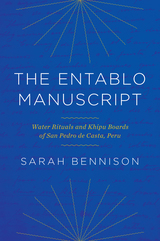
front cover of The Entablo Manuscript
The Entablo Manuscript
Water Rituals and Khipu Boards of San Pedro de Casta, Peru
Sarah Bennison
University of Texas Press, 2022

A unique study of an Andean community’s water rituals and the extraordinary document describing how they should be performed

In the dry season in the Andes, water from springs, lakes, reservoirs, and melting glaciers feeds irrigation canals that have sustained communities for thousands of years. Managing and maintaining these water infrastructures is essential, and in 1921, in the village of San Pedro de Casta, Peru, local authorities recorded their ritual canal-cleaning duties in a Spanish-language document called the Entablo. It is only the second book (along with the Huarochirí Manuscript) ever seen by scholars in which an Andean community explains its customs and ritual laws in its own words.

Sarah Bennison offers a critical introduction to the Entablo, a Spanish transcription of the document, and an English translation. Among its other revelations, the Entablo delves into the use of khipu boards, devices that meld the traditional knotted strings known as khipus with a written alphabet. Only in the Entablo do we learn that there were multiple khipu boards associated with a single canal-cleaning ritual, or that there were separate khipu records for men and women. The Entablo manuscript furnishes unparalleled insights into Andean rituals, religion, and community history at a historical moment when rural highland communities were changing rapidly.

[more]


Send via email Share on Facebook Share on Twitter