
 A SCHOLARLY BOOK REPOSITORY
17 start with E start with E
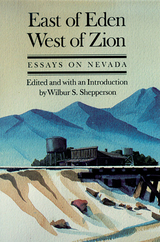
A collection of essays in which a dozen historians and novelists present their impressions and concerns about "end of the century Nevada." Human expectations and illusions are seen as a backdrop for today's Nevada as a new human frontier. As an overview of Nevada society, this study deals with culture as well as economics, with tradition as well as rapid population growth. The essayists inquire whether the friction between acquisition and preservation, quick wealth and refined sensitivity, will build a more humane and enlightened society.
First published in 1968, The Eastern Establishment and the Western Experience has become a classic in the field of American studies.
G. Edward White traces the origins of “the West of the imagination” to the adolescent experiences of Frederic Remington, Theodore Roosevelt, and Owen Wister—three Easterners from upper-class backgrounds who went West in the 1880s in search of an alternative way of life.
Each of the three men came to identify with a somewhat idealized “Wild West” that embodied the virtues of individualism, self-reliance, and rugged masculinity. When they returned East, they popularized this image of the West through art, literature, politics, and even their public personae. Moreover, these Western virtues soon became and have remained American virtues—a patriotic ideal that links Easterners with Westerners.
With a multidisciplinary blend of history, biography, sociology, psychology, and literary criticism, The Eastern Establishment and the Western Experience will appeal to a wide audience. The author has written a new preface, offering additional perspectives on the mythology of the West and its effect on the American character.

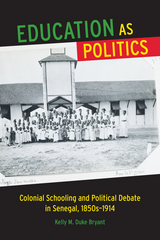
Kelly M. Duke Bryant demonstrates the critical impact of colonial schooling on Senegalese politics by examining the response to it by Africans from a variety of backgrounds and statuses—including rural chiefs, Islamic teachers, and educated young urbanites. For those Africans who chose to engage with them, the French schools in Senegal provided a new source of patronage, a potentially beneficial connection to the bureaucratizing colonial state, a basis for claims to authority or power, or an arena in which to debate pressing issues like the future of Qur’anic schooling and the increasing racism of urban society under colonial rule.
Based on evidence from archives in Senegal and France, and on interviews Duke Bryant conducted in Senegal, she demonstrates that colonial schooling remade African politics during this period of transition to French rule, creating political spaces that were at once African and colonial, and ultimately allowing Diagne to claim election victory.



Itamar Dubinsky’s extensive ethnographic research offers an innovative theoretical approach by assessing three institutions—Mandela Soccer Academy, Kumasi Sports Academy, and Unistar Soccer Academy—through an Africapitalist prism. He demonstrates that these business endeavors, when viewed from the perspective of local interests, realize many of the educational, financial, and community building ambitions of the region. This pioneering examination of locally owned academies in Ghana reflects Dubinsky’s aim of illuminating the entrepreneurs and programs whose success passes to participating youth and their families, while also exposing the contradictions of for-profit development initiatives that purport to reap collective social benefits.

Zachary A. Smith and John Freemuth bring together a roster of top scholars to explicate the issues noted above as well as other key questions in this new edition of Environmental Politics and Policy in the West, which was first published in 1993. This thoroughly revised and updated edition offers a comprehensive and current survey.
Contributors address the policy process as it affects western states, how bureaucracy and politics shape environmental dialogues in the West, how western states innovate environmental policies independently of Washington, and how and when science is involved (or ignored) in management of the West's federal lands. Experts in individual resource areas explore multifaceted issues such as the politics of dam removal and restoration, wildlife resource concerns, suburban sprawl and smart growth, the management of hard-rock mining, and the allocation of the West's tightly limited water resources. Contributors include: Leslie R. Alm, Carolyn D. Baber, Walter F. Baber, Robert V. Bartlett, Hugh Bartling, Matthew A. Cahn, R. McGreggor Cawley, Charles Davis, Sandra Davis, John C. Freemuth, Sheldon Kamieniecki, Matt Lindstrom, William R. Mangun, Denise McCain-Tharnstrom, Daniel McCool, Jaina L. Moan, and Zachary A. Smith.

In the third edition of Environmental Politics and Policy in the West, Zachary A. Smith and John C. Freemuth bring together a roster of top scholars to explicate the key issues involved. The volume has been completely updated to cover rapidly changing developments in the West, including climate change, land management politics and policy, science controversies, western water and river restoration, tribal sovereignty issues, the management of endangered species, and renewable energy development. Contributors also address how bureaucracy and politics shape environmental dialogues and explore multifaceted issues such as the politics of dam removal and restoration, wildlife resource concerns, suburban sprawl and smart growth, the management of renewable resources, public land reform and science, tribal sovereignty and energy, and the allocation of the West’s tightly limited water resources.
This timely new edition offers a comprehensive and current survey of influential western policy and environmental issues. It will be of great use to students of environmental studies and also public and environmental policy, as well as activists and professionals working in the environmental arena.
Contributors: Leslie R. Alm, Carolyn D. Baber, Walter F. Baber, Robert V. Bartlett, Hugh Bartling, Matthew A. Cahn, R. McGreggor Cawley, Charles Davis, Sandra Davis, John C. Freemuth, Sheldon Kamieniecki, Matt Lindstrom, William R. Mangun, Denise McCain-Tharnstrom, Daniel McCool, Jaina L. Moan, Zachary A. Smith
The effect of Western influence on the later Ottoman Empire and on the development of the modern Turkish nation-state links these twelve essays by a prominent American scholar. Roderic Davison draws from his extensive knowledge of Western diplomatic history and Turkish history to describe a period in which the actions of the Great Powers, incipient and rising nationalisms, and Westernizing reforms shaped the destiny of the Ottoman Empire and the creation of the new Turkish Republic.
Eleven of the essays were previously published in widely scattered journals and multi-authored volumes. The first of these provides a general survey of Turkish and Ottoman history, from early Turkish times to the end of the Empire. The following essays continue chronologically from 1774, detailing some of the changes in the nineteenth-century Empire. Several themes recur. One is the impact of Western ideas and institutions and the resistance to that influence by some elements in the Empire. Another concerns the diplomatic pressure exerted by the Great Powers of Europe on the Empire, which amounted at times to direct intervention in Ottoman domestic affairs. Taken together, the essays portray a confluence of civilizations as well as a clash of cultures.
Professor Davison has written an interpretive introduction that sets out the historical trends running throughout the book. In addition, he includes a previously unpublished article on the advent of the electric telegraph in the Ottoman Empire to show how the adoption of a Western technological advance could affect many areas of life.
Of particular interest to students of Ottoman and Middle East history, these essays will also be valuable for everyone concerned with modernization in developing nations. Davison's interpretations and keen methodological sense also shed new light on several aspects of European diplomatic history.
Eurafricans in Western Africa traces the rich social and commercial history of western Africa. The most comprehensive study to date, it begins prior to the sixteenth century when huge profits made by middlemen on trade in North African slaves, salt, gold, pepper, and numerous other commodities prompted Portuguese reconnaissance voyages along the coast of western Africa. From Senegal to Sierra Leone, Portuguese, including “New Christians” who reverted to Judaism while living in western Africa, thrived where riverine and caravan networks linked many African groups.
Portuguese and their Luso-African descendants contended with French, Dutch, and English rivals for trade in gold, ivory, slaves, cotton textiles, iron bars, cowhides, and other African products. As the Atlantic slave trade increased, French and Franco-Africans and English and Anglo-Africans supplanted Portuguese and Luso-Africans in many African places of trade.
Eurafricans in Western Africa follows the changes that took root in the eighteenth century when French and British colonial officials introduced European legal codes, and concludes with the onset of the French Revolution and Napoleonic Wars, when suppression of the slave trade and expanding commerce in forest and agricultural commodities again transformed circumstances in western Africa.
Professor George E. Brooks’s outstanding history of these vital aspects of western Africa is enriched by his discussion of the roles of the women who married or cohabited with European traders. Through accounts of incidents and personal histories, which are integrated into the narrative, the lives of these women and their children are accorded a prominent place in Professor Brooks’s fascinating discussion of this dynamic region of Africa.

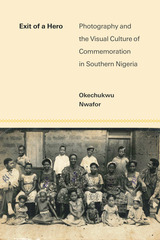
In Exit of a Hero, Okechukwu Nwafor explores the cultural, political, and socioeconomic implications of photography in commemorative practices in southern Nigeria from the nineteenth century to the present. Focusing on obituary and commemorative photographs of late nineteenth and early twentieth-century Lagos to contemporary funeral posters, booklets, and social media posts, Nwafor tracks the historical evolution of the iconic and heroic image. He argues that the quest to produce an ideal memorial body is not just a personal aesthetic choice but a deliberate photographic project that resonates with the Igbo aspirations for heroic achievement.
Exit of a Hero asserts that the visual canonization transforms the deceased from a fallible being to an unimpeachable character who transcends underachievement, imperfection, and failed social performance to emerge as a saintly icon of the Igbo public sphere. In seeking an alternative, hyper-visible public self, social media reclaims the lost hero image of the deceased, reconstituting the contested Igbo public space as a lived reality where heroes and icons are actively and eternally commemorated. Nwafor unveils the creative imaginations of colonial subjects and postcolonial citizens as memorialization has become entangled within the intersecting discursive spaces of print culture and the public sphere.

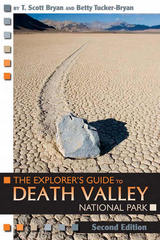
Originally published in 1995, soon after Death Valley National Park became the fifty-third park in the US park system, The Explorer’s Guide to Death Valley National Park was the first complete guidebook available for this spectacular area. Now in its fourth edition, this is still the only book that includes all aspects of the park. Much more than just a guidebook, it covers the park’s cultural history, botany and zoology, hiking and biking opportunities, and more. Information is provided for all of Death Valley’s visitors, from first-time travelers just learning about the area to those who are returning for in-depth explorations.
This new edition features a number of important changes—including information on the boundary and wilderness changes that resulted from the Dingell Act of 2019, the reopened Keane Wonder Mine area, the devastating flash flooding of Scotty’s Castle, scenic river designations, the Inn and Ranch resorts, renovated and now operated as the Oasis at Death Valley—as well as new maps and updated color photos. With extensive input from National Park Service resource management, law enforcement, and interpretive personnel, as well as a thorough bibliography for suggested reading, The Explorer’s Guide to Death Valley National Park, Fourth Edition is the most up-to-date, accurate, and comprehensive guide available for this national treasure.
READERS
Browse our collection.
PUBLISHERS
See BiblioVault's publisher services.
STUDENT SERVICES
Files for college accessibility offices.
RECENTLY PUBLISHED





UChicago Accessibility Resources
home | accessibility | search | about | contact us
BiblioVault ® 2001 - 2026
The University of Chicago Press