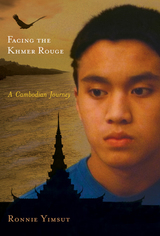
front cover of Facing the Khmer Rouge
Facing the Khmer Rouge
A Cambodian Journey
Ronnie Yimsut
Rutgers University Press, 2011

As a child growing up in Cambodia, Ronnie Yimsut played among the ruins of the Angkor Wat temples, surrounded by a close-knit community. As the Khmer Rouge gained power and began its genocidal reign of terror, his life became a nightmare. In this stunning memoir, Yimsut describes how, in the wake of death and destruction, he decides to live.

Escaping the turmoil of Cambodia, he makes a perilous journey through the jungle into Thailand, only to be sent to a notorious Thai prison. Fortunately, he is able to reach a refugee camp and ultimately migrate to the United States, where he attended the University of Oregon and became an influential leader in the community of Cambodian immigrants. Facing the Khmer Rouge shows Ronnie Yimsut’s personal quest to rehabilitate himself, make a new life in America, and then return to Cambodia to help rebuild the land of his birth.

[more]

logo for Pluto Press
Failing Peace
Gaza and the Palestinian-Israeli Conflict
Sara Roy
Pluto Press, 2006
Discussion of Israeli policy toward Palestinians is often regarded as a taboo subject, with the result that few people - especially in the US - understand the origins and consequences of the conflict. This book provides an indispensable context for understanding why the situation remains so intractable.

The book focuses on the Gaza Strip, an area that remains consistently neglected and misunderstood despite its political centrality. Drawing on more than two thousand interviews and extensive firsthand experience, Sara Roy chronicles the impact of Israeli occupation in Palestine over nearly a generation. 

Exploring the devastating consequences of socio-economic and political decline, this is a unique and powerful account of the reality of life in the West Bank and Gaza. Written by one of the world's foremost scholars of the region, it offers an unrivalled breadth of scholarship and insight.

[more]

logo for Duke University Press
Federal Courts in the International Human Rights Paradigm
Kenneth C. Randall
Duke University Press, 1990

front cover of Feminism, Interrupted
Feminism, Interrupted
Disrupting Power
Lola Olufemi
Pluto Press, 2020
"I was blown away"—Angela Davis
 
"Reading her is to believe that another world is possible."—The Guardian
 
More than just a slogan on a t-shirt, feminism is a radical tool for fighting back against structural violence and injustice. Feminism, Interrupted is a bold call to seize feminism back from the cultural gatekeepers and return it to its radical roots.
 
Writer and organizer Lola Olufemi explores state violence against women, the fight for reproductive justice, transmisogyny, gendered Islamophobia and solidarity with global struggles, showing that the fight for gendered liberation can change the world for everybody when we refuse to think of it solely as women's work. Chapters include:
 
*Know your history
*The sexist state
*The fight for reproductive justice
*The savior complex: Muslim women and gendered Islamophobia
*Complicated consent: How to support sex workers
*The answer to sexual violence is not more prisons
*Feminism and food
*Solidarity is a doing word
 
Including testimonials from Sisters Uncut, migrant groups working for reproductive justice, prison abolitionists and activists involved in the international fight for Kurdish and Palestinian rights, Olufemi emphasizes the link between feminism and grassroots organizing. Reclaiming feminism from the clutches of the consumerist, neoliberal model, Feminism, Interrupted shows that when “feminist” is more than a label, it holds the potential for radical transformative work.
 
Olufemi writes in her Introduction, "Feminism is a political project about what could be. It’s always looking forward, investing in future we can’t quite grasp yet. It’s a way of swishing, hoping, aiming at everything that has been deemed impossible. It’s a task that has to be approached seriously. This book is for anyone who is beginning to think critically….If this book makes you pick up another book, or watch a documentary, search the archive, reach for a poetry book—if it spars or reignites your interest in feminism, then it has served its purpose."

[more]

front cover of Ferryman of Memories
Ferryman of Memories
The Films of Rithy Panh
Deirdre Boyle
Rutgers University Press, 2023
Ferryman of Memories: The Films of Rithy Panh is an unconventional book about an unconventional filmmaker. Rithy Panh survived the Cambodian genocide and found refuge in France where he discovered in film a language that allowed him to tell what happened to the two million souls who suffered hunger, overwork, disease, and death at the hands of the Khmer Rouge. His innovative cinema is made with people, not about them—even those guilty of crimes against humanity.  Whether he is directing Isabelle Huppert in The Sea Wall, following laborers digging trenches, or interrogating the infamous director of S-21 prison, aesthetics and ethics inform all he does.  With remarkable access to the director and his work, Deirdre Boyle introduces readers to Panh’s groundbreaking approach to perpetrator cinema and dazzling critique of colonialism, globalization, and the refugee crisis. Ferryman of Memories reveals the art of one of the masters of world cinema today, focusing on nineteen of his award-winning films, including Rice People, The Land of Wandering Souls, S-21: The Khmer Rouge Killing Machine, and The Missing Picture.
[more]

logo for Duke University Press
Fields of Suspicion
Landmines and the Making of Peace in Rural Colombia
Diana Pardo Pedraza
Duke University Press, 2027
In Fields of Suspicion, Diana Pardo Pedraza examines how decades of explosive contamination, armed conflict, state neglect, and extractive projects have produced environments saturated with anxiety and doubt. Pardo Pedraza draws on years of ethnographic fieldwork in a Colombian “peace laboratory” where army soldiers and FARC-EP guerrillas worked together to clear landmines during the 2012–2016 peace negotiations. Rather than presenting demining as a purely humanitarian or technical activity, she reveals that, as an initiative of liberal peace, it is entangled with broader projects of governance, development, and territorial control. At the same time, Pardo Pedraza traces the fragile labor of rebuilding trust between guerrillas, military members, humanitarian workers, and campesino communities. By foregrounding the long-lived affective and territorial aftermath of war and humanitarian technologies, Fields of Suspicion contributes to anthropological conversations on military waste, ecological and political remediation, post-conflict development, and the ambiguity of nominal war and peace.
[more]

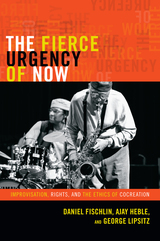
front cover of The Fierce Urgency of Now
The Fierce Urgency of Now
Improvisation, Rights, and the Ethics of Cocreation
Daniel Fischlin, Ajay Heble, and George Lipsitz
Duke University Press, 2013
The Fierce Urgency of Now links musical improvisation to struggles for social change, focusing on the connections between the improvisation associated with jazz and the dynamics of human rights struggles and discourses. The authors acknowledge that at first glance improvisation and rights seem to belong to incommensurable areas of human endeavor. Improvisation connotes practices that are spontaneous, personal, local, immediate, expressive, ephemeral, and even accidental, while rights refer to formal standards of acceptable human conduct, rules that are permanent, impersonal, universal, abstract, and inflexible. Yet the authors not only suggest that improvisation and rights can be connected; they insist that they must be connected.

Improvisation is the creation and development of new, unexpected, and productive cocreative relations among people. It cultivates the capacity to discern elements of possibility, potential, hope, and promise where none are readily apparent. Improvisers work with the tools they have in the arenas that are open to them. Proceeding without a written score or script, they collaborate to envision and enact something new, to enrich their experience in the world by acting on it and changing it. By analyzing the dynamics of particular artistic improvisations, mostly by contemporary American jazz musicians, the authors reveal improvisation as a viable and urgently needed model for social change. In the process, they rethink politics, music, and the connections between them.

[more]

front cover of First Do No Harm
First Do No Harm
Humanitarian Intervention and the Destruction of Yugoslavia
David N. Gibbs
Vanderbilt University Press, 2009
In First Do No Harm, David Gibbs raises basic questions about the humanitarian interventions that have played a key role in U.S. foreign policy for the past twenty years. Using a wide range of sources, including government documents, transcripts of international war crimes trials, and memoirs, Gibbs shows how these interventions often heightened violence and increased human suffering.

The book focuses on the 1991-99 breakup of Yugoslavia, which helped forge the idea that the United States and its allies could stage humanitarian interventions that would end ethnic strife. It is widely believed that NATO bombing campaigns in Bosnia and Kosovo played a vital role in stopping Serb-directed aggression, and thus resolving the conflict.

Gibbs challenges this view, offering an extended critique of Samantha Power's Pulitzer Prize-winning book, A Problem from Hell: America in the Age of Genocide. He shows that intervention contributed to the initial breakup of Yugoslavia, and then helped spread the violence and destruction. Gibbs also explains how the motives for U.S. intervention were rooted in its struggle for continued hegemony in Europe.

First Do No Harm argues for a new, noninterventionist model for U.S. foreign policy, one that deploys nonmilitary methods for addressing ethnic violence.
[more]

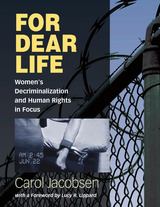
front cover of For Dear Life
For Dear Life
Women's Decriminalization and Human Rights in Focus
Carol Jacobsen
University of Michigan Press, 2019
For Dear Life chronicles feminist and artist Carol Jacobsen's deep commitment to the causes of justice and human rights, and focuses a critical lens on an American criminal-legal regime that imparts racist, gendered, and classist modes of punishment to women lawbreakers. Jacobsen's tireless work with and for women prisoners is charted in this rich assemblage of images and texts that reveal the collective strategies she and the prisoners have employed to receive justice. The book gives evidence that women's lawbreaking is often an effort to survive gender-based violence. The faces, letters, and testimonies of dozens of incarcerated women with whom Jacobsen has worked present a visceral yet politicized chorus of voices against the criminal-legal systems that fail us all. Their voices are joined by those of leading feminist scholars in essays that illuminate the arduous methods of dissent that Jacobsen and the others have employed to win freedom for more than a dozen women sentenced to life imprisonment, and to free many more from torturous prison conditions. The book is a document to Jacobsen's love and lifelong commitment to creating feminist justice and freedom, and to the efficacy of her artistic, legal, and extralegal political actions on behalf of women.
[more]

front cover of Forced Passages
Forced Passages
Imprisoned Radical Intellectuals and the U.S. Prison Regime
Dylan Rodríguez
University of Minnesota Press, 2006
More than two million people are currently imprisoned in the United States, and the nation’s incarceration rate is now the highest in the world. The dramatic rise and consolidation of America’s prison system has devastated lives and communities. But it has also transformed prisons into primary sites of radical political discourse and resistance as they have become home to a growing number of writers, activists, poets, educators, and other intellectuals who offer radical critiques of American society both within and beyond the prison walls. 

In Forced Passages, Dylan Rodríguez argues that the cultural production of such imprisoned intellectuals as Mumia Abu-Jamal, Angela Davis, Leonard Peltier, George Jackson, José Solis Jordan, Ramsey Muniz, Viet Mike Ngo, and Marilyn Buck should be understood as a social and intellectual movement in and of itself, unique in context and substance. Rodríguez engages with a wide range of texts, including correspondence, memoirs, essays, poetry, communiqués, visual art, and legal writing, drawing on published works by widely recognized figures and by individuals outside the public’s field of political vision or concern. Throughout, Rodríguez focuses on the conditions under which imprisoned intellectuals live and work, and he explores how incarceration shapes the ways in which insurgent knowledge is created, disseminated, and received. 

More than a series of close readings of prison literature, Forced Passages identifies and traces the discrete lineage of radical prison thought since the 1970s, one formed by the logic of state violence and by the endemic racism of the criminal justice system. 

Dylan Rodríguez is assistant professor of ethnic studies at the University of California, Riverside.
[more]

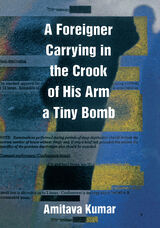
front cover of A Foreigner Carrying in the Crook of His Arm a Tiny Bomb
A Foreigner Carrying in the Crook of His Arm a Tiny Bomb
Amitava Kumar
Duke University Press, 2010
Part reportage and part protest, A Foreigner Carrying in the Crook of His Arm a Tiny Bomb is an inquiry into the cultural logic and global repercussions of the war on terror. At its center are two men convicted in U.S. courts on terrorism-related charges: Hemant Lakhani, a seventy-year-old tried for attempting to sell a fake missile to an FBI informant, and Shahawar Matin Siraj, baited by the New York Police Department into a conspiracy to bomb a subway. Lakhani and Siraj were caught through questionable sting operations involving paid informants; both men received lengthy jail sentences. Their convictions were celebrated as major victories in the war on terror. In Amitava Kumar’s riveting account of their cases, Lakhani and Siraj emerge as epic bunglers, and the U.S. government as the creator of terror suspects to prosecute. Kumar analyzed the trial transcripts and media coverage, and he interviewed Lakhani, Siraj, their families, and their lawyers. Juxtaposing such stories of entrapment in the United States with narratives from India, another site of multiple terror attacks and state crackdowns, Kumar explores the harrowing experiences of ordinary people entangled in the war on terror. He also considers the fierce critiques of post-9/11 surveillance and security regimes by soldiers and torture victims, as well as artists and writers, including Coco Fusco, Paul Shambroom, and Arundhati Roy.
[more]

front cover of Freedom in Entangled Worlds
Freedom in Entangled Worlds
West Papua and the Architecture of Global Power
Eben Kirksey
Duke University Press, 2012
Eben Kirksey first went to West Papua, the Indonesian-controlled half of New Guinea, as an exchange student in 1998. His later study of West Papua's resistance to the Indonesian occupiers and the forces of globalization morphed as he discovered that collaboration, rather than resistance, was the primary strategy of this dynamic social movement. Accompanying indigenous activists to Washington, London, and the offices of the oil giant BP, Kirksey saw the revolutionaries' knack for getting inside institutions of power and building coalitions with unlikely allies, including many Indonesians. He discovered that the West Papuans' pragmatic activism was based on visions of dramatic transformations on coming horizons, of a future in which they would give away their natural resources in grand humanitarian gestures, rather than watch their homeland be drained of timber, gold, copper, and natural gas. During a lengthy, brutal occupation, West Papuans have harbored a messianic spirit and channeled it in surprising directions. Kirksey studied West Papua's movement for freedom while a broad-based popular uprising gained traction from 1998 until 2008. Blending ethnographic research with indigenous parables, historical accounts, and narratives of his own experiences, he argues that seeking freedom in entangled worlds requires negotiating complex interdependencies.
[more]

front cover of From Bureaucracy to Bullets
From Bureaucracy to Bullets
Extreme Domicide and the Right to Home
Bree Akesson
Rutgers University Press, 2022
There are currently a record-setting number of forcibly displaced persons in the world. This number continues to rise as solutions to alleviate humanitarian catastrophes of large-scale violence and displacement continue to fail. The likelihood of the displaced returning to their homes is becoming increasingly unlikely. In many cases, their homes have been destroyed as the result of violence. Why are the homes of certain populations targeted for destruction? What are the impacts of loss of home upon children, adults, families, communities, and societies? If having a home is a fundamental human right, then why is the destruction of home not viewed as a rights violation and punished accordingly? From Bureaucracy to Bullets answers these questions and more by focusing on the violent practice of extreme domicide, or the intentional destruction of the home, as a central and overlooked human rights issue.
[more]

front cover of From Day to Day
From Day to Day
One Man's Diary of Survival in Nazi Concentration Camps
Odd Nansen
Vanderbilt University Press, 2016
This new hardcover edition of Odd Nansen's diary, the first in over sixty-five years, contains extensive annotations and other material not found in any other hardcover or paperback versions.

Nansen, a Norwegian, was arrested in 1942 by the Nazis, and spent the remainder of World War II in concentration camps--Grini in Oslo, Veidal above the Arctic Circle, and Sachsenhausen in Germany. For three and a half years, Nansen kept a secret diary on tissue-paper-thin pages later smuggled out by various means, including inside the prisoners' hollowed-out breadboards.

Unlike writers of retrospective Holocaust memoirs, Nansen recorded the mundane and horrific details of camp life as they happened, "from day to day." With an unsparing eye, Nansen described the casual brutality and random terror that was the fate of a camp prisoner. His entries reveal his constantly frustrated hopes for an early end to the war, his longing for his wife and children, his horror at the especially barbaric treatment reserved for Jews, and his disgust at the anti-Semitism of some of his fellow Norwegians. Nansen often confronted his German jailors with unusual outspokenness and sometimes with a sense of humor and absurdity that was not appreciated by his captors.

After the Putnam's edition received rave reviews in 1949, the book fell into obscurity. In 1956, in response to a poll about the "most undeservedly neglected" book of the preceding quarter-century, Carl Sandburg singled out From Day to Day, calling it "an epic narrative," which took "its place among the great affirmations of the power of the human spirit to rise above terror, torture, and death." Indeed, Nansen witnessed all the horrors of the camps, yet still saw hope for the future. He sought reconciliation with the German people, even donating the proceeds of the German edition of his book to German refugee relief work. Nansen was following in the footsteps of his father, Fridtjof, an Arctic explorer and humanitarian who was awarded the Nobel Peace Prize in 1922 for his work on behalf of World War I refugees. (Fridtjof also created the "Nansen passport" for stateless persons.)

Forty sketches of camp life and death by Nansen, an architect and talented draftsman, provide a sense of immediacy and acute observation matched by the diary entries. The preface is written by Thomas Buergenthal, who was "Tommy," the ten-year-old survivor of the Auschwitz Death March, whom Nansen met at Sachsenhausen and saved using his extra food rations. Buergenthal, author of A Lucky Child, formerly served as a judge on the International Court of Justice at The Hague and is a recipient of the 2015 Elie Wiesel Award from the US Holocaust Memorial Museum.
[more]

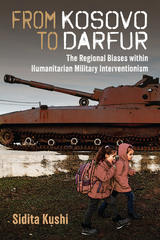
front cover of From Kosovo to Darfur
From Kosovo to Darfur
The Regional Biases within Humanitarian Military Interventionism
Sidita Kushi
University of Michigan Press, 2025
Why are some violent crises more likely to prompt humanitarian military interventions than others? Conventional wisdom says that humanitarian military interventions occur due to national interests, shared values and norms, or economic benefits for the interveners. Yet neither of these factors can fully explain the selectivity of such interventions. The international community continues to ignore the decades-long suffering in Darfur, often dismisses the genocidal policies within Myanmar, and even perpetuates the suffering in contemporary Yemen, while undertaking humanitarian-laden missions in Libya, Syria, and the Balkans.

Using in-depth case studies and new data on all post–Cold War internal armed conflicts matched to third-party responses, From Kosovo to Darfur offers the first regionally sensitive analysis of humanitarian military intervention since the end of the Cold War. It shows that international military interventions in the context of acute humanitarian crises are driven by different pathways within the Western versus the non-Western world and fueled by elite perceptions of the crisis, making interventions closer to the geographic and cultural West most probable and most intense. As our international community becomes increasingly interdependent and aware of human suffering across borders, From Kosovo to Darfur points to new pathways of conflict trajectories and reveals vital implications for leaders, scholars, and nongovernmental actors advocating for or against international military intervention as a policy choice.
[more]

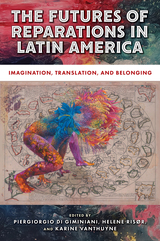
front cover of The Futures of Reparations in Latin America
The Futures of Reparations in Latin America
Imagination, Translation, and Belonging
Piergiorgio Di Giminiani
Rutgers University Press, 2026
Over the last thirty years, Latin America has undergone an unprecedented wave of reparations targeting victims of political violence during military regimes, Indigenous and Afro-Latin groups affected by historical processes of dispossession, and citizens suffering from environmental harm. Reparations prompt us to face uncomfortable pasts and in so doing, create conditions for imagination of multiple futures. In representing the experiences and hopes of those affected by political violence in El Salvador and Argentina, environmental harm in Guatemala and Peru, and colonial dispossession in Chile and Bolivia, reparations are built upon conflictive forms of future imagination, translation of harm and new forms of belonging to and beyond the nation state, which reifies as much as challenges state authority over the promises of actual repair. In today’s Latin American political debate, hopes for justice and democracy remain anchored to the question of the kinds of future that can be imagined through and after reparation.
 
[more]


Send via email Share on Facebook Share on Twitter