
 A SCHOLARLY BOOK REPOSITORY
13 start with F start with F

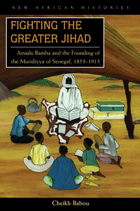
In Senegal, the Muridiyya, a large Islamic Sufi order, is the single most influential religious organization, including among its numbers the nation’s president. Yet little is known of this sect in the West. Drawn from a wide variety of archival, oral, and iconographic sources in Arabic, French, and Wolof, Fighting the Greater Jihad offers an astute analysis of the founding and development of the order and a biographical study of its founder, Cheikh Ahmadu Bamba Mbakke.
Cheikh Anta Babou explores the forging of Murid identity and pedagogy around the person and initiative of Amadu Bamba as well as the continuing reconstruction of this identity by more recent followers. He makes a compelling case for reexamining the history of Muslim institutions in Africa and elsewhere in order to appreciate believers’ motivation and initiatives, especially religious culture and education, beyond the narrow confines of political collaboration and resistance. Fighting the Greater Jihad also reveals how religious power is built at the intersection of genealogy, knowledge, and spiritual force, and how this power in turn affected colonial policy.
Fighting the Greater Jihad will dramatically alter the perspective from which anthropologists, historians, and political scientists study Muslim mystical orders.
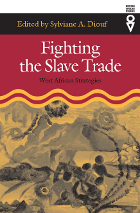
While most studies of the slave trade focus on the volume of captives and on their ethnic origins, the question of how the Africans organized their familial and communal lives to resist and assail it has not received adequate attention. But our picture of the slave trade is incomplete without an examination of the ways in which men and women responded to the threat and reality of enslavement and deportation.
Fighting the Slave Trade is the first book to explore in a systematic manner the strategies Africans used to protect and defend themselves and their communities from the onslaught of the Atlantic slave trade and how they assaulted it.
It challenges widely held myths of African passivity and general complicity in the trade and shows that resistance to enslavement and to involvement in the slave trade was much more pervasive than has been acknowledged by the orthodox interpretation of historical literature.
Focused on West Africa, the essays collected here examine in detail the defensive, protective, and offensive strategies of individuals, families, communities, and states. In chapters discussing the manipulation of the environment, resettlement, the redemption of captives, the transformation of social relations, political centralization, marronage, violent assaults on ships and entrepôts, shipboard revolts, and controlled participation in the slave trade as a way to procure the means to attack it, Fighting the Slave Trade presents a much more complete picture of the West African slave trade than has previously been available.
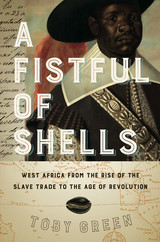
With A Fistful of Shells, Toby Green transforms our view of West and West-Central Africa by reconstructing the world of these kingdoms, which revolved around trade, diplomacy, complex religious beliefs, and the production of art. Green shows how the slave trade led to economic disparities that caused African kingdoms to lose relative political and economic power. The concentration of money in the hands of Atlantic elites in and outside these kingdoms brought about a revolutionary nineteenth century in Africa, parallel to the upheavals then taking place in Europe and America. Yet political fragmentation following the fall of African aristocracies produced radically different results as European colonization took hold.
Drawing not just on written histories, but on archival research in nine countries, art, oral history, archaeology, and letters, Green lays bare the transformations that have shaped world politics and the global economy since the fifteenth century and paints a new and masterful portrait of West Africa, past and present.


Situated in the rugged hills west of downtown Portland, Forest Park is the nation’s premier urban natural sanctuary. It supports essential habitat for hundreds of native plants and animals, including species at risk, and is one of the largest city parks in the world. While extending critical ecosystem services to the region, it offers miles of outstanding hiking trails, all within minutes of the downtown core.
Forest Park: Exploring Portland’s Natural Sanctuary showcases this treasure in new light, offering a compendium of the most up-to-date and comprehensive information available. Twenty-one hikes covering 75 miles bring a full awareness of the park’s outstanding attributes. Hikes are grouped by theme to encourage people to explore Forest Park’s watersheds; geology; lichens and mosses; vegetation; amphibians and reptiles; pollinators; native wildlife; and wildlife corridors. Beautiful photographs and full-color maps accompany each trail description.
Forest Park is a shining example of the Pacific Northwest western hemlock community--an ecosystem unique among all temperate forests of the world. It is also an exciting model for a future Urban Biodiversity Reserve, a concept under development recognizing the park’s scientific, natural, and cultural qualities. Forest Park: Exploring Portland’s Natural Sanctuary will help all visitors discover the beauty and wonders of this extraordinary natural resource.
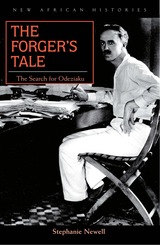
Between 1905 and 1939 a conspicuously tall white man with a shock of red hair, dressed in a silk shirt and white linen trousers, could be seen on the streets of Onitsha, in Eastern Nigeria. How was it possible for an unconventional, boy-loving Englishman to gain a social status among the local populace enjoyed by few other Europeans in colonial West Africa?
In The Forger’s Tale: The Search for Odeziaku Stephanie Newell charts the story of the English novelist and poet John Moray Stuart-Young (1881–1939) as he traveled from the slums of Manchester to West Africa in order to escape the homophobic prejudices of late-Victorian society. Leaving behind a criminal record for forgery and embezzlement and his notoriety as a “spirit rapper,” Stuart-Young found a new identity as a wealthy palm oil trader and a celebrated author, known to Nigerians as “Odeziaku.”
In this fascinating biographical account, Newell draws on queer theory, African gender debates, and “new imperial history” to open up a wider study of imperialism, (homo)sexuality, and nonelite culture between the 1880s and the late 1930s. The Forger’s Tale pays close attention to different forms of West African cultural production in the colonial period and to public debates about sexuality and ethics, as well as to movements in mainstream English literature.
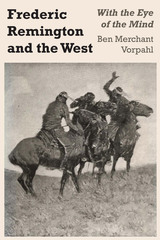
Frederic Remington and the West sheds new light on the remarkably complicated and much misunderstood career of Frederic Remington. This study of the complex relationship between Remington and the American West focuses on the artist’s imagination and how it expressed itself. Ben Merchant Vorpahl takes into account all the dimensions of Remington’s extensive work—from journalism to fiction, sculpture, and painting. He traces the events of Remington’s life and makes extensive use of literary and art criticism and nineteenth-century American social cultural and military history in interpreting his work.
Vorpahl reveals Remington as a talented, sensitive, and sometimes neurotic American whose work reflects with peculiar force the excitement and distress of the period between the Civil War and the Spanish-American War. Remington was not a “western” artist in the conventional sense; neither was he a historian: he lacked the historian’s breadth of vision and discipline, expressing himself not through analysis but through synthesis. Vorpahl shows that, even while Remington catered to the sometimes maudlin, sometimes jingoistic tastes of his public and his editors, his resourceful imagination was at work devising a far more demanding and worthwhile design—a composite work, executed in prose, pictures, and bronze. This body of work, as the author demonstrates, demands to be regarded as an interrelated whole. Here guilt, shame, and personal failure are honestly articulated, and death itself is confronted as the artist’s chief subject.
Because Remington was so prolific a painter, sculptor, illustrator, and writer, and because his subjects, techniques, and media were so apparently diverse, the deeper continuity of his work had not previously been recognized. This study is a major contribution to our understanding of an important American artist. In addition, Vorpahl illuminates the interplay between history, artistic consciousness, and the development of America’s sense of itself during Remington’s lifetime.
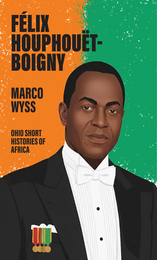
Félix Houphouët-Boigny, who ruled Côte d’Ivoire from independence in 1960 until his death in 1993, remains one of the most influential and controversial figures in modern African history. Revered by some as the “old sage” who transformed his country into an economic powerhouse and a haven of stability during the Cold War and reviled by others as a neocolonial collaborator whose policies sowed the seeds of later crisis, Houphouët-Boigny left a legacy that continues to shape debates about postcolonial governance and African international relations. This first English-language biography offers a comprehensive and nuanced portrait of Houphouët-Boigny’s life and career. It traces his journey from Baoulé nobility and early prominence in colonial politics to his emergence as a leading African statesman after World War II. The book examines his shifting ideological positions—championing France’s imperial project, then embracing African nationalism during the collapse of the French Community—and his pivotal role in negotiating Côte d’Ivoire’s postcolonial relationship with France. Houphouët-Boigny consolidated domestic power into a de facto one-party state, furthering his increasingly authoritarian tendencies and his efforts to modernize Côte d’Ivoire through economic development and grand architectural projects. Beyond domestic issues, the biography explores Houphouët-Boigny’s ambitions on the continental stage. It details his Cold War maneuvers, often in partnership with France, as he pursued regional dominance against figures like Kwame Nkrumah, supported Moïse Tshombe in the Congo, aided Biafra during the Nigerian Civil War, and even engaged with apartheid South Africa. By situating Houphouët-Boigny within the broader dynamics of Françafrique—the enduring neocolonial entanglement between France and its former African colonies—this biography sheds light on the complexities of postcolonial rule. It offers essential insights into the political, economic, and diplomatic forces that shaped Africa in the second half of the twentieth century and that continue to resonate today.
READERS
Browse our collection.
PUBLISHERS
See BiblioVault's publisher services.
STUDENT SERVICES
Files for college accessibility offices.
RECENTLY PUBLISHED



UChicago Accessibility Resources
home | accessibility | search | about | contact us
BiblioVault ® 2001 - 2026
The University of Chicago Press