
 A SCHOLARLY BOOK REPOSITORY
7 start with I start with I
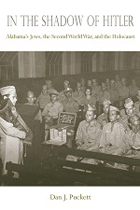
In this extensive study of how southern Jews in the United States responded to the Nazi persecution of European Jews, Dan J. Puckett recounts the divisions between Alabama Jews in the early 1930s. As awareness of the horrors of the Holocaust spread, Jews across Alabama from different backgrounds and from Reform, Conservative, and Orthodox traditions worked to bridge their internal divisions in order to mount efforts to save Jewish lives in Europe. Only by leveraging their collective strength were Alabama’s Jews able to sway the opinions of newspaper editors, Christian groups, and the general public as well as lobby local, state, and national political leaders.
Puckett’s comprehensive analysis is enlivened and illustrated by true stories that will fascinate all readers of southern history. One such story concerns the Altneuschule Torah of Prague and describes how the Nazis, during their brutal occupation of Czechoslovakia, confiscated 1,564 Torahs and sacred Judaic objects from communities throughout Bohemia and Moravia as exhibits in a planned museum to the extinct Jewish race. Recovered after the war by the Czech Memorial Scrolls Trust, the Altneuschule Torah was acquired in 1982 by the Orthodox congregation Ahavas Chesed of Mobile. Ahavas Chesed re-consecrated the scroll as an Alabama memorial to Czech Jews who perished in Nazi death camps.
In the Shadow of Hitler illustrates how Alabama’s Jews, in seeking to influence the national and international well-being of Jews, were changed, emerging from the war period with close cultural and religious cooperation that continues today.
Learn the Secrets of Alabama’s Fascinating Place Names
In Place Names in Alabama, readers embark on a captivating journey through the linguistic and cultural heritage embedded in the state’s geography. This masterful reference work, compiled by a renowned linguist and historian, unveils the origins and meanings of hundreds of towns, rivers, creeks, and landmarks—many rooted in Native American languages, colonial history, and local folklore. From the bustling streets of Tuscaloosa, whose name means “Black Warrior,” to Mobile, rooted in the name of the indigenous Maubila people, this book reveals the deep cultural and linguistic layers that shape Alabama’s identity. Other fascinating examples are Talladega, which traces its name to a Muscogee word meaning “border town” and Opelika, derived from Creek for “large swamp.”
Indian Place Names in Alabama is scholarly yet accessible, ideal for historians, educators, genealogists, and curious readers. It is richly annotated and includes historical maps, archival citations, and linguistic insights. Its etymologies include place names of Indigenous, French, Spanish, and English origin. Whether you're tracing ancestral roots, exploring regional history, or simply intrigued by the names on a map, Indian Place Names in Alabama offers a treasure trove of discovery.
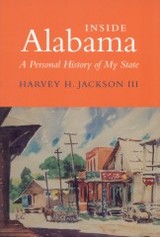
This book tells Alabama’s history in a conversational style with an unapologetically subjective approach. Accessible to general readers and students alike, it recounts the history and politics of a state known for its colorful past, told by one of the state’s most noted historians and educators, whose family came to the territory before statehood. A native and resident Alabamian, Harvey Jackson has spent a lifetime discovering and trying to understand his state. Expressing deep love for its people and culture, he is no less critical of its shortcomings.
Inside Alabama, as the title implies, gives Jackson’s insider perspective on the events and conditions that shaped modern-day Alabama. With humor and candor, he explores the state’s cultural, political, and economic development from prehistoric times to the dawning of the new millennium. Mound-builders, Hernando de Soto, William Bartram, Red Sticks, Andy Jackson, Bourbon Democrats, suffragettes, New Dealers, Hugo Black, Martin Luther King Jr., George Wallace, Rosa Parks all play colorful parts in this popular history. By focusing on state politics as the most accessible and tangible expression of these shaping forces, Jackson organizes the fourteen chapters chronologically, artfully explaining why the past is so important today.
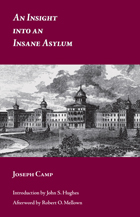
A rare 19th‑century voice revealing what asylum life felt like from the inside.
In 1881, Joseph Camp, an elderly and self-trained Methodist minister from Talladega County in eastern Alabama, was brought by his family to Bryce Hospital, an insane asylum in Tuscaloosa, where he remained for over five months. Camp, misled by relatives concerning the purpose of the trip, was shocked and angered at his loss of freedom and his treatment in the hospital. After his release, he composed an account of his stay and published it at his own expense, providing a rare glimpse of 19th century mental health care from a patient’s viewpoint. Camp’s account reveals his naive trust in others, but also a sharp and retentive memory. Camp is remarkably accurate in his account of the details of his treatment and the operation and staff of the hospital, although his emotional assessments reflect his unhappiness with his situation. Adding to the importance of Camp’s account is the fact that in the 19th century Bryce was considered a remarkably humane institution focused on recovery. Camp provides a glimpse into how treatment for the insane felt to the recipient.
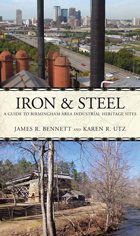
This guidebook of historic iron-production sites is designed to give the reader a factual and illuminating look at the people and events that shaped Birmingham into one of America’s leading steel centers. Iron & Steel is heavily illustrated with both color and historical black-and-white photographs. It can be used while visiting parks or read as a coherent volume before or after a visit.
The book contains chapters devoted to the larger preserved sites open to the public, such as Sloss Furnaces National Historic Landmark and Tannehill Ironworks Historical State Park. It also highlights lesser-known, yet still accessible, sites such as Blocton Coke Ovens Park. The work provides easy-to-follow maps for every site as well as driving directions to the more remote locations, giving visitors easy access to all the notable iron and steel sites in Jefferson, Shelby, Tuscaloosa, and Bibb counties. Each chapter also includes a variety of historical information, with accompanying photographs, in order to present the reader with a detailed and comprehensive account of the Birmingham Iron and Steel District.
Featured sites include: Tannehill Ironworks Historical State Park; Shelby Ironworks Park; Billy Gould Coke Ovens Park; Brierfield Ironworks Historical State Park; Oxmoor Furnace Site; Irondale Furnace Park; Helena Rolling Mill Site; Red Mountain Park, Iron Ore Mines; Lewisburg Coke Ovens Park; Sloss Furnaces National Historic Landmark; Ruffner Mountain Nature Center; Blocton Coke Ovens Park; and Vulcan Park and Museum.
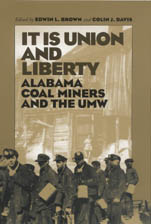
One union, many voices—Alabama coal miners and the century-long fight for justice.
Much of Alabama's labor history is written in its coal fields. This book records the critical contribution that District 20 of the United Mine Workers of America played in the state's labor movement through its strong stands on such issues as child labor, public education, and inter-racial unions.
Standing at the cutting edge of social and political history, these essays cover five periods over a century of union activity: the emergence of a militant labor force during mining's formative years; the World War I era, when mine operators tried to divide black and white labor; the increasing role of the state in labor relations during the interwar years; rapid changes in the union between 1942 and 1975; and the 1977-79 strike, the largest in the United Mine Workers' history.
Through historic photographs and depictions of living and working conditions, contributors Edwin L. Brown, Colin J. Davis, Daniel Letwin, Brian M. Kelly, Peter Alexander, Glenn Feldman, and Robert H. Woodrum portray the world that miners, both black and white, made. In a state where racial segregation was the norm,even the earliest District 20 contract proposals demanded equal pay for equal work regardless of color. It Is Union and Liberty shows that the UMW in Alabama stands apart from perceptions of southern trade unionism as exclusionary and racially fragmented. It sheds light on an important segment of the state's labor history and is a testament to District 20 on its centennial celebration.
READERS
Browse our collection.
PUBLISHERS
See BiblioVault's publisher services.
STUDENT SERVICES
Files for college accessibility offices.
RECENTLY PUBLISHED




UChicago Accessibility Resources
home | accessibility | search | about | contact us
BiblioVault ® 2001 - 2026
The University of Chicago Press